Built to Last / The rankings
The best watch for cold weather: ranked on the temperature each maker will put in writing
Every rugged watch is sold as a cold-weather watch. Only some of them publish a number. This page ranks them on the operating range the maker states, the charging range that matters more, and whether you can work the thing in gloves.
By Mike M.Updated Researched from the maker's manuals and spec sheets
#adReader-supported: we may earn a commission if you buy through our links, at no extra cost to you. It never decides a ranking. How we rate · Disclosure
Quick picks
The rankings at a glance
| # | Product | Best for | Score | Price |
|---|---|---|---|---|
| 1 | 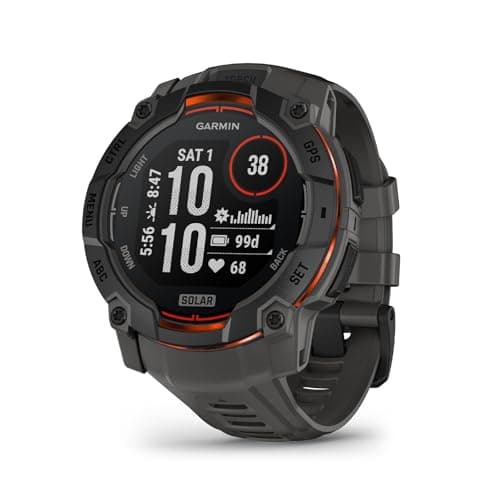 Garmin Instinct 3 Solar (50mm) Rated -20 to 60C, built to MIL-STD-810 for thermal and shock resistance, five physical buttons that work in mitts, a flashlight with a red mode, and solar that stretches a winter charge. | Best cold-weather watch overallSolar GPS | 8.7 /10 | $399.99Amazon |
| 2 |  COROS VERTIX 2S COROS states -30 to 50C working, with 118 hours of standard GPS and 36 days of daily use, under sapphire on a titanium bezel. The coldest number any maker here puts in writing. | Lowest published working temperatureRechargeable GPS | 8.1 /10 | Check price · Amazon |
| 3 | 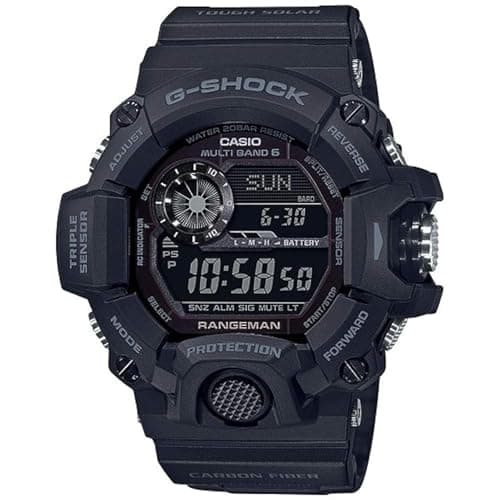 G-Shock Rangeman GW-9400 Tough Solar, so the cold-charging problem never arises: no cable, no lithium charge window. Casio states low-temperature resistance to -10C and puts a thermometer on the wrist. | Best with nothing to chargeSolar, no charger | 8.7 /10 | $320.00Amazon |
| 4 | Amazfit T-Rex 3 A low-temperature mode to -30C with the runtime stated: up to 28 hours with GNSS on and up to 32 days with it off. Gorilla Glass rather than sapphire. | The only one that publishes a cold runtimeRechargeable GPS | 7.0 /10 | Check price · Amazon |
| 5 | 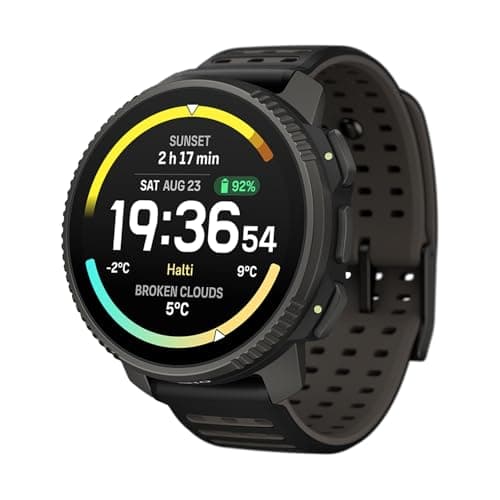 Suunto Vertical 2 Titanium Offline maps, a flashlight, sapphire and a titanium bezel, rated -20 to +55C. The AMOLED touchscreen is the compromise you accept for the map. | Best for maps in the snowRechargeable GPS | 7.6 /10 | $699.00Amazon |
#ad · Prices come live from Amazon, last checked November 4, 2026. Scores are ours, built from the makers' manuals, battery tables and spec pages. Product photos come from Amazon; anything still on a stock frame is labelled on its card. Tap a row for the full write-up.
The three numbers that decide it
Cold is the one environment where watch marketing and watch specifications diverge completely. Every rugged watch is photographed in snow. Very few makers will tell you the temperature at which theirs stops working, and almost none will tell you what the battery does down there. So this page is built on the three figures that actually get published, in the order they matter.
One: the stated operating range. This is the band inside which the maker says the watch functions. COROS states -30 to 50C for the VERTIX 2S. Garmin states -20 to 60C for the Instinct 3 Solar and -20 to 45C for the fenix 8. Suunto states -20 to +55C for the Vertical 2. Amazfit states a low-temperature mode down to -30C. Casio states low-temperature resistance to -10C for the Rangeman module. Those are not equivalent claims and we do not pretend they are, but they are what each maker will stand behind.
Two: the charging range. Separate from the operating range, usually buried, and far more likely to ruin your trip. See the next section.
Three: whether you can operate it. A watch that technically works at -25C but needs a bare fingertip on a touchscreen is not a cold-weather watch. Buttons, screen type and the strap all decide this, and no spec sheet scores it.
The charging range nobody reads
This is the most useful thing on the page. On a rechargeable watch, the temperature band for charging is narrower than the band for operating, and it starts at freezing. Garmin publishes a USB charging range of 0 to 45C for the fenix 8 series and the same 0 to 45C for the Instinct E, against an operating range that goes twenty degrees below zero. Garmin's Instinct 2 specifications page states solar charging from 0 to 60C.
Read that as a user. The watch works at -20C. It will not accept a charge below 0C. If you are hunting a late season out of a truck, ski touring from a hut, or camped above the snow line, the charge has to happen somewhere warm: inside a jacket, in a cab with the heater running, in a sleeping bag with the cable. This is lithium-ion chemistry, not a Garmin defect, and it is true of every rechargeable watch here whether or not the maker prints the range.
It is also the strongest argument on this site for a watch that never charges at all. A Tough Solar Casio has no charge window, because there is no charging event: the cell takes what light gives it, continuously, and how to charge a solar watch covers what that actually requires. A coin-cell watch has no charge event either; it has a battery change every few years, in a warm room, by someone else.
Why solar is only half an answer in winter
Solar is genuinely the right technology for a cold climate, and it is also where the marketing gets furthest from the lived experience, so both halves need saying.
The honest version: Garmin's solar figures assume three hours a day at 50,000 lux, which is midday summer sun. A January day at a northern latitude gives you a fraction of that, for fewer hours, through cloud, and your watch spends most of it under a cuff and a jacket sleeve. The solar lens is not doing nothing — it is stretching the interval between charges — but the unlimited-battery headline is not a winter number. The full arithmetic is in how Garmin solar actually works.
The other half, which matters more: solar still removes the charge event, and the charge event is the thing that fails in cold. A watch Garmin rates at 40 days of typical use will cross a long winter trip on its own, and whatever the lens adds is a bonus rather than a dependency. That is why the ranking below puts a solar Garmin first and a longer-rated non-solar watch second, and why the Tough Solar Casio sits third despite having the shortest published cold rating of the five.
Gloves, buttons and touchscreens
At -15C with wind, the interface is the watch. This is where the ranking stops being about numbers.
Buttons win. The Instinct 3 Solar has five, with a large start button, and they work through a liner glove and usually through a mitt. The Rangeman has four oversized pushers designed to be hit with a gloved thumb and a front-mounted light button. A touchscreen in snow reads water, not fingers, and an AMOLED display with gesture wake either does not see your sleeve move or sees it constantly.
Screens matter differently in winter. A monochrome memory-in-pixel display is readable in flat snow glare with no backlight at all, which is both a legibility and a battery argument; an AMOLED is brighter in the dark and costs more power to do it. The trade is laid out in MIP vs AMOLED battery life. For winter specifically, we favor the monochrome screen, and the Suunto Vertical 2 is on this list in spite of its AMOLED rather than because of it, because offline maps in a whiteout are worth a compromise.
A light is not a luxury. Short days mean half your outdoor hours are dark. The Instinct 3 Solar and the Suunto Vertical 2 have flashlights; the Instinct's red mode preserves night vision, which matters more to hunters than to skiers. The models that have one are listed in Garmin watches with a flashlight.
Metal, resin and skin in the cold
Three material facts change the ranking at the margins, and none of them appear on a spec sheet.
Metal conducts. A stainless steel case and bracelet pull heat out of your wrist and feel genuinely unpleasant at -20C, which is one reason the full-metal square is not on this list despite being one of the toughest watches we cover. Titanium is better: lower thermal conductivity than steel and roughly half the weight, which is part of why the VERTIX 2S and the Vertical 2 both use it for the bezel. The material comparison is in titanium vs stainless steel.
Resin stiffens. A fiber-reinforced polymer case and a resin strap get noticeably harder in deep cold, which is a comfort issue rather than a failure, though an old, UV-aged strap is more likely to crack when it is stiff. A worn strap is a cheap part; replace it before winter rather than after it fails in a parking lot. What resin does and does not do is in resin vs steel watch case.
Fit changes with layers. A watch sized to a bare wrist will not close over a baselayer cuff, and a watch worn loose over a jacket sleeve blocks the solar lens and the heart-rate sensor completely. Buy a strap long enough for your winter layering, or plan to wear the watch under everything. Sizing is covered in what size GPS watch should I buy.
Why these five, in this order
1. Garmin Instinct 3 Solar (50mm). Not the coldest number on the page, and still the right answer for almost everybody. Garmin publishes -20 to 60C, states a MIL-STD-810 build for thermal and shock resistance, and backs it with the things that make a watch usable in winter: five buttons, a sun-readable monochrome screen, a red-capable flashlight, a 10 ATM case and a battery Garmin rates at up to 40 days of typical use before the solar lens adds anything. Its weakness in this company is navigation — it has no maps, only breadcrumbs and waypoints.
2. COROS VERTIX 2S. The coldest published working range here at -30 to 50C, with 118 hours of standard full GPS, 36 days of daily use, sapphire glass and a Grade 5 titanium bezel. On paper it is the most cold-capable watch we cover. It sits second for two honest reasons: there is no solar lens and no flashlight, so you are back to finding somewhere above freezing to charge, and COROS makes no MIL-STD-810 claim. One practical note we verified rather than assumed: Amazon has no listing for this watch, so our link is a tagged search and COROS sells it direct. The full read is in our VERTIX 2S review.
3. G-Shock Rangeman GW-9400. The lowest published cold rating of the five at -10C, and the only one that sidesteps the charging problem entirely. Tough Solar means no cable, no 0C charge window and, per Casio, roughly eight months of running from a full charge with no light at all. It also puts a thermometer, barometer, altimeter and compass on the wrist without a phone, and four gloved-hands pushers to drive them. If your winter is a treestand, an ice shack or a job site rather than a summit, this is arguably the most appropriate watch on the page — see the review.
4. Amazfit T-Rex 3. Here because it publishes the one figure everyone else withholds: a low-temperature mode to -30C with the runtime stated, up to 28 hours with GNSS on and up to 32 days with it off. It also publishes its water-resistance test report, which is rare honesty. Against it: Gorilla Glass rather than sapphire, a stainless bezel, a touchscreen AMOLED, and a firmware history too short for us to promise a decade. Full detail in our T-Rex 3 review.
5. Suunto Vertical 2 Titanium. Rated -20 to +55C, with sapphire, a titanium bezel, an integrated flashlight and — the reason it is here — genuine offline maps. In a whiteout, on an unfamiliar traverse, a map beats a breadcrumb trail, and the Instinct cannot do this. The compromises are real: the Vertical 2 dropped the solar lens its predecessor had, the AMOLED touchscreen is the wrong interface for mitts, and the water rating is 100 m. Our longer read is here.
What we will not claim
No watch on this page has been in a cold chamber on our behalf, and we have not worn any of them at -30C. Every temperature figure above is the maker's own, read from the specification pages and operation guides linked at the bottom of this page, and where a maker publishes nothing we say so rather than estimating.
Specifically: Garmin publishes no operating temperature for the fenix 8 Solar in the sources we cite, so it is absent here despite being a better watch than several of these in most other respects. Casio publishes no low-temperature figure at all for some modules, including the Frogman's, so we print none. Nobody publishes a cold-weather capacity curve, so there is no table on this page claiming what percentage of battery you keep at -20C. And "cold-weather rated" is not a standard the way a water rating or MIL-STD-810 is — the methodology question is covered in MIL-STD-810 explained.
In detail
The picks, in full
Rank 1
Best cold-weather watch overall
Garmin Instinct 3 Solar (50mm)
Rated -20 to 60C, built to MIL-STD-810 for thermal and shock resistance, five physical buttons that work in mitts, a flashlight with a red mode, and solar that stretches a winter charge.
EvidenceResearched · every row sourced
How the 8.7 score breaks down
- Battery & power independence (25%)
- 10
- Durability of materials (25%)
- 8
- Serviceability & lifespan (20%)
- 7
- Field usability (15%)
- 9
- Value per decade (10%)
- 10
- Mission fit (5%)
- 8
What the spec sheet supports
- Garmin's own table shows the 50mm solar model doubling the 45mm in GPS-with-solar hours (260 vs 130).
- Physical buttons, a monochrome display readable in full sun, and a flashlight with a red mode.
- 10 ATM rating and a MIL-STD 810 claim on a watch that costs less than half a fenix.
Where it falls short
- No maps: it navigates breadcrumb trails and waypoints, not topo maps.
- The solar figures assume three hours a day at 50,000 lux, which is midday sun, not a sleeve.
- Garmin does not name the lens material; treat it as strengthened glass, not sapphire.
Skip this if…
…you need on-wrist topo maps, or you wear long sleeves and work indoors, where the solar math never happens.
#ad · Price as of November 4, 2026 · Disclosure for the link to Garmin Instinct 3 Solar (50mm)
Rank 2
Stock photoLowest published working temperature
COROS VERTIX 2S
COROS states -30 to 50C working, with 118 hours of standard GPS and 36 days of daily use, under sapphire on a titanium bezel. The coldest number any maker here puts in writing.
EvidenceResearched · every row sourced
| Power class | Rechargeable GPS. A rechargeable lithium cell charged from a cable. Days to a few weeks per charge; the cell ages with every cycle. |
|---|---|
| Battery (smartwatch) | 36 days daily use |
| Battery (GPS) | 118 hours standard full GPS; 73 hours all systems on; 43 hours dual-frequency |
| Glass | Sapphire glass |
| Bezel & case | Grade 5 titanium alloy bezel with PVD coating; titanium alloy cover |
| Water rating | 10 ATM (surface water activities, not diving) |
| Display | 1.4-inch touchscreen always-on memory LCD, 280 × 280 |
| Maps & GPS | Downloadable global landscape and topo maps; GPS, GLONASS, Galileo, BeiDou, QZSS dual-frequency |
| Weight | 87 g with silicone band; 70 g with nylon band |
| Size | 50.3 × 50.3 × 16 mm |
| Operating temp | -22°F to 122°F (-30°C to 50°C) working; charging under 2 hours |
How the 8.1 score breaks down
- Battery & power independence (25%)
- 9
- Durability of materials (25%)
- 9
- Serviceability & lifespan (20%)
- 6
- Field usability (15%)
- 8
- Value per decade (10%)
- 8
- Mission fit (5%)
- 7
What the spec sheet supports
- 118 standard-GPS hours without a solar lens beats every Garmin's non-solar figure here.
- Rated to work at -30°C, ten degrees colder than a Garmin's stated range.
- Sapphire, titanium, 10 ATM and free downloadable topo maps.
Where it falls short
- No solar, no flashlight.
- No MIL-STD claim in COROS's specs.
Skip this if…
…you want a watch that stops needing a cable altogether; that is the solar Garmin's job.
#ad · Price as of November 4, 2026 · Disclosure for the link to COROS VERTIX 2S
Rank 3
Best with nothing to charge
G-Shock Rangeman GW-9400
Tough Solar, so the cold-charging problem never arises: no cable, no lithium charge window. Casio states low-temperature resistance to -10C and puts a thermometer on the wrist.
EvidenceResearched · every row sourced
| Power class | Solar, no charger. A solar cell that recharges from any light and never meets a charger. The rechargeable cell is a watchmaker-replaceable part. |
|---|---|
| Battery (cell) | Approximately 8 months from full charge to Level 4 with no light (Casio's stated usage conditions) |
| Power | Solar panel and one rechargeable battery (Tough Solar) |
| Glass | Mineral crystal |
| Water rating | 200 meters |
| Sensors | Digital compass, barometer, altimeter, thermometer; sunrise/sunset; Multi-Band 6 time calibration (WWVB, DCF77, MSF, JJY, BPC) |
| Weight | 93 g |
| Size | 55.2 × 53.5 × 18.2 mm |
| Operating temp | Low-temperature resistance -10°C (14°F) |
How the 8.7 score breaks down
- Battery & power independence (25%)
- 10
- Durability of materials (25%)
- 7
- Serviceability & lifespan (20%)
- 10
- Field usability (15%)
- 7
- Value per decade (10%)
- 10
- Mission fit (5%)
- 8
What the spec sheet supports
- Solar and atomic: it sets itself from a radio signal and never sees a cable.
- A module that has been in production for over a decade; parts, straps and bezels are everywhere.
- Sunrise/sunset on the watch, the one hunting feature the Garmin Instinct does without a phone.
Where it falls short
- Mineral crystal, not sapphire; the Rangeman lives behind a raised bezel for a reason.
- No GPS, no maps, no heart rate. It tells you where north is, not where you are.
- Big and thick at 18.2 mm.
Skip this if…
…you want a track of where you walked; an ABC watch measures the world, it does not map it.
#ad · Price as of November 4, 2026 · Disclosure for the link to G-Shock Rangeman GW-9400
Rank 4
Stock photoThe only one that publishes a cold runtime
Amazfit T-Rex 3
A low-temperature mode to -30C with the runtime stated: up to 28 hours with GNSS on and up to 32 days with it off. Gorilla Glass rather than sapphire.
EvidenceResearched · every row sourced
| Power class | Rechargeable GPS. A rechargeable lithium cell charged from a cable. Days to a few weeks per charge; the cell ages with every cycle. |
|---|---|
| Battery (smartwatch) | Up to 27 days typical use; 13 days heavy use; 40 days battery saver; 81 days clock mode |
| Battery (GPS) | Up to 42 hours accurate GNSS; 72 hours power-saving GNSS; 114 hours long battery life mode |
| Battery (max GPS) | Up to 180 hours GNSS max battery life |
| Glass | Gorilla Glass touchscreen |
| Bezel & case | Stainless steel bezel; polymer middle frame |
| Water rating | 10 ATM (ISO 22810, third-party tested by SGS); freediving certification to 45 m (EN13319, ISO 6425) |
| Display | 1.5-inch AMOLED, 480 × 480 |
| Maps & GPS | Free offline maps with topographic contours; dual-band GPS, six satellite systems |
| Weight | 68.3 g without strap |
| Size | 48.5 × 48.5 × 13.75 mm |
| Operating temp | Low temperature mode to -30°C (GNSS on: up to 28 hours; GNSS off: up to 32 days) |
How the 7.0 score breaks down
- Battery & power independence (25%)
- 7
- Durability of materials (25%)
- 7
- Serviceability & lifespan (20%)
- 5
- Field usability (15%)
- 8
- Value per decade (10%)
- 9
- Mission fit (5%)
- 7
What the spec sheet supports
- Amazfit publishes its water-resistance test report number, which few makers do.
- 180 GPS hours in max-battery mode and a stated -30°C low-temperature mode.
- Free offline topo maps at a price where Garmin gives you breadcrumbs.
Where it falls short
- Amazfit says 'military-grade' but does not cite MIL-STD-810 on the page we read, so we do not credit it.
- Gorilla Glass, not sapphire, and a shorter firmware history than Garmin or COROS.
- Offline maps need a route file for navigation; you cannot tap a point on the map.
Skip this if…
…you plan to own it for a decade; Amazfit's update record is too short to promise that yet.
#ad · Price as of November 4, 2026 · Disclosure for the link to Amazfit T-Rex 3
Rank 5
Best for maps in the snow
Suunto Vertical 2 Titanium
Offline maps, a flashlight, sapphire and a titanium bezel, rated -20 to +55C. The AMOLED touchscreen is the compromise you accept for the map.
EvidenceResearched · every row sourced
| Power class | Rechargeable GPS. A rechargeable lithium cell charged from a cable. Days to a few weeks per charge; the cell ages with every cycle. |
|---|---|
| Battery (smartwatch) | Up to 20 days daily use; up to 40 days standby |
| Battery (GPS) | Up to 65 h all-systems + multi-band (60 h always-on); up to 75 h single-band |
| Battery (max GPS) | Up to 250 h in power-saving GNSS modes |
| Glass | Sapphire crystal |
| Bezel & case | Titanium bezel; glass fiber reinforced polyamide case |
| Water rating | 100 m |
| Display | 1.5-inch LTPO AMOLED, 466 × 466 |
| Maps & GPS | Offline maps; GPS, GLONASS, Galileo, QZSS, BeiDou |
| Flashlight | Integrated LED flashlight |
| Weight | 87 g / 3.07 oz |
| Operating temp | -20°C to +55°C (-5°F to +130°F) |
How the 7.6 score breaks down
- Battery & power independence (25%)
- 7
- Durability of materials (25%)
- 9
- Serviceability & lifespan (20%)
- 6
- Field usability (15%)
- 9
- Value per decade (10%)
- 7
- Mission fit (5%)
- 7
What the spec sheet supports
- Sapphire and titanium at the price of a polymer Garmin.
- Offline maps and a flashlight on a Suunto for the first time in the Vertical line.
Where it falls short
- The Vertical 2 dropped solar; the original Vertical Titanium Solar still has it.
- 100 m rating, no stated MIL-STD line, no dive rating.
Skip this if…
…you wanted a Suunto that never sees a charger; buy the first-gen Vertical Titanium Solar instead.
#ad · Price as of November 4, 2026 · Disclosure for the link to Suunto Vertical 2 Titanium
How to choose, in one pass
Start with the question of where the watch gets charged. If the answer is "a house, most nights", any watch on this list works and you should buy on interface and maps. If the answer is "a truck, a tent or nowhere for a week", the choice narrows to solar or to a cell measured in months, and it narrows fast.
Then decide whether you need navigation or information. A hunter, an ice angler or a trades worker in winter needs sunrise, temperature, pressure and a light, and the Rangeman delivers all four with nothing to charge. A ski tourer, a winter hiker or anyone moving through unfamiliar terrain needs a track, a route and ideally a map, which puts you on the Instinct, the VERTIX or the Suunto.
Only then look at the temperature figures, because for most people in most winters the difference between a -20C rating and a -30C rating never gets tested, while the difference between a watch you can work in mitts and one you cannot gets tested every single outing.
Three mistakes people make buying for winter
Buying the biggest battery instead of the right power source. A 36-day watch that needs a warm room to charge is worse on a cold week than a 40-day watch with a solar lens, and both are worse than a watch that has never been plugged in. Rank power independence above raw hours; the ranked list by hours alone is in longest-battery-life GPS watches.
Assuming a touchscreen will be fine. It is fine until it is wet, gloved or below freezing. Any watch you intend to use in winter should be fully operable from physical buttons with every glove you own, and that is a thing to test in a shop rather than read about.
Forgetting the strap. Winter layering changes your wrist circumference by an inch. A strap that is right in July blocks the sensor over a baselayer in January. Order the longer strap at the same time as the watch; it is the cheapest part of this purchase.
If your winter is more specific than this
This page is the general answer. Three neighboring pages are narrower and better if they fit you: altitude and sustained cold are ranked in best watch for mountaineering, lift-served and touring days in best watch for skiing, and sitting still in the cold before first light in best watch for deer hunting. The same durability argument, without the temperature frame, is most durable watches.
How we scored this
What we checked to build this ranking
Every pick here is researched against the documents that decide whether a watch lasts: the maker's own battery table read mode by mode, what the lens and case are actually made of, the water rating, whether a MIL-STD-810 line is on the record and in whose words, and how long the maker keeps updating the line. Each one is then scored on a public rubric weighted for a decade of ownership, and every figure links to where it came from.
That is why the order on this page is worth following: it is built from specs you can open yourself, and commissions never set a score or decide a pick. The rubric and its weights are published.
Questions
Frequently asked
What is the best watch for extreme cold?
On published figures, the COROS VERTIX 2S: COROS states a working range of -30 to 50C, the coldest number any maker on this page puts in writing. For most buyers the Garmin Instinct 3 Solar is the better overall cold-weather watch at -20 to 60C, because it adds a MIL-STD-810 thermal and shock claim, five gloved-hands buttons, a flashlight and a solar lens that reduces how often you have to find somewhere warm to charge.
Can you charge a smartwatch in freezing weather?
Generally no. Garmin publishes a USB charging range of 0 to 45C for the fenix 8 series and the Instinct E, against operating ranges that go to -20C. Lithium cells should not be charged below freezing, so the charge has to happen somewhere warm. A solar watch with no charge event, like a Tough Solar Casio, avoids the problem entirely.
Do solar watches work in winter?
They work, but they do not deliver their headline figures. Garmin's solar numbers assume three hours a day at 50,000 lux, which is midday summer sun; a short, overcast northern day under a jacket sleeve gives a fraction of that. The value of solar in winter is that it stretches the interval between charges and removes the dependency, not that it makes the battery infinite.
How cold can a G-Shock get?
Casio states low-temperature resistance to -10C (14F) for the Rangeman GW-9400 module and for the Pro Trek PRW-61. That is the figure Casio will stand behind, and it is colder than most people's winters. Casio does not publish a low-temperature figure for every module, and where it does not, we do not print one.
Is titanium or steel better for a cold-weather watch?
Titanium, for two reasons: it conducts heat away from your wrist more slowly than stainless steel, so it feels less punishing in deep cold, and it is roughly half the weight. That is part of why the COROS VERTIX 2S and the Suunto Vertical 2 both use titanium bezels. A full stainless steel case and bracelet is the least comfortable option in winter.
Does cold weather damage a watch battery?
Cold reduces how much of its rated capacity a lithium cell can deliver, which is why a watch seems to drain faster in winter; the capacity generally returns when the watch warms up. Charging a lithium cell below freezing is the thing that does lasting harm, which is why makers publish a charging range separate from the operating range. None of the makers here publishes a cold-temperature capacity curve, so we do not quote one.
Keep reading
Related on Bezel & Bearing
- Best watch for mountaineeringAltitude and sustained cold, ranked separately.
- Best watch for skiingResort days and touring days.
- How to charge a solar watchWhat the lux figures mean in December.
- MIP vs AMOLED battery lifeWhy a monochrome screen wins in snow glare.
- Best watch for deer huntingSitting still in the cold before light.
Receipts
Sources
- Garmin — Instinct 3 Solar Series Owner's Manual, Specifications (checked 2026-09-20)
- Garmin — Instinct 3 Solar Series Owner's Manual, Battery Life Information (checked 2026-09-20)
- Garmin newsroom — Instinct 3 Series press release (checked 2026-09-20)
- Garmin — fenix 8 Series Owner's Manual, Specifications (checked 2026-09-20)
- Garmin — Instinct E Owner's Manual, Specifications (checked 2026-09-20)
- Garmin — Instinct 2 Series Owner's Manual, Specifications (checked 2026-10-01)
- COROS — VERTIX 2S / APEX / NOMAD specification tables (checked 2026-09-20)
- Amazfit — T-Rex 3 product page, Technical Specifications (checked 2026-09-20)
- Suunto — Vertical 2 Titanium Black product page and tech specs (checked 2026-09-20)
- Casio — Operation Guide, module 3410 (GW-9400 Rangeman), Specifications (checked 2026-09-20)
Battery, glass, case and water figures come from the maker's own owner's manuals, spec pages and press releases, linked on every product so you can open the page they came from. Prices are set by Amazon and change often, so each buy button takes you to the current one. Read the full method.