GPS Watches / The rankings
The best rugged GPS watches: seven that will still be on your wrist in ten years
Ranked by battery hours in every mode, what the lens and case are made of, and what breaks first. Not by step counts, and not by which one we were sent.
By Mike M.Updated Spec-sheet researched, not worn by us
#adReader-supported: we may earn a commission if you buy through our links, at no extra cost to you. It never decides a ranking. How we rate · Disclosure
Quick picks
The rankings at a glance
| # | Product | Best for | Score | Price |
|---|---|---|---|---|
| 1 |  Garmin Instinct 3 Solar (50mm) Garmin rates it unlimited in smartwatch mode and 260 GPS hours with solar, in a 10 ATM case built to MIL-STD 810 with a flashlight. No maps, no sapphire, no charger. | Best rugged GPS watch overallSolar GPS | 8.7 /10 | Check price · Amazon |
| 2 | Garmin fenix 8 Solar (51mm, Sapphire) Sapphire, titanium, leakproof buttons, a 40 m dive rating and preloaded topo maps, with 48 days smartwatch and 149 GPS hours with solar. The complete watch if you charge it. | Best with maps and sapphireSolar GPS | 8.7 /10 | Check price · Amazon |
| 3 | Garmin Enduro 3 320 GPS hours with solar and 90 days in smartwatch mode, with maps, sapphire and titanium at 63 g. Garmin does not publish a water rating for it, which keeps it off the top step. | Best GPS hours with mapsSolar GPS | 8.5 /10 | Check price · Amazon |
| 4 | Garmin fenix 9 Pro (51mm) Titanium case, sapphire, solar on select models rated up to 57 days, 64 GB of maps and inReach on every size. Announced August 25, 2026; too new for an ownership record. | Best new flagshipSolar GPS | 8.4 /10 | Check price · Amazon |
| 5 | COROS VERTIX 2S 118 standard-GPS hours and 36 days of daily use from a rechargeable cell alone, under sapphire on a titanium bezel, rated to -30°C. | Best battery without solarRechargeable GPS | 8.1 /10 | Check price · Amazon |
| 6 | Suunto Vertical Titanium Solar Grade 5 titanium, sapphire, 74 g, and 60 days smartwatch or 90 multi-band GPS hours with solar. The previous generation, still sold, and better on battery than the new one. | Best solar watch that isn't a GarminSolar GPS | 8.1 /10 | Check price · Amazon |
| 7 | Amazfit T-Rex 3 Stainless bezel, Gorilla Glass, SGS-tested 10 ATM, 27 days typical use and 180 GPS hours in its lowest mode. The firmware history is the open question. | Best on a budgetRechargeable GPS | 7.0 /10 | Check price · Amazon |
#ad · Prices are set by Amazon and change often, so we don't print them. Scores are ours, built from the makers' manuals, battery tables and spec pages, not field tests. Photos are illustrative stock. Tap a row for the full write-up.
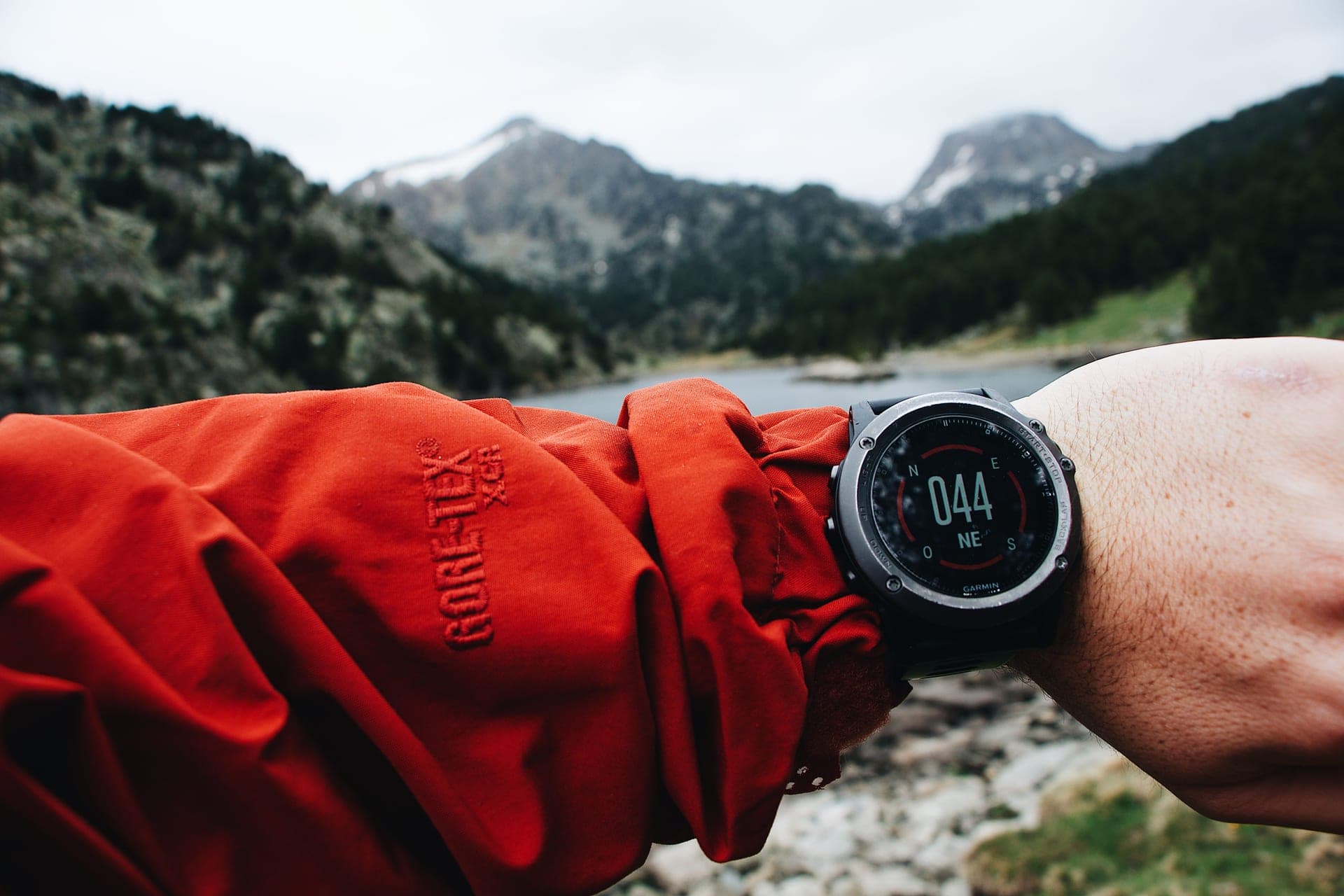
How we ranked them
We did not wear these watches. We read every maker's own battery table, mode by mode, then the lens, bezel, case and water rating, then the warranty and update history, and scored each watch on the published rubric: battery and power independence 25%, materials 25%, serviceability and lifespan 20%, field usability 15%, value per decade 10%, mission fit 5%. Every number on this page links to the Garmin, Suunto, COROS or Amazfit document it came from.
"Rugged" here means three concrete things: a stated water rating of 10 ATM or better, a case and lens that do not scratch or crack in ordinary use, and physical buttons that work with gloves. A MIL-STD-810 line helps but does not decide anything; see what MIL-STD-810 actually proves.
The battery table, side by side
Every figure is the maker's, in the mode the maker names. "With solar" means the maker's stated assumption, which for Garmin is all-day wear with three hours a day at 50,000 lux.
| Watch | Smartwatch mode | GPS (standard) | Longest GPS mode | Lens | Water |
|---|---|---|---|---|---|
| Garmin Instinct 3 Solar 50mm | 40 days; unlimited with solar | 60 h; 260 h with solar | 150 h max-battery; unlimited with solar | Strengthened (unnamed) | 10 ATM |
| Garmin fenix 8 Solar 51mm | 30 days; 48 with solar | 95 h; 149 h with solar | 186 h; 653 h with solar | Sapphire | 40 m dive |
| COROS VERTIX 2S | 36 days | 118 h | 118 h (standard is the longest) | Sapphire | 10 ATM |
| Suunto Vertical Titanium Solar | 30 days; 60 with solar | 65 h multi-band; 90 with solar | 500 h power-saving | Sapphire | 100 m |
| Garmin Enduro 3 | 90 days | 120 h multi-band | 320 h with solar | Sapphire | Not stated |
| Garmin fenix 9 Pro 51mm | 31 days; 57 with solar | Not in the release | Not in the release | Sapphire | 40 m dive |
| Amazfit T-Rex 3 | 27 days typical | 42 h accurate GNSS | 180 h max battery | Gorilla Glass | 10 ATM (SGS tested) |
Two things jump out. The COROS VERTIX 2S beats every solar Garmin on standard GPS hours without any solar help, and the Enduro 3 beats everything on the longest GPS mode. The Instinct 3 Solar wins the ranking anyway, because "unlimited" in smartwatch mode is the figure that decides whether a watch ever meets a charger, and the Instinct is the only watch here that reaches it at a price below a fenix.
What fails first
What solar honestly does
Garmin's Instinct 3 Solar table lists the 50 mm model at 60 GPS hours, and 260 with solar. That 4x multiplier assumes 50,000-lux conditions for the whole activity, which is a clear day with the watch on the outside of your sleeve. In smartwatch mode the assumption is three hours a day at that brightness. Wear it under a jacket cuff in an office and you get the non-solar figure, which is still 40 days. The solar lens is a range extender for people who are actually outside; it is not free energy for everyone. Our guide to how long solar watches last covers the difference between this kind of solar and a Casio that never sees a cable.
Maps: the fork in the road
The Instinct 3 navigates with breadcrumbs and waypoints; it does not show a map. The fenix 8, Enduro 3, fenix 9 Pro, VERTIX 2S and T-Rex 3 all do. If you have never used a map on a watch, do not pay for one on the assumption you will: a phone in a chest pocket does the job for most people, and the Instinct's battery is the reward for going without. If you navigate off-trail, in canyons, or on public-land boundaries, the offline maps rankings are your page.
The mistake buyers make
Choosing an AMOLED version of one of these watches for the screen. Garmin's own tables put the Instinct 3 AMOLED 50 mm at 24 days in gesture mode against the solar model's unlimited, and the fenix 8 AMOLED 51 mm at 29 days against the Solar's 48. Suunto dropped solar for the Vertical 2 and its daily-use figure fell from 60 days with solar to 20. The bright screen is real; so is the charger you will be tethered to. Read Instinct 3 Solar vs AMOLED before deciding.
Which one lasts a decade
In detail
The picks, in full
Rank 1
Stock photoBest rugged GPS watch overall
Garmin Instinct 3 Solar (50mm)
Garmin rates it unlimited in smartwatch mode and 260 GPS hours with solar, in a 10 ATM case built to MIL-STD 810 with a flashlight. No maps, no sapphire, no charger.
EvidenceResearched · not worn by us
How the 8.7 score breaks down
- Battery & power independence (25%)
- 10
- Durability of materials (25%)
- 8
- Serviceability & lifespan (20%)
- 7
- Field usability (15%)
- 9
- Value per decade (10%)
- 10
- Mission fit (5%)
- 8
What the spec sheet supports
- Garmin's own table shows the 50mm solar model doubling the 45mm in GPS-with-solar hours (260 vs 130).
- Physical buttons, a monochrome display readable in full sun, and a flashlight with a red mode.
- 10 ATM rating and a MIL-STD 810 claim on a watch that costs less than half a fenix.
Where it falls short
- No maps: it navigates breadcrumb trails and waypoints, not topo maps.
- The solar figures assume three hours a day at 50,000 lux, which is midday sun, not a sleeve.
- Garmin does not name the lens material; treat it as strengthened glass, not sapphire.
Skip this if…
…you need on-wrist topo maps, or you wear long sleeves and work indoors, where the solar math never happens.
#ad · Price set by Amazon · Disclosure for the link to Garmin Instinct 3 Solar (50mm)
Rank 2
Stock photoBest with maps and sapphire
Garmin fenix 8 Solar (51mm, Sapphire)
Sapphire, titanium, leakproof buttons, a 40 m dive rating and preloaded topo maps, with 48 days smartwatch and 149 GPS hours with solar. The complete watch if you charge it.
EvidenceResearched · not worn by us
| Power class | Solar GPS. A rechargeable cell topped up by a solar lens. Weeks between charges; the cell still ages like any lithium battery. |
|---|---|
| Battery (smartwatch) | Up to 30 days typical use; up to 48 days with solar |
| Battery (GPS) | Up to 95 hours GPS-only; up to 149 hours with solar |
| Battery (max GPS) | Up to 186 hours max-battery GPS; up to 653 hours with solar |
| Battery (solar) | Expedition GPS mode up to 50 days; up to 118 days with solar |
| Glass | Scratch-resistant sapphire lens (sapphire versions) |
| Bezel & case | Titanium bezel (sapphire versions); leakproof metal buttons; sensor guard |
| Water rating | 40-meter dive-rated case |
| MIL-STD-810 | Tested to U.S. military standards for thermal, shock and water resistance |
| Maps & GPS | TopoActive maps preloaded on sapphire versions |
| Flashlight | Built-in LED flashlight with variable intensities, red light and strobe |
How the 8.7 score breaks down
- Battery & power independence (25%)
- 9
- Durability of materials (25%)
- 10
- Serviceability & lifespan (20%)
- 7
- Field usability (15%)
- 10
- Value per decade (10%)
- 6
- Mission fit (5%)
- 8
What the spec sheet supports
- Sapphire, titanium and leakproof metal buttons on a case Garmin dive-rates to 40 m.
- 653 hours of max-battery GPS with solar is the longest figure in Garmin's fenix 8 table.
- Preloaded topo maps, a speaker and mic, and a flashlight.
Where it falls short
- A MIP display in a world of AMOLEDs; that is also why the battery lasts.
- The fenix 9 Pro (August 2026) now sits above it in the line, with a titanium case and solar on select models.
- Big: 51mm is a lot of watch under a sleeve.
Skip this if…
…you have never used the maps on a watch; the Instinct 3 Solar gives you the battery for half the money.
#ad · Price set by Amazon · Disclosure for the link to Garmin fenix 8 Solar (51mm, Sapphire)
Rank 3
Stock photoBest GPS hours with maps
Garmin Enduro 3
320 GPS hours with solar and 90 days in smartwatch mode, with maps, sapphire and titanium at 63 g. Garmin does not publish a water rating for it, which keeps it off the top step.
EvidenceResearched · not worn by us
| Power class | Solar GPS. A rechargeable cell topped up by a solar lens. Weeks between charges; the cell still ages like any lithium battery. |
|---|---|
| Battery (smartwatch) | Up to 90 days in smartwatch mode |
| Battery (GPS) | Up to 320 hours in GPS mode with solar charging; up to 120 hours with multi-band SatIQ |
| Glass | Scratch-resistant sapphire lens |
| Bezel & case | 51mm titanium bezel; UltraFit nylon band |
| Maps & GPS | Preloaded TopoActive maps |
| Flashlight | Built-in LED flashlight with variable brightness, red light and strobe |
| Weight | 63 grams |
How the 8.5 score breaks down
- Battery & power independence (25%)
- 10
- Durability of materials (25%)
- 9
- Serviceability & lifespan (20%)
- 7
- Field usability (15%)
- 9
- Value per decade (10%)
- 6
- Mission fit (5%)
- 8
What the spec sheet supports
- 320 GPS hours with solar is the largest GPS figure Garmin publishes for any watch we list.
- Lighter than a 51mm fenix 8 thanks to the nylon strap and titanium bezel.
- Sapphire and preloaded maps.
Where it falls short
- Garmin's Enduro 3 release does not state a water rating or MIL-STD line, so we do not claim them here.
- The nylon strap is the point of the weight; a silicone strap adds it back.
Skip this if…
…you swim or dive with your watch and need a stated depth rating; the fenix 8 gives you one.
#ad · Price set by Amazon · Disclosure for the link to Garmin Enduro 3
Rank 4
Stock photoBest new flagship
Garmin fenix 9 Pro (51mm)
Titanium case, sapphire, solar on select models rated up to 57 days, 64 GB of maps and inReach on every size. Announced August 25, 2026; too new for an ownership record.
EvidenceResearched · not worn by us
| Power class | Solar GPS. A rechargeable cell topped up by a solar lens. Weeks between charges; the cell still ages like any lithium battery. |
|---|---|
| Battery (smartwatch) | Up to 31 days in smartwatch mode; solar models up to 57 days |
| Glass | Sapphire lens |
| Bezel & case | Titanium watch case (first fenix with a titanium case) |
| Water rating | Dive-rated up to 40 meters |
| Display | AMOLED up to 3,000 nits; 51mm has a 1.5-inch AMOLED |
| Maps & GPS | 64 GB memory; maps 30% faster to pan; perspective view mapping |
| Sensors | inReach connectivity on all Pro sizes; satellite weather; LiveTrack via LTE |
| Flashlight | Integrated LED flashlight with green light mode |
How the 8.4 score breaks down
- Battery & power independence (25%)
- 9
- Durability of materials (25%)
- 10
- Serviceability & lifespan (20%)
- 6
- Field usability (15%)
- 10
- Value per decade (10%)
- 5
- Mission fit (5%)
- 9
What the spec sheet supports
- A titanium case, not just a titanium bezel; sapphire on top.
- Solar on select Pro models pushes the AMOLED fenix past 50 days for the first time.
- Twice the map storage of the fenix 8, with inReach built in.
Where it falls short
- Weeks old at the time of writing; there is no long-term ownership record yet.
- The press release we cite does not spell out a MIL-STD-810 line, so we do not claim one.
- Subscription needed for the inReach and LTE features.
Skip this if…
…a fenix 8 Solar does everything you need for less, now that it has a successor.
#ad · Price set by Amazon · Disclosure for the link to Garmin fenix 9 Pro (51mm)
Rank 5
Stock photoBest battery without solar
COROS VERTIX 2S
118 standard-GPS hours and 36 days of daily use from a rechargeable cell alone, under sapphire on a titanium bezel, rated to -30°C.
EvidenceResearched · not worn by us
| Power class | Rechargeable GPS. A rechargeable lithium cell charged from a cable. Days to a few weeks per charge; the cell ages with every cycle. |
|---|---|
| Battery (smartwatch) | 36 days daily use |
| Battery (GPS) | 118 hours standard full GPS; 73 hours all systems on; 43 hours dual-frequency |
| Glass | Sapphire glass |
| Bezel & case | Grade 5 titanium alloy bezel with PVD coating; titanium alloy cover |
| Water rating | 10 ATM (surface water activities, not diving) |
| Display | 1.4-inch touchscreen always-on memory LCD, 280 × 280 |
| Maps & GPS | Downloadable global landscape and topo maps; GPS, GLONASS, Galileo, BeiDou, QZSS dual-frequency |
| Weight | 87 g with silicone band; 70 g with nylon band |
| Size | 50.3 × 50.3 × 16 mm |
| Operating temp | -22°F to 122°F (-30°C to 50°C) working; charging under 2 hours |
How the 8.1 score breaks down
- Battery & power independence (25%)
- 9
- Durability of materials (25%)
- 9
- Serviceability & lifespan (20%)
- 6
- Field usability (15%)
- 8
- Value per decade (10%)
- 8
- Mission fit (5%)
- 7
What the spec sheet supports
- 118 standard-GPS hours without a solar lens beats every Garmin's non-solar figure here.
- Rated to work at -30°C, ten degrees colder than a Garmin's stated range.
- Sapphire, titanium, 10 ATM and free downloadable topo maps.
Where it falls short
- No solar, no flashlight.
- No MIL-STD claim in COROS's specs.
Skip this if…
…you want a watch that stops needing a cable altogether; that is the solar Garmin's job.
#ad · Price set by Amazon · Disclosure for the link to COROS VERTIX 2S
Rank 6
Stock photoBest solar watch that isn't a Garmin
Suunto Vertical Titanium Solar
Grade 5 titanium, sapphire, 74 g, and 60 days smartwatch or 90 multi-band GPS hours with solar. The previous generation, still sold, and better on battery than the new one.
EvidenceResearched · not worn by us
| Power class | Solar GPS. A rechargeable cell topped up by a solar lens. Weeks between charges; the cell still ages like any lithium battery. |
|---|---|
| Battery (smartwatch) | Up to 30 days daily use (60 days with solar); standby up to 60 days (1 year with solar) |
| Battery (GPS) | Up to 65 h multi-band (90 h with solar); up to 90 h single-band (140 h with solar) |
| Battery (max GPS) | Up to 500 h in power-saving GNSS modes |
| Glass | Sapphire crystal |
| Bezel & case | Titanium Grade 5 bezel; glass fiber reinforced polyamide case |
| Water rating | 100 m |
| Display | 1.4-inch matrix (MIP) |
| Weight | 74 g / 2.61 oz |
| Operating temp | -20°C to +55°C (-5°F to +130°F) |
How the 8.1 score breaks down
- Battery & power independence (25%)
- 9
- Durability of materials (25%)
- 9
- Serviceability & lifespan (20%)
- 6
- Field usability (15%)
- 8
- Value per decade (10%)
- 8
- Mission fit (5%)
- 7
What the spec sheet supports
- Solar, sapphire and titanium at 74 g, lighter than a fenix 8 51mm.
- 500 hours in power-saving GPS is the highest Suunto figure and beats the fenix 8 Solar 47mm's max-battery figure without solar.
Where it falls short
- Previous generation: no flashlight, dimmer MIP screen, older optical heart rate.
- 100 m water rating, no MIL-STD claim in Suunto's specs.
Skip this if…
…you want the brightest screen and a flashlight; that is the Vertical 2.
#ad · Price set by Amazon · Disclosure for the link to Suunto Vertical Titanium Solar
Rank 7
Stock photoBest on a budget
Amazfit T-Rex 3
Stainless bezel, Gorilla Glass, SGS-tested 10 ATM, 27 days typical use and 180 GPS hours in its lowest mode. The firmware history is the open question.
EvidenceResearched · not worn by us
| Power class | Rechargeable GPS. A rechargeable lithium cell charged from a cable. Days to a few weeks per charge; the cell ages with every cycle. |
|---|---|
| Battery (smartwatch) | Up to 27 days typical use; 13 days heavy use; 40 days battery saver; 81 days clock mode |
| Battery (GPS) | Up to 42 hours accurate GNSS; 72 hours power-saving GNSS; 114 hours long battery life mode |
| Battery (max GPS) | Up to 180 hours GNSS max battery life |
| Glass | Gorilla Glass touchscreen |
| Bezel & case | Stainless steel bezel; polymer middle frame |
| Water rating | 10 ATM (ISO 22810, third-party tested by SGS); freediving certification to 45 m (EN13319, ISO 6425) |
| Display | 1.5-inch AMOLED, 480 × 480 |
| Maps & GPS | Free offline maps with topographic contours; dual-band GPS, six satellite systems |
| Weight | 68.3 g without strap |
| Size | 48.5 × 48.5 × 13.75 mm |
| Operating temp | Low temperature mode to -30°C (GNSS on: up to 28 hours; GNSS off: up to 32 days) |
How the 7.0 score breaks down
- Battery & power independence (25%)
- 7
- Durability of materials (25%)
- 7
- Serviceability & lifespan (20%)
- 5
- Field usability (15%)
- 8
- Value per decade (10%)
- 9
- Mission fit (5%)
- 7
What the spec sheet supports
- Amazfit publishes its water-resistance test report number, which few makers do.
- 180 GPS hours in max-battery mode and a stated -30°C low-temperature mode.
- Free offline topo maps at a price where Garmin gives you breadcrumbs.
Where it falls short
- Amazfit says 'military-grade' but does not cite MIL-STD-810 on the page we read, so we do not credit it.
- Gorilla Glass, not sapphire, and a shorter firmware history than Garmin or COROS.
- Offline maps need a route file for navigation; you cannot tap a point on the map.
Skip this if…
…you plan to own it for a decade; Amazfit's update record is too short to promise that yet.
#ad · Price set by Amazon · Disclosure for the link to Amazfit T-Rex 3
What to check before you buy any rugged GPS watch
- The full battery table, not the headline. Find the owner's manual page. Garmin publishes six modes; the product page shows the best one.
- The lens material by name. If the maker does not say sapphire, it is not sapphire. Garmin says "scratch-resistant display" for the Instinct and "sapphire lens" only for sapphire fenix editions.
- The water rating and its type. 10 ATM is swimming; a 40 m dive rating is a different test. Enduro 3 has neither stated in its release.
- Buttons. Every watch here has physical buttons. Some also have touch; make sure touch can be locked.
- The successor. Garmin announced the fenix 9 in August 2026. A fenix 8 bought today is a previous-generation watch with a longer support tail than an Instinct 2, and that is fine as long as you know.
How we scored this
Watches we claim to have worn or tested: 0
Plenty of sites say they took every watch up a mountain. We didn't, and we say so. What we do instead: read the maker's own battery table mode by mode, check what the lens and case are actually made of, note the water rating and whether a MIL-STD-810 claim exists, ask how long the maker keeps updating the line, and score every pick on a public rubric weighted for a decade of ownership. Every figure links to where it came from.
Scores are editorial judgments from that documented research, not test results. Commissions never set a score or decide a pick. The rubric and its weights are published.
Questions
Frequently asked
What is the most rugged GPS watch?
By our rubric, the Garmin Instinct 3 Solar: 10 ATM, a MIL-STD 810 claim, a metal-reinforced bezel, physical buttons and a battery Garmin rates unlimited in smartwatch mode with solar. For materials alone, the fenix 8 Solar sapphire edition (sapphire, titanium, 40 m dive rating) is tougher; it trades that for a battery you have to charge.
Which rugged GPS watch has the longest battery life?
In GPS mode, the Garmin Enduro 3 at 320 hours with solar. In everyday smartwatch mode, the Instinct 3 Solar, which Garmin rates unlimited with solar, and the Enduro 3 at 90 days without it. Without any solar, the COROS VERTIX 2S at 118 GPS hours and 36 days. See the longest battery life GPS watches.
Is the Apple Watch Ultra a rugged GPS watch?
It has the materials (Grade 5 titanium, sapphire, 100 m and a 40 m dive rating, a MIL-STD 810H test list) and 42 hours of battery. We rank it in Apple Watch Ultra vs fenix 8, and it loses on the only metric that decides a decade.
Do I need multi-band GPS?
Only in canyons, dense tree cover or cities. Every maker's table shows multi-band costing a third or more of GPS battery. Our GPS accuracy guide explains when to turn it on.
Keep reading
Related on Bezel & Bearing
- Garmin Instinct 3 Solar reviewThe winner, spec by spec.
- Garmin fenix 8 Solar reviewThe complete watch, and what you charge for it.
- Suunto Vertical 2 reviewSapphire and titanium at a polymer price.
- G-Shock Rangeman GW-9400 reviewThe no-GPS alternative that never charges.
- Longest battery life GPS watchesEvery battery table, ranked.
- Most durable smartwatchMaterials-first ranking.
- Sapphire vs Gorilla GlassWhy the lens decides year three.
Receipts
Sources
- Garmin — Instinct 3 Solar Series Owner's Manual, Battery Life Information (checked 2026-09-20)
- Garmin newsroom — Instinct 3 Series press release (checked 2026-09-20)
- Garmin — fenix 8 Series Owner's Manual, Battery Information (checked 2026-09-20)
- Garmin newsroom — fenix 8 Series press release (checked 2026-09-20)
- Garmin newsroom — Enduro 3 press release (checked 2026-09-20)
- Garmin newsroom — fenix 9 and fenix 9 Pro press release (checked 2026-09-20)
- COROS — VERTIX 2S / APEX / NOMAD specification tables (checked 2026-09-20)
- Suunto — Vertical Titanium Solar Black product page and tech specs (checked 2026-09-20)
- Amazfit — T-Rex 3 product page, Technical Specifications (checked 2026-09-20)
We don't own or wear-test these watches and we don't pretend to. Battery, glass, case and water figures come from the maker's own owner's manuals, spec pages and press releases (linked on every product), and where a figure isn't published we say so. Prices are set by Amazon and change often, so we don't print them. Read the full method.