G-Shock & Pro Trek / Review
G-Shock Frogman GWF-A1000 review: the toughest case Casio builds, with the hardest dial to read
The first analog Frogman puts an ISO diver's 200 m rating, a sapphire crystal and a one-piece carbon case on a watch with no digital window. Casio's operation guide says what it does; this is what that costs you in the water.
By Mike M.Updated Researched from the maker's manuals and spec sheets
#adReader-supported: we may earn a commission if you buy through our links, at no extra cost to you. It never decides a ranking. How we rate · Disclosure
The verdict
The watch and its alternatives
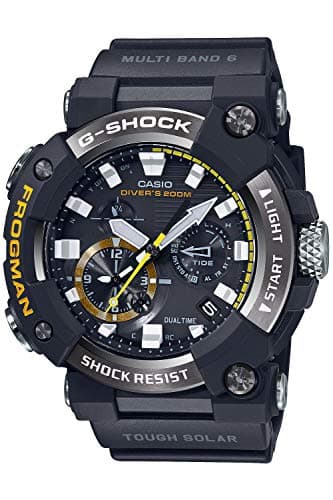
The watch under review
G-Shock Frogman GWF-A1000 (analog Frogman)
Solar, no charger7.7 /10ISO diver's 200 m, sapphire crystal, carbon monocoque case, Tough Solar at about five months in the dark, 30-record dive log and a tide graph for roughly 3,300 locations.
Check price · Amazon#ad · Price as of November 4, 2026 · Disclosure for the link to G-Shock Frogman GWF-A1000 (analog Frogman)
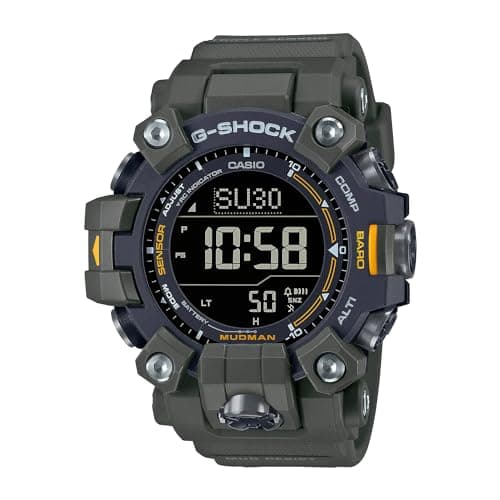
Alternative: the sealed land version
G-Shock Mudman GW-9500
Solar, no charger8.2 /10200 m, mud resistant, Tough Solar and a full ABC sensor set at 81 g, for a fraction of the Frogman's list price. No ISO dive certification.
$347.00Amazon#ad · Price as of November 4, 2026 · Disclosure for the link to G-Shock Mudman GW-9500
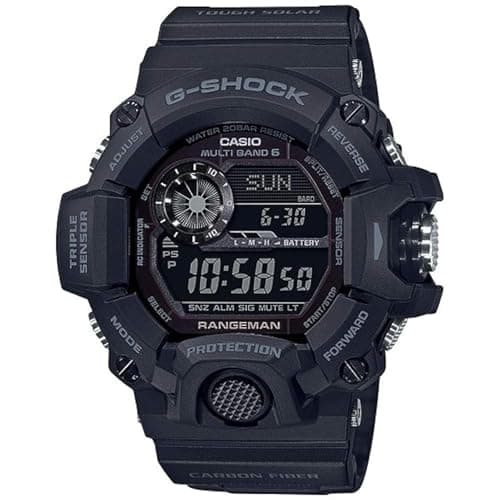
Alternative: the cheap one that does more
G-Shock Rangeman GW-9400
Solar, no charger8.7 /10Tough Solar rated at about eight months in the dark, 200 m, triple sensor and a digital display you can actually read numbers on.
$320.00Amazon#ad · Price as of November 4, 2026 · Disclosure for the link to G-Shock Rangeman GW-9400
Verdict and score
What an ISO diver's rating actually buys
Nearly every G-Shock says 200 m on the back. That figure is a static pressure rating and it is the reason a G-Shock survives a lifetime of swimming, surf and rain. An ISO diver's rating is a different and stricter claim, and the Frogman is where Casio makes it. The shorthand we use across this site is that a water-resistance figure describes what the case can hold back, while a diver's certification describes a watch built and verified to be relied on underwater: legibility in the dark, resistance to condensation and thermal shock, a secured strap, and a visible indication that the watch is still running. The standards themselves are unpacked in watch water resistance explained.
This matters more than the marketing suggests, because the question people actually ask about these watches is the one answered in can you swim with a G-Shock: yes, and nearly always yes, right up to the point where you are breathing compressed air and the watch is the thing telling you how long you have been down. At that point the difference between a watch resistant to 200 m and a watch certified as a diver's watch stops being pedantry. The Frogman is the only G-Shock in our registry that crosses that line.
One caution Casio prints in its own guide and we will repeat: "This watch is not a special-purpose measuring instrument. Measurement function readings are intended for general reference only." The dive timer is a timer. It is not a dive computer, it does not model decompression, and nothing on this page should be read as suggesting you leave the computer at home.
The carbon monocoque case and the sapphire
The construction is the reason to want this watch. G-Central describes a carbon monocoque single-shell case in carbon-fiber-reinforced resin with Carbon Core Guard structure, a stainless steel bezel and a fluoroelastomer band. Monocoque means one piece: there is no separate screwed-on case back, which removes the gasket that is the usual failure point on a watch that spends its life wet. For a buyer who thinks in decades, deleting a seam is worth more than any feature on a spec sheet.
The crystal is sapphire, spherical, with an anti-glare coating. Sapphire is rare on a G-Shock. It appears on the titanium squares and on the Mudmaster line, and the whole argument for it is in sapphire vs Gorilla Glass. Spherical is the part worth noticing here: a domed crystal gives you readability at an angle that a flat crystal does not, and the anti-glare coating is doing real work when the only light is a torch.
What Casio does not claim is a MIL-STD-810 build. That claim belongs to Garmin's Instinct and fenix lines on this site, not to Casio, and the standard is a test methodology rather than a grade in any case; the detail is in MIL-STD-810 explained. Casio also publishes no low-temperature resistance figure for module 5623, where it does publish one for the Rangeman GW-9400 and for the Pro Trek PRW-61. We print neither figure for this watch, because Casio has not published one.
The battery and charging figures, in full
Casio's guide gives two tables that are worth reproducing, because between them they answer the only question a buy-it-for-life buyer has about a solar watch: what happens when the sun stops.
| Condition | Approximate running time with no light |
|---|---|
| Bluetooth connected 10 hours/day (Casio's baseline, includes 3 dives/month) | About 5 months |
| Bluetooth connected 16 hours/day | About 4 months |
| Bluetooth connected 18 hours/day | About 3 months |
Casio's baseline load is specific and we will quote it rather than round it off: a Bluetooth connection ten hours a day, one ten-second alarm a day, one three-second light a day, six hours a day of second-hand sleep, and three dives a month with forty-five minutes of dive time and fifteen minutes of surface interval each. That is a working diver's month, not a desk month, and five months of darkness on top of it is a strong number.
| Light condition | Charge needed for one day of operation |
|---|---|
| Sunny day, outdoors (50,000 lux) | 8 minutes |
| Sunny day, near a window (10,000 lux) | 30 minutes |
| Overcast day, near a window (5,000 lux) | 48 minutes |
| Indoor fluorescent lighting (500 lux) | 8 hours |
Power saving is three-staged and worth understanding before you panic at a stopped watch. Leave it unmoved for about an hour and the phone connection drops (level 1). Leave it in the dark for about an hour between 9 p.m. and 6 a.m. and the second hand stops (level 2). Leave it there six or seven days and every hand stops (level 3). A Frogman in a drawer looks dead and is not. The same mechanism, on the digital models, is covered in G-Shock solar battery replacement, which is also where to look for what happens when the cell itself finally ages out after a decade or more.
The analog problem
This is the section that decides the purchase, and it is the reason this review does not end in a recommendation for most readers. The GWF-A1000 is the first Frogman with an analog display, and that is not a cosmetic choice. It changes how you use the watch.
Dive time is measured in one-second units up to two hours and the surface interval up to twenty-four hours. Both are read from hands. So is the tide level, which the mode hand points at across six levels. So is the result of the last time-signal reception, which the second hand indicates by pointing at a letter. There is a logic to it and owners learn it in a week. But a Rangeman shows you 43:12 and a Frogman shows you a hand somewhere between two marks, and underwater, in silt, through a mask, with cold hands, that difference is real.
The compensating features are the LED Super Illuminator with afterglow, which ramps up and fades rather than snapping on, and the spherical sapphire that keeps the dial readable off-axis. If you have worn a dive watch with a rotating bezel for twenty years and read elapsed time off a ring without thinking, none of this will bother you. If your mental model of a G-Shock is a digital readout, go and look at the dial photographs before you spend what this costs.
The tide graph and the dive log
Two functions here exist on no other watch in our registry, and they are the practical case for the Frogman over a cheaper G-Shock.
The tide graph covers approximately 3,300 locations worldwide, selected through the phone app, with the mode hand reading the current tide level across six levels. This is the one tide function on this site we are willing to state, because Casio states it: we deliberately make no tide claim on the best watch for fishing or on the best watch for kayaking, because none of the spec pages behind those picks publishes one. If tide is the function you are shopping for, this is the watch on the site that has it.
The dive log stores thirty records of dive start and end dates and times, or surface start and end dates and times. Thirty is a season for a recreational diver and a month for a working one. It is a log of times, not of depths, and that distinction is worth being precise about: the GWF-A1000 is a timing instrument, and the figures it records are the ones its clock measured, not the ones a pressure sensor measured.
Where you buy one, and which reference
This needs saying plainly, because it is the part of this purchase most likely to cost you money. The Frogman launched in June 2020 with three US references, the GWFA1000-1A, -1A2 and -1A4, at an $800 list price each, and the series has since run through a long list of later references and special editions, several of which sell well above that. Casio's own US store blocks automated readers, so we cannot verify from here which references it currently stocks.
What we can tell you is what our own price lookup found. The one live, purchasable Amazon listing that matches this exact model is a Japan-domestic import of the debut GWF-A1000-1AJF, and it is priced a long way above the original $800 list — the buy button on this page carries whatever that listing says today, so you can see it rather than take our word for it. Treat it as a reference point, not as the price of a Frogman.
So shop the reference rather than the first listing. Search the model, compare the references, and check what the US-market editions are going for before you buy an import at a premium; an anniversary or collaboration edition is a collector price rather than a watch price, and our standing view on that premium is in best G-Shock collabs. If the number you find is close to double the list price, the honest answer is that the Mudmaster GWG-2000 gives you sapphire, a carbon case and a full sensor set for far less, and the thing you would be paying the Frogman premium for is the dive certification.
Against the Mudman and the Rangeman
The honest comparison is not against other dive watches. It is against the two sealed Casios that cost a fraction as much and do more things.
The Mudman GW-9500 is 200 m and mud resistant, and Casio states that mud resistance separately from water resistance, which makes it a specification rather than a slogan. It carries a full altimeter, barometer, compass and thermometer set at 81 g. The Rangeman GW-9400 is 200 m with the same triple sensor and a stated low-temperature resistance to -10°C, and Casio rates its cell at roughly eight months in the dark. Both give you numbers on a digital display. Neither is ISO certified for diving, neither has sapphire, and neither has a tide graph.
So the trade is clear. The Frogman buys you the certification, the crystal and the one-piece case, and spends the ABC sensors and the readable display to get there. If you are choosing between the three for land use, the ranking in Rangeman vs Mudmaster vs Mudman is the page to read and the Frogman is not in that argument. If you want the single toughest Casio case regardless of features, see the toughest G-Shock.
Who should buy it, and who should not
Buy the Frogman GWF-A1000 if you actually get in the water, whether that is diving, spearfishing, surf rescue or commercial work on and under a boat, and you want one watch to do it for the next fifteen years. The ISO certification, the sapphire, the single-shell case and a cell measured in months of darkness are a coherent package for exactly that life, and the tide graph is a function you will use weekly rather than once. Buy it if you are an analog-dial person who finds digital modules fussy.
Do not buy it if you want altitude, pressure or temperature: it has no ABC sensors, and a Rangeman or a Pro Trek gives you all three for a third of the money. Do not buy it if you want to read elapsed time as a number. Do not buy it if 119 g and a 19.7 mm case height are more watch than your wrist wants, because the best G-Shock for small wrists is a different list entirely. And do not buy it as a tough everyday watch, because that is what the cheaper G-Shocks are for and they are very good at it.
One last framing, because it is the site's whole thesis. A watch at this price that lasts twenty years and never takes a battery costs less per year than a mid-priced watch replaced three times, and the Frogman's materials list is the strongest argument for longevity we have put on this site. The case for paying once is in buy-it-for-life watches. Whether you want to pay it for a dial you have to learn is a decision only you can make.
In detail
Spec sheet and score
The watch under review
G-Shock Frogman GWF-A1000 (analog Frogman)
ISO diver's 200 m, sapphire crystal, carbon monocoque case, Tough Solar at about five months in the dark, 30-record dive log and a tide graph for roughly 3,300 locations.
EvidenceResearched · every row sourced
How the 7.7 score breaks down
- Battery & power independence (25%)
- 9
- Durability of materials (25%)
- 9
- Serviceability & lifespan (20%)
- 7
- Field usability (15%)
- 6
- Value per decade (10%)
- 5
- Mission fit (5%)
- 8
What the spec sheet supports
- An ISO diver's 200 m rating plus a sapphire crystal: the only G-Shock on this site with both.
- A carbon monocoque case with no case-back seam to open, so the thing that usually lets water in is not there.
- Tough Solar, and Casio's own charging table says eight minutes of real sunlight buys a day of running.
Where it falls short
- Everything is read off hands. There is no digital window for dive time, so you count sub-dial positions in low visibility.
- 56.7 x 51.7 x 19.7 mm and 119 g on a wrist, over a wetsuit sleeve.
- Casio makes no MIL-STD-810 claim for it, and publishes no low-temperature figure for this module.
- An $800 list price at launch, and the live Amazon listing for the debut reference is a Japan-domestic import well above it.
Skip this if…
…you want altitude, pressure or temperature on your wrist; the Frogman has no ABC sensor set at all and a Rangeman costs a third as much.
#ad · Price as of November 4, 2026 · Disclosure for the link to G-Shock Frogman GWF-A1000 (analog Frogman)
Alternative: the sealed land version
G-Shock Mudman GW-9500
200 m, mud resistant, Tough Solar and a full ABC sensor set at 81 g, for a fraction of the Frogman's list price. No ISO dive certification.
EvidenceResearched · every row sourced
| Power class | Solar, no charger. A solar cell that recharges from any light and never meets a charger. The rechargeable cell is a watchmaker-replaceable part. |
|---|---|
| Battery (cell) | Approximately 6 months with no light (Casio's stated usage conditions) |
| Power | Solar panel and one rechargeable battery |
| Glass | Mineral |
| Bezel & case | Carbon, resin and bio-based resin |
| Water rating | 200 meters; shock resistant; mud resistant |
| Sensors | Digital compass, altimeter, barometer, thermometer; sunrise/sunset times |
| Weight | 81 g |
| Size | 56.7 × 52.7 × 14.8 mm |
How the 8.2 score breaks down
- Battery & power independence (25%)
- 9
- Durability of materials (25%)
- 7
- Serviceability & lifespan (20%)
- 9
- Field usability (15%)
- 7
- Value per decade (10%)
- 9
- Mission fit (5%)
- 9
What the spec sheet supports
- 3.4 mm thinner and 12 g lighter than the Rangeman GW-9400 by the published figures.
- Mud-resistant buttons and a carbon-reinforced case.
- Sunrise/sunset and a barometer graph for reading weather in a stand.
Where it falls short
- Six months of stated dark-running versus the Rangeman's eight.
- Mineral crystal.
Skip this if…
…you want the longest-proven G-Shock module; the Rangeman has a decade more history behind it.
#ad · Price as of November 4, 2026 · Disclosure for the link to G-Shock Mudman GW-9500
Alternative: the cheap one that does more
G-Shock Rangeman GW-9400
Tough Solar rated at about eight months in the dark, 200 m, triple sensor and a digital display you can actually read numbers on.
EvidenceResearched · every row sourced
| Power class | Solar, no charger. A solar cell that recharges from any light and never meets a charger. The rechargeable cell is a watchmaker-replaceable part. |
|---|---|
| Battery (cell) | Approximately 8 months from full charge to Level 4 with no light (Casio's stated usage conditions) |
| Power | Solar panel and one rechargeable battery (Tough Solar) |
| Glass | Mineral crystal |
| Water rating | 200 meters |
| Sensors | Digital compass, barometer, altimeter, thermometer; sunrise/sunset; Multi-Band 6 time calibration (WWVB, DCF77, MSF, JJY, BPC) |
| Weight | 93 g |
| Size | 55.2 × 53.5 × 18.2 mm |
| Operating temp | Low-temperature resistance -10°C (14°F) |
How the 8.7 score breaks down
- Battery & power independence (25%)
- 10
- Durability of materials (25%)
- 7
- Serviceability & lifespan (20%)
- 10
- Field usability (15%)
- 7
- Value per decade (10%)
- 10
- Mission fit (5%)
- 8
What the spec sheet supports
- Solar and atomic: it sets itself from a radio signal and never sees a cable.
- A module that has been in production for over a decade; parts, straps and bezels are everywhere.
- Sunrise/sunset on the watch, the one hunting feature the Garmin Instinct does without a phone.
Where it falls short
- Mineral crystal, not sapphire; the Rangeman lives behind a raised bezel for a reason.
- No GPS, no maps, no heart rate. It tells you where north is, not where you are.
- Big and thick at 18.2 mm.
Skip this if…
…you want a track of where you walked; an ABC watch measures the world, it does not map it.
#ad · Price as of November 4, 2026 · Disclosure for the link to G-Shock Rangeman GW-9400
How we scored this
What we checked to build this ranking
Every pick here is researched against the documents that decide whether a watch lasts: the maker's own battery table read mode by mode, what the lens and case are actually made of, the water rating, whether a MIL-STD-810 line is on the record and in whose words, and how long the maker keeps updating the line. Each one is then scored on a public rubric weighted for a decade of ownership, and every figure links to where it came from.
That is why the order on this page is worth following: it is built from specs you can open yourself, and commissions never set a score or decide a pick. The rubric and its weights are published.
Questions
Frequently asked
How long does the G-Shock Frogman GWF-A1000 battery last?
Casio's Operation Guide 5623 rates the rechargeable cell at approximately five months with no light exposure, under conditions that include a Bluetooth connection ten hours a day, one alarm and one three-second light a day, six hours a day of second-hand sleep and three dives a month. The same table gives roughly four months at sixteen hours a day of Bluetooth and roughly three months at eighteen hours a day. It is Tough Solar, so in normal wear it recharges from light and you never charge it from a cable.
Is the GWF-A1000 a real dive watch?
Casio rates it as ISO diver's 200 m water resistance, which is a stricter claim than the 200 m water-resistance figure on an ordinary G-Shock. Casio also states in the same guide that the watch "is not a special-purpose measuring instrument" and that its measurement readings are intended for general reference, so treat the dive timer as a timer and not as a dive computer.
Does the Frogman GWF-A1000 have sapphire glass?
Yes. G-Central's spec sheet lists a spherical sapphire crystal with an anti-glare coating. That makes it one of a short list of G-Shocks with sapphire, alongside the titanium squares and the Mudmaster line.
Does it have a compass, altimeter or barometer?
No. Module 5623 has no altimeter, barometer, compass or thermometer. What it has instead is dive time measurement up to two hours, a surface interval display up to twenty-four hours, a thirty-record dive log and a tide graph for approximately 3,300 locations. For sensors, look at the Rangeman, the Mudman or the Pro Trek line.
How big is the GWF-A1000 and how much does it weigh?
56.7 x 51.7 x 19.7 mm and 119 g, per G-Central's spec sheet. That is larger than a Rangeman and heavier than a Mudman, and it is a watch designed to be read over a wetsuit sleeve rather than to disappear under a shirt cuff.
Is the GWF-A1000 still being made?
The series is still in the catalog and new references are still being released, including anniversary editions, but the three debut US references from June 2020 are old enough that stock moves around. Casio's US store blocks automated readers so we cannot confirm its current listings from here. The live Amazon listing our price lookup verified for this exact model is a Japan-domestic import of the debut reference, priced well above the original $800 list, so compare references before you buy rather than taking the first listing you find.
Keep reading
Related on Bezel & Bearing
- Can you swim with a G-Shock?What 200 m means and where it stops.
- Mudman GW-9500 reviewThe sealed land Casio, at a third of the price.
- The toughest G-ShockWhere this case ranks against the rest.
- Water resistance explainedRatings, certifications and the gap between them.
- Sapphire vs Gorilla GlassWhy the crystal is the upgrade that lasts.
Receipts
Sources
- Casio — Operation Guide 5623 (GWF-A1000 Frogman): Specifications, Solar Charging, Power Saving (checked 2026-10-21)
- G-Central — G-Shock GWF-A1000 Frogman spec sheet, list price and references (checked 2026-10-21)
- G-Central — G-Shock Frogman GWF-A1000 with Full Analog Display (carbon monocoque case, US references, June 2020 release) (checked 2026-10-21)
- Casio — Operation Guide, module 3553 (GW-9500 Mudman), Specifications (checked 2026-09-20)
- Casio — Operation Guide, module 3410 (GW-9400 Rangeman), Specifications (checked 2026-09-20)
Battery, glass, case and water figures come from the maker's own owner's manuals, spec pages and press releases, linked on every product so you can open the page they came from. Prices are set by Amazon and change often, so each buy button takes you to the current one. Read the full method.