G-Shock & Pro Trek / Review
G-Shock GMW-B5000 review: the square that solved every durability problem except its own weight
Casio took the 1983 square, built it in stainless steel with a screw-back case, added Tough Solar and radio time, and shipped the most serviceable G-Shock in the catalog. Then it put 167 grams on your wrist.
By Mike M.Updated Researched from the maker's manuals and spec sheets
#adReader-supported: we may earn a commission if you buy through our links, at no extra cost to you. It never decides a ranking. How we rate · Disclosure
The verdict
The watch and its alternatives
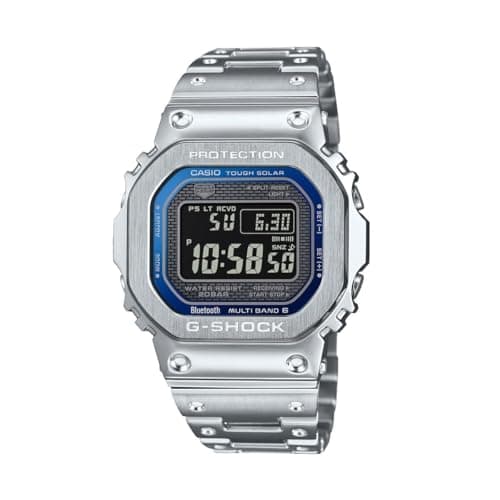
The watch under review
G-Shock GMW-B5000 (full metal square)
Solar, no charger8.1 /10Stainless steel case, bezel and band with a screw-back case, Tough Solar at 10 months of dark running (22 in power save), 200 m, Multi-Band 6 and Bluetooth. 167 g.
$483.00Amazon#ad · Price as of November 4, 2026 · Disclosure for the link to G-Shock GMW-B5000 (full metal square)
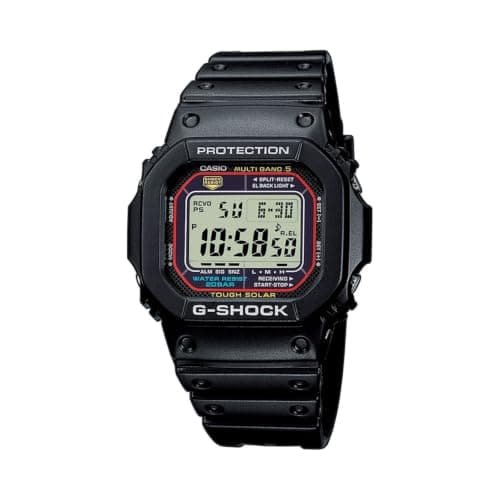
Alternative: the same functions, 90 grams lighter
G-Shock GW-M5610U
Solar, no charger8.2 /10Tough Solar and Multi-Band 6 in the resin square. Casio rates it at about 10 months in the dark too, and it costs a fraction as much.
$155.63Amazon#ad · Price as of November 4, 2026 · Disclosure for the link to G-Shock GW-M5610U
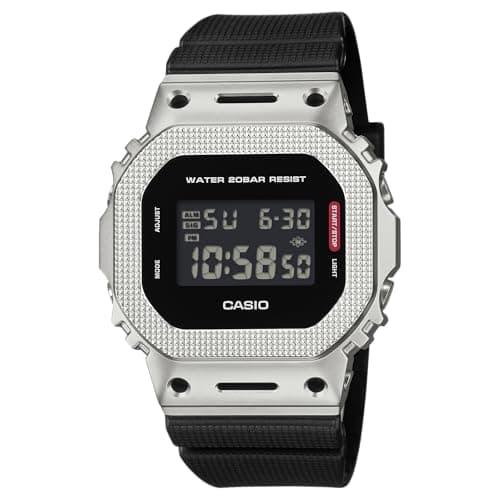
Alternative: the steel look at 73 grams
G-Shock GM-5600 (steel bezel square)
Replaceable cell7.6 /10A stainless bezel on the resin case. You get the metal face without the mass, and give up solar and radio time.
$220.00Amazon#ad · Price as of November 4, 2026 · Disclosure for the link to G-Shock GM-5600 (steel bezel square)
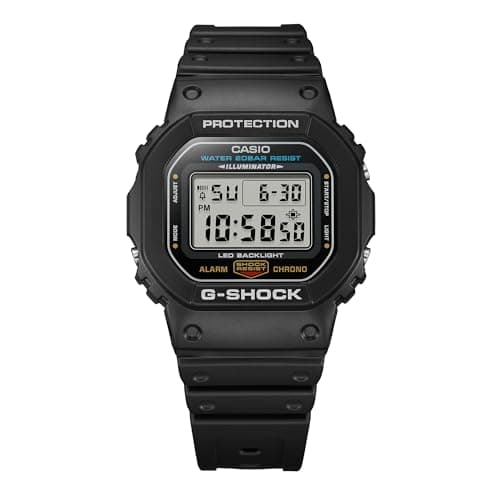
Alternative: the cheap one that lasts anyway
G-Shock DW-5600E
Replaceable cell7.7 /1052 g, 200 m, a coin cell Casio rates for about five years, and a case design in production since 1987.
$83.99Amazon#ad · Price as of November 4, 2026 · Disclosure for the link to G-Shock DW-5600E
Verdict and score
What the GMW-B5000 actually is
The square is the original G-Shock shape, the DW-5000C of 1983, and it has been sold continuously in resin ever since. In 2018 Casio built the same shape out of stainless steel: case, bezel and band. That is the GMW-B5000. It is not a new watch with a retro look. It is the forty-year-old watch, in metal, with the current solar module inside it.
That matters to a buy-it-for-life buyer more than any feature list, because it means the design has already survived four decades of production. Straps, bezels, modules and service knowledge for the square are the deepest in the G-Shock catalog, and the resin version of the same case — the DW-5600E — is still being made today. When you buy into this shape you are buying into a parts ecosystem, not a model year. The ranking of the whole family is in the best square G-Shock.
What you get over the resin squares is specific and short: a stainless steel case and bracelet, a screw-back case, Bluetooth phone sync on top of the radio calibration, and a full auto LED light. What you do not get is any sensor. No compass, no altimeter, no barometer, no thermometer, no GPS. If you want those, the line starts at the compass models and ends at the Rangeman.
Ten months dark, twenty-two in power save
These two numbers are the reason this watch is on a site about power independence. Casio's stated figures for the module are ten months of normal use with no light exposure after a full charge, and twenty-two months when the watch is stored in total darkness with the power save function on.
Read that again as a buyer rather than as a spec-sheet reader. Normal use with no light means ten months of wearing the watch under a sleeve in winter, in an office, with nothing reaching the solar cell, and it keeps time anyway. Twenty-two months is a watch you put in a drawer for nearly two years and find still running. There is nothing else in our registry that does that, and it is the entire argument for Tough Solar over a rechargeable GPS watch — the contrast is laid out in are solar watches worth it.
One honest caveat on every solar watch, this one included: the rechargeable cell is a consumable with a very long life, not a permanent part. It is a watchmaker-replaceable component, and what that service looks like is in G-Shock solar battery replacement. Plan on it once in the watch's life, not once a year.
The screw-back case, and why it matters
G-Central's spec sheet lists a screw-back case, and this is the single most underrated line on the sheet. Most G-Shocks use a case back held by four screws into a resin body. A screw-back is a threaded steel back that seals against a gasket and torques closed. For the person who intends to keep the watch for twenty years it means two things: the seal is renewable, and a competent watchmaker can open and close it correctly without guessing at plastic.
That is why serviceability scores higher here than anywhere else on the site. A watch is not durable because it survives untouched; it is durable because when something does fail — a gasket, a cell, a bracelet pin — the repair is routine and the parts exist. A steel case with a threaded back and a module that has been in production since 2018 is about as routine as watch repair gets. The broader version of this argument is in buy-it-for-life watches.
The water rating is 200 m with shock resistance, which is the standard square rating and more than this watch will ever meet. Casio makes no MIL-STD-810 claim for it, and does not publish a low-temperature figure for the module, so we state neither. Nothing here is a dive certification either: for that, in the G-Shock line, you need the Frogman.
The mineral glass problem
The crystal is mineral glass on the stainless references. Casio puts sapphire only on the titanium editions. That is the one specification on this watch that does not match its price or its ambition, and on a steel watch it is slightly worse than it sounds: a steel bezel sits flush with the crystal and does less to shield it than a tall resin bezel does.
How much this matters depends on your hands. Mineral glass is hard enough to shrug off cloth, skin and most desk life, and soft enough that a door frame, a brick wall or a tailgate will mark it. Sapphire is the upgrade that is genuinely permanent, and the full materials comparison is in sapphire vs Gorilla Glass, with the ranked list of what actually has it in the most scratch-resistant screens.
There is a cheap partial answer, which is that a scratched mineral crystal on a square is a known, inexpensive replacement part at any watch service counter. It is not the problem a scratched sapphire-less smartwatch is. It is still a cost a sapphire watch does not have.
167 grams
Here is the number that decides whether you keep this watch or sell it. The stainless GMW-B5000 weighs 167 grams. The resin DW-5600E in the identical case shape weighs 52. The steel-bezel GM-5600 weighs 73. Casio's own titanium variants come in at roughly 104 to 106 grams.
167 grams is not a disqualification — plenty of people wear heavier watches happily, and the bracelet distributes the mass better than a single-sided head would. But it is three times the resin square, and it changes the watch from something you forget about to something you are aware of. If you have never worn a full metal bracelet watch all day, that is the thing to go and try before you buy, and the thickness and weight arithmetic across every case we cover is in titanium vs stainless steel. On a small wrist, start instead with the small-wrist list.
Against the other squares
The only fair comparison is inside the family, because the square competes with itself more than with anything else in the catalog.
| Evidence | G-Shock GMW-B5000 (full metal square) | G-Shock GW-M5610U | G-Shock GM-5600 (steel bezel square) | G-Shock DW-5600E |
|---|---|---|---|---|
| Power class | Solar, no charger | Solar, no charger | Replaceable cell | Replaceable cell |
| Battery (cell) | 10 months with normal use and no light after a charge; 22 months stored in total darkness with power save on | Approximately 10 months with no light (Casio's stated conditions, power saving 6 hours/day) | CR2016, approx. 2 years (module 3229); the June 2023 module 3525 versions are rated at approx. 5 years | CR2016, approx. 5 years |
| Glass | Mineral on the stainless steel models; the titanium editions use sapphire | Mineral (square case family) | Mineral | Mineral |
| Water rating | 200-meter water resistance, shock resistant | 200 meters; shock resistant (DW-5600 square case family) | 200-meter water resistance, shock resistant | 200 meters; shock resistant |
| Weight | 167 g in stainless steel; titanium variants approx. 104-106 g | — | 73 g | 52 g |
| Score | 8.1/10 | 8.2/10 | 7.6/10 | 7.7/10 |
The uncomfortable row is the GW-M5610U. It is the resin square with the same Tough Solar and the same Multi-Band 6 radio, Casio rates it at about ten months in the dark as well, and it weighs a fraction of the metal watch. On the measures this site weighs most heavily — power independence, serviceability, value per decade — the resin solar square is the rational purchase and the metal one is the one you want. We are not going to pretend otherwise.
What the GMW-B5000 adds, honestly stated, is material: a steel case instead of resin, a threaded case back, a bracelet, and Bluetooth. If those are worth several times the price to you, that is a legitimate decision about objects rather than a specification argument, and the watch is extremely good at being that object. If they are not, buy the GW-M5610U and spend the difference on something else. The whole price ladder is in best G-Shock under $200.
Should you buy the titanium instead?
Casio also sells titanium versions of this exact watch, and per G-Central they weigh roughly 104 to 106 grams against 167, and they carry sapphire rather than mineral glass. On paper that fixes both of this watch's real faults at once.
The catch is price: the titanium editions sit a long way above the steel references, well into the bracket where you are choosing between a G-Shock and a mechanical watch. Our position is that if the weight is the thing stopping you, the resin solar square solves it for less money than titanium does, and if the crystal is the thing stopping you, a replacement mineral crystal is cheap. Titanium is worth it when you want both fixes in this specific object and the money is not the constraint. The material itself is explained in titanium vs stainless steel, and the titanium watches we cover are ranked in best titanium watches.
Who should buy it, and who should not
Buy the GMW-B5000 if you want one digital watch for the next twenty years, you want it in metal, and you like the idea of a watch that never needs charging or setting. It is the most maintenance-free object on this site: solar, radio-corrected, 200 m, screw-back, with a parts ecosystem four decades deep. Buy it if you work indoors and a sealed sensor-free watch is genuinely all you need. Buy it if the square is the shape you have always wanted and resin has never felt like enough.
Do not buy it if you need sensors or navigation; it has none, and the hiking models or a rugged GPS watch are the right category. Do not buy it if 167 grams on a bracelet sounds unpleasant, because it will not grow on you. Do not buy it if sapphire is non-negotiable at this price, because the steel references do not have it. And do not buy it for the field: cold metal, small buttons and a bracelet are the wrong answer in gloves, where the work and trade models are right.
One sentence of summary, because this review has been hard on a watch we rate highly: the GMW-B5000 is the correct answer to the question "what is the last digital watch I will ever need to buy", and the wrong answer to the question "what is the best value in the G-Shock catalog". Both of those questions are reasonable, and only one of them is about money.
In detail
Spec sheet and score
The watch under review
G-Shock GMW-B5000 (full metal square)
Stainless steel case, bezel and band with a screw-back case, Tough Solar at 10 months of dark running (22 in power save), 200 m, Multi-Band 6 and Bluetooth. 167 g.
EvidenceResearched · every row sourced
| Power class | Solar, no charger. A solar cell that recharges from any light and never meets a charger. The rechargeable cell is a watchmaker-replaceable part. |
|---|---|
| Battery (cell) | 10 months with normal use and no light after a charge; 22 months stored in total darkness with power save on |
| Power | Tough Solar, solar rechargeable battery |
| Glass | Mineral on the stainless steel models; the titanium editions use sapphire |
| Bezel & case | Stainless steel case, bezel and band; screw-back case (titanium variants also sold) |
| Water rating | 200-meter water resistance, shock resistant |
| Sensors | None. Multi-Band 6 radio time calibration, Bluetooth Mobile Link, full auto LED light; module 3459 |
| Weight | 167 g in stainless steel; titanium variants approx. 104-106 g |
| Size | 49.3 × 43.2 × 13 mm |
How the 8.1 score breaks down
- Battery & power independence (25%)
- 10
- Durability of materials (25%)
- 8
- Serviceability & lifespan (20%)
- 9
- Field usability (15%)
- 6
- Value per decade (10%)
- 6
- Mission fit (5%)
- 5
What the spec sheet supports
- Solar and atomic in a full stainless steel case: the square with nothing to charge and nothing to set.
- Twenty-two months of stated power-save running in total darkness, the longest dark figure of any square here.
- A screw-back steel case is the most serviceable construction Casio uses on a square.
Where it falls short
- 167 grams. This is more than three times the weight of a resin DW-5600E and you feel every gram of it.
- Mineral glass on the steel models; only the titanium editions get sapphire, at a much higher price.
- Steel scratches and shows it, where resin just goes matte.
Skip this if…
…you want the square to disappear on your wrist; the resin DW-5600E is 52 g and does the same job for a fraction of the money.
#ad · Price as of November 4, 2026 · Disclosure for the link to G-Shock GMW-B5000 (full metal square)
Alternative: the same functions, 90 grams lighter
G-Shock GW-M5610U
Tough Solar and Multi-Band 6 in the resin square. Casio rates it at about 10 months in the dark too, and it costs a fraction as much.
EvidenceResearched · every row sourced
| Power class | Solar, no charger. A solar cell that recharges from any light and never meets a charger. The rechargeable cell is a watchmaker-replaceable part. |
|---|---|
| Battery (cell) | Approximately 10 months with no light (Casio's stated conditions, power saving 6 hours/day) |
| Power | Solar panel and one rechargeable battery |
| Glass | Mineral (square case family) |
| Water rating | 200 meters; shock resistant (DW-5600 square case family) |
| Sensors | Multi-Band 6 radio time calibration; world time; 5 alarms |
How the 8.2 score breaks down
- Battery & power independence (25%)
- 10
- Durability of materials (25%)
- 6
- Serviceability & lifespan (20%)
- 10
- Field usability (15%)
- 6
- Value per decade (10%)
- 10
- Mission fit (5%)
- 6
What the spec sheet supports
- Ten months of stated dark running, the longest solar figure Casio publishes among the watches here.
- Atomic time and solar in the smallest G-Shock case.
Where it falls short
- Same flat mineral crystal as the DW-5600.
- No sensors.
Skip this if…
…you need a compass or altimeter on the watch; step up to the Rangeman.
#ad · Price as of November 4, 2026 · Disclosure for the link to G-Shock GW-M5610U
Alternative: the steel look at 73 grams
G-Shock GM-5600 (steel bezel square)
A stainless bezel on the resin case. You get the metal face without the mass, and give up solar and radio time.
EvidenceResearched · every row sourced
| Power class | Replaceable cell. A replaceable coin cell measured in years. No charging, no electronics to update, and the cheapest thing on the watch to service. |
|---|---|
| Battery (cell) | CR2016, approx. 2 years (module 3229); the June 2023 module 3525 versions are rated at approx. 5 years |
| Glass | Mineral |
| Bezel & case | Stainless steel bezel on a resin case, resin band |
| Water rating | 200-meter water resistance, shock resistant |
| Sensors | None. 1/100-second stopwatch, timer, multi-function alarm, flash alert, EL backlight (LED on newer models); shares the DW-5600 module |
| Weight | 73 g |
| Size | 49.6 × 43.2 × 12.9 mm |
How the 7.6 score breaks down
- Battery & power independence (25%)
- 7
- Durability of materials (25%)
- 7
- Serviceability & lifespan (20%)
- 10
- Field usability (15%)
- 8
- Value per decade (10%)
- 6
- Mission fit (5%)
- 5
What the spec sheet supports
- The steel bezel at 73 g, less than half the weight of the full-metal square.
- It runs the DW-5600 module, so parts, straps and service knowledge are the deepest on the site.
- The newer module 3525 versions push the cell from about two years to about five.
Where it falls short
- No solar and no radio time at $220, which the $165 GW-M5610U both has.
- Mineral glass, and a steel bezel that scratches where resin would not.
- Which module you get depends on the reference, and the cell figure changes with it.
Skip this if…
…you want the watch to run on light and set itself; the GW-M5610U is cheaper and does both.
#ad · Price as of November 4, 2026 · Disclosure for the link to G-Shock GM-5600 (steel bezel square)
Alternative: the cheap one that lasts anyway
G-Shock DW-5600E
52 g, 200 m, a coin cell Casio rates for about five years, and a case design in production since 1987.
EvidenceResearched · every row sourced
| Power class | Replaceable cell. A replaceable coin cell measured in years. No charging, no electronics to update, and the cheapest thing on the watch to service. |
|---|---|
| Battery (cell) | CR2016, approx. 5 years |
| Glass | Mineral |
| Bezel & case | Resin case and band |
| Water rating | 200 meters; shock resistant |
| Weight | 52 g |
| Size | 48.9 × 42.8 × 13.4 mm |
How the 7.7 score breaks down
- Battery & power independence (25%)
- 8
- Durability of materials (25%)
- 6
- Serviceability & lifespan (20%)
- 10
- Field usability (15%)
- 6
- Value per decade (10%)
- 10
- Mission fit (5%)
- 6
What the spec sheet supports
- In production since 1987 with a module refresh in 2023; parts and straps will exist for the rest of your life.
- A five-year coin cell is the longest-stated battery on the site.
- Small enough for any wrist and any cuff.
Where it falls short
- Mineral crystal on a flat face with a low bezel; it scratches.
- No sensors, no solar, no radio time.
Skip this if…
…you want it to set itself; the GW-M5610U is the same square with solar and radio time.
#ad · Price as of November 4, 2026 · Disclosure for the link to G-Shock DW-5600E
How we scored this
What we checked to build this ranking
Every pick here is researched against the documents that decide whether a watch lasts: the maker's own battery table read mode by mode, what the lens and case are actually made of, the water rating, whether a MIL-STD-810 line is on the record and in whose words, and how long the maker keeps updating the line. Each one is then scored on a public rubric weighted for a decade of ownership, and every figure links to where it came from.
That is why the order on this page is worth following: it is built from specs you can open yourself, and commissions never set a score or decide a pick. The rubric and its weights are published.
Questions
Frequently asked
How long does the GMW-B5000 battery last?
Casio's figures for module 3459 are approximately ten months of normal use with no light exposure after a charge, and approximately twenty-two months when the watch is stored in total darkness with the power save function enabled. In normal wear the solar cell keeps it topped up and you never charge it from a cable. The rechargeable cell itself is a watchmaker-replaceable part with a multi-year life.
Does the GMW-B5000 have sapphire glass?
Not on the stainless steel references, which use mineral glass. Casio fits sapphire to the titanium editions of the same watch. If sapphire is the priority, that is the version to look at, or a different model altogether.
How heavy is the GMW-B5000?
167 grams in stainless steel, per G-Central's spec sheet, in a 49.3 x 43.2 x 13 mm case. The titanium variants are listed at roughly 104 to 106 grams. For reference, the resin DW-5600E in the same case shape is 52 grams.
Does the GMW-B5000 have a compass or altimeter?
No. Module 3459 carries no sensors at all. What it has is Tough Solar, Multi-Band 6 radio time calibration, Bluetooth Mobile Link and a full auto LED light. For a compass, altimeter, barometer and thermometer in a G-Shock, look at the Rangeman, the Mudman or the Mudmaster.
Is the GMW-B5000 worth it over the GW-M5610U?
On specifications, no: the resin GW-M5610U has the same Tough Solar and Multi-Band 6, a similar stated ten-month dark-running figure and the same 200 m case, at a fraction of the price and a fraction of the weight. What the GMW-B5000 adds is a stainless steel case and bracelet, a screw-back case and Bluetooth. That is a decision about the object, not about function.
Can you replace the GMW-B5000 case back seal?
The spec sheet lists a screw-back case, which is a threaded steel back sealing against a gasket. That is the most serviceable construction Casio uses on a square: the gasket is a renewable part and a watchmaker can open and torque the back correctly. It is a large part of why this watch scores so well on serviceability here.
Keep reading
Related on Bezel & Bearing
- The best square G-ShockWhere the full metal sits in the family.
- Best G-Shock under $200The resin solar square that competes with it.
- Titanium vs stainless steel167 g against 104 g, and what you pay for it.
- Buy-it-for-life watchesWhy a screw-back case changes the math.
- G-Shock solar battery replacementThe one service a Tough Solar watch needs.
Receipts
Sources
- G-Central — G-Shock GMW-B5000 spec sheet and list price (checked 2026-09-28)
- CasioFanMag — GMW-B5000, module 3459 battery operating times transcribed from Casio's operation guide (checked 2026-09-28)
- Casio — Operation Guide, module 3495 (GW-M5610U), Specifications (checked 2026-09-20)
- G-Central — G-Shock DW-5600 spec sheet (checked 2026-09-20)
- G-Central — G-Shock GM-5600 spec sheet and list price (checked 2026-09-28)
Battery, glass, case and water figures come from the maker's own owner's manuals, spec pages and press releases, linked on every product so you can open the page they came from. Prices are set by Amazon and change often, so each buy button takes you to the current one. Read the full method.