GPS Watches / The rankings
The best watches for skiing: cold-rated, glove-proof, and able to read a skin track in a whiteout
A resort day asks a watch for vertical and a lift count. A touring day asks it for ascent rate, a pressure trend, a map and enough battery to still be working at the top. Those are different watches.
By Mike M.Updated Researched from the maker's manuals and spec sheets
#adReader-supported: we may earn a commission if you buy through our links, at no extra cost to you. It never decides a ranking. How we rate · Disclosure
Quick picks
The rankings at a glance
| # | Product | Best for | Score | Price |
|---|---|---|---|---|
| 1 | 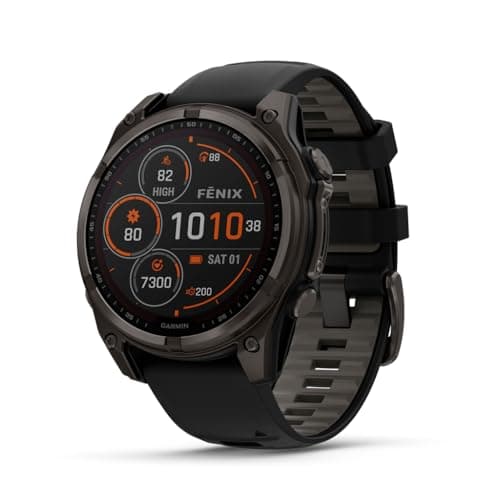 Garmin fenix 8 Solar (47mm, Sapphire) Preloaded TopoActive maps for the skin track, sapphire, a titanium bezel, 28 days with solar and 92 GPS hours with solar at 47 mm. | Best for skiing overallSolar GPS | 8.4 /10 | $960.00Amazon |
| 2 | 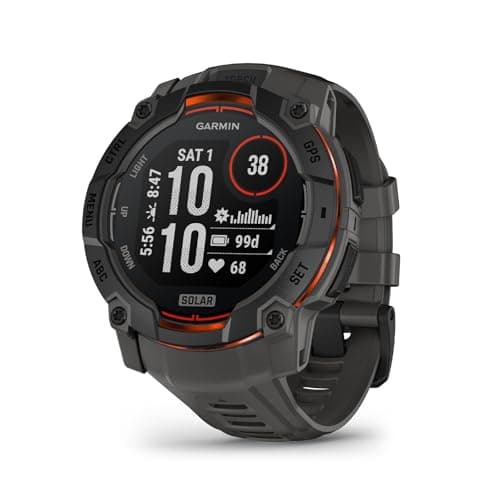 Garmin Instinct 3 Solar (50mm) Rated -20 to 60 C with unlimited smartwatch battery in sun, a flashlight, 10 ATM and the full ABC sensor set. No maps. | Best for resort daysSolar GPS | 8.7 /10 | $399.99Amazon |
| 3 | 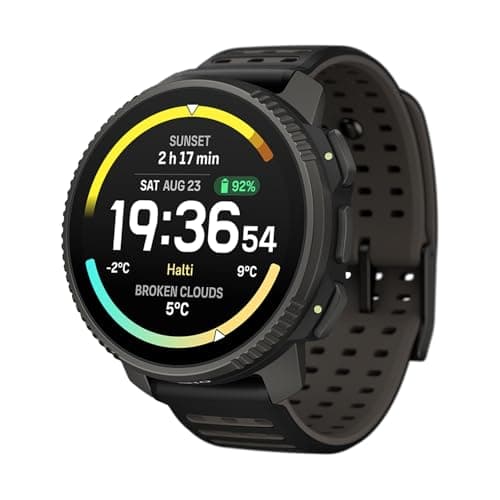 Suunto Vertical 2 Titanium A 1.5-inch AMOLED under sapphire with offline maps and a flashlight, on a titanium bezel at 100 m. 20 days per charge. | Best screen for the skin trackRechargeable GPS | 7.6 /10 | $699.00Amazon |
| 4 |  Amazfit T-Rex 3 A published -30 C low-temperature mode with up to 28 GNSS hours at that temperature, free offline topo maps, and 10 ATM tested by SGS. | Best budget cold-weather watchRechargeable GPS | 7.0 /10 | Check price · Amazon |
| 5 | 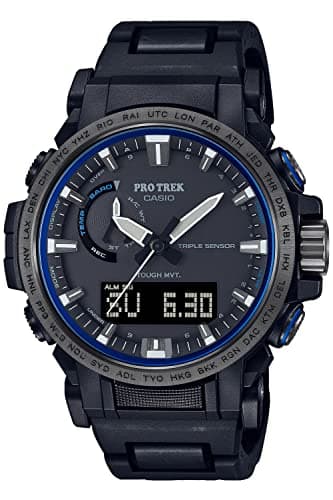 Casio Pro Trek PRW-61 62 g with altimeter, barometer, compass and thermometer on Tough Solar. Reads vertical and pressure all season with no cable. | Best watch that never chargesSolar, no charger | 8.1 /10 | $528.47Amazon |
#ad · Prices come live from Amazon, last checked November 4, 2026. Scores are ours, built from the makers' manuals, battery tables and spec pages. Product photos come from Amazon; anything still on a stock frame is labelled on its card. Tap a row for the full write-up.
The direct answer
Skiing splits into two completely different watch problems, and buying the wrong one is the usual mistake.
Resort skiing needs vertical, runs, time and a battery that survives a cold day with the watch outside a shell. That is a cheap requirement, and the Instinct 3 Solar or the Pro Trek meets it entirely.
Ski touring, ski mountaineering and patrol work need ascent rate, a barometric pressure trend, a map you can read in flat light, a light you can keep red for a pre-dawn start, and a battery that is still there at the top of the third lap. That is a flagship requirement, and it is why the fenix 8 Solar leads.
Resort skiing: what you actually need
Three readings and nothing else: vertical descended, run count and the time the lifts stop. Any watch with a barometric altimeter and GPS does all three, and the barometric sensor is what makes the vertical figure believable rather than noisy.
What matters more than features on a resort day is that the watch is on the outside of a shell sleeve in cold air for six hours. That is the condition that flattens batteries, and it is where a solar watch has a real advantage you can see: it is also in bright, snow-reflected daylight all day, which is the single best charging environment there is. Garmin's solar figures assume three hours a day at 50,000 lux; a bluebird day above the treeline exceeds that comfortably.
So for resort days the Instinct 3 Solar is the rational purchase: rated -20 to 60 C, unlimited in smartwatch mode with that exposure, 10 ATM, built to MIL-STD-810 in Garmin's words, a flashlight, and physical buttons that work through a glove. The Pro Trek PRW-61 at 62 grams is the cheaper answer if you do not want GPS at all and are happy reading altitude and pressure.
Ski touring and ski mountaineering
Now the requirement changes, because you are moving uphill in the dark and navigating terrain you cannot see.
Ascent rate from a barometric altimeter is the pacing instrument for a skin track, and it is more useful than speed because speed on skins is meaningless. A pressure trend is your earliest warning that the day is closing down. A map is what tells you which of three identical-looking benches is the one that does not cliff out, and in flat light that is not a luxury.
That points at two watches. The fenix 8 Solar 47 mm carries preloaded TopoActive maps, sapphire, a titanium bezel, a 40 m dive-rated case with leakproof buttons, and up to 67 GPS-only hours rising to 92 with solar, plus 132 max-battery GPS hours and 283 with solar. The Suunto Vertical 2 Titanium gives a 1.5-inch, 480 by 480 AMOLED with offline maps under sapphire with a titanium bezel, a flashlight and 100 m, at 20 days of daily use with no solar lens.
The screen choice is a genuine trade-off here and worth thinking about. An AMOLED is easier to read a map on in the dark. A reflective MIP display, which is what the solar fenix uses, gets more readable as light rises and is the better screen in snow glare at midday, while costing almost nothing to leave on. The argument is in MIP vs AMOLED battery life.
The cold numbers, as published
Battery capacity falls as temperature falls, so the only honest way to compare winter watches is by what the makers actually print:
| Watch | Published cold figure |
|---|---|
| Amazfit T-Rex 3 | Low-temperature mode to -30 C: up to 28 h with GNSS on, 32 days with GNSS off |
| COROS VERTIX 2S | -30 C to 50 C working range |
| Garmin Instinct 3 Solar | -20 C to 60 C |
| Suunto Vertical Titanium Solar | -20 C to +55 C |
| Casio Pro Trek PRW-61 | Low-temperature resistance to -10 C |
The Amazfit T-Rex 3 is the only watch here that quotes runtime at a cold temperature rather than just survival at it, which is why it is on this list at all despite being the cheapest and the one watch here without sapphire. For a resort skier on a budget in a genuinely cold climate, that -30 C mode plus free offline topo maps and a documented 10 ATM rating is a lot of winter watch for the money. The full assessment, including what it gives up, is in the T-Rex 3 review.
The picks, side by side
Read the glass row as a snow-specific concern rather than a general one. Skiing is the activity most likely to drag a watch along ice, a chairlift bar, a boot buckle and a ski edge, and the three sapphire picks here will come out of a season unmarked where the Gorilla Glass one will not. The hardness argument is in most scratch-resistant smartwatch.
Gloves, and the one rule that matters
Buttons only. There is no second rule. Every pick on this page has physical buttons, and the fenix 8 and Suunto Vertical 2 both have touchscreens you can ignore. A watch you cannot start an activity on without taking a glove off at the top of a lift is a watch you stop using by February.
Two smaller details worth having: a red light mode, which the Garmin flashlight and the Suunto backlight both provide, for pre-dawn starts where you do not want to lose night vision; and a thermometer, which the Pro Trek carries and which reads your wrist as much as the air but is still a useful trend.
Wear the watch over the glove cuff and under the shell if you can manage it. Outside the shell it is cold and the solar lens is in full light; inside both it is warm and charging nothing. On a resort day, outside is correct. On a sub -15 C touring day, warm it against the baselayer on the descent.
The decade pick
In detail
The picks, in full
Rank 1
Best for skiing overall
Garmin fenix 8 Solar (47mm, Sapphire)
Preloaded TopoActive maps for the skin track, sapphire, a titanium bezel, 28 days with solar and 92 GPS hours with solar at 47 mm.
EvidenceResearched · every row sourced
| Power class | Solar GPS. A rechargeable cell topped up by a solar lens. Weeks between charges; the cell still ages like any lithium battery. |
|---|---|
| Battery (smartwatch) | Up to 21 days typical use; up to 28 days with solar |
| Battery (GPS) | Up to 67 hours GPS-only; up to 92 hours with solar |
| Battery (max GPS) | Up to 132 hours max-battery GPS; up to 283 hours with solar |
| Glass | Scratch-resistant sapphire lens (sapphire versions) |
| Bezel & case | Titanium bezel (sapphire versions); leakproof metal buttons |
| Water rating | 40-meter dive-rated case |
| MIL-STD-810 | Tested to U.S. military standards for thermal, shock and water resistance |
| Maps & GPS | TopoActive maps preloaded on sapphire versions |
How the 8.4 score breaks down
- Battery & power independence (25%)
- 8
- Durability of materials (25%)
- 10
- Serviceability & lifespan (20%)
- 7
- Field usability (15%)
- 10
- Value per decade (10%)
- 6
- Mission fit (5%)
- 8
What the spec sheet supports
- Every fenix 8 durability feature in the size most people can actually wear.
- 92 GPS hours with solar covers a long weekend of tracking with margin.
Where it falls short
- Smartwatch battery drops below a month (28 days with solar) versus the 51mm's 48.
- Same MIP-display trade-off as the 51mm.
Skip this if…
…battery days are the reason you are here; the 51mm solar is the fenix for that.
#ad · Price as of November 4, 2026 · Disclosure for the link to Garmin fenix 8 Solar (47mm, Sapphire)
Rank 2
Best for resort days
Garmin Instinct 3 Solar (50mm)
Rated -20 to 60 C with unlimited smartwatch battery in sun, a flashlight, 10 ATM and the full ABC sensor set. No maps.
EvidenceResearched · every row sourced
How the 8.7 score breaks down
- Battery & power independence (25%)
- 10
- Durability of materials (25%)
- 8
- Serviceability & lifespan (20%)
- 7
- Field usability (15%)
- 9
- Value per decade (10%)
- 10
- Mission fit (5%)
- 8
What the spec sheet supports
- Garmin's own table shows the 50mm solar model doubling the 45mm in GPS-with-solar hours (260 vs 130).
- Physical buttons, a monochrome display readable in full sun, and a flashlight with a red mode.
- 10 ATM rating and a MIL-STD 810 claim on a watch that costs less than half a fenix.
Where it falls short
- No maps: it navigates breadcrumb trails and waypoints, not topo maps.
- The solar figures assume three hours a day at 50,000 lux, which is midday sun, not a sleeve.
- Garmin does not name the lens material; treat it as strengthened glass, not sapphire.
Skip this if…
…you need on-wrist topo maps, or you wear long sleeves and work indoors, where the solar math never happens.
#ad · Price as of November 4, 2026 · Disclosure for the link to Garmin Instinct 3 Solar (50mm)
Rank 3
Best screen for the skin track
Suunto Vertical 2 Titanium
A 1.5-inch AMOLED under sapphire with offline maps and a flashlight, on a titanium bezel at 100 m. 20 days per charge.
EvidenceResearched · every row sourced
| Power class | Rechargeable GPS. A rechargeable lithium cell charged from a cable. Days to a few weeks per charge; the cell ages with every cycle. |
|---|---|
| Battery (smartwatch) | Up to 20 days daily use; up to 40 days standby |
| Battery (GPS) | Up to 65 h all-systems + multi-band (60 h always-on); up to 75 h single-band |
| Battery (max GPS) | Up to 250 h in power-saving GNSS modes |
| Glass | Sapphire crystal |
| Bezel & case | Titanium bezel; glass fiber reinforced polyamide case |
| Water rating | 100 m |
| Display | 1.5-inch LTPO AMOLED, 466 × 466 |
| Maps & GPS | Offline maps; GPS, GLONASS, Galileo, QZSS, BeiDou |
| Flashlight | Integrated LED flashlight |
| Weight | 87 g / 3.07 oz |
| Operating temp | -20°C to +55°C (-5°F to +130°F) |
How the 7.6 score breaks down
- Battery & power independence (25%)
- 7
- Durability of materials (25%)
- 9
- Serviceability & lifespan (20%)
- 6
- Field usability (15%)
- 9
- Value per decade (10%)
- 7
- Mission fit (5%)
- 7
What the spec sheet supports
- Sapphire and titanium at the price of a polymer Garmin.
- Offline maps and a flashlight on a Suunto for the first time in the Vertical line.
Where it falls short
- The Vertical 2 dropped solar; the original Vertical Titanium Solar still has it.
- 100 m rating, no stated MIL-STD line, no dive rating.
Skip this if…
…you wanted a Suunto that never sees a charger; buy the first-gen Vertical Titanium Solar instead.
#ad · Price as of November 4, 2026 · Disclosure for the link to Suunto Vertical 2 Titanium
Rank 4
Stock photoBest budget cold-weather watch
Amazfit T-Rex 3
A published -30 C low-temperature mode with up to 28 GNSS hours at that temperature, free offline topo maps, and 10 ATM tested by SGS.
EvidenceResearched · every row sourced
| Power class | Rechargeable GPS. A rechargeable lithium cell charged from a cable. Days to a few weeks per charge; the cell ages with every cycle. |
|---|---|
| Battery (smartwatch) | Up to 27 days typical use; 13 days heavy use; 40 days battery saver; 81 days clock mode |
| Battery (GPS) | Up to 42 hours accurate GNSS; 72 hours power-saving GNSS; 114 hours long battery life mode |
| Battery (max GPS) | Up to 180 hours GNSS max battery life |
| Glass | Gorilla Glass touchscreen |
| Bezel & case | Stainless steel bezel; polymer middle frame |
| Water rating | 10 ATM (ISO 22810, third-party tested by SGS); freediving certification to 45 m (EN13319, ISO 6425) |
| Display | 1.5-inch AMOLED, 480 × 480 |
| Maps & GPS | Free offline maps with topographic contours; dual-band GPS, six satellite systems |
| Weight | 68.3 g without strap |
| Size | 48.5 × 48.5 × 13.75 mm |
| Operating temp | Low temperature mode to -30°C (GNSS on: up to 28 hours; GNSS off: up to 32 days) |
How the 7.0 score breaks down
- Battery & power independence (25%)
- 7
- Durability of materials (25%)
- 7
- Serviceability & lifespan (20%)
- 5
- Field usability (15%)
- 8
- Value per decade (10%)
- 9
- Mission fit (5%)
- 7
What the spec sheet supports
- Amazfit publishes its water-resistance test report number, which few makers do.
- 180 GPS hours in max-battery mode and a stated -30°C low-temperature mode.
- Free offline topo maps at a price where Garmin gives you breadcrumbs.
Where it falls short
- Amazfit says 'military-grade' but does not cite MIL-STD-810 on the page we read, so we do not credit it.
- Gorilla Glass, not sapphire, and a shorter firmware history than Garmin or COROS.
- Offline maps need a route file for navigation; you cannot tap a point on the map.
Skip this if…
…you plan to own it for a decade; Amazfit's update record is too short to promise that yet.
#ad · Price as of November 4, 2026 · Disclosure for the link to Amazfit T-Rex 3
Rank 5
Best watch that never charges
Casio Pro Trek PRW-61
62 g with altimeter, barometer, compass and thermometer on Tough Solar. Reads vertical and pressure all season with no cable.
EvidenceResearched · every row sourced
| Power class | Solar, no charger. A solar cell that recharges from any light and never meets a charger. The rechargeable cell is a watchmaker-replaceable part. |
|---|---|
| Battery (cell) | Approximately 6 months with no light (Casio's stated usage conditions) |
| Power | Solar panel and one rechargeable battery |
| Bezel & case | Biomass plastics case |
| Water rating | 100 m |
| Sensors | Direction, pressure/altitude and temperature sensors; radio time calibration (JJY, WWVB, MSF, DCF77, BPC); double LED light |
| Weight | 62 g |
| Size | 51.0 × 47.4 × 14.7 mm |
| Operating temp | Low-temperature resistance to -10°C (14°F) |
How the 8.1 score breaks down
- Battery & power independence (25%)
- 9
- Durability of materials (25%)
- 6
- Serviceability & lifespan (20%)
- 9
- Field usability (15%)
- 8
- Value per decade (10%)
- 9
- Mission fit (5%)
- 8
What the spec sheet supports
- Solar, atomic and triple sensor at 62 g and 14.7 mm.
- Cleaner dial and a proper altimeter graph for hikers.
Where it falls short
- 100 m and no mud-resistant buttons; it is a hiking watch, not a Mudman.
- Mineral glass.
Skip this if…
…your watch gets buried in mud or dunked regularly; the G-Shock Mudman is the sealed version of this idea.
#ad · Price as of November 4, 2026 · Disclosure for the link to Casio Pro Trek PRW-61
How to choose a ski watch
1. Decide resort or touring first. Resort needs vertical and battery. Touring needs ascent rate, a pressure trend and a map.
2. Require a barometric altimeter. It is what makes a vertical figure believable, and it is the pacing instrument on a skin track.
3. Buttons, not a touchscreen. Gloves, wet snow and cold fingers make this non-negotiable.
4. Read the published cold rating. Amazfit and COROS state -30 C, Garmin -20 to 60 C, Suunto -20 to +55 C, Casio -10 C. Expect shorter runtime than the room-temperature table.
5. Prefer sapphire for this one activity. Edges, buckles, lift bars and ice are abrasive in a way most sports are not.
6. Use the daylight. Snow and altitude give a solar watch more light than almost any other environment. Wearing it outside the shell on a bright day is free charging.
How we scored this
What we checked to build this ranking
Every pick here is researched against the documents that decide whether a watch lasts: the maker's own battery table read mode by mode, what the lens and case are actually made of, the water rating, whether a MIL-STD-810 line is on the record and in whose words, and how long the maker keeps updating the line. Each one is then scored on a public rubric weighted for a decade of ownership, and every figure links to where it came from.
That is why the order on this page is worth following: it is built from specs you can open yourself, and commissions never set a score or decide a pick. The rubric and its weights are published.
Questions
Frequently asked
What is the best watch for skiing?
The Garmin fenix 8 Solar in 47 mm Sapphire, for preloaded TopoActive maps, a sapphire lens in a titanium bezel, leakproof buttons on a 40 m dive-rated case, and up to 28 days of smartwatch battery and 92 GPS hours with solar. For resort-only use the Instinct 3 Solar does the job for much less.
What is the best watch for ski touring?
A watch with a barometric altimeter for ascent rate, a pressure trend and an offline map: the fenix 8 Solar or the Suunto Vertical 2 Titanium. The Suunto gives a brighter AMOLED map screen for dark starts; the solar fenix gives a reflective MIP screen that reads better in snow glare and a longer battery.
Will my watch battery die in the cold?
Capacity drops as temperature drops, on every lithium cell. The makers publish operating ranges: Amazfit states a -30 C low-temperature mode with up to 28 GNSS hours, COROS states -30 to 50 C, Garmin -20 to 60 C and Suunto -20 to +55 C. Warming the watch against a baselayer on very cold days recovers most of the difference. The charging limit matters more than the operating range, and both are ranked in the best watch for cold weather.
Do I need a touchscreen on a ski watch?
No, and it is a liability. Buy a watch with physical buttons you can press through a glove. The fenix 8 and Suunto Vertical 2 have both, so the touchscreen is optional rather than the only input.
Can a watch measure avalanche risk?
No. A watch gives you altitude, ascent rate and a barometric pressure trend. Slope angle, aspect and hazard assessment come from a map, the avalanche bulletin and training, and no watch on this page claims otherwise.
Keep reading
Related on Bezel & Bearing
Receipts
Sources
- Garmin newsroom — fenix 8 Series press release (checked 2026-09-20)
- Garmin — fenix 8 Series Owner's Manual, Battery Information (checked 2026-09-20)
- Garmin newsroom — Instinct 3 Series press release (checked 2026-09-20)
- Garmin — Instinct 3 Solar Series Owner's Manual, Specifications (checked 2026-09-20)
- Garmin — Instinct 3 Solar Series Owner's Manual, Battery Life Information (checked 2026-09-20)
- Suunto — Vertical 2 Titanium Black product page and tech specs (checked 2026-09-20)
- Suunto — Vertical Titanium Solar Black product page and tech specs (checked 2026-09-20)
- Amazfit — T-Rex 3 product page, Technical Specifications (checked 2026-09-20)
- COROS — VERTIX 2S / APEX / NOMAD specification tables (checked 2026-09-20)
- Casio — Operation Guide, module 5673 (Pro Trek PRW-61), Specifications (checked 2026-09-20)
Battery, glass, case and water figures come from the maker's own owner's manuals, spec pages and press releases, linked on every product so you can open the page they came from. Prices are set by Amazon and change often, so each buy button takes you to the current one. Read the full method.