Built to Last / Guide
How to charge a solar watch: it needs sunlight, not light, and most people never give it any
A solar watch worn under a sleeve all winter will slowly go flat, and the owner will blame the watch. Charging one properly takes no effort at all once you know how much light the makers are actually asking for.
By Mike M.Updated Researched from the maker's manuals and spec sheets
#adReader-supported: we may earn a commission if you buy through our links, at no extra cost to you. It never decides a ranking. How we rate · Disclosure
The short version
There is no technique to learn and nothing to buy. A solar watch charges whenever light reaches the dial, and the only variable that matters is how bright that light is. The failure mode is not people charging wrongly, it is people never charging at all, because the watch spends its life under a cuff, in an office, or in a drawer.
Two numbers tell you everything. Garmin specifies the Instinct 3 Solar's unlimited smartwatch battery life at three hours a day at 50,000 lux. Fifty thousand lux is bright overcast to full sun. A well-lit office is around 500 lux. The watch is not asking for light; it is asking for daylight, and the gap between those two figures is a factor of a hundred.
How much light it actually needs
Rank the places a watch finds itself, brightest first, and the advice writes itself:
- Direct sun outdoors. The real thing. Tens of thousands of lux. An hour here does more than a week indoors.
- Bright overcast outdoors. Still thousands of lux, still genuinely useful. Solar watches charge fine on a grey day.
- A south-facing windowsill or a car dashboard. The best indoor option by a wide margin, because the light has not been filtered down to room level. Glass cuts some of it; it is still daylight.
- Room lighting. Hundreds of lux. Keeps a charged watch from falling, does very little to raise one.
- A drawer, a sleeve, a pocket. Nothing. This is where solar watches die.
Note what is not on that list: a desk lamp held close to the dial. People try this and it works slightly, because a bulb at a few centimetres is brighter than the room, but it is a worse option than five minutes on a windowsill and there is a risk of heating the watch. Casio rates the Pro Trek PRW-61 and the Rangeman GW-9400 for low-temperature resistance to -10 degrees Celsius; neither maker invites you to bake a watch under a halogen bulb.
Charging indoors, and why it barely works
This is the single most searched version of the question, so here is the honest answer: you cannot meaningfully charge a solar watch from room lighting. You can hold it steady, which is not the same thing.
If your situation is genuinely indoors, the fix is placement rather than effort. Leave the watch face up on a windowsill when you take it off at night, rather than in a drawer or face down on a nightstand. That single habit converts eight dead hours a day into the best indoor charging available, and for a Casio Tough Solar watch worn daily it is usually enough on its own.
If the watch is a solar GPS watch, placement is not enough, because the power draw is in a different league. Garmin's solar figures are an extension of the battery, not a replacement for the cable. The Instinct 3 Solar states up to 40 days of typical use and unlimited with that three-hours-a-day-at-50,000-lux exposure; indoors, you will still be plugging it in, just much less often. That distinction is laid out in Garmin solar explained.
Winter, sleeves and desk jobs
Three real-world situations cause almost every flat solar watch:
Long sleeves. A watch under a jacket cuff is in a drawer as far as the panel is concerned. Wearing the watch outside the sleeve, which is what most people do with an outdoor watch anyway, solves it.
Short winter days plus indoor work. This is the classic one. The watch loses ground slowly for four months and the owner notices in February when the power indicator has dropped a level. The fix is the windowsill habit, or one deliberate afternoon in the sun every few weeks. If you are choosing a watch for a genuinely cold winter rather than managing one you own, the watches with published temperature ranges are ranked in the best watch for cold weather.
Rotation. A solar watch that sits unworn in a box for six months will run its reserve down and stop. Casio states the Rangeman GW-9400 holds roughly eight months from a full charge with no light at all, and the Pro Trek PRW-61 roughly six, under Casio's own stated usage conditions. Those are generous numbers, and they are not infinite. If you rotate watches, store them face up near a window.
What the reserve covers in the dark
The reserve is the reason a solar watch is a sensible buy-it-for-life purchase rather than a gimmick: it is sized so that normal life cannot catch you out.
| Watch | Power system | Maker-stated reserve with no light |
|---|---|---|
| G-Shock Rangeman GW-9400 | Tough Solar | About 8 months from full charge |
| Casio Pro Trek PRW-61 | Solar panel, rechargeable cell | About 6 months |
| Casio Pro Trek PRG-340 | Tough Solar | Up to 7 months in use, up to 27 months in power save |
| Citizen Promaster Dive BN0151 | E168 Eco-Drive | Powered by any light source; no battery replacement |
| Garmin Instinct 3 Solar (50mm) | Rechargeable lithium plus solar lens | Up to 40 days typical use; unlimited at 3 h/day in 50,000 lux |
Read the Casio column and the Garmin column as two different products, because they are. A Tough Solar watch is designed never to see a charger in its service life. A solar GPS watch is designed to stretch the interval between charges from days to weeks, and the solar lens is doing the work of keeping a lithium cell off the charger, which is the thing that makes it last. The full comparison is in best solar watches and best solar GPS watches.
Three ways people flatten a solar watch
1. Storing it face down. The panel is the dial. A watch resting on its crystal is charging nothing.
2. Leaving the alarms, backlight and sensors running in low light. Compass, altimeter and barometer draws on an ABC watch are small but constant, and a watch living indoors can lose ground to them. Casio's power-save modes exist for exactly this; the PRG-340 states up to 27 months in power save against up to 7 months in use.
3. Expecting a solar GPS watch to never need a cable. It will, unless you work outdoors. The solar lens changes how often, not whether.
The picks
Our picks for this
Solar watches that reward the windowsill habit
One solar GPS watch, two Casio solar ABC watches that should never see a charger, and a solar analog diver, with each maker's own reserve figure.
Best for a decade of GPS without a charger
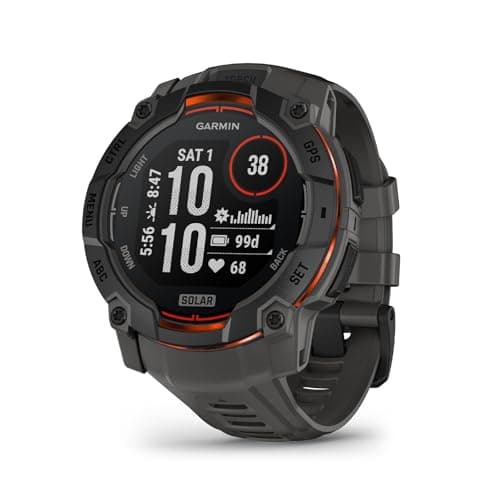
Garmin Instinct 3 Solar (50mm)
Solar GPS8.7/10Up to 40 days of typical use and unlimited with three hours a day at 50,000 lux. The solar lens buys weeks, not independence.
$399.99Amazon#ad · Price as of November 4, 2026 · Disclosure for the link to Garmin Instinct 3 Solar (50mm)
Best Pro Trek overall
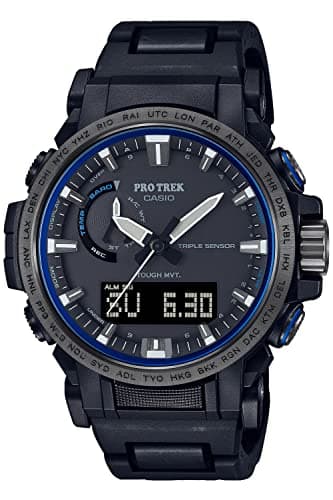
Casio Pro Trek PRW-61
Solar, no charger8.1/10A 62 g, 100 m ABC watch Casio rates at about six months of reserve in the dark. Worn outdoors it will not see a charger again.
$528.47Amazon#ad · Price as of November 4, 2026 · Disclosure for the link to Casio Pro Trek PRW-61
Best for a decade without a charger
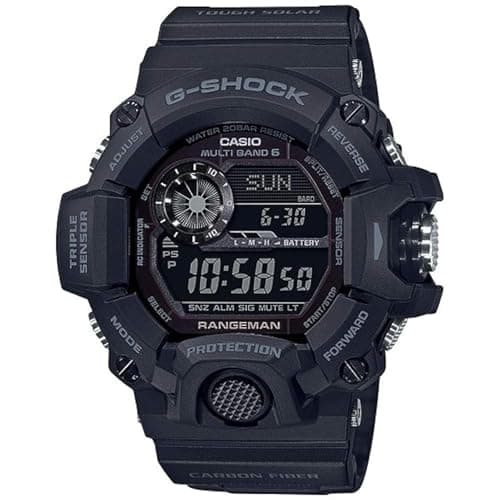
G-Shock Rangeman GW-9400
Solar, no charger8.7/10Casio states roughly eight months from full charge with no light at all, plus Multi-Band 6 radio time calibration, at 200 m.
$320.00Amazon#ad · Price as of November 4, 2026 · Disclosure for the link to G-Shock Rangeman GW-9400
Best solar analog watch
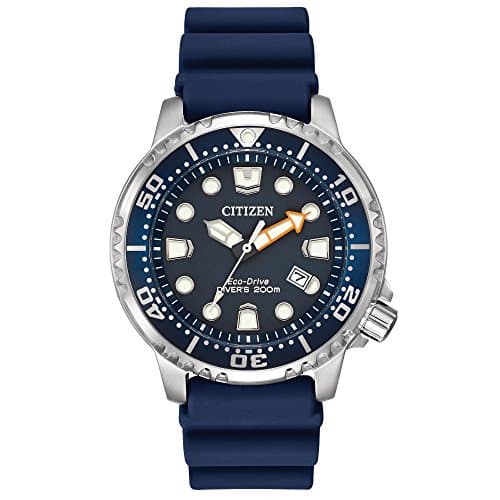
Citizen Promaster Dive BN0151-09L
Solar, no charger7.9/10E168 Eco-Drive: powered by any light source with no battery replacement, in a 200 m ISO-certified dive case with a five-year warranty.
$337.50Amazon#ad · Price as of November 4, 2026 · Disclosure for the link to Citizen Promaster Dive BN0151-09L
The routine that works
Wear it outside. Not under the sleeve. Ten minutes walking to a vehicle in daylight is worth more than an evening under a lamp.
Store it face up near a window. Every night, not occasionally. This is the entire maintenance schedule for a Tough Solar watch.
Give it a deliberate afternoon of sun each season. Dashboard, windowsill, patio table. Top it back to full and forget it again.
Use power save when you put it away. On a Casio that turns months of reserve into years of it.
How we scored this
What we checked to build this ranking
Every pick here is researched against the documents that decide whether a watch lasts: the maker's own battery table read mode by mode, what the lens and case are actually made of, the water rating, whether a MIL-STD-810 line is on the record and in whose words, and how long the maker keeps updating the line. Each one is then scored on a public rubric weighted for a decade of ownership, and every figure links to where it came from.
That is why the order on this page is worth following: it is built from specs you can open yourself, and commissions never set a score or decide a pick. The rubric and its weights are published.
Questions
Frequently asked
How do you charge a solar watch?
Put the dial in direct sunlight, face up, with nothing covering it, or simply wear the watch outdoors with your sleeve above it. A south-facing windowsill or a car dashboard is the best indoor option. Room lighting is roughly a hundred times dimmer than daylight and will hold a charge rather than build one.
Can you charge a solar watch indoors?
Only slowly, and in practice only enough to hold its level. Indoor lighting runs in the hundreds of lux where Garmin specifies its solar figures at 50,000 lux. The practical indoor fix is to store the watch face up on a windowsill instead of in a drawer.
How long does it take to charge a solar watch?
It depends entirely on light level, which is why makers publish exposure conditions rather than charge times. Garmin states unlimited smartwatch battery for the Instinct 3 Solar at three hours a day in 50,000 lux. For a Casio Tough Solar watch, a few hours of direct sun will move the power indicator up a level, and a flat watch typically restarts after a day or two in the sun.
What happens if a solar watch runs out of charge?
It stops, and nothing is damaged. Put it in direct sun and it will restart. Casio rates the Rangeman GW-9400 at roughly eight months of reserve with no light at all, so a watch that has gone flat has usually been in a drawer for most of a year.
Can you overcharge a solar watch?
No. Solar watches have overcharge protection, so leaving one in sunlight will not damage the cell. The thing worth avoiding is heat for its own sake, such as a lamp held against the crystal or a dashboard in extreme summer temperatures, since heat rather than charge is what ages a cell.
Keep reading
Related on Bezel & Bearing
Receipts
Sources
- Garmin — Instinct 3 Solar Series Owner's Manual, Battery Life Information (checked 2026-09-20)
- Garmin — Instinct 3 Solar Series Owner's Manual, Solar Charging and Tips for Solar Charging (checked 2026-09-21)
- Garmin newsroom — Instinct 3 Series press release (checked 2026-09-20)
- Casio — Operation Guide, module 3410 (GW-9400 Rangeman), Specifications (checked 2026-09-20)
- Casio — Operation Guide, module 5673 (Pro Trek PRW-61), Specifications (checked 2026-09-20)
- G-Central — Pro Trek PRG-340 announcement (size, weight, water rating, battery) (checked 2026-09-20)
- Citizen — Promaster Dive BN0151-09L product page (checked 2026-09-20)
Battery, glass, case and water figures come from the maker's own owner's manuals, spec pages and press releases, linked on every product so you can open the page they came from. Prices are set by Amazon and change often, so each buy button takes you to the current one. Read the full method.