Built to Last / Guide
Resin vs steel watch cases: the cheap plastic one survives the impact, the metal one survives the years
A resin G-Shock weighs a third of the same watch in steel and takes hits that would dent metal. Steel does not scuff, does not go brittle, and does not need replacing in year eight. Both are correct answers to different questions.
By Mike M.Updated Researched from the maker's manuals and spec sheets
#adReader-supported: we may earn a commission if you buy through our links, at no extra cost to you. It never decides a ranking. How we rate · Disclosure
The short version
Resin and steel fail in opposite ways, and that is the whole decision. Resin absorbs energy and gives up on time; steel resists time and transmits energy. Pick the one that matches the thing most likely to happen to your watch.
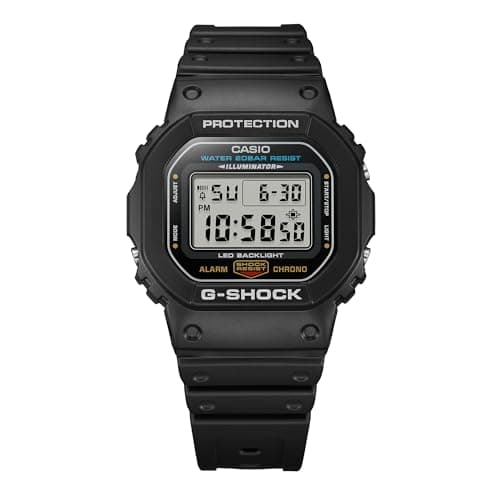
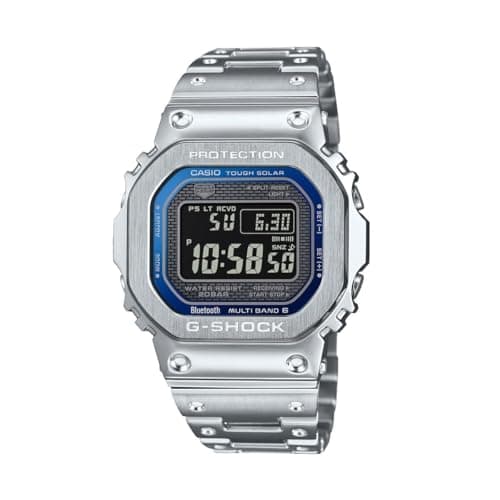
Casio makes this easy to see, because it sells the same watch in both. The G-Shock GMW-B5000 is the square case in stainless steel at 167 grams. The DW-5600E is the same 48.9 by 42.8 mm square in resin at 52 grams, with the same 200-metre rating and the same shock resistance. One watch, two materials, a three-fold weight difference, and a price gap most people would not believe.
Why resin wins on impact
A G-Shock is not tough because resin is strong. It is tough because resin is compliant. Three things follow from that, and they are the reason shock-resistance claims and water-resistance claims come as a pair on these watches:
- Energy goes into deformation, not the module. Resin flexes on impact and springs back. A steel case transmits the shock to whatever is inside it, which is why steel sports watches need their movements cushioned in other ways.
- There is no dent to live with. A hard knock on steel leaves a permanent deformation that needs a watchmaker. The same knock on resin leaves a scuff that you stop noticing in a week.
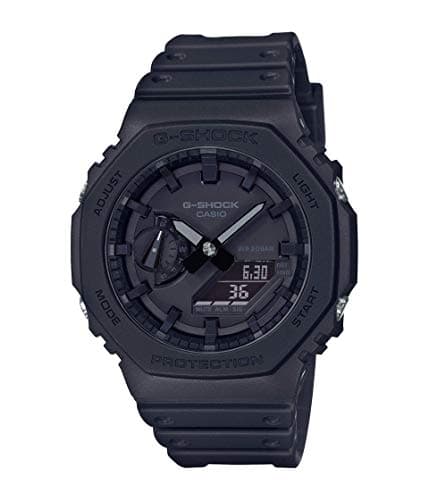
- Casio builds structure into it. The Carbon Core Guard construction on the GA-2100 and the Mudmaster line replaces part of the resin with carbon-fibre-reinforced material, which is how Casio gets a 48.5 by 45.4 mm 200-metre watch down to 51 grams while keeping the shock rating.
This is also why resin watches dominate the lists on this site for work where things get swung into things: best G-Shock for work, best rugged smartwatch for construction workers and basic training.
What fails first on resin
Being honest about this matters more than the impact argument, because it is the part that decides whether a resin watch is a buy-it-for-life purchase or a consumable.
The band goes before anything else. Resin stiffens with age, UV exposure and skin oils, and then it cracks, usually at the lug or at the keeper. On a heavily worn G-Shock that is a three-to-five-year part rather than a lifetime one. It is also a ten-minute job and a cheap component, which is exactly why it is not a reason to avoid resin.
The bezel is next. Same mechanism: a bezel on a watch left on a dashboard in summer will eventually craze. Casio sells those as parts too.
The case itself rarely fails. Resin cases on 20-year-old squares are generally still sealed and still intact; what people replace are the soft parts around them.
The practical implication for a decade-long purchase: a resin watch is a lifetime module with replaceable bodywork, where a steel watch is a lifetime body with a replaceable movement. Neither is more honest than the other, but they want different things from you. The ownership-cost version of this argument is in how long do G-Shocks last.
What steel actually buys
Three things, and only three.
A surface that does not scuff. Resin picks up matte grey marks from everything. 316L stainless, which Marathon specifies on its 41 mm diver, takes a hairline and keeps its finish.
Repairability on a different axis. You cannot refinish resin. You can refinish steel over and over, which means a steel watch can be made to look new in year fifteen in a way a resin one cannot.
Pressure resistance at depth. Serious dive cases are metal because metal does not creep under sustained pressure. The 30 ATM on the Marathon and the dive ratings on the Garmin sapphire models come with metal structure; a resin case tops out at the 200-metre class.
What steel does not buy is shock survival, and it is worth saying clearly because the assumption runs the other way. A 167-gram steel square is a heavier object swinging on your wrist, and the extra mass works against you in an impact.
Bands: the part that always dies
Whatever the case is made of, the band is the component you will replace, so it deserves its own paragraph.
- Resin is light, cheap, waterproof and comfortable, and it cracks eventually. It is the right band for a work watch.
- Steel bracelets last effectively forever and are the heaviest option, which is most of why the GMW-B5000 is 167 grams.
- Nylon is the sleeper answer for an outdoor watch: it does not crack, it dries, and it is replaceable for the price of a coffee. It is why the Enduro 3 ships on a UltraFit nylon band at 63 grams and why COROS quotes its watches 15 to 20 grams lighter on nylon than on silicone.
- Silicone and fluoroelastomer sit between resin and nylon: softer, more UV-stable than cheap resin, more expensive.
The comparison table
| Resin | Stainless steel | |
|---|---|---|
| Impact | Flexes and recovers; the better case material | Dents, and transmits shock inward |
| Weight | Very light (52 g for the resin square) | Heavy (167 g for the same square in steel) |
| Scratches | Scuffs constantly, matte, unrepairable | Hairlines; polishable back to new |
| Ageing | Stiffens and cracks with UV and oils | Does not age; can pit in trapped salt |
| Replacement parts | Cheap bands and bezels, easy to fit | Links and bracelets cost real money |
| Depth | Up to the 200-metre class | Required for serious dive ratings |
| Cost | The cheapest tough case there is | Several times more for the same design |
The picks
Our picks for this
Two resin, one hybrid, one steel
The plain resin square, the carbon-reinforced thin one, the same square in stainless steel, and a 316L diver, so the weight and finish trade is visible in four real watches.
Best cheap buy-it-for-life watch
G-Shock DW-5600E
Replaceable cell7.7/1048.9 by 42.8 mm resin case and band, 200 m, shock resistant, 52 g. The cheapest watch on this site that can genuinely outlive you.
$83.99Amazon#ad · Price as of November 4, 2026 · Disclosure for the link to G-Shock DW-5600E
Best thin G-Shock
G-Shock GA-2100
Replaceable cell7.6/10Carbon Core Guard: a carbon-and-resin case at 48.5 by 45.4 mm, 200 m, 11.8 mm thick and 51 g. Resin with structure engineered into it.
$94.95Amazon#ad · Price as of November 4, 2026 · Disclosure for the link to G-Shock GA-2100
Best metal square
G-Shock GMW-B5000 (full metal square)
Solar, no charger8.1/10The same square in stainless steel case, bezel and bracelet at 167 g, with a screw-back case. Three times the weight, a finish you can polish.
$483.00Amazon#ad · Price as of November 4, 2026 · Disclosure for the link to G-Shock GMW-B5000 (full metal square)
 Stock photo
Best military-issue analog
Marathon 41mm Large Diver's Quartz (TSAR)
Replaceable cell8.2/10316L stainless steel, 41 mm, 30 ATM, sapphire and a screw-down crown. What metal is for: pressure and permanence.
Check price · Amazon#ad · Price as of November 4, 2026 · Disclosure for the link to Marathon 41mm Large Diver's Quartz (TSAR)
How to choose
Buy resin if the watch goes to work, into a pack, onto a ladder, or anywhere things get struck. Accept that you will buy a band every few years and that the case will look used. That is the cheapest route to a watch that lasts decades.
Buy steel if the watch has to look presentable for twenty years, if you want the finish restored rather than replaced, or if you need a real dive rating. Accept the weight.
Buy the hybrid if you want both arguments served: a metal bezel on a resin or polymer case is what almost every serious outdoor watch now uses, from the steel-bezel GM-5600 to the titanium-bezel Garmin and Suunto flagships. The bezel takes the scratches and the case takes the impact.
How we scored this
What we checked to build this ranking
Every pick here is researched against the documents that decide whether a watch lasts: the maker's own battery table read mode by mode, what the lens and case are actually made of, the water rating, whether a MIL-STD-810 line is on the record and in whose words, and how long the maker keeps updating the line. Each one is then scored on a public rubric weighted for a decade of ownership, and every figure links to where it came from.
That is why the order on this page is worth following: it is built from specs you can open yourself, and commissions never set a score or decide a pick. The rubric and its weights are published.
Questions
Frequently asked
Is a resin or stainless steel watch case better?
Resin is better against impact and weight; steel is better against scratches and time. The same G-Shock square is 52 grams in resin and 167 grams in stainless steel with the same 200-metre rating, which is the clearest way to see the trade.
How long does a resin watch band last?
On a watch worn hard outdoors, typically a few years before it stiffens and cracks at a lug or keeper. It is a cheap, user-replaceable part rather than the end of the watch, and buying a spare band while the model is current is the sensible move.
Does resin crack with age?
Yes. UV exposure, heat and skin oils stiffen resin over years, and the band and bezel are where it shows first. The case itself usually stays sealed and intact far longer, which is why twenty-year-old resin squares are still in service on replacement bands.
Is a steel watch tougher than a G-Shock?
Not against impact. Steel resists scratching and pressure better, but it dents and passes shock through to the movement. A resin G-Shock survives being struck in a way a steel sports watch does not, which is the whole reason the design exists.
What is Carbon Core Guard?
Casio's construction that replaces part of the resin case with carbon-fibre-reinforced material. It is how the GA-2100 reaches 200-metre water resistance and shock resistance in an 11.8 mm, 51-gram case, and it is used on the Mudmaster line too.
Keep reading
Related on Bezel & Bearing
Receipts
Sources
- G-Central — G-Shock DW-5600 spec sheet (checked 2026-09-20)
- G-Central — G-Shock GA-2100 spec sheet (checked 2026-09-26)
- G-Central — G-Shock GMW-B5000 spec sheet and list price (checked 2026-09-28)
- CasioFanMag — GMW-B5000, module 3459 battery operating times transcribed from Casio's operation guide (checked 2026-09-28)
- G-Central — G-Shock GM-5600 spec sheet and list price (checked 2026-09-28)
- Marathon Watch — 41mm Large Diver's Quartz (TSAR) product page (checked 2026-09-20)
- COROS — VERTIX 2S / APEX / NOMAD specification tables (checked 2026-09-20)
- Garmin newsroom — Enduro 3 press release (checked 2026-09-20)
- Timex — IRONMAN Original 30 Shock Full-Size (T5K195), specifications (checked 2026-09-28)
Battery, glass, case and water figures come from the maker's own owner's manuals, spec pages and press releases, linked on every product so you can open the page they came from. Prices are set by Amazon and change often, so each buy button takes you to the current one. Read the full method.