GPS Watches / Review
Amazfit T-Rex 3 review: the cheapest honest rugged watch, and the one claim it will not back up
Amazfit publishes its water-test report number, ships free offline topo maps, and quotes 180 GPS hours. It also says military-grade without citing a standard, and the lens is Gorilla Glass. Here is what that adds up to.
By Mike M.Updated Researched from the maker's manuals and spec sheets
#adReader-supported: we may earn a commission if you buy through our links, at no extra cost to you. It never decides a ranking. How we rate · Disclosure
The verdict
The watch and its alternatives
 Stock photo
The watch under review
Amazfit T-Rex 3
Rechargeable GPS7.0 /101.5-inch AMOLED, 48.5 by 48.5 by 13.75 mm, 68.3 g, 10 ATM plus a 45 m freediving certification, free offline topo maps. Score below.
Check price · Amazon#ad · Price as of November 4, 2026 · Disclosure for the link to Amazfit T-Rex 3
Alternative: the decade watch
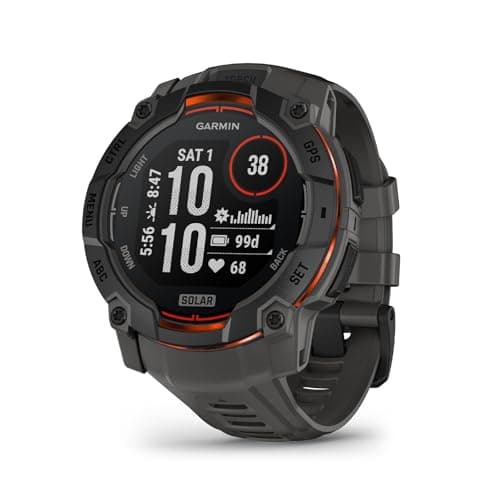
Garmin Instinct 3 Solar (50mm)
Solar GPS8.7 /10No maps and no colour screen, but a solar lens Garmin rates as unlimited smartwatch battery and a case built to MIL-STD-810.
$399.99Amazon#ad · Price as of November 4, 2026 · Disclosure for the link to Garmin Instinct 3 Solar (50mm)
Alternative: the cheaper Garmin
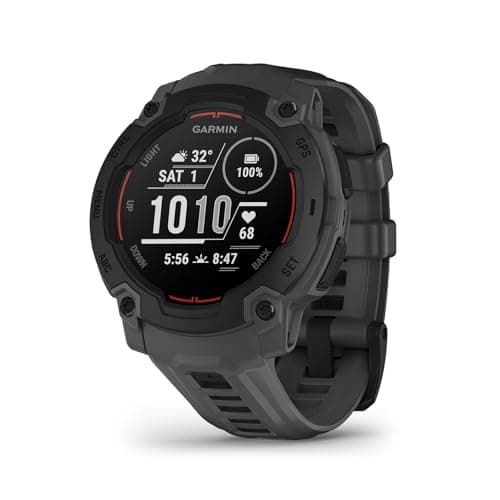
Garmin Instinct E (45mm)
Rechargeable GPS6.7 /1010 ATM, up to 16 days and 24 GPS hours, with Garmin's support record. No solar, no flashlight.
$249.99Amazon#ad · Price as of November 4, 2026 · Disclosure for the link to Garmin Instinct E (45mm)
Verdict and score
That split is worth stating clearly, because a lot of reviews land on one side or the other and pretend the other does not exist. This watch is genuinely good and genuinely cheap. It is also the pick you buy knowing you may replace it, where the point of an Instinct 3 Solar is that you do not.
What it is built for
Amazfit has aimed this squarely at the person who wants an outdoor watch and will not spend Garmin money. The hardware list reads like a flagship: a 1.5-inch, 480 by 480 AMOLED, a stainless steel bezel on a polymer middle frame, 48.5 by 48.5 by 13.75 mm, 68.3 grams without a strap, dual-band GPS across six satellite systems, and free offline maps with topographic contours.
The 13.75 mm thickness deserves a note. That is thin for a watch with this battery and this screen, and it is thinner than most of the Casios on this site. On a wrist it wears like a normal watch rather than a puck.
Battery in real modes
Amazfit publishes four daily figures and four GPS figures, which is unusually transparent, and the spread between them is the thing to understand:
| Mode | Amazfit's stated figure |
|---|---|
| Typical use | Up to 27 days |
| Heavy use | 13 days |
| Battery saver | 40 days |
| Clock mode only | 81 days |
| Accurate GNSS | Up to 42 hours |
| Power-saving GNSS | 72 hours |
| Long battery life mode | 114 hours |
| GNSS max battery life | Up to 180 hours |
The number to plan around is 13 days heavy use and 42 accurate GNSS hours. Those are the modes you will actually run if you bought this watch to use the screen and the maps, and they are both good.
The number to be sceptical of is 180 hours, not because it is wrong but because of what it costs: max-battery GNSS modes on every brand reduce how often the watch fixes a position, which degrades track quality. It is a useful mode on day four of a trip, not a mode to live in. The cross-brand version of that argument is in longest battery life GPS watches.
What is absent from the whole table is solar. There is no lens, so every one of those figures ends at a charging cable, and each full cycle takes a little capacity off the cell. That is the structural reason this is not the decade pick, and it is explained in are solar watches worth it.
Water rating, and the claim it does back up
Credit where it is due, because almost nobody does this. Amazfit states 10 ATM to ISO 22810, third-party tested by SGS, and a separate freediving certification to 45 metres under EN13319 and ISO 6425.
Those are not marketing adjectives. ISO 6425 is the dive-watch standard, EN13319 is the depth-gauge standard, and naming an independent test house is a specific, checkable claim. At this price that is better documentation than several watches costing three times as much, and it is why the watch scores 9 on value per decade even while losing points elsewhere. What the ratings mean in practice is in watch water resistance explained.
The military-grade claim it does not
Amazfit describes the T-Rex line as military-grade. On the page we read it does not cite MIL-STD-810 or name a test method, so we do not credit it and the watch carries no MIL-STD flag on this site.
That is not an accusation that the watch is fragile; the stainless bezel and the documented water testing suggest otherwise. It is a statement about evidence. Garmin writes "built to MIL-STD-810 for thermal and shock resistance" on the Instinct 3 and the fenix 8, which is a specific standard with specific test methods, and that is the difference between a claim we can pass on and one we cannot. The standard itself, and how little it guarantees even when cited, is in MIL-STD-810 watches explained.
The lens is the other materials gap: Gorilla Glass, not sapphire. Chemically strengthened glass is tough and less brittle than sapphire under impact, and it is softer, so it will pick up scratches that a sapphire watch would not. See sapphire vs Gorilla Glass 3 for exactly what that trade looks like.
Maps: free, and limited
Free offline maps with topographic contours, at this price, is the headline feature and it is real. Garmin reserves preloaded TopoActive maps for its sapphire fenix models and gives Instinct owners breadcrumb navigation instead.
The limitation is in how you use them. The maps are for following a route you have loaded, not for picking a point on the screen and asking the watch to route you there. If your workflow is plan-at-home, follow-on-wrist, that is fine and it is how most people navigate anyway. If you expect to improvise off the map mid-trip, a mapping Garmin or a COROS does that and this does not. The options are in best watch with offline maps.
The cold-weather mode
One genuinely distinctive specification: Amazfit publishes a low-temperature mode rated to -30 degrees Celsius, with up to 28 hours of runtime with GNSS on and up to 32 days with GNSS off.
Published cold figures are rare and useful, because cold is where lithium cells lose capacity fastest and where a lot of outdoor watches quietly underperform their room-temperature tables. For ice fishing, winter hunting or a cold-weather job this is worth more than a feature list entry, and it is the one place the T-Rex 3 outdocuments most of its competition.
Who should skip it
Anyone buying one watch for the next decade. That is the stated reason this watch is not our overall pick: Amazfit's firmware and support history is short compared with Garmin or Casio, there is no solar lens to spare the cell, and the lens is glass. Buy the Instinct 3 Solar instead.
Anyone who needs the toughness claim to be documented. If MIL-STD-810 in the maker's own words matters to you, this watch does not provide it.
Anyone who wants a screen that never scratches. Gorilla Glass is not sapphire; see most scratch-resistant smartwatch.
In detail
Spec sheet and score
Stock photoThe watch under review
Amazfit T-Rex 3
1.5-inch AMOLED, 48.5 by 48.5 by 13.75 mm, 68.3 g, 10 ATM plus a 45 m freediving certification, free offline topo maps. Score below.
EvidenceResearched · every row sourced
| Power class | Rechargeable GPS. A rechargeable lithium cell charged from a cable. Days to a few weeks per charge; the cell ages with every cycle. |
|---|---|
| Battery (smartwatch) | Up to 27 days typical use; 13 days heavy use; 40 days battery saver; 81 days clock mode |
| Battery (GPS) | Up to 42 hours accurate GNSS; 72 hours power-saving GNSS; 114 hours long battery life mode |
| Battery (max GPS) | Up to 180 hours GNSS max battery life |
| Glass | Gorilla Glass touchscreen |
| Bezel & case | Stainless steel bezel; polymer middle frame |
| Water rating | 10 ATM (ISO 22810, third-party tested by SGS); freediving certification to 45 m (EN13319, ISO 6425) |
| Display | 1.5-inch AMOLED, 480 × 480 |
| Maps & GPS | Free offline maps with topographic contours; dual-band GPS, six satellite systems |
| Weight | 68.3 g without strap |
| Size | 48.5 × 48.5 × 13.75 mm |
| Operating temp | Low temperature mode to -30°C (GNSS on: up to 28 hours; GNSS off: up to 32 days) |
How the 7.0 score breaks down
- Battery & power independence (25%)
- 7
- Durability of materials (25%)
- 7
- Serviceability & lifespan (20%)
- 5
- Field usability (15%)
- 8
- Value per decade (10%)
- 9
- Mission fit (5%)
- 7
What the spec sheet supports
- Amazfit publishes its water-resistance test report number, which few makers do.
- 180 GPS hours in max-battery mode and a stated -30°C low-temperature mode.
- Free offline topo maps at a price where Garmin gives you breadcrumbs.
Where it falls short
- Amazfit says 'military-grade' but does not cite MIL-STD-810 on the page we read, so we do not credit it.
- Gorilla Glass, not sapphire, and a shorter firmware history than Garmin or COROS.
- Offline maps need a route file for navigation; you cannot tap a point on the map.
Skip this if…
…you plan to own it for a decade; Amazfit's update record is too short to promise that yet.
#ad · Price as of November 4, 2026 · Disclosure for the link to Amazfit T-Rex 3
Alternative: the decade watch
Garmin Instinct 3 Solar (50mm)
No maps and no colour screen, but a solar lens Garmin rates as unlimited smartwatch battery and a case built to MIL-STD-810.
EvidenceResearched · every row sourced
How the 8.7 score breaks down
- Battery & power independence (25%)
- 10
- Durability of materials (25%)
- 8
- Serviceability & lifespan (20%)
- 7
- Field usability (15%)
- 9
- Value per decade (10%)
- 10
- Mission fit (5%)
- 8
What the spec sheet supports
- Garmin's own table shows the 50mm solar model doubling the 45mm in GPS-with-solar hours (260 vs 130).
- Physical buttons, a monochrome display readable in full sun, and a flashlight with a red mode.
- 10 ATM rating and a MIL-STD 810 claim on a watch that costs less than half a fenix.
Where it falls short
- No maps: it navigates breadcrumb trails and waypoints, not topo maps.
- The solar figures assume three hours a day at 50,000 lux, which is midday sun, not a sleeve.
- Garmin does not name the lens material; treat it as strengthened glass, not sapphire.
Skip this if…
…you need on-wrist topo maps, or you wear long sleeves and work indoors, where the solar math never happens.
#ad · Price as of November 4, 2026 · Disclosure for the link to Garmin Instinct 3 Solar (50mm)
Alternative: the cheaper Garmin
Garmin Instinct E (45mm)
10 ATM, up to 16 days and 24 GPS hours, with Garmin's support record. No solar, no flashlight.
EvidenceResearched · every row sourced
| Power class | Rechargeable GPS. A rechargeable lithium cell charged from a cable. Days to a few weeks per charge; the cell ages with every cycle. |
|---|---|
| Battery (smartwatch) | Up to 16 days |
| Battery (GPS) | Up to 24 hours GPS-only |
| Battery (max GPS) | Up to 50 hours max-battery GPS |
| Power | Rechargeable, built-in lithium-ion battery (no solar column in Garmin's battery table) |
| Water rating | 10 ATM |
| Flashlight | None: the owner's manual has no flashlight section |
| Operating temp | -20° to 60°C (-4° to 140°F) |
How the 6.7 score breaks down
- Battery & power independence (25%)
- 6
- Durability of materials (25%)
- 6
- Serviceability & lifespan (20%)
- 7
- Field usability (15%)
- 8
- Value per decade (10%)
- 8
- Mission fit (5%)
- 6
What the spec sheet supports
- 10 ATM water rating and the Instinct button layout at the lowest price in the line.
- Sixteen days of watch use is still weeks between charges.
Where it falls short
- No solar and no flashlight; Garmin's manual lists neither.
- 24 GPS hours is a weekend, not a week.
- Garmin does not make a MIL-STD 810 claim for the Instinct E in the material we could cite.
Skip this if…
…the reason you want an Instinct is to stop charging; this one charges like any other watch.
#ad · Price as of November 4, 2026 · Disclosure for the link to Garmin Instinct E (45mm)
How we scored this
What we checked to build this ranking
Every pick here is researched against the documents that decide whether a watch lasts: the maker's own battery table read mode by mode, what the lens and case are actually made of, the water rating, whether a MIL-STD-810 line is on the record and in whose words, and how long the maker keeps updating the line. Each one is then scored on a public rubric weighted for a decade of ownership, and every figure links to where it came from.
That is why the order on this page is worth following: it is built from specs you can open yourself, and commissions never set a score or decide a pick. The rubric and its weights are published.
Questions
Frequently asked
Is the Amazfit T-Rex 3 any good?
Yes, as the best-value rugged smartwatch. Amazfit states up to 27 days of typical use, 42 accurate GNSS hours rising to 180 in max-battery mode, free offline topo maps, a 1.5-inch AMOLED and a 10 ATM rating third-party tested by SGS with a 45 m freediving certification. The limits are a Gorilla Glass lens, no solar and no cited MIL-STD-810.
Is the Amazfit T-Rex 3 actually military-grade?
Amazfit uses the phrase but does not cite MIL-STD-810 or a test method on the page we read, so we do not credit it. By contrast Garmin states "built to MIL-STD-810 for thermal and shock resistance" on the Instinct 3. The water rating, however, is documented in detail: ISO 22810 at 10 ATM, tested by SGS.
Does the Amazfit T-Rex 3 have sapphire glass?
No. Amazfit specifies a Gorilla Glass touchscreen, which is chemically strengthened glass. It resists impact well and scratches more easily than sapphire. The scratch-resistant alternatives are listed in most scratch-resistant smartwatch.
How long does the Amazfit T-Rex 3 battery last?
Amazfit states up to 27 days typical use, 13 days heavy use, 40 days in battery saver and 81 days in clock mode, with 42 hours of accurate GNSS, 72 power-saving, 114 in long battery life mode and up to 180 hours in GNSS max battery life. There is no solar lens, so every figure ends at a charging cable.
T-Rex 3 or Garmin Instinct 3 Solar?
T-Rex 3 for a colour screen, offline topo maps and a documented dive rating at a much lower price. Instinct 3 Solar for a solar lens Garmin rates as unlimited smartwatch battery, a MIL-STD-810 build claim, a flashlight and a decade of support. The full head-to-head is in Amazfit T-Rex 3 vs Garmin.
Keep reading
Related on Bezel & Bearing
Receipts
Sources
- Amazfit — T-Rex 3 product page, Technical Specifications (checked 2026-09-20)
- Garmin newsroom — Instinct 3 Series press release (checked 2026-09-20)
- Garmin — Instinct 3 Solar Series Owner's Manual, Battery Life Information (checked 2026-09-20)
- Garmin — Instinct E Owner's Manual, Battery Life Information (checked 2026-09-20)
Battery, glass, case and water figures come from the maker's own owner's manuals, spec pages and press releases, linked on every product so you can open the page they came from. Prices are set by Amazon and change often, so each buy button takes you to the current one. Read the full method.