GPS Watches / Head to head
Amazfit T-Rex 3 vs Garmin: the Amazfit publishes better numbers, the Garmin publishes a better decade
On a spec sheet the T-Rex 3 beats an Instinct 3 Solar on screen, maps and water-test paperwork for a fraction of a fenix. Then you ask what happens in year eight, and the answer changes. Here is the comparison with both makers' own documents side by side.
By Mike M.Updated Researched from the maker's manuals and spec sheets
#adReader-supported: we may earn a commission if you buy through our links, at no extra cost to you. It never decides a ranking. How we rate · Disclosure
The contenders
Side by side
The decade buy
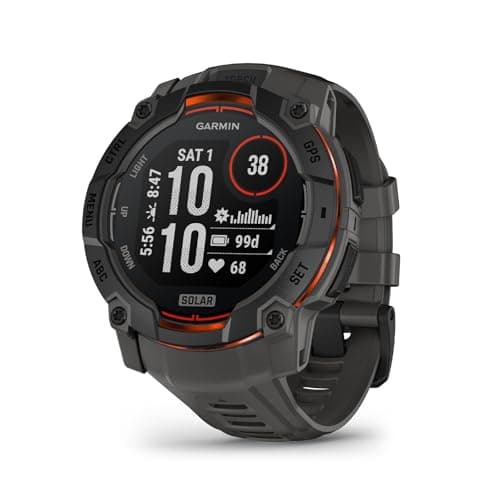
Garmin Instinct 3 Solar (50mm)
Solar GPS8.7 /10Solar, so the cell barely cycles: up to 40 days of typical use and unlimited with three hours a day of sun. 10 ATM and built to MIL-STD-810 in Garmin's own words.
$399.99Amazon#ad · Price as of November 4, 2026 · Disclosure for the link to Garmin Instinct 3 Solar (50mm)
 Stock photo
The spec-sheet winner
Amazfit T-Rex 3
Rechargeable GPS7.0 /10A 1.5-inch AMOLED, free offline topo maps, 10 ATM tested to ISO 22810 by SGS, freediving certification to 45 m, and up to 180 GNSS hours. No solar.
Check price · Amazon#ad · Price as of November 4, 2026 · Disclosure for the link to Amazfit T-Rex 3
If you want maps and sapphire
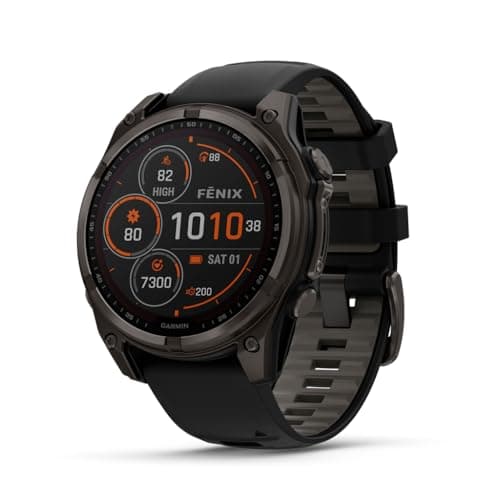
Garmin fenix 8 Solar (47mm, Sapphire)
Solar GPS8.4 /10Sapphire lens, titanium bezel, a 40 m dive-rated case, preloaded TopoActive maps, and 21 days of smartwatch battery rising to 28 with solar.
$960.00Amazon#ad · Price as of November 4, 2026 · Disclosure for the link to Garmin fenix 8 Solar (47mm, Sapphire)
The short version
This comparison is interesting precisely because the cheap watch is not the worse watch on paper. Amazfit publishes figures most of this market does not: a water-resistance rating tested by a named third-party lab, a freediving certification, a low-temperature mode with its own battery table, and offline topographic maps included rather than sold.
What Amazfit does not publish is a MIL-STD-810 citation, a sapphire lens, or a decade of firmware updates behind it. On a site that ranks watches for ten years of ownership, those three absences are the whole argument, and they are the reason the Instinct 3 Solar is ranked first here despite losing several individual specs.
The numbers, side by side
| Amazfit T-Rex 3 | Garmin Instinct 3 Solar (50mm) | Garmin fenix 8 Solar (47mm) | |
|---|---|---|---|
| Power | Rechargeable, cable only | Rechargeable with a solar charging display | Rechargeable with a solar charging display |
| Smartwatch battery | Up to 27 days typical; 13 heavy; 40 battery saver; 81 clock mode | Up to 40 days; unlimited with solar | Up to 21 days; 28 with solar |
| GPS battery | 42 h accurate GNSS; 72 h power saving; 114 h long battery; 180 h max | 60 h GPS-only; 260 h with solar; 150 h max-battery | 67 h GPS-only; 92 h with solar; 132 h max-battery |
| Lens | Gorilla Glass touchscreen | Scratch-resistant display; sapphire not named | Scratch-resistant sapphire lens |
| Case and bezel | Stainless steel bezel; polymer middle frame | Metal-reinforced bezel; fibre-reinforced polymer case | Titanium bezel; leakproof metal buttons |
| Water | 10 ATM (ISO 22810, SGS tested); freediving to 45 m (EN13319, ISO 6425) | 10 ATM | 40 m dive-rated case |
| MIL-STD-810 | Not cited on the page we read | Built to MIL-STD 810 for thermal and shock resistance | Tested to U.S. military standards |
| Display | 1.5-inch AMOLED, 480 x 480 | MIP, always on | MIP under a solar lens |
| Maps | Free offline maps with topographic contours | No map screen; breadcrumb navigation | Preloaded TopoActive maps |
| Weight | 68.3 g without strap | Not stated for the 50 mm in the table we cite | Not stated in the release |
Water: the Amazfit genuinely wins
This is not close and it deserves credit. Amazfit states 10 ATM to ISO 22810, third-party tested by SGS, and a separate freediving certification to 45 m against EN13319 and ISO 6425. Garmin states 10 ATM for the Instinct 3 and gives no lab. The fenix 8 goes further than either with a 40 m dive-rated case and leakproof metal buttons, which is a stricter claim than a static pressure number, but the T-Rex 3 is the one watch here that tells you who did the test.
If you dive, snorkel or wade regularly, that matters, and it is a straightforward reason to choose the Amazfit over an Instinct. The standards themselves are unpacked in watch water resistance explained.
Power: the Garmin genuinely wins
The T-Rex 3's headline figures are good. 27 days of typical use is longer than almost any AMOLED watch, and 180 GNSS hours in its lowest mode beats the fenix 8 Solar's 132. But every one of those hours comes out of a cell you refill from a cable, and that is the part that ages.
The Instinct 3 Solar's number is not 40 days; it is unlimited with three hours a day at 50,000 lux, which is Garmin's way of saying a watch worn outdoors need not be charged on any schedule at all. In ownership terms the solar watch cycles its lithium cell a handful of times a year and the Amazfit cycles it dozens, and lithium cells age by cycle. That is why this site ranks the power system first, and the full reasoning is in how long solar watches last.
Maps, and what free really means
Amazfit includes free offline maps with topographic contours, dual-band GPS and six constellations. The Instinct 3 has no map screen at all: it navigates by breadcrumb and bearing. On price per feature, that is an enormous win for Amazfit, and it is the single best reason to buy a T-Rex 3.
The honest limit, from Amazfit's own behaviour rather than marketing: the offline maps need a route file to navigate against. You cannot tap an arbitrary point on the map and ask the watch to take you there, which is exactly what a fenix 8 does with preloaded TopoActive maps. So the comparison is really three-way: no maps (Instinct), maps you follow (T-Rex 3), maps you route on (fenix 8). The watches that can genuinely route are listed in best watch with offline maps.
The year-eight question
Everything above is specifications. Here is the part a spec sheet cannot show you, stated as plainly as we can.
A Garmin Instinct or fenix bought in 2026 sits on a product line that has been receiving firmware, app support and parts for over a decade, with a service network and a used market. Amazfit's outdoor line is younger, and we have no basis for predicting what support looks like in 2034. That is not a criticism of the watch in front of you; it is an honest statement about what we do and do not know. For a buyer whose whole brief is "buy once, keep ten years", it is the deciding factor, and it is the reason we list "skip this if you plan to own it for a decade" on the T-Rex 3's own card.
The second year-eight issue is the lens. Gorilla Glass is strengthened glass: it survives impact well and scratches under ordinary quartz sand. Sapphire scratches almost never. Over ten years of grit the lens is what you look through every day, which is why the fenix 8 is ranked where it is. The materials comparison is sapphire vs Gorilla Glass 3.
Who should buy which
Buy the Amazfit T-Rex 3 if the budget is the constraint, if you want an AMOLED and offline topo contours, if you swim or freedive and value a tested rating, or if a cold-weather season needs a published -30 C mode. It is the best rugged smartwatch on a budget and we rank it as such in most durable smartwatch.
Buy the Garmin Instinct 3 Solar if the point is to stop thinking about the watch. Solar, 10 ATM, a MIL-STD-810 line, a flashlight with a red mode, and a battery table that ends in the word unlimited. The full read is the Instinct 3 Solar review.
Buy the Garmin fenix 8 Solar if you want all of it: sapphire, titanium, a dive-rated case, routable maps and solar, and you accept paying several times the Amazfit's price for the materials and the mapping.
The T-Rex 3 on its own terms. If you have already decided against the Garmin, the full assessment of what Amazfit documents and what it does not is in the Amazfit T-Rex 3 review.
In detail
The contenders, in full
The decade buy
Garmin Instinct 3 Solar (50mm)
Solar, so the cell barely cycles: up to 40 days of typical use and unlimited with three hours a day of sun. 10 ATM and built to MIL-STD-810 in Garmin's own words.
EvidenceResearched · every row sourced
How the 8.7 score breaks down
- Battery & power independence (25%)
- 10
- Durability of materials (25%)
- 8
- Serviceability & lifespan (20%)
- 7
- Field usability (15%)
- 9
- Value per decade (10%)
- 10
- Mission fit (5%)
- 8
What the spec sheet supports
- Garmin's own table shows the 50mm solar model doubling the 45mm in GPS-with-solar hours (260 vs 130).
- Physical buttons, a monochrome display readable in full sun, and a flashlight with a red mode.
- 10 ATM rating and a MIL-STD 810 claim on a watch that costs less than half a fenix.
Where it falls short
- No maps: it navigates breadcrumb trails and waypoints, not topo maps.
- The solar figures assume three hours a day at 50,000 lux, which is midday sun, not a sleeve.
- Garmin does not name the lens material; treat it as strengthened glass, not sapphire.
Skip this if…
…you need on-wrist topo maps, or you wear long sleeves and work indoors, where the solar math never happens.
#ad · Price as of November 4, 2026 · Disclosure for the link to Garmin Instinct 3 Solar (50mm)
Stock photoThe spec-sheet winner
Amazfit T-Rex 3
A 1.5-inch AMOLED, free offline topo maps, 10 ATM tested to ISO 22810 by SGS, freediving certification to 45 m, and up to 180 GNSS hours. No solar.
EvidenceResearched · every row sourced
| Power class | Rechargeable GPS. A rechargeable lithium cell charged from a cable. Days to a few weeks per charge; the cell ages with every cycle. |
|---|---|
| Battery (smartwatch) | Up to 27 days typical use; 13 days heavy use; 40 days battery saver; 81 days clock mode |
| Battery (GPS) | Up to 42 hours accurate GNSS; 72 hours power-saving GNSS; 114 hours long battery life mode |
| Battery (max GPS) | Up to 180 hours GNSS max battery life |
| Glass | Gorilla Glass touchscreen |
| Bezel & case | Stainless steel bezel; polymer middle frame |
| Water rating | 10 ATM (ISO 22810, third-party tested by SGS); freediving certification to 45 m (EN13319, ISO 6425) |
| Display | 1.5-inch AMOLED, 480 × 480 |
| Maps & GPS | Free offline maps with topographic contours; dual-band GPS, six satellite systems |
| Weight | 68.3 g without strap |
| Size | 48.5 × 48.5 × 13.75 mm |
| Operating temp | Low temperature mode to -30°C (GNSS on: up to 28 hours; GNSS off: up to 32 days) |
How the 7.0 score breaks down
- Battery & power independence (25%)
- 7
- Durability of materials (25%)
- 7
- Serviceability & lifespan (20%)
- 5
- Field usability (15%)
- 8
- Value per decade (10%)
- 9
- Mission fit (5%)
- 7
What the spec sheet supports
- Amazfit publishes its water-resistance test report number, which few makers do.
- 180 GPS hours in max-battery mode and a stated -30°C low-temperature mode.
- Free offline topo maps at a price where Garmin gives you breadcrumbs.
Where it falls short
- Amazfit says 'military-grade' but does not cite MIL-STD-810 on the page we read, so we do not credit it.
- Gorilla Glass, not sapphire, and a shorter firmware history than Garmin or COROS.
- Offline maps need a route file for navigation; you cannot tap a point on the map.
Skip this if…
…you plan to own it for a decade; Amazfit's update record is too short to promise that yet.
#ad · Price as of November 4, 2026 · Disclosure for the link to Amazfit T-Rex 3
If you want maps and sapphire
Garmin fenix 8 Solar (47mm, Sapphire)
Sapphire lens, titanium bezel, a 40 m dive-rated case, preloaded TopoActive maps, and 21 days of smartwatch battery rising to 28 with solar.
EvidenceResearched · every row sourced
| Power class | Solar GPS. A rechargeable cell topped up by a solar lens. Weeks between charges; the cell still ages like any lithium battery. |
|---|---|
| Battery (smartwatch) | Up to 21 days typical use; up to 28 days with solar |
| Battery (GPS) | Up to 67 hours GPS-only; up to 92 hours with solar |
| Battery (max GPS) | Up to 132 hours max-battery GPS; up to 283 hours with solar |
| Glass | Scratch-resistant sapphire lens (sapphire versions) |
| Bezel & case | Titanium bezel (sapphire versions); leakproof metal buttons |
| Water rating | 40-meter dive-rated case |
| MIL-STD-810 | Tested to U.S. military standards for thermal, shock and water resistance |
| Maps & GPS | TopoActive maps preloaded on sapphire versions |
How the 8.4 score breaks down
- Battery & power independence (25%)
- 8
- Durability of materials (25%)
- 10
- Serviceability & lifespan (20%)
- 7
- Field usability (15%)
- 10
- Value per decade (10%)
- 6
- Mission fit (5%)
- 8
What the spec sheet supports
- Every fenix 8 durability feature in the size most people can actually wear.
- 92 GPS hours with solar covers a long weekend of tracking with margin.
Where it falls short
- Smartwatch battery drops below a month (28 days with solar) versus the 51mm's 48.
- Same MIP-display trade-off as the 51mm.
Skip this if…
…battery days are the reason you are here; the 51mm solar is the fenix for that.
#ad · Price as of November 4, 2026 · Disclosure for the link to Garmin fenix 8 Solar (47mm, Sapphire)
How we scored this
What we checked to build this ranking
Every pick here is researched against the documents that decide whether a watch lasts: the maker's own battery table read mode by mode, what the lens and case are actually made of, the water rating, whether a MIL-STD-810 line is on the record and in whose words, and how long the maker keeps updating the line. Each one is then scored on a public rubric weighted for a decade of ownership, and every figure links to where it came from.
That is why the order on this page is worth following: it is built from specs you can open yourself, and commissions never set a score or decide a pick. The rubric and its weights are published.
Questions
Frequently asked
Is the Amazfit T-Rex 3 as good as a Garmin?
On several measurable things, yes or better: a 10 ATM rating tested to ISO 22810 by SGS, a freediving certification to 45 m, free offline topo maps and a 1.5-inch AMOLED. On the things that decide a decade of ownership, no: there is no solar lens, the lens is Gorilla Glass rather than sapphire, and Amazfit does not cite MIL-STD-810 on the page we read.
Does the Amazfit T-Rex 3 have better battery life than a Garmin Instinct 3 Solar?
In raw GNSS hours it can: up to 180 hours in its maximum battery-life mode against 150 for the Instinct 3 Solar's max-battery GPS. In everyday use the Garmin wins, because Garmin states up to 40 days of typical use and calls it unlimited with three hours a day at 50,000 lux, so the watch charges while you wear it.
Amazfit T-Rex 3 or Garmin fenix 8?
The fenix 8 if you want sapphire, a titanium bezel, a 40 m dive-rated case and maps you can route on. The T-Rex 3 if you want 80% of the outdoor capability for a fraction of the money and are happy to charge from a cable. The fenix 8 Solar also publishes 92 GPS hours with solar against the T-Rex 3's 42 in its accurate mode.
Is the Amazfit T-Rex 3 military grade?
Amazfit uses the phrase, but the specification page we read does not cite MIL-STD-810, so we do not credit the flag. Garmin states a MIL-STD-810 line in its own words for the Instinct 3 and the fenix 8. What the standard does and does not prove is in MIL-STD-810 watches explained.
Which has better maps?
The fenix 8, by a clear margin: preloaded TopoActive maps you can route on. The T-Rex 3 has free offline maps with topographic contours, but navigation works against a route file rather than a point you tap. The Instinct 3 has no map screen at all and navigates by breadcrumb.
Keep reading
Related on Bezel & Bearing
Receipts
Sources
- Amazfit — T-Rex 3 product page, Technical Specifications (checked 2026-09-20)
- Garmin newsroom — Instinct 3 Series press release (checked 2026-09-20)
- Garmin — Instinct 3 Solar Series Owner's Manual, Battery Life Information (checked 2026-09-20)
- Garmin — Instinct 3 Solar Series Owner's Manual, Specifications (checked 2026-09-20)
- Garmin newsroom — fenix 8 Series press release (checked 2026-09-20)
- Garmin — fenix 8 Series Owner's Manual, Battery Information (checked 2026-09-20)
Battery, glass, case and water figures come from the maker's own owner's manuals, spec pages and press releases, linked on every product so you can open the page they came from. Prices are set by Amazon and change often, so each buy button takes you to the current one. Read the full method.