GPS Watches / The rankings
The best watches for mountain biking: the ones that survive the crash, not just the ride
A bike computer does the data better. A watch does the thing a bar-mounted computer cannot: stay on your wrist when the bike goes down the hill without you, and still be there for the hike-a-bike out.
By Mike M.Updated Researched from the maker's manuals and spec sheets
#adReader-supported: we may earn a commission if you buy through our links, at no extra cost to you. It never decides a ranking. How we rate · Disclosure
Quick picks
The rankings at a glance
| # | Product | Best for | Score | Price |
|---|---|---|---|---|
| 1 | 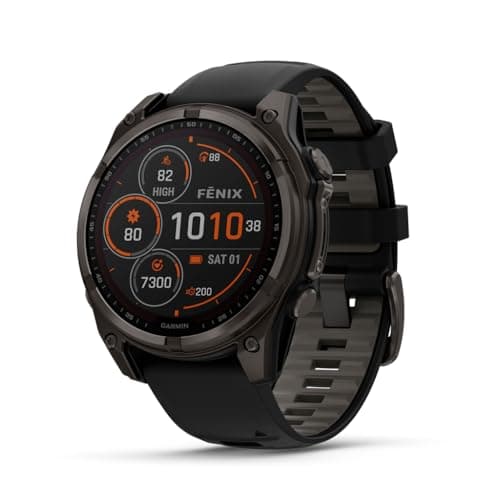 Garmin fenix 8 Solar (47mm, Sapphire) Preloaded TopoActive maps, sapphire in a titanium bezel, leakproof buttons, and 67 GPS hours rising to 92 with solar at 47 mm. | Best for mountain biking overallSolar GPS | 8.4 /10 | $960.00Amazon |
| 2 | 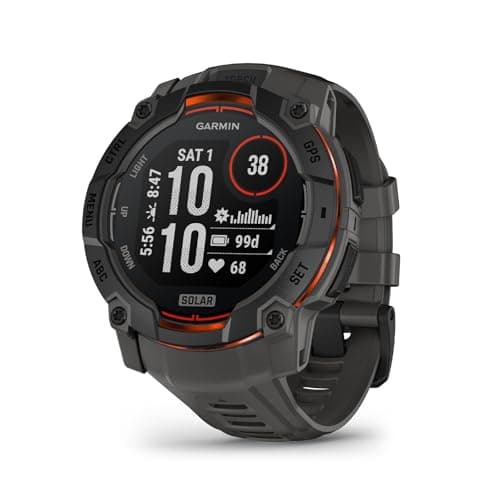 Garmin Instinct 3 Solar (50mm) Built to MIL-STD-810, 10 ATM, a flashlight for shuttle road finishes, and unlimited smartwatch battery with sun. No maps. | Best value trail watchSolar GPS | 8.7 /10 | $399.99Amazon |
| 3 |  Amazfit T-Rex 3 Free offline topo maps, a 1.5-inch AMOLED, 42 accurate GNSS hours and 10 ATM third-party tested by SGS, on Gorilla Glass. | Best budget pick with mapsRechargeable GPS | 7.0 /10 | Check price · Amazon |
| 4 | 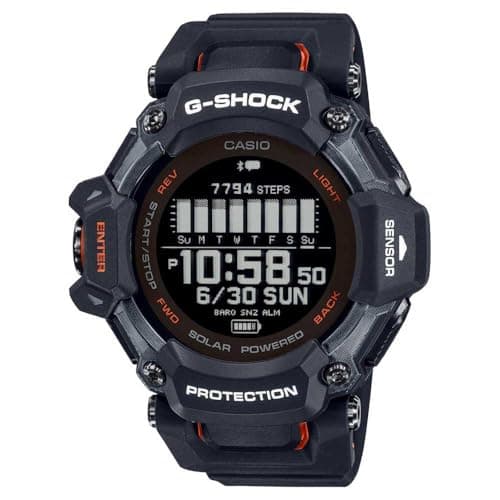 G-Shock GBD-H2000 200 m water resistant and shock resistant in a 63 g resin case, with GPS, heart rate and the full triple sensor on solar-assisted charging. | Toughest case hereSolar GPS | 6.8 /10 | $450.00Amazon |
| 5 | 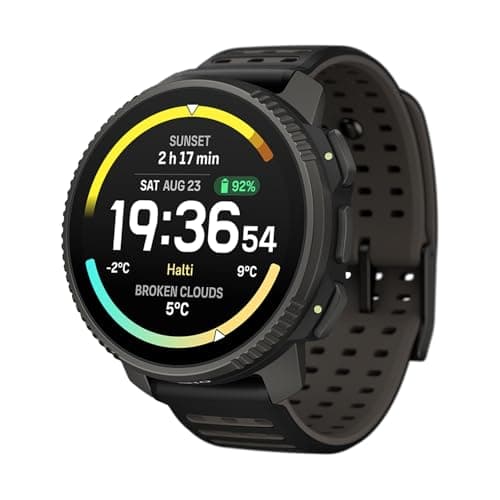 Suunto Vertical 2 Titanium A 1.5-inch, 480 by 480 AMOLED under sapphire with offline maps, a titanium bezel, a flashlight and 100 m. | Best map screenRechargeable GPS | 7.6 /10 | $699.00Amazon |
#ad · Prices come live from Amazon, last checked November 4, 2026. Scores are ours, built from the makers' manuals, battery tables and spec pages. Product photos come from Amazon; anything still on a stock frame is labelled on its card. Tap a row for the full write-up.
The direct answer
Mountain biking is unusual among the activities on this site because the watch is not really the measuring instrument. If you want power, cadence, grade and a big map, a bar-mounted computer does all of it better and you can read it without taking a hand off the grip.
What a watch gives you is survival and continuity. It is still on your wrist when the bike is twenty feet down the slope. It keeps recording on the hike-a-bike. It tells you how much light is left. And it is the only navigation you have if the computer battery dies or the mount snaps.
So the ranking here is built on case and lens durability first, then maps, then battery, then everything else.
Crash survival is the real specification
Three failure modes, in the order they actually happen:
- Abrasion on the lens. A watch dragged along rock, gravel or a bar end gets scratched, and this is the most common damage by a wide margin. Sapphire is the fix: the fenix 8, the Suunto Vertical 2 and the tactix and Enduro all specify it, and the T-Rex 3 and the G-Shock do not. The hardness argument is in most scratch-resistant smartwatch.
- Impact on the case and bezel. A raised metal bezel takes the hit a lens would have taken. Titanium on the Garmin and Suunto flagships does that, and resin does it differently and arguably better: the GBD-H2000 is a 200-metre shock-resistant resin case that flexes rather than dents. Which is better depends on whether you mind scuffs, and it is covered in resin vs steel cases.
- Water and mud ingress. Pressure-washing a bike with a watch on your wrist is routine, and so is a creek crossing. Every pick here is rated to at least 10 ATM, and the Garmin flagship is a 40 m dive-rated case with leakproof metal buttons. What those numbers mean is in water resistance explained.
The one spec that does not matter much here: heart-rate accuracy from the wrist while gripping bars over rough ground. Everything on your forearm is vibrating. If you train off heart rate, use a chest strap.
The picks, side by side
The fenix 8 Solar 47 mm wins on the combination nothing else here matches: sapphire, titanium, a dive-rated case, leakproof buttons, preloaded maps and a solar lens. For riding unfamiliar trail networks it is the most useful watch on the market, and 92 GPS hours with solar means a weekend of riding does not need a cable.
The Instinct 3 Solar is what most riders should buy. Garmin states it is built to MIL-STD-810 for thermal and shock resistance, it is 10 ATM, the buttons work in gloves, the flashlight is genuinely useful for a shuttle road finish in the dark, and the battery is unlimited in smartwatch mode with sun. No maps and no sapphire are the two things you are giving up.
The Amazfit T-Rex 3 is the budget route to maps: free offline topo maps with contours, a 1.5-inch AMOLED, 42 hours of accurate GNSS, and 10 ATM to ISO 22810 third-party tested by SGS. The lens is Gorilla Glass, which on this activity is the thing to be realistic about; the full assessment is in the T-Rex 3 review.
The G-Shock GBD-H2000 is here because nothing else is as hard to break: 200-metre water resistance and shock resistance in a resin and bio-resin case at 63 grams, with GPS, wrist heart rate, compass, altimeter, barometer and thermometer, charged by solar with USB as backup. Casio states two months in watch mode with monitoring off and 14 hours of GPS at high accuracy, rising to 19 in long-battery mode. The honest limits: mineral glass, no maps, and it is a large watch at 59.6 by 52.6 by 19.4 mm.
The Suunto Vertical 2 Titanium has the best map screen of the five, a 480 by 480 AMOLED under sapphire with a titanium bezel and a flashlight at 100 m, with 20 days of daily use and no solar lens.
Maps on the wrist, and when they help
A trail map on a 1.4-inch screen is not how you plan a ride. It is how you answer one question at a junction: which of these is the one I meant to take?
That is worth a lot on a network you do not know, in a bike park with forty named trails, or when you have committed to a descent and need to know whether it links back. It is worth almost nothing on your local loop.
So the maps question is really a "how often do you ride somewhere new?" question. Riders who travel should buy the fenix 8 Solar, the Suunto Vertical 2 or the T-Rex 3. Riders on home trails are better served by the Instinct 3 Solar's breadcrumb navigation and the money they did not spend. The full mapping comparison is in best watch with offline maps and Garmin watches with topo maps.
Battery over a shuttle day
Mountain biking rarely stresses battery the way thru-hiking does, because a ride is hours rather than days. The figure that matters is whether the watch survives a weekend of five-hour days plus the drive, the camping and the beer, without a charger in the bag.
On that test: the Instinct 3 Solar is rated up to 60 GPS-only hours and 260 with solar, and unlimited in smartwatch mode with sun, so a weekend is trivially inside it. The fenix 8 Solar 47 mm does 67 GPS hours and 92 with solar. The T-Rex 3 does 42 accurate GNSS hours. The GBD-H2000 does 14 hours at high accuracy and 19 in long-battery mode, which covers a long day but means a cable on a multi-day trip.
The one to plan carefully around is the Suunto Vertical 2, because at 65 multi-band GPS hours with no solar lens and an AMOLED to feed, a long trip will want its charger. The full ranking is in longest battery life GPS watches.
Watch or bike computer?
Honestly: both, and a watch if you only buy one.
A bar-mounted computer has a bigger screen, a better map, longer battery and a better view of your data while riding. It also goes down the hill with the bike, gets snapped off by a branch, and is useless once you are walking.
A watch is the thing that is still with you. For a rider who also hikes, hunts, skis or works outdoors, it is also the one purchase that covers all of it, which is the entire argument this site makes in buy-it-for-life watches.
The decade pick
In detail
The picks, in full
Rank 1
Best for mountain biking overall
Garmin fenix 8 Solar (47mm, Sapphire)
Preloaded TopoActive maps, sapphire in a titanium bezel, leakproof buttons, and 67 GPS hours rising to 92 with solar at 47 mm.
EvidenceResearched · every row sourced
| Power class | Solar GPS. A rechargeable cell topped up by a solar lens. Weeks between charges; the cell still ages like any lithium battery. |
|---|---|
| Battery (smartwatch) | Up to 21 days typical use; up to 28 days with solar |
| Battery (GPS) | Up to 67 hours GPS-only; up to 92 hours with solar |
| Battery (max GPS) | Up to 132 hours max-battery GPS; up to 283 hours with solar |
| Glass | Scratch-resistant sapphire lens (sapphire versions) |
| Bezel & case | Titanium bezel (sapphire versions); leakproof metal buttons |
| Water rating | 40-meter dive-rated case |
| MIL-STD-810 | Tested to U.S. military standards for thermal, shock and water resistance |
| Maps & GPS | TopoActive maps preloaded on sapphire versions |
How the 8.4 score breaks down
- Battery & power independence (25%)
- 8
- Durability of materials (25%)
- 10
- Serviceability & lifespan (20%)
- 7
- Field usability (15%)
- 10
- Value per decade (10%)
- 6
- Mission fit (5%)
- 8
What the spec sheet supports
- Every fenix 8 durability feature in the size most people can actually wear.
- 92 GPS hours with solar covers a long weekend of tracking with margin.
Where it falls short
- Smartwatch battery drops below a month (28 days with solar) versus the 51mm's 48.
- Same MIP-display trade-off as the 51mm.
Skip this if…
…battery days are the reason you are here; the 51mm solar is the fenix for that.
#ad · Price as of November 4, 2026 · Disclosure for the link to Garmin fenix 8 Solar (47mm, Sapphire)
Rank 2
Best value trail watch
Garmin Instinct 3 Solar (50mm)
Built to MIL-STD-810, 10 ATM, a flashlight for shuttle road finishes, and unlimited smartwatch battery with sun. No maps.
EvidenceResearched · every row sourced
How the 8.7 score breaks down
- Battery & power independence (25%)
- 10
- Durability of materials (25%)
- 8
- Serviceability & lifespan (20%)
- 7
- Field usability (15%)
- 9
- Value per decade (10%)
- 10
- Mission fit (5%)
- 8
What the spec sheet supports
- Garmin's own table shows the 50mm solar model doubling the 45mm in GPS-with-solar hours (260 vs 130).
- Physical buttons, a monochrome display readable in full sun, and a flashlight with a red mode.
- 10 ATM rating and a MIL-STD 810 claim on a watch that costs less than half a fenix.
Where it falls short
- No maps: it navigates breadcrumb trails and waypoints, not topo maps.
- The solar figures assume three hours a day at 50,000 lux, which is midday sun, not a sleeve.
- Garmin does not name the lens material; treat it as strengthened glass, not sapphire.
Skip this if…
…you need on-wrist topo maps, or you wear long sleeves and work indoors, where the solar math never happens.
#ad · Price as of November 4, 2026 · Disclosure for the link to Garmin Instinct 3 Solar (50mm)
Rank 3
Stock photoBest budget pick with maps
Amazfit T-Rex 3
Free offline topo maps, a 1.5-inch AMOLED, 42 accurate GNSS hours and 10 ATM third-party tested by SGS, on Gorilla Glass.
EvidenceResearched · every row sourced
| Power class | Rechargeable GPS. A rechargeable lithium cell charged from a cable. Days to a few weeks per charge; the cell ages with every cycle. |
|---|---|
| Battery (smartwatch) | Up to 27 days typical use; 13 days heavy use; 40 days battery saver; 81 days clock mode |
| Battery (GPS) | Up to 42 hours accurate GNSS; 72 hours power-saving GNSS; 114 hours long battery life mode |
| Battery (max GPS) | Up to 180 hours GNSS max battery life |
| Glass | Gorilla Glass touchscreen |
| Bezel & case | Stainless steel bezel; polymer middle frame |
| Water rating | 10 ATM (ISO 22810, third-party tested by SGS); freediving certification to 45 m (EN13319, ISO 6425) |
| Display | 1.5-inch AMOLED, 480 × 480 |
| Maps & GPS | Free offline maps with topographic contours; dual-band GPS, six satellite systems |
| Weight | 68.3 g without strap |
| Size | 48.5 × 48.5 × 13.75 mm |
| Operating temp | Low temperature mode to -30°C (GNSS on: up to 28 hours; GNSS off: up to 32 days) |
How the 7.0 score breaks down
- Battery & power independence (25%)
- 7
- Durability of materials (25%)
- 7
- Serviceability & lifespan (20%)
- 5
- Field usability (15%)
- 8
- Value per decade (10%)
- 9
- Mission fit (5%)
- 7
What the spec sheet supports
- Amazfit publishes its water-resistance test report number, which few makers do.
- 180 GPS hours in max-battery mode and a stated -30°C low-temperature mode.
- Free offline topo maps at a price where Garmin gives you breadcrumbs.
Where it falls short
- Amazfit says 'military-grade' but does not cite MIL-STD-810 on the page we read, so we do not credit it.
- Gorilla Glass, not sapphire, and a shorter firmware history than Garmin or COROS.
- Offline maps need a route file for navigation; you cannot tap a point on the map.
Skip this if…
…you plan to own it for a decade; Amazfit's update record is too short to promise that yet.
#ad · Price as of November 4, 2026 · Disclosure for the link to Amazfit T-Rex 3
Rank 4
Toughest case here
G-Shock GBD-H2000
200 m water resistant and shock resistant in a 63 g resin case, with GPS, heart rate and the full triple sensor on solar-assisted charging.
EvidenceResearched · every row sourced
How the 6.8 score breaks down
- Battery & power independence (25%)
- 7
- Durability of materials (25%)
- 7
- Serviceability & lifespan (20%)
- 5
- Field usability (15%)
- 8
- Value per decade (10%)
- 6
- Mission fit (5%)
- 9
What the spec sheet supports
- Two months of stated watch-mode running is far beyond any AMOLED running watch, and the solar panel means most weeks need no cable at all.
- GPS, heart rate and the full triple sensor in a 63-gram case with 200 m water resistance.
- Sunrise, sunset and moon data on the watch, which running watches usually leave to a phone.
Where it falls short
- 19.4 mm thick and 59.6 mm tall. This is a large watch by any measure and the largest Casio we rank.
- Mineral glass on a watch that costs $399, and no maps.
- A sealed rechargeable cell and a firmware dependency: this is the one G-Shock with the ageing profile of a smartwatch.
Skip this if…
…you want maps or the longest GPS hours; 14 hours at high accuracy is short next to a Garmin Enduro 3 or a COROS VERTIX 2S.
#ad · Price as of November 4, 2026 · Disclosure for the link to G-Shock GBD-H2000
Rank 5
Best map screen
Suunto Vertical 2 Titanium
A 1.5-inch, 480 by 480 AMOLED under sapphire with offline maps, a titanium bezel, a flashlight and 100 m.
EvidenceResearched · every row sourced
| Power class | Rechargeable GPS. A rechargeable lithium cell charged from a cable. Days to a few weeks per charge; the cell ages with every cycle. |
|---|---|
| Battery (smartwatch) | Up to 20 days daily use; up to 40 days standby |
| Battery (GPS) | Up to 65 h all-systems + multi-band (60 h always-on); up to 75 h single-band |
| Battery (max GPS) | Up to 250 h in power-saving GNSS modes |
| Glass | Sapphire crystal |
| Bezel & case | Titanium bezel; glass fiber reinforced polyamide case |
| Water rating | 100 m |
| Display | 1.5-inch LTPO AMOLED, 466 × 466 |
| Maps & GPS | Offline maps; GPS, GLONASS, Galileo, QZSS, BeiDou |
| Flashlight | Integrated LED flashlight |
| Weight | 87 g / 3.07 oz |
| Operating temp | -20°C to +55°C (-5°F to +130°F) |
How the 7.6 score breaks down
- Battery & power independence (25%)
- 7
- Durability of materials (25%)
- 9
- Serviceability & lifespan (20%)
- 6
- Field usability (15%)
- 9
- Value per decade (10%)
- 7
- Mission fit (5%)
- 7
What the spec sheet supports
- Sapphire and titanium at the price of a polymer Garmin.
- Offline maps and a flashlight on a Suunto for the first time in the Vertical line.
Where it falls short
- The Vertical 2 dropped solar; the original Vertical Titanium Solar still has it.
- 100 m rating, no stated MIL-STD line, no dive rating.
Skip this if…
…you wanted a Suunto that never sees a charger; buy the first-gen Vertical Titanium Solar instead.
#ad · Price as of November 4, 2026 · Disclosure for the link to Suunto Vertical 2 Titanium
How to choose a mountain biking watch
1. Start with the lens. Abrasion is the damage you will actually get. Sapphire if the budget reaches it.
2. Then the bezel. Metal or structural resin. A flush bezel lets the ground reach the glass.
3. Buttons, always. Mud plus a full-finger glove defeats a touchscreen.
4. Buy maps only if you ride new places. On home trails, breadcrumbs and the saved money are the better deal.
5. Use a chest strap if heart rate matters. Wrist optical sensors and vibrating bars do not mix.
6. Check the water rating against a pressure washer. Everything here is 10 ATM or better; rinse grit off the buttons rather than letting it dry in the gaps.
How we scored this
What we checked to build this ranking
Every pick here is researched against the documents that decide whether a watch lasts: the maker's own battery table read mode by mode, what the lens and case are actually made of, the water rating, whether a MIL-STD-810 line is on the record and in whose words, and how long the maker keeps updating the line. Each one is then scored on a public rubric weighted for a decade of ownership, and every figure links to where it came from.
That is why the order on this page is worth following: it is built from specs you can open yourself, and commissions never set a score or decide a pick. The rubric and its weights are published.
Questions
Frequently asked
What is the best watch for mountain biking?
The Garmin fenix 8 Solar in 47 mm Sapphire: a sapphire lens in a titanium bezel, leakproof metal buttons on a 40 m dive-rated case, preloaded TopoActive maps and up to 67 GPS hours rising to 92 with solar. The Instinct 3 Solar is the value pick and the G-Shock GBD-H2000 has the toughest case.
Do I need a watch if I have a bike computer?
A computer is better for data and maps while riding. A watch is what stays on your wrist in a crash, keeps recording on the hike-a-bike, and still navigates if the computer dies or the mount breaks. If you only buy one, buy the watch, because it also covers every other activity.
Will a GPS watch survive a mountain bike crash?
The usual damage is abrasion on the lens rather than a broken watch. A sapphire lens behind a raised metal bezel, as on the fenix 8 and Suunto Vertical 2, resists it. A resin G-Shock case flexes on impact instead of denting, which is why the GBD-H2000 is here at 200 m and shock resistant.
Is wrist heart rate accurate while mountain biking?
Less so than in most sports, because gripping bars over rough ground vibrates the whole forearm and optical sensors depend on a stable skin contact. If you train by heart rate, pair a chest strap to the watch.
How much battery do I need for a shuttle weekend?
Two days of five-hour rides is roughly ten GPS hours, which every watch here covers. The Instinct 3 Solar does up to 60 GPS-only hours and 260 with solar, the fenix 8 Solar 47 mm does 67 and 92, the T-Rex 3 does 42, and the GBD-H2000 does 14 at high accuracy and 19 in long-battery mode.
Keep reading
Related on Bezel & Bearing
Receipts
Sources
- Garmin newsroom — fenix 8 Series press release (checked 2026-09-20)
- Garmin — fenix 8 Series Owner's Manual, Battery Information (checked 2026-09-20)
- Garmin newsroom — Instinct 3 Series press release (checked 2026-09-20)
- Garmin — Instinct 3 Solar Series Owner's Manual, Battery Life Information (checked 2026-09-20)
- Amazfit — T-Rex 3 product page, Technical Specifications (checked 2026-09-20)
- Suunto — Vertical 2 Titanium Black product page and tech specs (checked 2026-09-20)
- G-Central — G-Shock GBD-H2000 spec sheet and list price (checked 2026-09-28)
- Casio — Specifications, module 3515 (GBD-H2000), battery operating times and sensor accuracy (checked 2026-09-28)
Battery, glass, case and water figures come from the maker's own owner's manuals, spec pages and press releases, linked on every product so you can open the page they came from. Prices are set by Amazon and change often, so each buy button takes you to the current one. Read the full method.