Tactical / The rankings
The best solar military watches: ranked on what each maker says it does in the dark
A solar watch for uniformed use is not a watch that likes sunshine. It is a watch that keeps time through a week in a vehicle, a night shift and a cargo bay, without a cable in your assault pack. Here is what each maker will put in writing.
By Mike M.Updated Researched from the maker's manuals and spec sheets
#adReader-supported: we may earn a commission if you buy through our links, at no extra cost to you. It never decides a ranking. How we rate · Disclosure
Quick picks
The rankings at a glance
| # | Product | Best for | Score | Price |
|---|---|---|---|---|
| 1 | 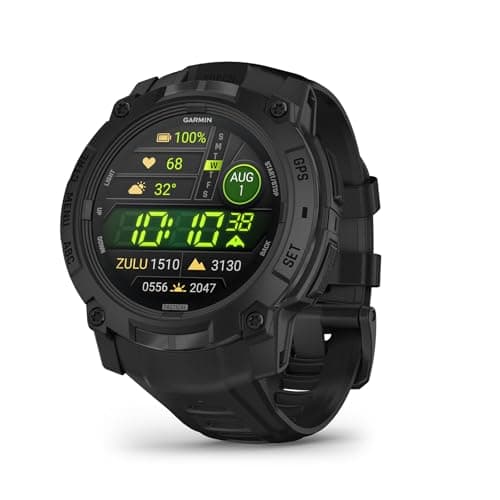 Garmin Instinct 3 Solar – Tactical Edition (50mm) Garmin rates the solar models unlimited in smartwatch mode and 260 GPS hours with solar, and adds the features a uniform needs: stealth mode, a kill switch, NVG mode, jumpmaster and a green flashlight. | Best solar military watch overallSolar GPS | 8.6 /10 | $499.99Amazon |
| 2 | 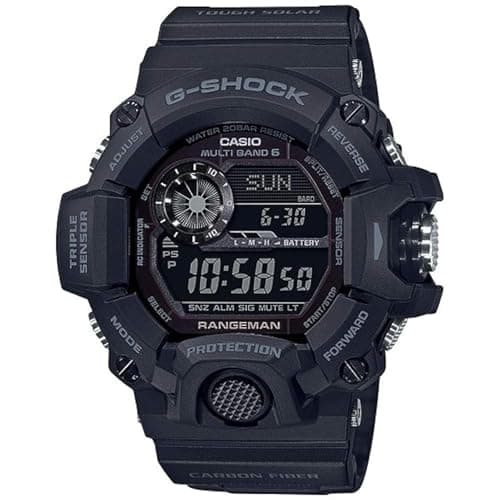 G-Shock Rangeman GW-9400 Tough Solar rated at about eight months from a full charge with no light at all, radio-set time, the full ABC sensor set, 200 m and mud resistance. Nothing to pair, nothing to disable. | Best with no radio to switch offSolar, no charger | 8.7 /10 | $320.00Amazon |
| 3 | 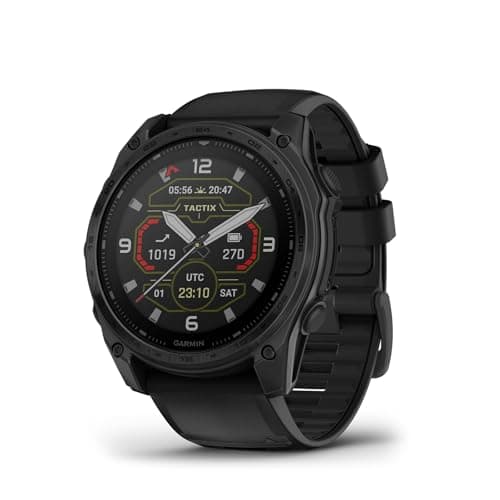 Garmin tactix 8 – Solar (51mm) Sapphire, a titanium bezel, a MIL-STD-810 claim, a 40 m dive rating, the Applied Ballistics solver preloaded and 48 smartwatch days on the solar model. The most watch here, at the most money. | Best solar tactical watch with mapsSolar GPS | 8.7 /10 | $1,399.99Amazon |
| 4 | 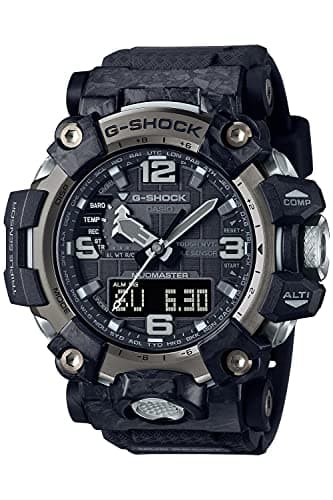 G-Shock Mudmaster GWG-2000 The only G-Shock on the site with sapphire, on a forged-carbon bezel and a Carbon Core Guard case, solar and radio-set, rated about six months with no light. Also the heaviest watch we cover at 106 g. | Toughest solar buildSolar, no charger | 8.7 /10 | $699.00Amazon |
| 5 | 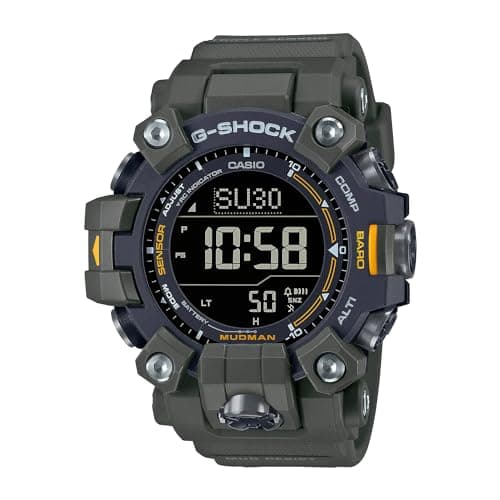 G-Shock Mudman GW-9500 The same triple sensor and sunrise/sunset as the Rangeman, 3.4 mm thinner and 12 g lighter by Casio's figures, with mud-resistant buttons. Six months in the dark instead of eight. | Best solar ABC watch to wear all daySolar, no charger | 8.2 /10 | $347.00Amazon |
| 6 | 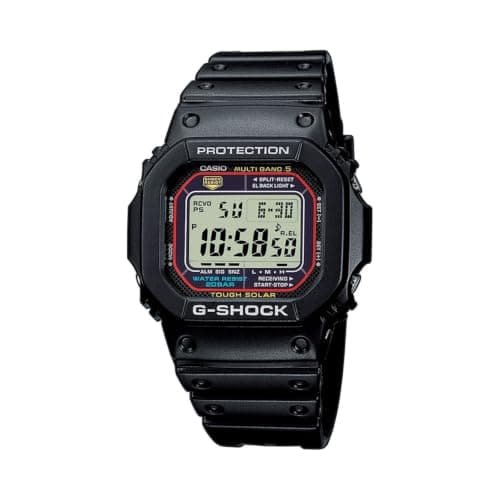 G-Shock GW-M5610U The longest dark-running figure Casio publishes among the watches here, about ten months, plus Multi-Band 6 and a 200 m square case at a fraction of the price. No sensors at all. | Best cheap solar squareSolar, no charger | 8.2 /10 | $155.63Amazon |
#ad · Prices come live from Amazon, last checked November 4, 2026. Scores are ours, built from the makers' manuals, battery tables and spec pages. Product photos come from Amazon; anything still on a stock frame is labelled on its card. Tap a row for the full write-up.
Why solar is the right power source for service use
Every argument for a solar watch gets stronger the further you are from an outlet, and service use is the furthest most people ever get. The chain of failure for a rechargeable watch in the field is short and well known: a cable gets left in a drawer, a power bank runs flat, a vehicle socket is in use, a billet has four outlets and nineteen people, and then one morning the watch is a bracelet. Solar does not make a watch invincible. It removes one specific dependency, and that dependency is the one that fails.
There is a second argument that matters more over a career than over a deployment. A watch that charges from light puts far fewer full cycles through its cell than a watch you plug in on Sunday nights, and cycles are what age a lithium battery. A Casio Tough Solar cell goes further still: it is a rechargeable cell that never meets a charger at all and that a watchmaker can replace years out, for a two-figure sum, rather than a sealed pack that decides the watch's service life. That is the whole premise of this site, and it is laid out in are solar watches worth it.
What solar is not: a reason to accept a weaker watch. Everything on this page also has to survive being worn by someone who is not being careful with it. So the ranking below starts with power, then applies the same durability test as the rest of the site, and only then looks at the features that exist specifically for uniformed use.
Two kinds of solar, and they are not comparable
Mixing these two together is the single most common mistake in "best solar watch" lists, so it is worth being blunt about. They are different technologies solving different problems, and no honest table ranks them against each other on a single number.
Solar GPS (Garmin). A rechargeable lithium cell with a solar layer in the lens, topping the cell up while you wear it. The solar lens is an extender, not a power source: it buys days and hours against a draw that is large to begin with, because a GPS watch runs a satellite receiver, an optical sensor, a backlight and a radio. Garmin's solar figures all carry the same footnote — three hours a day at 50,000 lux, which is midday summer sun outdoors. The arithmetic, and what it means in November, is in how Garmin solar actually works.
Tough Solar (Casio). A solar cell driving a watch module whose draw is measured in microamps. There is no charger, no port and no charge event. Casio publishes the figure that matters instead: how long the watch runs from a full charge in total darkness, with the power-saving function doing its work. For the Rangeman GW-9400 that is approximately eight months to Level 4; for the GW-M5610U square it is approximately ten. Those are not "up to" marketing numbers from a lux assumption. They are what the module does with the lights off.
The dark-running figure is the only honest ranking
Service life is not sunny. It is a hangar, a hull, a night rotation, a guard tower, a sleeve pulled over the watch under a uniform and body armor. Any ranking of solar watches built on how well they charge in bright sun is ranking the wrong condition, which is why this page is built the other way round.
Here is the complete set of published dark-running figures for the Casio watches on this page, read from Casio's own operation guides: GW-M5610U, about ten months (Casio's stated conditions, with power saving six hours a day); Rangeman GW-9400, about eight months from a full charge to Level 4 with no light; Mudman GW-9500, about six months with no light; Mudmaster GWG-2000, about six months with no light. Garmin publishes nothing equivalent for the Instinct or tactix — there is no Garmin figure for "days with the solar lens covered" — so what we can quote for the solar Garmins is the non-solar side of the table: up to 40 days of typical smartwatch use and up to 60 GPS hours for the 50mm Instinct 3 Solar before the lens adds anything, and up to 48 smartwatch days on the tactix 8 Solar 51mm.
Read those two sets honestly and the ranking almost writes itself. A Garmin gives you weeks of independence plus GPS, maps on the expensive one, and tactical software no Casio has. A Casio gives you months of independence and no charger in existence, and gives up the satellites to do it. Which matters more depends entirely on whether your job needs a track log, and that is the question the ranked section turns on.
Light discipline, stealth and the uniform rules
Three things separate a watch sold for service use from a rugged watch with a camouflage strap, and only one of them is durability.
Light color. A white backlight at night is a signature. The tactical Garmins here answer this with a green flashlight and a night-vision goggle mode rather than the red mode on the civilian Instinct, because green is what NVG-compatible equipment uses. Garmin states a multi-LED flashlight with white or green light on the tactix 8, and variable intensities plus a green light and strobe mode on the Instinct 3 Tactical. A Tough Solar Casio has an LED backlight and no flashlight at all, which is a real limitation and worth knowing before you buy one. The models that do have a light are listed in Garmin watches with a flashlight.
Emissions. Garmin's stealth mode stops wireless transmission and location recording, and the kill switch wipes user memory. Those are genuinely useful and they are also an admission: the watch transmits by default. A Rangeman has no Bluetooth and no GPS, so there is nothing to switch off and nothing to forget to switch off. For some readers that is a decisive advantage and for others it is simply a watch with fewer features; both readings are fair.
What is actually allowed. Unit policy, not spec sheets, decides what you can wear on duty, and it varies by service, by garrison and by course. Black, non-reflective and quiet is the safe answer almost everywhere; a shiny bracelet is not. We have collected what the published rules say in what watches are allowed in the military, and the basic-training case — where the honest answer is usually a cheap square — in best watch for army basic training.
Why these six, in this order
1. Garmin Instinct 3 Solar – Tactical Edition (50mm). The right default. It is the only watch here that combines a solar battery table Garmin describes as unlimited in smartwatch mode with the software that exists for uniformed use: stealth mode, a kill switch, NVG mode, jumpmaster with dual-position format, and a green flashlight with strobe. Garmin states a bolted construction with a metal-reinforced bezel and fiber-reinforced polymer case, a 100 m water rating and a build to MIL-STD-810 for thermal and shock resistance, and the GPS table is the same 60 hours (260 with solar) as the standard 50mm Instinct 3 Solar. Against it: Garmin does not name sapphire anywhere on the Instinct 3 line, there are no maps, and the Applied Ballistics solver needs a paid unlock. Our longer read is here, and the honest comparison with the civilian model is that you are paying for software, not hardware — see the Instinct 3 Solar review.
2. G-Shock Rangeman GW-9400. Second on this page and first on several others, because it wins the power argument outright and then refuses to play the rest of the game. Casio rates it at approximately eight months from a full charge with no light; it sets itself from a radio signal on five bands; it carries a compass, barometer, altimeter, thermometer and sunrise/sunset on the wrist with no phone anywhere; and the case is 200 m and mud resistant with four gloved-hands pushers. It has been on sale since 2013, which means straps, bezels and a watchmaker who has seen one are all easy to find. What it does not do is tell you where you are, and the crystal is mineral. Full detail in our Rangeman review.
3. Garmin tactix 8 – Solar (51mm). The most capable watch on the page by a wide margin and third because of what it costs. Garmin states a scratch-resistant sapphire lens, a titanium bezel with leakproof buttons, a 40 m dive rating, a build to MIL-STD-810 for thermal, shock and water resistance, a multi-LED flashlight with white or green light, and 48 days in smartwatch mode with always-on display on the 51mm solar model — plus the Applied Ballistics Ultralight solver preloaded rather than unlocked. If your work needs a real topo map on the wrist as well as light discipline, nothing else here does both. It is also a 51mm watch at the top of Garmin's tactical pricing, and the Instinct 3 Tactical does the light-discipline features for a great deal less. The ranked tactical field is in best tactical smartwatch.
4. G-Shock Mudmaster GWG-2000. Here for one row no other Casio on the site can fill: sapphire with an anti-glare coating, on a forged-carbon bezel and a Carbon Core Guard monocoque case, with Tough Solar, radio time on five bands and the triple sensor. Casio rates it at about six months with no light. The reasons it is fourth rather than second are physical: 61.2 mm wide, 16.1 mm thick and 106 g, which makes it the heaviest watch we cover and a poor match for a sleeve or a cuff, and the analog-digital dial is slower to read at a glance than a pure digital. See the Mudmaster review.
5. G-Shock Mudman GW-9500. The Rangeman for people who have to wear the watch every day rather than every hunt: Casio's figures put it 3.4 mm thinner and 12 g lighter than the GW-9400, with the same compass, altimeter, barometer, thermometer and sunrise/sunset set, mud-resistant buttons and a carbon-reinforced case at 200 m. The cost of the slimmer case is the battery figure, about six months in the dark instead of eight, and the module has a decade less history behind it. Our read is in the Mudman review.
6. G-Shock GW-M5610U. Last by capability and first by one number: Casio rates the square at approximately ten months with no light, the longest dark-running figure in this group, with Multi-Band 6 radio time in the smallest, lightest G-Shock case at 200 m. It has no sensors whatsoever — no compass, no altimeter, no thermometer — and the same flat mineral crystal as a DW-5600. For anyone whose actual requirement is "correct time, never charge it, do not care if it gets destroyed", it is the most rational purchase on the page and the cheapest. The square family is ranked in best square G-Shock.
What we will not claim
No watch here has been issued to us, worn on an exercise on our behalf, or tested in a chamber. Every figure above is the maker's own, read from the Garmin press releases and battery tables and the Casio operation guides linked at the bottom of this page.
Specifically: we do not claim any of these watches is "military issue" or approved by any service. Garmin names MIL-STD-810 for the Instinct 3 Tactical and the tactix 8 and Casio names it for none of these G-Shocks, so the flag is set on two of the six and not the rest — what that standard is and is not is in MIL-STD-810 explained. We do not convert Casio's dark-running months into a service life in years, because a rechargeable solar cell ages and Casio does not publish a curve for it. And we do not claim a dive rating for any watch that does not carry one: the tactix 8 Solar is the only watch on this page for which Garmin states a dive rating, and a 200 m water rating is not the same thing — the distinction is in watch water resistance explained.
In detail
The picks, in full
Rank 1
Best solar military watch overall
Garmin Instinct 3 Solar – Tactical Edition (50mm)
Garmin rates the solar models unlimited in smartwatch mode and 260 GPS hours with solar, and adds the features a uniform needs: stealth mode, a kill switch, NVG mode, jumpmaster and a green flashlight.
EvidenceResearched · every row sourced
| Power class | Solar GPS. A rechargeable cell topped up by a solar lens. Weeks between charges; the cell still ages like any lithium battery. |
|---|---|
| Battery (smartwatch) | Solar models: unlimited battery life (all-day wear, 3 hr/day at 50,000 lux) |
| Battery (GPS) | Up to 60 hours GPS-only; up to 260 hours with solar (50mm Instinct 3 Solar table) |
| Bezel & case | Bolted construction with a metal-reinforced bezel; fiber-reinforced polymer case |
| Water rating | Water-rated up to 100 meters |
| MIL-STD-810 | Built to MIL-STD 810 for thermal and shock resistance |
| Sensors | Stealth Mode, Kill Switch, Night Vision Goggle mode, Jumpmaster, dual-position format, multi-band GPS with SatIQ |
| Flashlight | Built-in LED flashlight with variable intensities, a green light and strobe mode |
How the 8.6 score breaks down
- Battery & power independence (25%)
- 10
- Durability of materials (25%)
- 8
- Serviceability & lifespan (20%)
- 7
- Field usability (15%)
- 9
- Value per decade (10%)
- 8
- Mission fit (5%)
- 10
What the spec sheet supports
- Stealth mode stops wireless and location recording; the kill switch wipes user memory, per Garmin.
- NVG mode and a green (not red) flashlight are the light-discipline features a standard Instinct lacks.
- Same solar battery table as the Instinct 3 Solar 50mm.
Where it falls short
- Applied Ballistics needs a paid unlock.
- Everything durable about it is already in the standard Instinct 3 Solar; you are paying for software.
Skip this if…
…you will never use stealth mode, NVG mode or jumpmaster; the standard Instinct 3 Solar is the same hardware for less.
#ad · Price as of November 4, 2026 · Disclosure for the link to Garmin Instinct 3 Solar – Tactical Edition (50mm)
Rank 2
Best with no radio to switch off
G-Shock Rangeman GW-9400
Tough Solar rated at about eight months from a full charge with no light at all, radio-set time, the full ABC sensor set, 200 m and mud resistance. Nothing to pair, nothing to disable.
EvidenceResearched · every row sourced
| Power class | Solar, no charger. A solar cell that recharges from any light and never meets a charger. The rechargeable cell is a watchmaker-replaceable part. |
|---|---|
| Battery (cell) | Approximately 8 months from full charge to Level 4 with no light (Casio's stated usage conditions) |
| Power | Solar panel and one rechargeable battery (Tough Solar) |
| Glass | Mineral crystal |
| Water rating | 200 meters |
| Sensors | Digital compass, barometer, altimeter, thermometer; sunrise/sunset; Multi-Band 6 time calibration (WWVB, DCF77, MSF, JJY, BPC) |
| Weight | 93 g |
| Size | 55.2 × 53.5 × 18.2 mm |
| Operating temp | Low-temperature resistance -10°C (14°F) |
How the 8.7 score breaks down
- Battery & power independence (25%)
- 10
- Durability of materials (25%)
- 7
- Serviceability & lifespan (20%)
- 10
- Field usability (15%)
- 7
- Value per decade (10%)
- 10
- Mission fit (5%)
- 8
What the spec sheet supports
- Solar and atomic: it sets itself from a radio signal and never sees a cable.
- A module that has been in production for over a decade; parts, straps and bezels are everywhere.
- Sunrise/sunset on the watch, the one hunting feature the Garmin Instinct does without a phone.
Where it falls short
- Mineral crystal, not sapphire; the Rangeman lives behind a raised bezel for a reason.
- No GPS, no maps, no heart rate. It tells you where north is, not where you are.
- Big and thick at 18.2 mm.
Skip this if…
…you want a track of where you walked; an ABC watch measures the world, it does not map it.
#ad · Price as of November 4, 2026 · Disclosure for the link to G-Shock Rangeman GW-9400
Rank 3
Best solar tactical watch with maps
Garmin tactix 8 – Solar (51mm)
Sapphire, a titanium bezel, a MIL-STD-810 claim, a 40 m dive rating, the Applied Ballistics solver preloaded and 48 smartwatch days on the solar model. The most watch here, at the most money.
EvidenceResearched · every row sourced
| Power class | Solar GPS. A rechargeable cell topped up by a solar lens. Weeks between charges; the cell still ages like any lithium battery. |
|---|---|
| Battery (smartwatch) | Up to 48 days in smartwatch mode with always-on display (51mm Solar) |
| Glass | Scratch-resistant sapphire lens |
| Bezel & case | Titanium bezel; leakproof buttons |
| Water rating | 40-meter dive rating with leakproof buttons |
| MIL-STD-810 | Built to a U.S. military standard (MIL-STD-810) for thermal, shock and water resistance |
| Sensors | Stealth Mode, Night Vision Goggle mode, Jumpmaster (HAHO, HALO, static), Applied Ballistics Ultralight solver |
| Flashlight | Multi-LED flashlight with white or green light |
How the 8.7 score breaks down
- Battery & power independence (25%)
- 9
- Durability of materials (25%)
- 10
- Serviceability & lifespan (20%)
- 7
- Field usability (15%)
- 10
- Value per decade (10%)
- 5
- Mission fit (5%)
- 10
What the spec sheet supports
- The only watch here with sapphire, titanium, a MIL-STD claim, a dive rating and the tactical software in one case.
- Preloaded Applied Ballistics solver, unlike the Instinct 3 Tactical's paid unlock.
- 48 days in smartwatch mode on the solar model.
Where it falls short
- Garmin positions it at the top of its tactical line; the Instinct 3 Tactical does the light-discipline features for far less.
- A big 51mm watch.
Skip this if…
…you want the tactical features without the fenix price; the Instinct 3 Solar Tactical is the honest alternative.
#ad · Price as of November 4, 2026 · Disclosure for the link to Garmin tactix 8 – Solar (51mm)
Rank 4
Toughest solar build
G-Shock Mudmaster GWG-2000
The only G-Shock on the site with sapphire, on a forged-carbon bezel and a Carbon Core Guard case, solar and radio-set, rated about six months with no light. Also the heaviest watch we cover at 106 g.
EvidenceResearched · every row sourced
| Power class | Solar, no charger. A solar cell that recharges from any light and never meets a charger. The rechargeable cell is a watchmaker-replaceable part. |
|---|---|
| Battery (cell) | Approximately 6 months with no light (Casio's stated usage conditions) |
| Power | Solar panel and one rechargeable battery |
| Glass | Sapphire with anti-glare coating |
| Bezel & case | Carbon Core Guard case; forged carbon, resin and stainless steel bezel |
| Water rating | 200 meters; shock resistant; mud resistant |
| Sensors | Digital compass, altimeter, barometer, thermometer; radio time calibration (JJY, WWVB, MSF, DCF77, BPC) |
| Weight | 106 g |
| Size | 61.2 × 54.4 × 16.1 mm |
How the 8.7 score breaks down
- Battery & power independence (25%)
- 9
- Durability of materials (25%)
- 10
- Serviceability & lifespan (20%)
- 9
- Field usability (15%)
- 7
- Value per decade (10%)
- 7
- Mission fit (5%)
- 8
What the spec sheet supports
- Sapphire on a G-Shock: the glass that stops the usual first failure.
- Forged carbon bezel and a carbon monocoque case.
- Solar and atomic like the Rangeman.
Where it falls short
- At 106 g and 61 mm wide it is the heaviest watch on this site.
- Analog-digital display: harder to read at a glance than a pure digital.
Skip this if…
…you have a small wrist or wear a cuff over your watch.
#ad · Price as of November 4, 2026 · Disclosure for the link to G-Shock Mudmaster GWG-2000
Rank 5
Best solar ABC watch to wear all day
G-Shock Mudman GW-9500
The same triple sensor and sunrise/sunset as the Rangeman, 3.4 mm thinner and 12 g lighter by Casio's figures, with mud-resistant buttons. Six months in the dark instead of eight.
EvidenceResearched · every row sourced
| Power class | Solar, no charger. A solar cell that recharges from any light and never meets a charger. The rechargeable cell is a watchmaker-replaceable part. |
|---|---|
| Battery (cell) | Approximately 6 months with no light (Casio's stated usage conditions) |
| Power | Solar panel and one rechargeable battery |
| Glass | Mineral |
| Bezel & case | Carbon, resin and bio-based resin |
| Water rating | 200 meters; shock resistant; mud resistant |
| Sensors | Digital compass, altimeter, barometer, thermometer; sunrise/sunset times |
| Weight | 81 g |
| Size | 56.7 × 52.7 × 14.8 mm |
How the 8.2 score breaks down
- Battery & power independence (25%)
- 9
- Durability of materials (25%)
- 7
- Serviceability & lifespan (20%)
- 9
- Field usability (15%)
- 7
- Value per decade (10%)
- 9
- Mission fit (5%)
- 9
What the spec sheet supports
- 3.4 mm thinner and 12 g lighter than the Rangeman GW-9400 by the published figures.
- Mud-resistant buttons and a carbon-reinforced case.
- Sunrise/sunset and a barometer graph for reading weather in a stand.
Where it falls short
- Six months of stated dark-running versus the Rangeman's eight.
- Mineral crystal.
Skip this if…
…you want the longest-proven G-Shock module; the Rangeman has a decade more history behind it.
#ad · Price as of November 4, 2026 · Disclosure for the link to G-Shock Mudman GW-9500
Rank 6
Best cheap solar square
G-Shock GW-M5610U
The longest dark-running figure Casio publishes among the watches here, about ten months, plus Multi-Band 6 and a 200 m square case at a fraction of the price. No sensors at all.
EvidenceResearched · every row sourced
| Power class | Solar, no charger. A solar cell that recharges from any light and never meets a charger. The rechargeable cell is a watchmaker-replaceable part. |
|---|---|
| Battery (cell) | Approximately 10 months with no light (Casio's stated conditions, power saving 6 hours/day) |
| Power | Solar panel and one rechargeable battery |
| Glass | Mineral (square case family) |
| Water rating | 200 meters; shock resistant (DW-5600 square case family) |
| Sensors | Multi-Band 6 radio time calibration; world time; 5 alarms |
How the 8.2 score breaks down
- Battery & power independence (25%)
- 10
- Durability of materials (25%)
- 6
- Serviceability & lifespan (20%)
- 10
- Field usability (15%)
- 6
- Value per decade (10%)
- 10
- Mission fit (5%)
- 6
What the spec sheet supports
- Ten months of stated dark running, the longest solar figure Casio publishes among the watches here.
- Atomic time and solar in the smallest G-Shock case.
Where it falls short
- Same flat mineral crystal as the DW-5600.
- No sensors.
Skip this if…
…you need a compass or altimeter on the watch; step up to the Rangeman.
#ad · Price as of November 4, 2026 · Disclosure for the link to G-Shock GW-M5610U
The one question that decides it
Do you need a track of where you went, or do you need to know what the world is doing around you? That single question splits this page down the middle, and almost nobody needs both badly enough to pay for both.
If you need the track — a route, a breadcrumb back, a grid reference, a pace — you are buying a solar Garmin and the only remaining decision is whether maps and sapphire are worth the step up from the Instinct 3 Tactical to the tactix 8. If you need the world — a bearing, a pressure trend, first light, how cold it actually is — you are buying a Tough Solar Casio, and you will spend a quarter of the money for a watch that outruns the Garmin by months rather than days. The two philosophies are compared directly in GPS vs ABC watch.
Three mistakes buyers make here
Buying the solar lens and ignoring the draw behind it. A solar lens on a watch that eats power is still a watch that eats power. The lens buys roughly the difference between 60 and 260 GPS hours on an Instinct 3 Solar, which is enormous and still finite; it does not turn a GPS watch into a Casio. Rank the base figure first and treat solar as the multiplier it is.
Assuming a sleeve is sunlight. Every solar figure on this page assumes the lens can see light. Under a uniform sleeve and body armor for twelve hours, it sees none, which is exactly why the dark-running figure is the ranking criterion and not a footnote. If the watch lives under a cuff, buy the one that runs longest with the lights off.
Paying for tactical software you will never open. Stealth mode, jumpmaster and a ballistics solver are worth real money to a small number of people and nothing at all to everyone else. If you will not use them, the standard Instinct 3 Solar is the same hardware for less, and that is the honest recommendation even though it is not the one on this page.
If your requirement is narrower than this
This page is the solar-specific answer. Four neighboring pages are better if they fit you more exactly: the full tactical field with no power-source filter is in best tactical watches, the non-smart and coin-cell options are in best military watches, a Casio-only ranking is in best G-Shock for military, the warranty terms behind all six are compared in our watch warranty comparison, and the "what-do-I-take" question is answered in best watch for deployment. The general solar ranking without the uniform frame is best solar watches.
How we scored this
What we checked to build this ranking
Every pick here is researched against the documents that decide whether a watch lasts: the maker's own battery table read mode by mode, what the lens and case are actually made of, the water rating, whether a MIL-STD-810 line is on the record and in whose words, and how long the maker keeps updating the line. Each one is then scored on a public rubric weighted for a decade of ownership, and every figure links to where it came from.
That is why the order on this page is worth following: it is built from specs you can open yourself, and commissions never set a score or decide a pick. The rubric and its weights are published.
Questions
Frequently asked
What is the best solar military watch?
The Garmin Instinct 3 Solar Tactical Edition (50mm) for most people: Garmin describes the solar models as having unlimited battery life in smartwatch mode at three hours a day of 50,000-lux light, states 60 GPS hours rising to 260 with solar, and adds stealth mode, a kill switch, NVG mode, jumpmaster and a green flashlight on a 100 m, MIL-STD-810 case. If you want the longest independence rather than the most features, the G-Shock Rangeman GW-9400 runs about eight months with no light at all.
How long does a solar watch last with no sunlight?
It depends entirely on which kind of solar. Casio publishes the figures: approximately ten months for the GW-M5610U square, about eight months for the Rangeman GW-9400 and about six for the Mudman GW-9500 and the Mudmaster GWG-2000, all from a full charge with no light. Garmin publishes no equivalent dark figure for a solar GPS watch; what it publishes is the battery life without solar, which for the 50mm Instinct 3 Solar is up to 40 days of typical use and up to 60 GPS hours.
Do solar watches work under a uniform sleeve?
Not while they are covered. A solar lens needs light, and a sleeve and body armor give it none, so the watch runs on stored charge for as long as its cell allows. That is why this page ranks on the dark-running figure rather than on charging performance: a Tough Solar Casio measured in months survives a covered week comfortably, while a solar GPS watch is running on its ordinary battery table during that week.
Are these watches military issue?
No, and we do not claim otherwise. None of the six is an issued item, and none of our sources says it is. Garmin names a build to MIL-STD-810 for the Instinct 3 Tactical Edition and the tactix 8; Casio does not name that standard for any of the G-Shocks here. What a unit permits on duty is set by policy rather than by a spec sheet, and the published rules are collected in what watches are allowed in the military.
Which of these has a green light for night vision use?
Two of them. Garmin states a built-in LED flashlight with variable intensities, a green light and a strobe mode on the Instinct 3 Solar Tactical Edition, and a multi-LED flashlight with white or green light on the tactix 8. Both also have a night-vision goggle display mode. The four Casio watches here have an LED backlight for the display and no flashlight at all.
Is a Tough Solar G-Shock better than a solar Garmin for deployment?
For independence, yes; for capability, no. A Rangeman keeps correct time and gives you a bearing, pressure, altitude, temperature and first light for months with no charger in existence. A solar Garmin gives you satellites, a track log, maps on the tactix, and the stealth and NVG features, in exchange for a battery measured in weeks and a charging cable you have to keep. Many people in uniform carry the Garmin for work and keep a square for everything else, which is a legitimate answer rather than a cop-out.
Keep reading
Related on Bezel & Bearing
Receipts
Sources
- Garmin newsroom — Instinct 3 Tactical Edition press release (checked 2026-09-20)
- Garmin — Instinct 3 Solar Series Owner's Manual, Battery Life Information (checked 2026-09-20)
- Garmin — Instinct 3 Solar Series Owner's Manual, Specifications (checked 2026-09-20)
- Garmin newsroom — tactix 8 press release (checked 2026-09-20)
- Casio — Operation Guide, module 3410 (GW-9400 Rangeman), Specifications (checked 2026-09-20)
- Pilot Mall — Casio G-Shock Rangeman GW9400-1 listing (case size, weight, water rating) (checked 2026-09-20)
- Casio — Operation Guide, module 3553 (GW-9500 Mudman), Specifications (checked 2026-09-20)
- Casio — Operation Guide, module 5678 (GWG-2000 Mudmaster), Specifications (checked 2026-09-20)
- G-Central — G-Shock GWG-2000 Mudmaster spec sheet (checked 2026-09-20)
- Casio — Operation Guide, module 3495 (GW-M5610U), Specifications (checked 2026-09-20)
Battery, glass, case and water figures come from the maker's own owner's manuals, spec pages and press releases, linked on every product so you can open the page they came from. Prices are set by Amazon and change often, so each buy button takes you to the current one. Read the full method.