Tactical / Guide
What watches are allowed in the military: one, conservative, and whatever your commander says
The Army writes it down. AR 670-1 permits one wristwatch, it has to be conservative, and you get one item per wrist plus a separate allowance for a tracker. Everything beyond that is service policy, unit policy and a first sergeant's judgment, which is why nobody should sell you a universal answer.
By Mike M.Updated Researched from the maker's manuals and spec sheets
#adReader-supported: we may earn a commission if you buy through our links, at no extra cost to you. It never decides a ranking. How we rate · Disclosure
The short, sourced answer
Almost every answer to this question online is somebody's recollection of what their platoon sergeant said. There is an actual document, it is public, and it is specific. For the Army it is AR 670-1, Wear and Appearance of Army Uniforms and Insignia, and the watch rules live in the jewelry paragraph, 3-4.
We quote and link it below rather than paraphrasing it, because the whole value of this page is that it points at the regulation instead of at a forum. What this page cannot do is tell you what your particular unit, school, range or deployment allows, and anyone who tells you otherwise is guessing.
What AR 670-1 actually says
The provisions that matter for a watch, as written in paragraph 3-4:
- One wristwatch. Soldiers may wear a wristwatch, a wrist religious or identification bracelet, and a total of two rings, a wedding set counting as one ring, with Army uniforms.
- One item per wrist. Soldiers are authorized to wear only one item on each wrist while in uniform or in civilian clothes on duty. So a watch on one wrist and an ID bracelet on the other is fine; a watch and a bracelet on the same wrist is not.
- Conservative. Any jewelry or monitors worn in uniform or in civilian clothes on duty must be conservative and must not detract from a professional military image.
- Unless the commander prohibits it. The permission is explicitly conditional on the commander not prohibiting the item for safety or health reasons.
Nothing in there specifies a brand, a case size, a colour list or a price. That is deliberate: the regulation sets a standard and leaves the judgment to the chain of command, which is also why two units can reach different answers about the same watch and both be correct.
What conservative means in practice
"Conservative" is the word doing all the work, and because the regulation does not define it by example, the practical reading comes from how inspections actually go. The watches that never cause a problem share a short list of traits:
- A dark, plain case. Black resin, matte grey, flat stainless. Not gold, not chrome, not a colourway.
- No loud branding or decoration on the bezel or the strap, and no collaboration graphics. The collectible end of the G-Shock catalogue is the wrong end for this, which is why we keep those in a separate list, best G-Shock collabs.
- A strap that matches, in a material that survives. Resin, nylon or a plain steel bracelet. A bright nylon strap is the easiest avoidable flag.
- A size that fits under a sleeve. Not a rule, but a 61 mm-wide watch under a dress sleeve attracts the kind of attention you do not want from a regulation that uses the word conservative.
Trackers and smartwatches
This is the part that surprises people, and it is written into the regulation rather than being a local workaround: in addition to the one item authorized on each wrist, soldiers may wear an activity tracker, pedometer or heart-rate monitor. The practical effect is that a tracker is treated as a monitor rather than as jewelry, and it is subject to the same conservative standard.
Where a smartwatch sits depends entirely on your environment rather than on the uniform regulation. Two separate issues come up repeatedly and neither is about appearance:
- Light and signal discipline. A watch that lights up, buzzes, or transmits is a tactical problem, not an appearance problem. This is why the features that matter on a tactical watch are a night-vision-compatible light, a stealth mode that stops position sharing, and a kill switch. Garmin builds all three into the Instinct 3 Tactical Edition and names them in its release.
- Secure spaces. Policies on wearable devices with wireless radios, recording ability or location logging are set locally and are far stricter than any uniform rule. Ask before you take a connected watch into a facility, every time, at every new unit. Nobody should be reading a web page for that answer.
If light discipline is the deciding factor, the models that do it are ranked in best tactical smartwatch.
Why your unit can still say no
The regulation itself hands the decision down. The jewelry permissions apply unless prohibited by the commander for safety or health reasons, which covers an enormous amount of ordinary military life: a watch comes off for range time in some units, for field maintenance in others, for a specific school, for a medical procedure, for hand-to-hand training, for a flight crew position.
So the honest answer to "what watches are allowed" has two halves. The regulation half is specific and quoted above. The local half is whatever you are told, and it overrides the general case every time. That is also why this site never states a wear rule as universal: unit and command policy varies, and we are not in your formation.
The safe choices
Our picks for this
Watches no reasonable inspection objects to
Plain, dark, durable and useful: the three Casios that have been standard-issue-by-choice for decades, plus the Garmin built for the tactical feature set.
Best for basic training
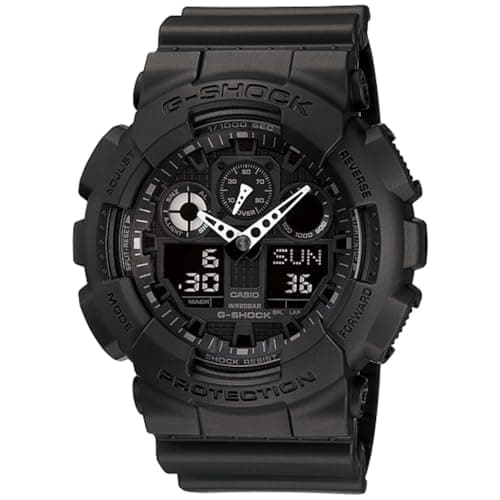
G-Shock GA-100-1A1
Replaceable cell7.2/10The default first watch: black resin, 200 m, shock resistant, a CR1220 rated at about two years, and cheap enough to be replaceable.
$83.60Amazon#ad · Price as of November 4, 2026 · Disclosure for the link to G-Shock GA-100-1A1
Best cheap buy-it-for-life watch
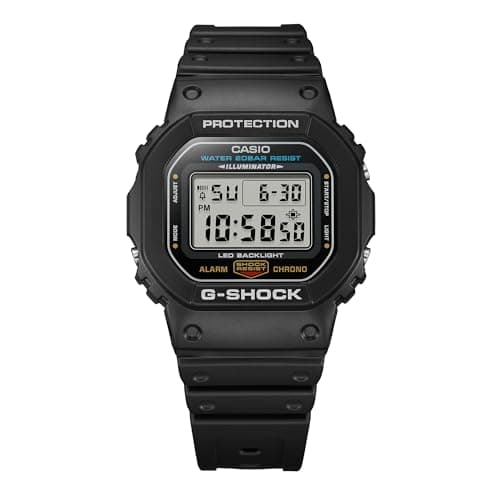
G-Shock DW-5600E
Replaceable cell7.7/1042.8 mm, 13.4 mm thick, 52 g, 200 m, a five-year cell: the smallest, flattest, least conspicuous tough watch there is.
$83.99Amazon#ad · Price as of November 4, 2026 · Disclosure for the link to G-Shock DW-5600E
Best for a decade without a charger
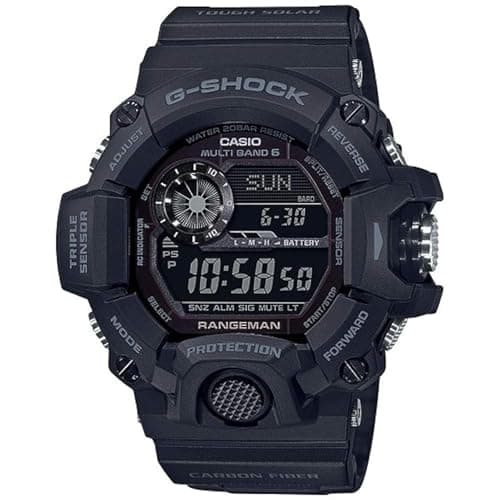
G-Shock Rangeman GW-9400
Solar, no charger8.7/10Tough Solar and Multi-Band 6 so it sets itself and never needs charging, with a compass, barometer, altimeter and thermometer.
$320.00Amazon#ad · Price as of November 4, 2026 · Disclosure for the link to G-Shock Rangeman GW-9400
Best for a deployment
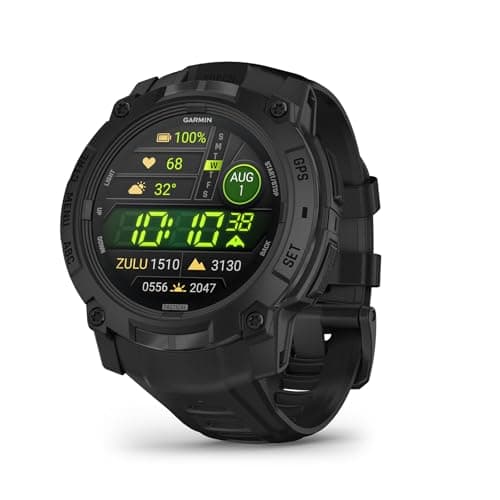
Garmin Instinct 3 Solar – Tactical Edition (50mm)
Solar GPS8.6/10Stealth Mode, Kill Switch, night-vision-goggle mode and Jumpmaster, with a green-light flashlight and an unlimited-with-solar battery claim.
$499.99Amazon#ad · Price as of November 4, 2026 · Disclosure for the link to Garmin Instinct 3 Solar – Tactical Edition (50mm)
If you are buying for the first weeks specifically, the sizing, cost and replaceability argument is in best watch for army basic training, and the rotation after that is in best watch for deployment.
Other services, and what we will not claim
The document quoted on this page is the Army's. The Navy, Marine Corps, Air Force, Space Force and Coast Guard each publish their own uniform regulations, and they are not identical: the shared themes are one watch, worn conservatively, with authority delegated downward, but the specific wording, the colour guidance and the exceptions differ.
We are not going to reproduce rules we have not read in the source document, and we are not going to summarise a service's uniform policy from memory. If you serve outside the Army, read your own service's uniform regulation and ask your chain of command. Our standard of evidence is published on our editorial policy, and it is the reason this page quotes one regulation properly rather than six badly.
What transfers across all of them is the hardware. A plain black digital watch with a published water rating and a battery measured in years is the correct answer in every uniform, which is why the same two or three Casios turn up on every service's wrists. The brand-by-brand version of that observation is in what watch do Marines and soldiers wear.
How we scored this
What we checked to build this ranking
Every pick here is researched against the documents that decide whether a watch lasts: the maker's own battery table read mode by mode, what the lens and case are actually made of, the water rating, whether a MIL-STD-810 line is on the record and in whose words, and how long the maker keeps updating the line. Each one is then scored on a public rubric weighted for a decade of ownership, and every figure links to where it came from.
That is why the order on this page is worth following: it is built from specs you can open yourself, and commissions never set a score or decide a pick. The rubric and its weights are published.
Questions
Frequently asked
What watches are allowed in the military?
Under the Army's AR 670-1, one wristwatch, conservative in appearance, with only one item authorized per wrist, and an activity tracker, pedometer or heart-rate monitor permitted in addition. All of it is subject to a commander prohibiting the item for safety or health reasons. Other services publish their own uniform regulations.
Can you wear a smartwatch in uniform?
The uniform regulation's test is whether it is conservative, and AR 670-1 separately permits an activity tracker, pedometer or heart-rate monitor in addition to the one item per wrist. The real constraints on a smartwatch are operational rather than cosmetic: light and signal discipline in the field, and local policy on wireless, recording or location-logging devices in secure spaces. Ask locally, every time.
What color watch can you wear in the Army?
AR 670-1 does not publish a colour list; it requires the watch to be conservative and not to detract from a professional military image. In practice a dark, plain case on a matching strap is never the problem, and bright or shiny watches are what get called out. Your unit can be more specific than the regulation, and often is.
Can you wear two watches, or a watch and a bracelet?
Not on the same wrist. AR 670-1 authorizes only one item on each wrist while in uniform or in civilian clothes on duty, with the activity tracker, pedometer or heart-rate monitor allowance on top of that. A watch on one wrist and an identification bracelet on the other is within the rule.
What watch is safest to buy for basic training?
A plain black digital with a published water rating and a replaceable cell: the G-Shock GA-100 or the DW-5600E are the two that have done this job for decades, both 200 m and shock resistant, and both cheap enough that losing one is not a problem. The full reasoning is in best watch for army basic training.
Keep reading
Related on Bezel & Bearing
Receipts
Sources
- U.S. Army Publishing Directorate — AR 670-1, Wear and Appearance of Army Uniforms and Insignia (checked 2026-10-10)
- AR670.com — AR 670-1 paragraph 3-4, Jewelry, reproduced in full (checked 2026-10-10)
- G-Central — G-Shock GA-100 spec sheet (checked 2026-09-20)
- G-Central — G-Shock DW-5600 spec sheet (checked 2026-09-20)
- Casio — Operation Guide, module 3410 (GW-9400 Rangeman), Specifications (checked 2026-09-20)
- Garmin newsroom — Instinct 3 Tactical Edition press release (checked 2026-09-20)
Battery, glass, case and water figures come from the maker's own owner's manuals, spec pages and press releases, linked on every product so you can open the page they came from. Prices are set by Amazon and change often, so each buy button takes you to the current one. Read the full method.