Built to Last / The rankings
The best solar watches: seven ranked by what 'solar' actually means on the spec sheet
Solar means three different things. On a Casio or Citizen it means no charger, ever. On a Garmin or Suunto it means a lens that stretches a rechargeable cell. Here are the seven that earn the word, from the makers' own figures.
By Mike M.Updated Spec-sheet researched, not worn by us
#adReader-supported: we may earn a commission if you buy through our links, at no extra cost to you. It never decides a ranking. How we rate · Disclosure
Quick picks
The rankings at a glance
| # | Product | Best for | Score | Price |
|---|---|---|---|---|
| 1 |  G-Shock Rangeman GW-9400 Tough Solar rated about 8 months in the dark and indefinite in light, radio time, ABC sensors, 200 m. A solar cell that a watchmaker can replace, years out. | Best solar watch overallSolar, no charger | 8.7 /10 | Check price · Amazon |
| 2 |  Garmin Instinct 3 Solar (50mm) Garmin rates it unlimited in smartwatch mode with three hours a day at 50,000 lux, and 260 GPS hours with solar. | Best solar GPS watchSolar GPS | 8.7 /10 | Check price · Amazon |
| 3 | Garmin fenix 8 Solar (51mm, Sapphire) 48 days with solar, 653 max-battery GPS hours with solar, sapphire, titanium, a dive rating. | Best solar watch with mapsSolar GPS | 8.7 /10 | Check price · Amazon |
| 4 |  G-Shock GW-M5610U Tough Solar rated about 10 months in the dark, Multi-Band 6, 200 m, in the smallest G-Shock. | Best solar squareSolar, no charger | 8.2 /10 | Check price · Amazon |
| 5 | Suunto Vertical Titanium Solar 60 days with solar, 90 multi-band hours with solar, sapphire, titanium, 74 g. | Best solar GPS watch with sapphireSolar GPS | 8.1 /10 | Check price · Amazon |
| 6 | Casio Pro Trek PRW-61 Tough Solar, radio time, triple sensor at 62 g and 100 m. | Best solar hiking watchSolar, no charger | 8.1 /10 | Check price · Amazon |
| 7 |  Citizen Promaster Dive BN0151-09L Eco-Drive on an ISO-certified 200 m diver with a five-year limited warranty. | Best solar analogSolar, no charger | 7.9 /10 | Check price · Amazon |
#ad · Prices are set by Amazon and change often, so we don't print them. Scores are ours, built from the makers' manuals, battery tables and spec pages, not field tests. Photos are illustrative stock. Tap a row for the full write-up.
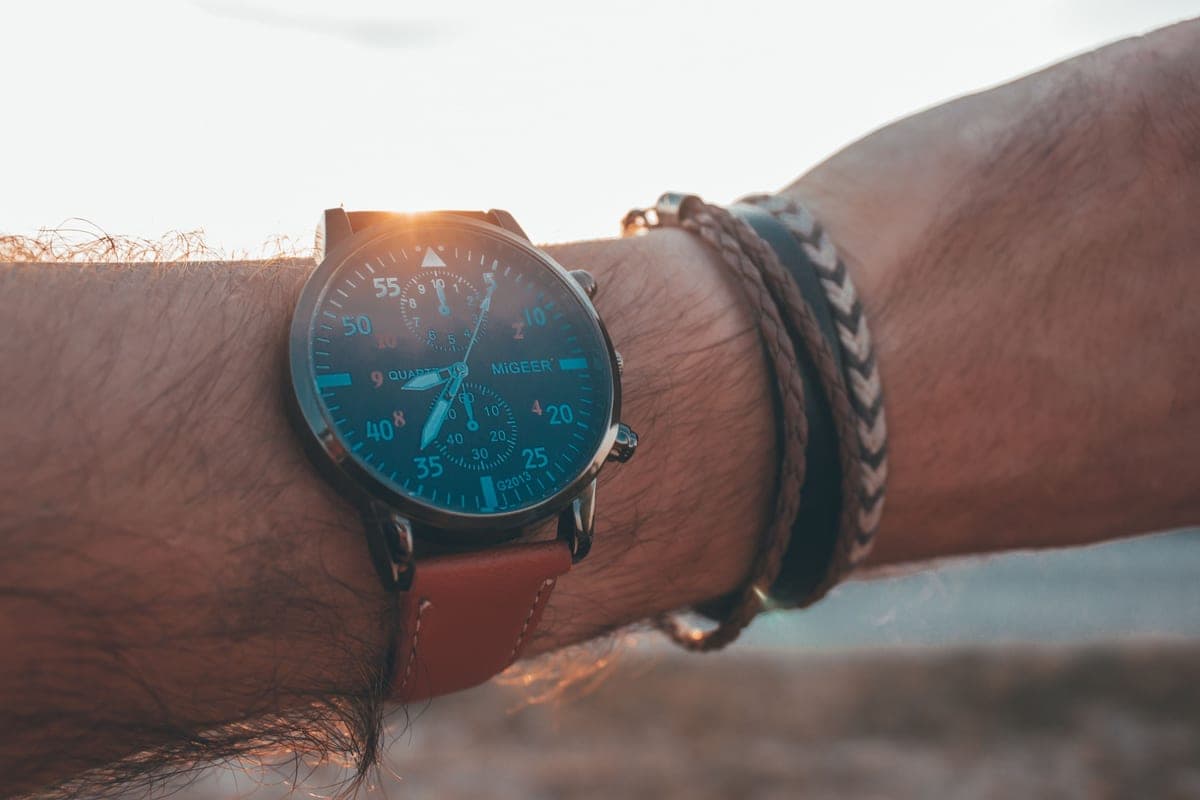
Three kinds of solar
- Solar that replaces the charger. Casio Tough Solar and Citizen Eco-Drive: a panel under the dial charges a small rechargeable cell that runs a low-draw module. Casio publishes months of dark running; Citizen says Eco-Drive "eliminates the need to replace watch batteries." No cable exists.
- Solar that stretches a charger. Garmin's solar lens and Suunto's solar variants top up a lithium cell that runs a GPS chip. Garmin's "unlimited" assumes three hours a day at 50,000 lux; without it, the Instinct 3 Solar 50mm is rated 40 days and charges by cable.
- Solar as a word. Panels too small to matter on watches that still charge weekly. None of those are on this list.
We ranked the first two kinds together because that is how people search, and scored each on the rubric, power independence first. The GPS-only version is best solar GPS watches.
The makers' figures, side by side
| Watch | Kind | Maker's figure | Cable? |
|---|---|---|---|
| G-Shock Rangeman GW-9400 | Tough Solar | About 8 months, no light, full charge to Level 4 | None |
| Garmin Instinct 3 Solar 50mm | Solar GPS | 40 days; unlimited with solar (smartwatch) | Yes, rarely with sun |
| Garmin fenix 8 Solar 51mm | Solar GPS | 30 days; 48 with solar | Yes |
| G-Shock GW-M5610U | Tough Solar | About 10 months, no light | None |
| Suunto Vertical Titanium Solar | Solar GPS | 30 days; 60 with solar | Yes |
| Casio Pro Trek PRW-61 | Tough Solar | About 6 months, no light | None |
| Citizen Promaster Dive BN0151 | Eco-Drive | No battery replacement, per Citizen; no reserve figure on its page | None |
What each figure assumes
The cell underneath
Every solar watch has a rechargeable cell; the difference is what it drives and how often it cycles. A Tough Solar module draws so little that the cell rarely cycles at all, and Casio's guides treat cell replacement as a service-center job years out. A solar GPS watch cycles its cell whenever the sun is not enough, which for most people is often; the solar lens reduces cycles rather than eliminating them. That is why the Casios and the Citizen top this list on serviceability and the Garmins top it on everything a GPS watch does.
The mistake buyers make
Expecting a solar Garmin to behave like a solar Casio. It will not, unless you spend three hours a day in the sun. Buy the Garmin for the GPS and the reduced charging; buy the Casio for the absence of charging. If you wanted the second thing, the G-Shock vs Garmin Instinct page is where that decision lives.
The decade pick
In detail
The picks, in full
Rank 1
Stock photoBest solar watch overall
G-Shock Rangeman GW-9400
Tough Solar rated about 8 months in the dark and indefinite in light, radio time, ABC sensors, 200 m. A solar cell that a watchmaker can replace, years out.
EvidenceResearched · not worn by us
| Power class | Solar, no charger. A solar cell that recharges from any light and never meets a charger. The rechargeable cell is a watchmaker-replaceable part. |
|---|---|
| Battery (cell) | Approximately 8 months from full charge to Level 4 with no light (Casio's stated usage conditions) |
| Power | Solar panel and one rechargeable battery (Tough Solar) |
| Glass | Mineral crystal |
| Water rating | 200 meters |
| Sensors | Digital compass, barometer, altimeter, thermometer; sunrise/sunset; Multi-Band 6 time calibration (WWVB, DCF77, MSF, JJY, BPC) |
| Weight | 93 g |
| Size | 55.2 × 53.5 × 18.2 mm |
| Operating temp | Low-temperature resistance -10°C (14°F) |
How the 8.7 score breaks down
- Battery & power independence (25%)
- 10
- Durability of materials (25%)
- 7
- Serviceability & lifespan (20%)
- 10
- Field usability (15%)
- 7
- Value per decade (10%)
- 10
- Mission fit (5%)
- 8
What the spec sheet supports
- Solar and atomic: it sets itself from a radio signal and never sees a cable.
- A module that has been in production for over a decade; parts, straps and bezels are everywhere.
- Sunrise/sunset on the watch, the one hunting feature the Garmin Instinct does without a phone.
Where it falls short
- Mineral crystal, not sapphire; the Rangeman lives behind a raised bezel for a reason.
- No GPS, no maps, no heart rate. It tells you where north is, not where you are.
- Big and thick at 18.2 mm.
Skip this if…
…you want a track of where you walked; an ABC watch measures the world, it does not map it.
#ad · Price set by Amazon · Disclosure for the link to G-Shock Rangeman GW-9400
Rank 2
Stock photoBest solar GPS watch
Garmin Instinct 3 Solar (50mm)
Garmin rates it unlimited in smartwatch mode with three hours a day at 50,000 lux, and 260 GPS hours with solar.
EvidenceResearched · not worn by us
How the 8.7 score breaks down
- Battery & power independence (25%)
- 10
- Durability of materials (25%)
- 8
- Serviceability & lifespan (20%)
- 7
- Field usability (15%)
- 9
- Value per decade (10%)
- 10
- Mission fit (5%)
- 8
What the spec sheet supports
- Garmin's own table shows the 50mm solar model doubling the 45mm in GPS-with-solar hours (260 vs 130).
- Physical buttons, a monochrome display readable in full sun, and a flashlight with a red mode.
- 10 ATM rating and a MIL-STD 810 claim on a watch that costs less than half a fenix.
Where it falls short
- No maps: it navigates breadcrumb trails and waypoints, not topo maps.
- The solar figures assume three hours a day at 50,000 lux, which is midday sun, not a sleeve.
- Garmin does not name the lens material; treat it as strengthened glass, not sapphire.
Skip this if…
…you need on-wrist topo maps, or you wear long sleeves and work indoors, where the solar math never happens.
#ad · Price set by Amazon · Disclosure for the link to Garmin Instinct 3 Solar (50mm)
Rank 3
Stock photoBest solar watch with maps
Garmin fenix 8 Solar (51mm, Sapphire)
48 days with solar, 653 max-battery GPS hours with solar, sapphire, titanium, a dive rating.
EvidenceResearched · not worn by us
| Power class | Solar GPS. A rechargeable cell topped up by a solar lens. Weeks between charges; the cell still ages like any lithium battery. |
|---|---|
| Battery (smartwatch) | Up to 30 days typical use; up to 48 days with solar |
| Battery (GPS) | Up to 95 hours GPS-only; up to 149 hours with solar |
| Battery (max GPS) | Up to 186 hours max-battery GPS; up to 653 hours with solar |
| Battery (solar) | Expedition GPS mode up to 50 days; up to 118 days with solar |
| Glass | Scratch-resistant sapphire lens (sapphire versions) |
| Bezel & case | Titanium bezel (sapphire versions); leakproof metal buttons; sensor guard |
| Water rating | 40-meter dive-rated case |
| MIL-STD-810 | Tested to U.S. military standards for thermal, shock and water resistance |
| Maps & GPS | TopoActive maps preloaded on sapphire versions |
| Flashlight | Built-in LED flashlight with variable intensities, red light and strobe |
How the 8.7 score breaks down
- Battery & power independence (25%)
- 9
- Durability of materials (25%)
- 10
- Serviceability & lifespan (20%)
- 7
- Field usability (15%)
- 10
- Value per decade (10%)
- 6
- Mission fit (5%)
- 8
What the spec sheet supports
- Sapphire, titanium and leakproof metal buttons on a case Garmin dive-rates to 40 m.
- 653 hours of max-battery GPS with solar is the longest figure in Garmin's fenix 8 table.
- Preloaded topo maps, a speaker and mic, and a flashlight.
Where it falls short
- A MIP display in a world of AMOLEDs; that is also why the battery lasts.
- The fenix 9 Pro (August 2026) now sits above it in the line, with a titanium case and solar on select models.
- Big: 51mm is a lot of watch under a sleeve.
Skip this if…
…you have never used the maps on a watch; the Instinct 3 Solar gives you the battery for half the money.
#ad · Price set by Amazon · Disclosure for the link to Garmin fenix 8 Solar (51mm, Sapphire)
Rank 4
Stock photoBest solar square
G-Shock GW-M5610U
Tough Solar rated about 10 months in the dark, Multi-Band 6, 200 m, in the smallest G-Shock.
EvidenceResearched · not worn by us
| Power class | Solar, no charger. A solar cell that recharges from any light and never meets a charger. The rechargeable cell is a watchmaker-replaceable part. |
|---|---|
| Battery (cell) | Approximately 10 months with no light (Casio's stated conditions, power saving 6 hours/day) |
| Power | Solar panel and one rechargeable battery |
| Glass | Mineral (square case family) |
| Water rating | 200 meters; shock resistant (DW-5600 square case family) |
| Sensors | Multi-Band 6 radio time calibration; world time; 5 alarms |
How the 8.2 score breaks down
- Battery & power independence (25%)
- 10
- Durability of materials (25%)
- 6
- Serviceability & lifespan (20%)
- 10
- Field usability (15%)
- 6
- Value per decade (10%)
- 10
- Mission fit (5%)
- 6
What the spec sheet supports
- Ten months of stated dark running, the longest solar figure Casio publishes among the watches here.
- Atomic time and solar in the smallest G-Shock case.
Where it falls short
- Same flat mineral crystal as the DW-5600.
- No sensors.
Skip this if…
…you need a compass or altimeter on the watch; step up to the Rangeman.
#ad · Price set by Amazon · Disclosure for the link to G-Shock GW-M5610U
Rank 5
Stock photoBest solar GPS watch with sapphire
Suunto Vertical Titanium Solar
60 days with solar, 90 multi-band hours with solar, sapphire, titanium, 74 g.
EvidenceResearched · not worn by us
| Power class | Solar GPS. A rechargeable cell topped up by a solar lens. Weeks between charges; the cell still ages like any lithium battery. |
|---|---|
| Battery (smartwatch) | Up to 30 days daily use (60 days with solar); standby up to 60 days (1 year with solar) |
| Battery (GPS) | Up to 65 h multi-band (90 h with solar); up to 90 h single-band (140 h with solar) |
| Battery (max GPS) | Up to 500 h in power-saving GNSS modes |
| Glass | Sapphire crystal |
| Bezel & case | Titanium Grade 5 bezel; glass fiber reinforced polyamide case |
| Water rating | 100 m |
| Display | 1.4-inch matrix (MIP) |
| Weight | 74 g / 2.61 oz |
| Operating temp | -20°C to +55°C (-5°F to +130°F) |
How the 8.1 score breaks down
- Battery & power independence (25%)
- 9
- Durability of materials (25%)
- 9
- Serviceability & lifespan (20%)
- 6
- Field usability (15%)
- 8
- Value per decade (10%)
- 8
- Mission fit (5%)
- 7
What the spec sheet supports
- Solar, sapphire and titanium at 74 g, lighter than a fenix 8 51mm.
- 500 hours in power-saving GPS is the highest Suunto figure and beats the fenix 8 Solar 47mm's max-battery figure without solar.
Where it falls short
- Previous generation: no flashlight, dimmer MIP screen, older optical heart rate.
- 100 m water rating, no MIL-STD claim in Suunto's specs.
Skip this if…
…you want the brightest screen and a flashlight; that is the Vertical 2.
#ad · Price set by Amazon · Disclosure for the link to Suunto Vertical Titanium Solar
Rank 6
Stock photoBest solar hiking watch
Casio Pro Trek PRW-61
Tough Solar, radio time, triple sensor at 62 g and 100 m.
EvidenceResearched · not worn by us
| Power class | Solar, no charger. A solar cell that recharges from any light and never meets a charger. The rechargeable cell is a watchmaker-replaceable part. |
|---|---|
| Battery (cell) | Approximately 6 months with no light (Casio's stated usage conditions) |
| Power | Solar panel and one rechargeable battery |
| Bezel & case | Biomass plastics case |
| Water rating | 100 m |
| Sensors | Direction, pressure/altitude and temperature sensors; radio time calibration (JJY, WWVB, MSF, DCF77, BPC); double LED light |
| Weight | 62 g |
| Size | 51.0 × 47.4 × 14.7 mm |
| Operating temp | Low-temperature resistance to -10°C (14°F) |
How the 8.1 score breaks down
- Battery & power independence (25%)
- 9
- Durability of materials (25%)
- 6
- Serviceability & lifespan (20%)
- 9
- Field usability (15%)
- 8
- Value per decade (10%)
- 9
- Mission fit (5%)
- 8
What the spec sheet supports
- Solar, atomic and triple sensor at 62 g and 14.7 mm.
- Cleaner dial and a proper altimeter graph for hikers.
Where it falls short
- 100 m and no mud-resistant buttons; it is a hiking watch, not a Mudman.
- Mineral glass.
Skip this if…
…your watch gets buried in mud or dunked regularly; the G-Shock Mudman is the sealed version of this idea.
#ad · Price set by Amazon · Disclosure for the link to Casio Pro Trek PRW-61
Rank 7
Stock photoBest solar analog
Citizen Promaster Dive BN0151-09L
Eco-Drive on an ISO-certified 200 m diver with a five-year limited warranty.
EvidenceResearched · not worn by us
| Power class | Solar, no charger. A solar cell that recharges from any light and never meets a charger. The rechargeable cell is a watchmaker-replaceable part. |
|---|---|
| Power | E168 Eco-Drive: powered by any light source, no battery replacement |
| Glass | Anti-reflective mineral crystal |
| Bezel & case | Stainless steel, 44 mm; polyurethane strap |
| Water rating | 200M/20Bar, ISO-certified dive watch |
| Warranty | 5-year limited warranty |
How the 7.9 score breaks down
- Battery & power independence (25%)
- 9
- Durability of materials (25%)
- 7
- Serviceability & lifespan (20%)
- 9
- Field usability (15%)
- 6
- Value per decade (10%)
- 9
- Mission fit (5%)
- 6
What the spec sheet supports
- A five-year warranty is the longest on the site.
- Solar analog with an ISO dive rating for the price of a Rangeman.
Where it falls short
- Mineral crystal.
- Citizen's page does not state a dark-running power reserve for this model.
Skip this if…
…you want a sapphire diver; Citizen's page names mineral for this one.
#ad · Price set by Amazon · Disclosure for the link to Citizen Promaster Dive BN0151-09L
How we scored this
Watches we claim to have worn or tested: 0
Plenty of sites say they took every watch up a mountain. We didn't, and we say so. What we do instead: read the maker's own battery table mode by mode, check what the lens and case are actually made of, note the water rating and whether a MIL-STD-810 claim exists, ask how long the maker keeps updating the line, and score every pick on a public rubric weighted for a decade of ownership. Every figure links to where it came from.
Scores are editorial judgments from that documented research, not test results. Commissions never set a score or decide a pick. The rubric and its weights are published.
Questions
Frequently asked
What is the best solar-powered watch?
The G-Shock Rangeman GW-9400 by our rubric: Tough Solar rated about 8 months in the dark and indefinite in daylight, radio time, ABC sensors, 200 m. For a solar GPS watch, the Garmin Instinct 3 Solar.
Do solar watches really never need a battery?
Casio and Citizen solar watches run on a rechargeable cell that light keeps charged; Casio's guides describe cell replacement as a service job years out, and Citizen says Eco-Drive eliminates battery replacement. Garmin solar watches still charge by cable when sun is short.
Is a Garmin solar watch worth it?
If you are outdoors: Garmin's tables show the Instinct 3 Solar 50mm going from 40 days to unlimited and 60 to 260 GPS hours with its solar assumption met. Indoors, the solar lens adds little.
Keep reading
Related on Bezel & Bearing
Receipts
Sources
- Casio — Operation Guide, module 3410 (GW-9400 Rangeman), Specifications (checked 2026-09-20)
- Pilot Mall — Casio G-Shock Rangeman GW9400-1 listing (case size, weight, water rating) (checked 2026-09-20)
- Casio — Operation Guide, module 3495 (GW-M5610U), Specifications (checked 2026-09-20)
- Casio — Operation Guide, module 5673 (Pro Trek PRW-61), Specifications (checked 2026-09-20)
- Garmin — Instinct 3 Solar Series Owner's Manual, Battery Life Information (checked 2026-09-20)
- Garmin — fenix 8 Series Owner's Manual, Battery Information (checked 2026-09-20)
- Suunto — Vertical Titanium Solar Black product page and tech specs (checked 2026-09-20)
- Citizen — Promaster Dive BN0151-09L product page (checked 2026-09-20)
We don't own or wear-test these watches and we don't pretend to. Battery, glass, case and water figures come from the maker's own owner's manuals, spec pages and press releases (linked on every product), and where a figure isn't published we say so. Prices are set by Amazon and change often, so we don't print them. Read the full method.