GPS Watches / Head to head
Suunto Vertical Solar vs Garmin Instinct 3 Solar: maps and sapphire, or battery and a light
The only two solar GPS watches most buyers seriously compare at this money. Suunto brings sapphire, Grade 5 titanium and free offline maps at 74 grams. Garmin brings a solar battery table it calls unlimited, a MIL-STD-810 claim and a flashlight. Both makers publish enough to settle it.
By Mike M.Updated Researched from the maker's manuals and spec sheets
#adReader-supported: we may earn a commission if you buy through our links, at no extra cost to you. It never decides a ranking. How we rate · Disclosure
The contenders
Side by side
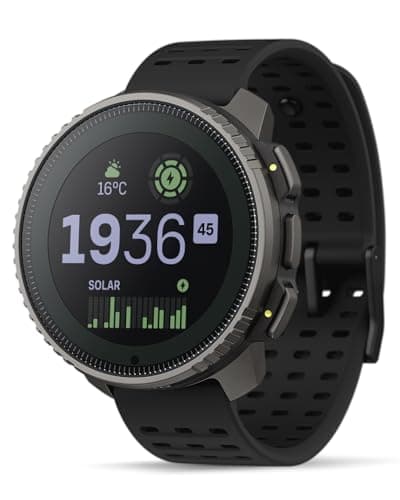
Buy this for maps and materials
Suunto Vertical Titanium Solar
Solar GPS8.1 /10Sapphire on a Grade 5 titanium bezel at 74 g, free offline outdoor maps with 32 GB of storage, dual-band L1 + L5, and 500 hours in power-saving GNSS modes.
$549.00Amazon#ad · Price as of November 4, 2026 · Disclosure for the link to Suunto Vertical Titanium Solar
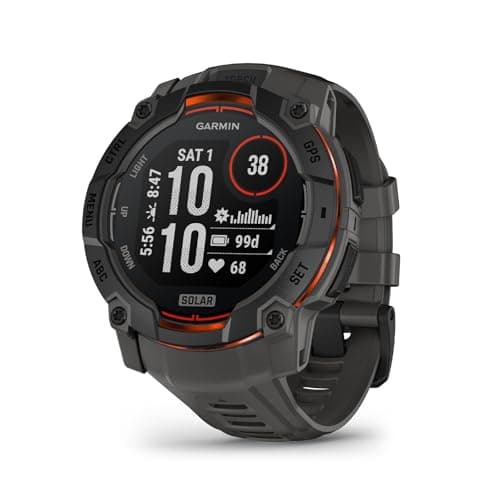
Buy this for battery and the build claims
Garmin Instinct 3 Solar (50mm)
Solar GPS8.7 /10Unlimited smartwatch battery with solar and 260 GPS hours with solar, a 10 ATM rating, a MIL-STD-810 claim, five buttons and a red-mode flashlight. No maps, no named sapphire.
$399.99Amazon#ad · Price as of November 4, 2026 · Disclosure for the link to Garmin Instinct 3 Solar (50mm)
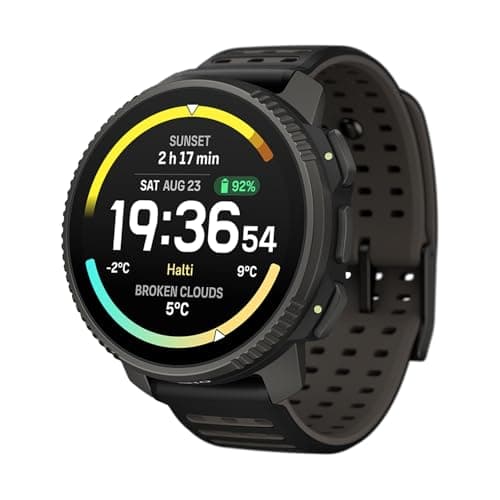
The newer Suunto, for completeness
Suunto Vertical 2 Titanium
Rechargeable GPS7.6 /10The same sapphire and titanium with a 1.5-inch AMOLED, a flashlight and 65 multi-band hours, but Suunto dropped the solar lens on this generation: 20 days daily use, not 60.
$699.00Amazon#ad · Price as of November 4, 2026 · Disclosure for the link to Suunto Vertical 2 Titanium
The short version
These two watches are not trying to be the same thing, which is why the comparison is actually useful rather than a spec-sheet tie. The Suunto is a lighter, harder, better-navigating watch with a sensible solar lens. The Garmin is a tougher-claimed, longer-running watch with a light and no map.
One thing to get straight before the tables, because the model names are a trap: the watch in this comparison is the first-generation Suunto Vertical, the Titanium Solar, which is still sold alongside its successor. The newer Vertical 2 is a different proposition — Suunto replaced the solar MIP screen with an AMOLED and dropped the solar lens, taking daily-use battery from 30 days (60 with solar) down to 20. If solar is why you are here, the word has to be in the model name. The head-to-head against that newer model is Garmin Instinct 3 vs Suunto Vertical 2.
Row by row
Every figure in that table is the maker's own, from Suunto's Vertical Titanium Solar product page and spec table and from Garmin's Instinct 3 Solar battery table and specifications. Where a row is blank for one of them, the maker does not publish it, and that silence is itself information: Suunto states no MIL-STD-810 line and no flashlight, and Garmin publishes no weight in the specifications we cite and does not name the lens material at all.
Battery: two makers measuring different things
This is where most comparisons of these watches go wrong, because the two makers are quoting different modes and the headline numbers are not like-for-like.
Everyday wear. Suunto states up to 30 days of daily use, rising to 60 days with solar, and standby of 60 days rising to a year with solar. Garmin states up to 40 days of typical use on the 50mm Instinct 3 Solar and then calls the solar figure unlimited for all-day wear. Garmin wins this row on the published words, but read the footnote: Garmin's unlimited assumes three hours a day at 50,000 lux, which is midday sun outdoors. Suunto's 60-day solar figure carries its own light assumption. Neither number survives a sleeve, which is the point we make at length in how Garmin solar actually works.
Full-accuracy GPS. Suunto states up to 65 hours all-systems multi-band, rising to 90 with solar, and up to 90 hours single-band rising to 140. Garmin states up to 60 hours GPS-only, rising to 260 with solar. So Suunto is marginally ahead before the sun does anything and far behind once Garmin's solar multiplier is applied — and note that Garmin's 60 hours is GPS-only while Suunto's 65 is all systems with dual frequency, which is a harder mode to run. That is a genuine point in Suunto's favor that the big number hides.
The long-trip mode. Suunto states up to 500 hours in power-saving GNSS modes. Garmin states up to 150 hours in max-battery GPS, and unlimited with solar. For a planned multi-week trip where you can accept a degraded fix rate, Suunto's 500 hours is the biggest finite figure either maker prints, and Garmin's answer is to stop printing a figure and say unlimited. Which you believe depends on how much bright sun your route actually has; the arithmetic for a long walk is in best watch for thru-hiking.
Materials: the one row that is not close
Suunto wins this outright, and it is the reason the Vertical Solar costs more.
Suunto states a sapphire crystal and a Titanium Grade 5 bezel on a glass fiber reinforced polyamide case, at 74 grams. Garmin states a metal-reinforced bezel and a fiber-reinforced polymer case, and describes the Instinct 3 lens only as a "scratch-resistant display" — Garmin does not name sapphire anywhere on the Instinct 3 line, in either size or either screen type. We treat "not named" as "not sapphire", which is the policy across this site and the subject of Garmin sapphire vs Gorilla Glass.
For a buyer who intends to keep the watch for a decade, that single row is the most consequential thing on the page, because a scratched crystal is the most common cosmetic write-off on a hard-worn watch and no warranty covers it — see our watch warranty comparison. If you want the lens to still read clearly in year ten, the Suunto is the answer and the Instinct is not.
Garmin takes the row back on the claims the case carries rather than the materials it is made of. Garmin states 10 ATM water resistance against Suunto's 100 m — nominally the same pressure — and, crucially, states the Instinct 3 Solar is built to MIL-STD-810 for thermal and shock resistance. Suunto's specification table makes no MIL-STD claim for the Vertical at all. That standard is a self-declared set of test methods rather than a certification, and we say so in MIL-STD-810 explained, but it is a claim one maker is willing to make and the other is not.
Maps against breadcrumbs
The Vertical Titanium Solar carries free offline outdoor maps with 32 GB of map storage and dual-band GNSS on L1 + L5, per Suunto's own page. Contour lines, water and paths, offline, with no subscription. The Instinct 3 Solar has no maps at all: it navigates waypoints, routes and a real-time breadcrumb trail, which will get you back to a trailhead but will not show you the drainage you are standing in.
How much that matters is entirely situational, and we would rather say so than pretend a map is always better. On a familiar hunting property, a breadcrumb and a compass bearing are enough, and a smaller, longer- running watch is the better tool. On unfamiliar terrain, in a whiteout, or anywhere a route has to be improvised, a map on the wrist is a different class of capability. The honest framing is that a watch map is a confirmation device, not a primary navigation tool; the full list of watches that have one is in best watch with offline maps, and the cheapest way into the category is in cheapest GPS watch with maps.
One row goes Garmin's way here and it is often overlooked: Garmin publishes sunrise, sunset and civil twilight glances plus moonrise, moonset and moon phase from GPS position on the Instinct 3. Those are the data a hunter actually uses, and Suunto's spec table does not list them. If your navigation requirement is "when is legal light" rather than "where is this creek", the Garmin is the better instrument — see watches with sunrise, sunset and moon phase.
In the hand: buttons, light and weight
Weight. Suunto publishes 74 g for the Vertical Titanium Solar. Garmin publishes no weight for the Instinct 3 Solar 50mm in the specifications we cite, so we are not going to guess one; what we can say is that the 50mm Instinct is a physically large watch and the 74 g Suunto is lighter than a fenix 8 51mm. If a small wrist is the constraint, neither is the right answer and the sizing question is covered in what size GPS watch should I buy.
A light. Garmin has a built-in flashlight with variable intensities, a red light and a strobe mode. Suunto's spec sheet for the Vertical Titanium Solar lists an LED display backlight and no flashlight — the flashlight arrived with the Vertical 2. For anyone who walks in before first light, that is a real, daily difference, and it is the row the Instinct wins most often in practice. The models with one are listed in Garmin watches with a flashlight.
Screens and buttons. Both watches use a transflective memory-in-pixel display rather than an AMOLED, which is the correct choice for this kind of watch and the reason both can quote battery life in weeks; the trade is set out in MIP vs AMOLED battery life. Suunto's is 1.4 inches. Both drive from physical buttons, so gloves are not a problem on either.
Temperature. Suunto states -20 to +55°C; Garmin states -20 to 60°C. Effectively the same watch in the cold, and the figure that actually bites on both is the charging range rather than the operating range — the full argument is in best watch for cold weather.
Which one to buy
Buy the Suunto Vertical Titanium Solar if you want the harder, lighter watch and you will use the map. Sapphire and Grade 5 titanium at 74 grams is a materials specification Garmin does not match at this price in any line, the 32 GB of free offline maps is capability the Instinct simply does not have, and the 500-hour power-saving figure is the largest finite GPS number either maker prints. You are accepting a previous-generation platform with no flashlight, no MIL-STD claim and older optical heart rate, and paying more for the privilege.
Buy the Garmin Instinct 3 Solar (50mm) if you want the watch that will not run out and will not care what you do to it. Unlimited smartwatch battery with solar, 260 GPS hours with solar, 10 ATM, MIL-STD-810, five buttons, a red-mode flashlight and the sunrise, sunset and moon-phase data the Suunto does not list — for meaningfully less money, from a maker with better service and dealer coverage in the States. You are giving up sapphire, titanium and maps to get it.
Buy neither if what you actually wanted was the current Suunto with a bright screen: that is the Vertical 2, and it has a flashlight and an AMOLED but no solar lens. And if maps plus sapphire plus solar in one watch is the requirement, the honest answer is that you are shopping a fenix, not either watch on this page — Instinct 3 vs fenix 8 is the page for that.
In detail
The contenders, in full
Buy this for maps and materials
Suunto Vertical Titanium Solar
Sapphire on a Grade 5 titanium bezel at 74 g, free offline outdoor maps with 32 GB of storage, dual-band L1 + L5, and 500 hours in power-saving GNSS modes.
EvidenceResearched · every row sourced
| Power class | Solar GPS. A rechargeable cell topped up by a solar lens. Weeks between charges; the cell still ages like any lithium battery. |
|---|---|
| Battery (smartwatch) | Up to 30 days daily use (60 days with solar); standby up to 60 days (1 year with solar) |
| Battery (GPS) | Up to 65 h multi-band (90 h with solar); up to 90 h single-band (140 h with solar) |
| Battery (max GPS) | Up to 500 h in power-saving GNSS modes |
| Glass | Sapphire crystal |
| Bezel & case | Titanium Grade 5 bezel; glass fiber reinforced polyamide case |
| Water rating | 100 m |
| Display | 1.4-inch matrix (MIP) |
| Maps & GPS | Free offline outdoor maps, 32 GB map storage; dual-band GNSS, L1 + L5 |
| Weight | 74 g / 2.61 oz |
| Operating temp | -20°C to +55°C (-5°F to +130°F) |
How the 8.1 score breaks down
- Battery & power independence (25%)
- 9
- Durability of materials (25%)
- 9
- Serviceability & lifespan (20%)
- 6
- Field usability (15%)
- 8
- Value per decade (10%)
- 8
- Mission fit (5%)
- 7
What the spec sheet supports
- Solar, sapphire and titanium at 74 g, lighter than a fenix 8 51mm.
- 500 hours in power-saving GPS is the highest Suunto figure and beats the fenix 8 Solar 47mm's max-battery figure without solar.
Where it falls short
- Previous generation: no flashlight, dimmer MIP screen, older optical heart rate.
- 100 m water rating, no MIL-STD claim in Suunto's specs.
Skip this if…
…you want the brightest screen and a flashlight; that is the Vertical 2.
#ad · Price as of November 4, 2026 · Disclosure for the link to Suunto Vertical Titanium Solar
Buy this for battery and the build claims
Garmin Instinct 3 Solar (50mm)
Unlimited smartwatch battery with solar and 260 GPS hours with solar, a 10 ATM rating, a MIL-STD-810 claim, five buttons and a red-mode flashlight. No maps, no named sapphire.
EvidenceResearched · every row sourced
How the 8.7 score breaks down
- Battery & power independence (25%)
- 10
- Durability of materials (25%)
- 8
- Serviceability & lifespan (20%)
- 7
- Field usability (15%)
- 9
- Value per decade (10%)
- 10
- Mission fit (5%)
- 8
What the spec sheet supports
- Garmin's own table shows the 50mm solar model doubling the 45mm in GPS-with-solar hours (260 vs 130).
- Physical buttons, a monochrome display readable in full sun, and a flashlight with a red mode.
- 10 ATM rating and a MIL-STD 810 claim on a watch that costs less than half a fenix.
Where it falls short
- No maps: it navigates breadcrumb trails and waypoints, not topo maps.
- The solar figures assume three hours a day at 50,000 lux, which is midday sun, not a sleeve.
- Garmin does not name the lens material; treat it as strengthened glass, not sapphire.
Skip this if…
…you need on-wrist topo maps, or you wear long sleeves and work indoors, where the solar math never happens.
#ad · Price as of November 4, 2026 · Disclosure for the link to Garmin Instinct 3 Solar (50mm)
The newer Suunto, for completeness
Suunto Vertical 2 Titanium
The same sapphire and titanium with a 1.5-inch AMOLED, a flashlight and 65 multi-band hours, but Suunto dropped the solar lens on this generation: 20 days daily use, not 60.
EvidenceResearched · every row sourced
| Power class | Rechargeable GPS. A rechargeable lithium cell charged from a cable. Days to a few weeks per charge; the cell ages with every cycle. |
|---|---|
| Battery (smartwatch) | Up to 20 days daily use; up to 40 days standby |
| Battery (GPS) | Up to 65 h all-systems + multi-band (60 h always-on); up to 75 h single-band |
| Battery (max GPS) | Up to 250 h in power-saving GNSS modes |
| Glass | Sapphire crystal |
| Bezel & case | Titanium bezel; glass fiber reinforced polyamide case |
| Water rating | 100 m |
| Display | 1.5-inch LTPO AMOLED, 466 × 466 |
| Maps & GPS | Offline maps; GPS, GLONASS, Galileo, QZSS, BeiDou |
| Flashlight | Integrated LED flashlight |
| Weight | 87 g / 3.07 oz |
| Operating temp | -20°C to +55°C (-5°F to +130°F) |
How the 7.6 score breaks down
- Battery & power independence (25%)
- 7
- Durability of materials (25%)
- 9
- Serviceability & lifespan (20%)
- 6
- Field usability (15%)
- 9
- Value per decade (10%)
- 7
- Mission fit (5%)
- 7
What the spec sheet supports
- Sapphire and titanium at the price of a polymer Garmin.
- Offline maps and a flashlight on a Suunto for the first time in the Vertical line.
Where it falls short
- The Vertical 2 dropped solar; the original Vertical Titanium Solar still has it.
- 100 m rating, no stated MIL-STD line, no dive rating.
Skip this if…
…you wanted a Suunto that never sees a charger; buy the first-gen Vertical Titanium Solar instead.
#ad · Price as of November 4, 2026 · Disclosure for the link to Suunto Vertical 2 Titanium
How we scored this
What we checked to build this ranking
Every pick here is researched against the documents that decide whether a watch lasts: the maker's own battery table read mode by mode, what the lens and case are actually made of, the water rating, whether a MIL-STD-810 line is on the record and in whose words, and how long the maker keeps updating the line. Each one is then scored on a public rubric weighted for a decade of ownership, and every figure links to where it came from.
That is why the order on this page is worth following: it is built from specs you can open yourself, and commissions never set a score or decide a pick. The rubric and its weights are published.
Questions
Frequently asked
Is the Suunto Vertical Solar better than the Garmin Instinct 3 Solar?
It is the better-made watch and the better navigator: Suunto states sapphire, a Grade 5 titanium bezel, 74 grams, free offline maps with 32 GB of storage and 500 hours in power-saving GNSS. The Instinct 3 Solar 50mm is the better-running and better-claimed watch: Garmin states unlimited smartwatch battery with solar, 260 GPS hours with solar, 10 ATM, a MIL-STD-810 build and a flashlight, for less money. Neither is simply better.
Does the Suunto Vertical Titanium Solar have offline maps?
Yes. Suunto's product page states free offline outdoor maps with 32 GB of map storage, showing contour lines, water and paths in three map styles, and says all navigation features work offline. The Garmin Instinct 3 Solar has no maps at all — it navigates waypoints, routes and a breadcrumb trail.
Does the Garmin Instinct 3 have sapphire?
No. Garmin describes the Instinct 3 display only as scratch-resistant and does not name sapphire anywhere on the line, in either size or either screen type. The Suunto Vertical Titanium Solar does state a sapphire crystal. Our rule across the site is that an unnamed lens is not sapphire.
Which has better battery life?
It depends on the mode and on your light. Garmin states the larger everyday figure (up to 40 days typical use, unlimited with solar, against Suunto's 30 days and 60 with solar) and a far larger solar GPS figure (260 hours against 90). Suunto states more hours before solar in the hardest GPS mode (65 hours all-systems multi-band against Garmin's 60 GPS-only) and the longest finite figure of all, 500 hours in power-saving GNSS modes.
Does the Suunto Vertical Solar have a flashlight?
No. Suunto's specification table for the Vertical Titanium Solar lists an LED display backlight and no flashlight; the integrated flashlight arrived on the Vertical 2. The Garmin Instinct 3 Solar has a built-in flashlight with variable intensities, a red light and a strobe mode.
Is the Suunto Vertical Titanium Solar discontinued?
No. Suunto still sells it on its own US store alongside the newer Vertical 2, and it is the only Vertical with a solar lens, which is why it has not simply been replaced. It is a previous-generation platform though: no flashlight, a dimmer MIP screen and older optical heart rate than the Vertical 2.
Keep reading
Related on Bezel & Bearing
- Instinct 3 vs Suunto Vertical 2The same fight against the newer, non-solar Suunto.
- Suunto Vertical 2 reviewWhat Suunto gained and lost in the second generation.
- Best solar GPS watchesWhere both land in the full solar GPS ranking.
- Best watch with offline mapsIf the map is the deciding factor.
- Watch warranty comparisonSuunto's two years against Garmin's one, and what both exclude.
Receipts
Sources
- Suunto — Vertical Titanium Solar Black product page and tech specs (checked 2026-09-20)
- Suunto — Vertical 2 Titanium Black product page and tech specs (checked 2026-09-20)
- Garmin — Instinct 3 Solar Series Owner's Manual, Battery Life Information (checked 2026-09-20)
- Garmin — Instinct 3 Solar Series Owner's Manual, Specifications (checked 2026-09-20)
- Garmin newsroom — Instinct 3 Series press release (checked 2026-09-20)
- Garmin — Instinct 3 Solar Series Owner's Manual, Glances (sunrise/sunset, moon phase, ABC) (checked 2026-09-20)
Battery, glass, case and water figures come from the maker's own owner's manuals, spec pages and press releases, linked on every product so you can open the page they came from. Prices are set by Amazon and change often, so each buy button takes you to the current one. Read the full method.