GPS Watches / The rankings
The best watches for thru-hiking: the ones that get to the next town without your power bank
On a long trail every watt you carry is weight, and every charge comes out of a battery bank you have to haul. That makes thru-hiking the one use case where a solar lens is not a nice feature, it is the whole specification.
By Mike M.Updated Researched from the maker's manuals and spec sheets
#adReader-supported: we may earn a commission if you buy through our links, at no extra cost to you. It never decides a ranking. How we rate · Disclosure
Quick picks
The rankings at a glance
| # | Product | Best for | Score | Price |
|---|---|---|---|---|
| 1 | 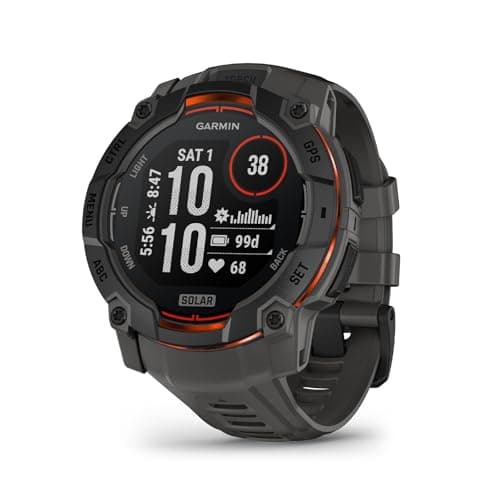 Garmin Instinct 3 Solar (50mm) Unlimited smartwatch battery with three hours a day of sun, 150 max-battery GPS hours that also goes unlimited with solar, 10 ATM and a flashlight. | Best for thru-hiking overallSolar GPS | 8.7 /10 | $399.99Amazon |
| 2 | 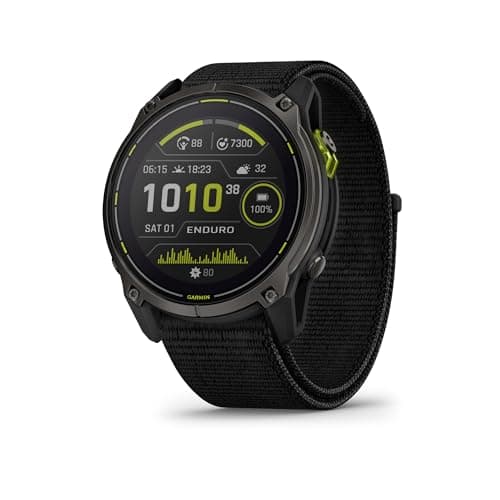 Garmin Enduro 3 Up to 90 days of smartwatch battery, 320 GPS hours with solar, sapphire, a titanium bezel and 63 grams on a nylon band. | Best if you want maps tooSolar GPS | 8.5 /10 | $799.99Amazon |
| 3 | 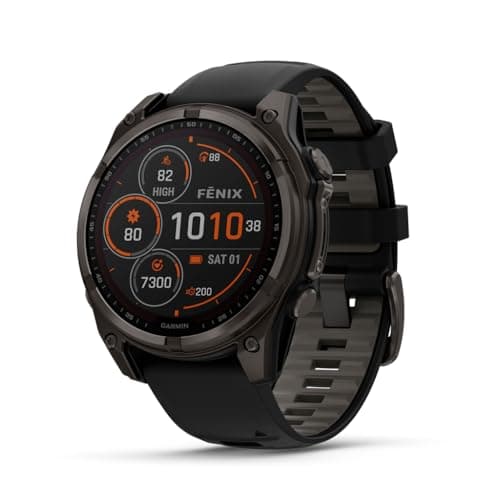 Garmin fenix 8 Solar (47mm, Sapphire) Sapphire, titanium bezel, preloaded TopoActive maps, 28 days with solar and 92 GPS hours with solar at 47 mm. | Best mapping watch for a medium wristSolar GPS | 8.4 /10 | $960.00Amazon |
| 4 | 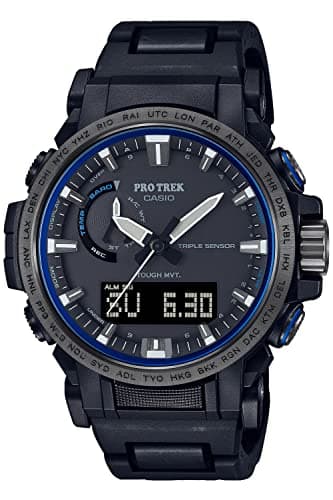 Casio Pro Trek PRW-61 62 grams, 100 m, altimeter, barometer, compass and thermometer, with about six months of solar reserve in the dark. No GPS. | Best watch with nothing to chargeSolar, no charger | 8.1 /10 | $528.47Amazon |
| 5 | 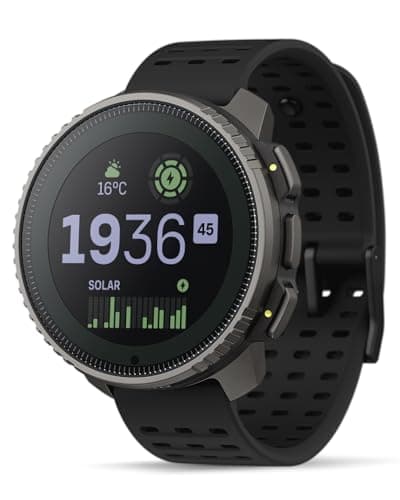 Suunto Vertical Titanium Solar 74 g with a Grade 5 titanium bezel and sapphire, 60 days of daily use with solar and up to 140 single-band GPS hours with solar. | Lightest sapphire solar watchSolar GPS | 8.1 /10 | $549.00Amazon |
#ad · Prices come live from Amazon, last checked November 4, 2026. Scores are ours, built from the makers' manuals, battery tables and spec pages. Product photos come from Amazon; anything still on a stock frame is labelled on its card. Tap a row for the full write-up.
The direct answer
Thru-hiking inverts how watches are normally judged. Heart-rate accuracy, training load and race predictors are irrelevant. What matters is the amount of electricity the watch takes out of a battery bank you are carrying on your back, and how many grams it adds on your wrist.
That reduces the whole category to one question: can the watch get from town to town without being plugged in? On a long trail, resupply is typically four to six days apart, and your bank is already committed to a phone. A watch that wants a charge every five days is a watch that costs you capacity you needed for navigation.
A solar lens solves that outright, which is why four of these five picks have one.
Think in resupply intervals, not hours
Here is the translation that makes the spec sheets useful. A thru-hiker wearing a watch all day in daylight is the exact user Garmin's solar figures are written for: three hours a day at 50,000 lux is bright overcast to full sun, which is what you get walking ten hours a day in the open.
At that exposure, Garmin states the Instinct 3 Solar is unlimited in smartwatch mode and unlimited in max-battery GPS mode, with up to 260 hours of GPS-only. Those are the only numbers on this page where the honest answer to "how often will I charge it?" is "you will not".
If you want the watch recording a GPS track for the whole trail rather than just telling the time, read the second number instead of the first. The Enduro 3 states up to 320 GPS hours with solar charging and up to 120 hours with multi-band SatIQ, which is roughly two weeks of all-day recording in the lower-accuracy mode. The fenix 8 Solar 47 mm gives 67 GPS-only hours and 92 with solar, which is a few days of all-day recording and then a charge.
The picks, side by side
| Evidence | Garmin Instinct 3 Solar (50mm) | Garmin Enduro 3 | Garmin fenix 8 Solar (47mm, Sapphire) | Suunto Vertical Titanium Solar |
|---|---|---|---|---|
| Power | Rechargeable, built-in lithium-ion battery with solar charging display | — | — | — |
| Battery (smartwatch) | Up to 40 days typical use; unlimited with solar (3 hr/day at 50,000 lux) | Up to 90 days in smartwatch mode | Up to 21 days typical use; up to 28 days with solar | Up to 30 days daily use (60 days with solar); standby up to 60 days (1 year with solar) |
| Battery (GPS) | Up to 60 hours GPS-only; up to 260 hours with solar (50,000 lux) | Up to 320 hours in GPS mode with solar charging; up to 120 hours with multi-band SatIQ | Up to 67 hours GPS-only; up to 92 hours with solar | Up to 65 h multi-band (90 h with solar); up to 90 h single-band (140 h with solar) |
| Glass | Scratch-resistant display (Garmin does not name sapphire on the Instinct 3) | Scratch-resistant sapphire lens | Scratch-resistant sapphire lens (sapphire versions) | Sapphire crystal |
| Weight | — | 63 grams | — | 74 g / 2.61 oz |
| Score | 8.7/10 | 8.5/10 | 8.4/10 | 8.1/10 |
The Instinct 3 Solar leads because it is the cheapest watch here and the only one whose battery answer is a word rather than a number. It is also the one with the fewest things to go wrong: a monochrome MIP display that costs almost nothing to leave on, physical buttons, 10 ATM, a build Garmin states is to MIL-STD-810, and a flashlight with a red mode that doubles as a camp light. What it does not have is maps or a sapphire lens.
The Enduro 3 is the thru-hiker's flagship and the better watch if the budget allows: 90 days of smartwatch battery, 320 GPS hours with solar, a sapphire lens, a 51 mm titanium bezel, and — the detail that matters most on trail — 63 grams on its UltraFit nylon band. That is lighter than the 62-gram Pro Trek is heavy, for a watch with maps and a battery measured in months.
The fenix 8 Solar in 47 mm is the pick if you want full mapping on a medium wrist and accept shorter figures than the Enduro. Sapphire, a titanium bezel, preloaded TopoActive maps, a 40 m dive-rated case and leakproof buttons. It is the most capable watch here and the one that most needs a plan for charging.
The Suunto Vertical Titanium Solar is the lightest sapphire solar watch anyone makes at 74 grams, with a Grade 5 titanium bezel, 100 m, and Suunto's own figures of 60 days of daily use with solar and up to 140 single-band GPS hours with solar. It is a strong alternative if you prefer Suunto's simpler interface; the comparison is in Suunto vs Garmin.
Weight, and the nylon strap trick
Thru-hikers count grams, so here is the single cheapest change you can make: swap the silicone strap for nylon.
The published figures make the point. The Enduro 3 ships on a nylon band at 63 grams. COROS publishes its weights both ways and the difference is consistent: the VERTIX 2S is 87 grams on silicone and 70 on nylon, and the NOMAD is 61 on silicone and 49 on nylon. That is a 15 to 20 per cent saving for a few dollars, and nylon also dries, does not trap sweat against skin for weeks, and does not crack with UV the way cheap resin does.
The strap-material argument in full is in resin vs steel cases.
Do you need maps on a marked trail?
Mostly, no, and this is where a lot of money gets wasted.
A marked long-distance trail is navigated with a phone app and a paper or digital guide. The watch's job is to answer the questions you ask twenty times a day without taking a phone out of a hip pocket: what time is it, how far have I come, how much climbing is left, when does the light go, and is the pressure dropping.
That is an ABC-and-GPS job, not a mapping job. Every pick here does it. Maps earn their place in two situations: off-trail alternates and bail-outs, where seeing the terrain around you matters; and winter or fog, where you cannot see the next marker. If either applies, buy the Enduro 3 or the fenix 8 Solar. Otherwise the Instinct 3 Solar does the actual work for a fraction of the price. The mapping options are compared in best watch with offline maps and Garmin watches with topo maps.
The case for no GPS at all
It is a better case than it sounds, and the Casio Pro Trek PRW-61 is here to make it.
62 grams, 51.0 by 47.4 by 14.7 mm, 100 metres, a biomass plastics case, and the direction, pressure, altitude and temperature sensor set with radio time calibration and a double LED light. It runs on Tough Solar, which Casio rates at about six months of reserve with no light at all, and it has no charging port, no firmware, no app dependency and nothing to go unsupported.
For a hiker whose phone handles navigation, that is arguably the correct instrument: the lightest option here, the only one that genuinely never needs power, and the one that will still work identically in fifteen years. The trade is that a barometric altimeter drifts with the weather and needs calibrating at known points, which is covered in ABC watch explained.
The decade pick
In detail
The picks, in full
Rank 1
Best for thru-hiking overall
Garmin Instinct 3 Solar (50mm)
Unlimited smartwatch battery with three hours a day of sun, 150 max-battery GPS hours that also goes unlimited with solar, 10 ATM and a flashlight.
EvidenceResearched · every row sourced
How the 8.7 score breaks down
- Battery & power independence (25%)
- 10
- Durability of materials (25%)
- 8
- Serviceability & lifespan (20%)
- 7
- Field usability (15%)
- 9
- Value per decade (10%)
- 10
- Mission fit (5%)
- 8
What the spec sheet supports
- Garmin's own table shows the 50mm solar model doubling the 45mm in GPS-with-solar hours (260 vs 130).
- Physical buttons, a monochrome display readable in full sun, and a flashlight with a red mode.
- 10 ATM rating and a MIL-STD 810 claim on a watch that costs less than half a fenix.
Where it falls short
- No maps: it navigates breadcrumb trails and waypoints, not topo maps.
- The solar figures assume three hours a day at 50,000 lux, which is midday sun, not a sleeve.
- Garmin does not name the lens material; treat it as strengthened glass, not sapphire.
Skip this if…
…you need on-wrist topo maps, or you wear long sleeves and work indoors, where the solar math never happens.
#ad · Price as of November 4, 2026 · Disclosure for the link to Garmin Instinct 3 Solar (50mm)
Rank 2
Best if you want maps too
Garmin Enduro 3
Up to 90 days of smartwatch battery, 320 GPS hours with solar, sapphire, a titanium bezel and 63 grams on a nylon band.
EvidenceResearched · every row sourced
| Power class | Solar GPS. A rechargeable cell topped up by a solar lens. Weeks between charges; the cell still ages like any lithium battery. |
|---|---|
| Battery (smartwatch) | Up to 90 days in smartwatch mode |
| Battery (GPS) | Up to 320 hours in GPS mode with solar charging; up to 120 hours with multi-band SatIQ |
| Glass | Scratch-resistant sapphire lens |
| Bezel & case | 51mm titanium bezel; UltraFit nylon band |
| Maps & GPS | Preloaded TopoActive maps |
| Flashlight | Built-in LED flashlight with variable brightness, red light and strobe |
| Weight | 63 grams |
How the 8.5 score breaks down
- Battery & power independence (25%)
- 10
- Durability of materials (25%)
- 9
- Serviceability & lifespan (20%)
- 7
- Field usability (15%)
- 9
- Value per decade (10%)
- 6
- Mission fit (5%)
- 8
What the spec sheet supports
- 320 GPS hours with solar is the largest GPS figure Garmin publishes for any watch we list.
- Lighter than a 51mm fenix 8 thanks to the nylon strap and titanium bezel.
- Sapphire and preloaded maps.
Where it falls short
- Garmin's Enduro 3 release does not state a water rating or MIL-STD line, so we do not claim them here.
- The nylon strap is the point of the weight; a silicone strap adds it back.
Skip this if…
…you swim or dive with your watch and need a stated depth rating; the fenix 8 gives you one.
#ad · Price as of November 4, 2026 · Disclosure for the link to Garmin Enduro 3
Rank 3
Best mapping watch for a medium wrist
Garmin fenix 8 Solar (47mm, Sapphire)
Sapphire, titanium bezel, preloaded TopoActive maps, 28 days with solar and 92 GPS hours with solar at 47 mm.
EvidenceResearched · every row sourced
| Power class | Solar GPS. A rechargeable cell topped up by a solar lens. Weeks between charges; the cell still ages like any lithium battery. |
|---|---|
| Battery (smartwatch) | Up to 21 days typical use; up to 28 days with solar |
| Battery (GPS) | Up to 67 hours GPS-only; up to 92 hours with solar |
| Battery (max GPS) | Up to 132 hours max-battery GPS; up to 283 hours with solar |
| Glass | Scratch-resistant sapphire lens (sapphire versions) |
| Bezel & case | Titanium bezel (sapphire versions); leakproof metal buttons |
| Water rating | 40-meter dive-rated case |
| MIL-STD-810 | Tested to U.S. military standards for thermal, shock and water resistance |
| Maps & GPS | TopoActive maps preloaded on sapphire versions |
How the 8.4 score breaks down
- Battery & power independence (25%)
- 8
- Durability of materials (25%)
- 10
- Serviceability & lifespan (20%)
- 7
- Field usability (15%)
- 10
- Value per decade (10%)
- 6
- Mission fit (5%)
- 8
What the spec sheet supports
- Every fenix 8 durability feature in the size most people can actually wear.
- 92 GPS hours with solar covers a long weekend of tracking with margin.
Where it falls short
- Smartwatch battery drops below a month (28 days with solar) versus the 51mm's 48.
- Same MIP-display trade-off as the 51mm.
Skip this if…
…battery days are the reason you are here; the 51mm solar is the fenix for that.
#ad · Price as of November 4, 2026 · Disclosure for the link to Garmin fenix 8 Solar (47mm, Sapphire)
Rank 4
Best watch with nothing to charge
Casio Pro Trek PRW-61
62 grams, 100 m, altimeter, barometer, compass and thermometer, with about six months of solar reserve in the dark. No GPS.
EvidenceResearched · every row sourced
| Power class | Solar, no charger. A solar cell that recharges from any light and never meets a charger. The rechargeable cell is a watchmaker-replaceable part. |
|---|---|
| Battery (cell) | Approximately 6 months with no light (Casio's stated usage conditions) |
| Power | Solar panel and one rechargeable battery |
| Bezel & case | Biomass plastics case |
| Water rating | 100 m |
| Sensors | Direction, pressure/altitude and temperature sensors; radio time calibration (JJY, WWVB, MSF, DCF77, BPC); double LED light |
| Weight | 62 g |
| Size | 51.0 × 47.4 × 14.7 mm |
| Operating temp | Low-temperature resistance to -10°C (14°F) |
How the 8.1 score breaks down
- Battery & power independence (25%)
- 9
- Durability of materials (25%)
- 6
- Serviceability & lifespan (20%)
- 9
- Field usability (15%)
- 8
- Value per decade (10%)
- 9
- Mission fit (5%)
- 8
What the spec sheet supports
- Solar, atomic and triple sensor at 62 g and 14.7 mm.
- Cleaner dial and a proper altimeter graph for hikers.
Where it falls short
- 100 m and no mud-resistant buttons; it is a hiking watch, not a Mudman.
- Mineral glass.
Skip this if…
…your watch gets buried in mud or dunked regularly; the G-Shock Mudman is the sealed version of this idea.
#ad · Price as of November 4, 2026 · Disclosure for the link to Casio Pro Trek PRW-61
Rank 5
Lightest sapphire solar watch
Suunto Vertical Titanium Solar
74 g with a Grade 5 titanium bezel and sapphire, 60 days of daily use with solar and up to 140 single-band GPS hours with solar.
EvidenceResearched · every row sourced
| Power class | Solar GPS. A rechargeable cell topped up by a solar lens. Weeks between charges; the cell still ages like any lithium battery. |
|---|---|
| Battery (smartwatch) | Up to 30 days daily use (60 days with solar); standby up to 60 days (1 year with solar) |
| Battery (GPS) | Up to 65 h multi-band (90 h with solar); up to 90 h single-band (140 h with solar) |
| Battery (max GPS) | Up to 500 h in power-saving GNSS modes |
| Glass | Sapphire crystal |
| Bezel & case | Titanium Grade 5 bezel; glass fiber reinforced polyamide case |
| Water rating | 100 m |
| Display | 1.4-inch matrix (MIP) |
| Maps & GPS | Free offline outdoor maps, 32 GB map storage; dual-band GNSS, L1 + L5 |
| Weight | 74 g / 2.61 oz |
| Operating temp | -20°C to +55°C (-5°F to +130°F) |
How the 8.1 score breaks down
- Battery & power independence (25%)
- 9
- Durability of materials (25%)
- 9
- Serviceability & lifespan (20%)
- 6
- Field usability (15%)
- 8
- Value per decade (10%)
- 8
- Mission fit (5%)
- 7
What the spec sheet supports
- Solar, sapphire and titanium at 74 g, lighter than a fenix 8 51mm.
- 500 hours in power-saving GPS is the highest Suunto figure and beats the fenix 8 Solar 47mm's max-battery figure without solar.
Where it falls short
- Previous generation: no flashlight, dimmer MIP screen, older optical heart rate.
- 100 m water rating, no MIL-STD claim in Suunto's specs.
Skip this if…
…you want the brightest screen and a flashlight; that is the Vertical 2.
#ad · Price as of November 4, 2026 · Disclosure for the link to Suunto Vertical Titanium Solar
How to choose a thru-hiking watch
1. Decide whether you are recording a track. If not, any solar watch here lasts the whole trail. If you are, read the GPS row rather than the smartwatch row and expect to charge.
2. Insist on solar, or accept the power bank cost. Every charge your watch takes is capacity your phone does not get.
3. Prefer a MIP display to an AMOLED. Reflective screens get more readable in bright light and cost almost nothing to leave on, which is why the long-battery picks all use one. See MIP vs AMOLED battery life.
4. Weigh it with the strap you will actually use. Nylon saves 15 to 20 per cent over silicone and dries out.
5. Check the sunrise and sunset data. Knowing when the light goes is the most-used feature on a long trail. The Instinct 3 provides sunrise, sunset and civil twilight plus moon phase from GPS position; the Casios compute sunrise and sunset too.
6. Buttons, not a touchscreen. Rain, gloves and sweat make a touchscreen a liability.
How we scored this
What we checked to build this ranking
Every pick here is researched against the documents that decide whether a watch lasts: the maker's own battery table read mode by mode, what the lens and case are actually made of, the water rating, whether a MIL-STD-810 line is on the record and in whose words, and how long the maker keeps updating the line. Each one is then scored on a public rubric weighted for a decade of ownership, and every figure links to where it came from.
That is why the order on this page is worth following: it is built from specs you can open yourself, and commissions never set a score or decide a pick. The rubric and its weights are published.
Questions
Frequently asked
What is the best watch for thru-hiking?
The Garmin Instinct 3 Solar in 50 mm. Garmin rates it unlimited in smartwatch mode and unlimited in max-battery GPS mode with three hours a day at 50,000 lux, which is the exposure a thru-hiker actually gets, so it never draws on your power bank. The Enduro 3 is the upgrade if you want maps, at 63 grams and 90 days of smartwatch battery.
Can a GPS watch record a whole thru-hike?
Continuously, no watch does 2,000 miles on one charge. The Enduro 3 states up to 320 GPS hours with solar and 120 hours with multi-band SatIQ, which is roughly two weeks of all-day recording before a charge. The Instinct 3 Solar reaches unlimited in max-battery GPS mode with sun, at reduced track fidelity.
Do I need maps on my watch for a long trail?
Usually not. Marked trails are navigated with a phone app, and the watch answers time, distance, climb, sunset and pressure. Maps earn their place for off-trail alternates, bail-outs, and winter or fog. If that is your plan, buy the Enduro 3 or the fenix 8 Solar.
What is the lightest watch for backpacking?
Among the picks here, the Casio Pro Trek PRW-61 at 62 grams and the Garmin Enduro 3 at 63 grams on its nylon band, which is remarkable for a mapping watch. Swapping any watch from silicone to nylon saves roughly 15 to 20 per cent of its strap-on weight.
Is a solar watch worth it for thru-hiking?
More than for any other use. Solar figures assume several hours a day of bright light, which is exactly what ten hours of walking in the open provides, and the saved charges come straight off the weight of the battery bank you are carrying.
Keep reading
Related on Bezel & Bearing
Receipts
Sources
- Garmin newsroom — Instinct 3 Series press release (checked 2026-09-20)
- Garmin — Instinct 3 Solar Series Owner's Manual, Battery Life Information (checked 2026-09-20)
- Garmin newsroom — Enduro 3 press release (checked 2026-09-20)
- Garmin newsroom — fenix 8 Series press release (checked 2026-09-20)
- Garmin — fenix 8 Series Owner's Manual, Battery Information (checked 2026-09-20)
- Suunto — Vertical Titanium Solar Black product page and tech specs (checked 2026-09-20)
- COROS — VERTIX 2S / APEX / NOMAD specification tables (checked 2026-09-20)
- Casio — Operation Guide, module 5673 (Pro Trek PRW-61), Specifications (checked 2026-09-20)
- New Atlas — Casio Pro Trek PRW-61 announcement (size, weight, water rating, battery) (checked 2026-09-20)
Battery, glass, case and water figures come from the maker's own owner's manuals, spec pages and press releases, linked on every product so you can open the page they came from. Prices are set by Amazon and change often, so each buy button takes you to the current one. Read the full method.