GPS Watches / Review
Suunto Race 2 review: the lightest sapphire-and-titanium watch anyone sells, minus the solar
Suunto put its best materials on its racing watch: sapphire, Grade 5 titanium, 65 grams, 32 GB of offline maps and dual-band GNSS on four constellations. Then it left off the solar lens and the flashlight. Here is who that adds up for.
By Mike M.Updated Researched from the maker's manuals and spec sheets
#adReader-supported: we may earn a commission if you buy through our links, at no extra cost to you. It never decides a ranking. How we rate · Disclosure
The verdict
The watch and its alternatives
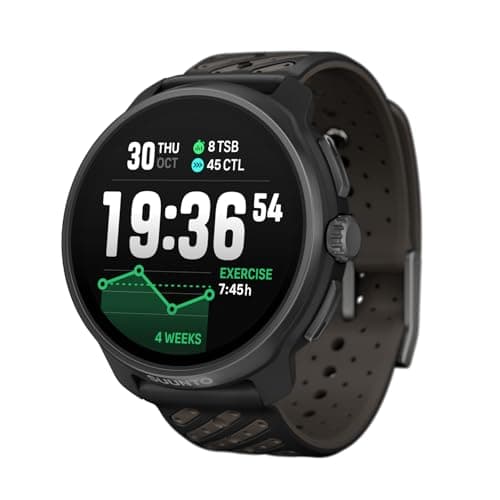
The watch under review
Suunto Race 2 Titanium
Rechargeable GPS7.2 /10Sapphire over a Grade 5 titanium bezel at 65 g, 1.5-inch LTPO AMOLED, 55 h multi-band GPS, 200 h in power saving, 32 GB of offline maps. Score below.
$599.00Amazon#ad · Price as of November 4, 2026 · Disclosure for the link to Suunto Race 2 Titanium
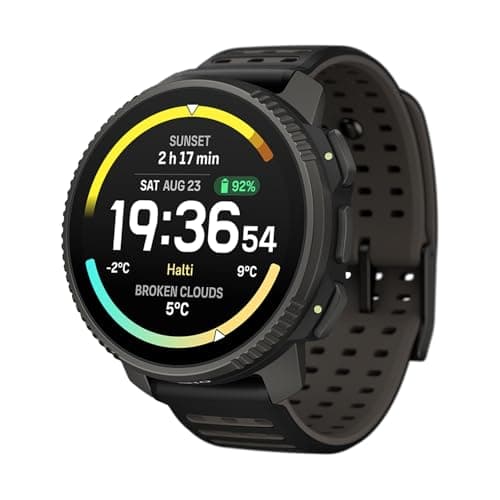
Alternative: the one with the flashlight
Suunto Vertical 2 Titanium
Rechargeable GPS7.6 /10Suunto's adventure flagship. Same sapphire and titanium, adds an LED flashlight and 65 h multi-band hours, at 87 g instead of 65.
$699.00Amazon#ad · Price as of November 4, 2026 · Disclosure for the link to Suunto Vertical 2 Titanium
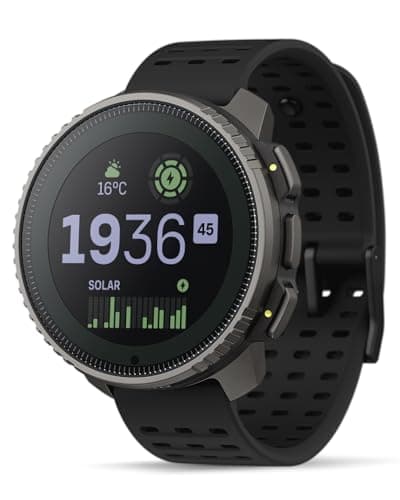
Alternative: the one that runs on light
Suunto Vertical Titanium Solar
Solar GPS8.1 /10The previous-generation Vertical with a solar lens: 60 smartwatch days and 90 multi-band GPS hours with solar, 74 g, MIP rather than AMOLED.
$549.00Amazon#ad · Price as of November 4, 2026 · Disclosure for the link to Suunto Vertical Titanium Solar
Verdict and score
Suunto has quietly become the cheapest way to buy the two materials that decide whether a watch survives a decade. Sapphire crystal and Grade 5 titanium are fenix-tier specifications, and Suunto puts them on a watch that weighs less than two thirds of what a 51 mm fenix weighs. The Race 2 is the lightest version of that deal the company sells.
It is also, on paper, a racing watch rather than an expedition watch, and the spec sheet is honest about it. Fifty-five hours of multi-band GPS is a hundred-miler, not a thru-hike. Eighteen days of daily use is good for an AMOLED and short for this site. There is no solar lens, so the lithium cell gets cycled every two to three weeks for the rest of its life, and that is the single fastest-ageing arrangement in any watch we cover.
So the score lands where the specifications put it: very high on materials, mid-table on power independence, and strong on field usability because of what 65 grams and a 1.5-inch screen do for you on a long day.
The materials, which are the point
Suunto's spec table for this model reads: glass "Sapphire crystal", bezel "Titanium Grade 5", case "Glass fibre reinforced polyamide". All three of those are worth unpacking.
Sapphire is the only lens material that reliably survives a decade of contact with rock, door frames and truck beds without a visible scratch. It is harder than the quartz dust that does most real-world damage, which chemically strengthened glass is not. The trade is that it is more brittle under a sharp impact and it reflects more light. We rank screens on exactly this in most scratch-resistant smartwatch, and the material argument is in sapphire vs Gorilla Glass.
Grade 5 titanium is Ti-6Al-4V, the alloy aerospace uses, not the commercially pure Grade 2 that shows up on cheaper "titanium" watches. It is roughly as strong as steel at a little over half the density, and it conducts heat away from your wrist more slowly, which is why titanium watches feel less punishing in deep cold. The grades and what they mean are covered in titanium vs stainless steel.
Glass-fiber-reinforced polyamide for the case is the same choice Suunto makes on the Vertical line and the same class of material Garmin calls fiber-reinforced polymer. It is the reason the watch is this light, and it is a rational one: the bezel takes the abuse, and a polymer case does not dent.
65 grams, and why it matters more than you think
Suunto states 65 g / 2.29 oz for the titanium Race 2, in a 49 mm case 12.5 mm thick. For context inside our own registry, Suunto states 87 g for the Vertical 2 Titanium and 74 g for the Vertical Titanium Solar, and a full-metal G-Shock square runs 167 g. The Race 2 is the lightest GPS watch with sapphire and titanium we have specs for.
Weight is the most underrated specification on a watch you intend to wear every day for ten years. It decides whether you sleep in it, which decides whether its recovery and HRV data is worth anything. It decides whether it swings on your wrist under a pack strap. And 12.5 mm of thickness decides whether it catches on a jacket cuff. A watch you take off is a watch that is not collecting data and not on your wrist when you need the time.
The counterweight to that, honestly stated: 49 mm across is still a large watch, and the useful guide to whether that fits you is what size GPS watch should I buy.
Battery, in Suunto's four modes
Suunto publishes an unusually clear battery table — four named training modes with four figures, plus two daily figures — and it is one of the few makers that tells you which display setting each training figure assumes.
- Daily use, smartwatch mode: up to 18 days.
- Daily use, standby only: up to 30 days.
- Training, all-systems GNSS + multi-band: up to 55 hours (always-on display at 50).
- Training, all-systems GNSS + single-band: up to 65 hours (always-on display at 60).
- Training, all four battery modes: Suunto states 55 h / 65 h / 90 h / 200 h across Performance, Endurance, Ultra and Tour.
- Training, power-saving GNSS modes: up to 200 hours.
Two readings. The first is that 55 hours of the most accurate GPS this watch can do is a strong figure for a 12.5 mm AMOLED watch — it is within striking distance of the 65 hours Suunto quotes for the much larger Vertical 2, and it is more than double what most AMOLED running watches manage. The second is that the Tour figure of 200 hours is a genuinely useful long-trip mode, at the cost of GPS accuracy and heart rate.
Maps and satellites
This is where Suunto has been beating the market for two generations, and the Race 2 keeps the advantage. Offline maps are on the watch, Suunto states 32 GB of storage for them, and they are free — no subscription, no regional purchase. Outdoor terrain and satellite map layers, route planning with an altitude profile, global heatmaps for 20 sports, snap-to-route, POI navigation and ETA are all on the published feature list.
On satellites, Suunto states GPS, GLONASS, Galileo, QZSS and BeiDou, with dual-band L1+L5 support, four simultaneous satellite systems and up to 32 connected satellites. Dual-band is the thing that matters in canyons and under canopy, and what it does and does not fix is explained in GPS watch accuracy explained.
For altitude, Suunto states a barometric altimeter, GPS altitude and FusedAlti, which combines the two, with 1 m resolution and a 1-second log rate, plus a digital compass. That is a full ABC sensor set in everything but the marketing name; the distinction between a barometric and a GPS altitude reading is the one that matters on a mountain, and it is covered in best watch for mountaineering.
What it does not have
No solar lens. This is the big one for this site. The Race 2 charges from a cable, and every charge cycle ages the cell. Over a decade that is the difference between a watch whose battery you never think about and one whose battery is a consumable. Suunto still sells a solar watch — the previous-generation Vertical Titanium Solar — and it is the one we point buy-it-for-life readers at.
No flashlight. Suunto's spec sheet for the Race 2 lists none, and the Vertical 2's does. If you want a Suunto with a light on it, that is the model.
No MIL-STD-810 claim and no dive rating. Suunto states 100 m water resistance and an operating range of -20°C to +55°C, and makes no military-standard claim for this watch. We do not award a MIL-STD flag that a maker has not claimed; what the standard means when it is claimed is in MIL-STD-810 watches explained.
No tide function in any source we read, and no published charge time. Where a maker does not publish a figure, this page leaves the row empty rather than filling it.
Race 2 or Vertical 2
These are the two watches most people shopping Suunto are actually deciding between, and the published differences are small and specific.
Take the Race 2 if weight and thickness matter to you, if you sleep in your watch, or if your long days are measured in hours rather than days. Take the Vertical 2 if you want the flashlight and the extra ten hours of multi-band GPS and do not mind 87 g. Take the Vertical Titanium Solar if you want to stop charging, and accept a dimmer MIP screen and an older sensor generation in exchange for 60 smartwatch days with solar. The broader ranking is in best Suunto watch, and the cross-brand version is Suunto vs Garmin.
The decade question
Will you still be wearing this in ten years? The case for yes is unusually strong on materials: a sapphire lens and a Grade 5 titanium bezel are the two parts of a watch that normally look worn out first, and both of these will look new. A polyamide case does not corrode. Suunto's offline maps are free, so there is no subscription to lapse.
The case for no is the cell. A lithium battery cycled every two to three weeks for ten years is somewhere between 170 and 260 full cycles, and no maker publishes a replacement path for this watch in the sources we read. That is the structural argument for solar on this site, and it is why a watch with better materials than a Garmin Instinct scores lower than one on power independence. The full method is at how we rate, and the category argument is in buy-it-for-life watches.
Who should skip it
Skip it if your trips are measured in days away from power. Fifty-five GPS hours and no solar means a charger comes with you, and the watches that solve that problem are ranked in longest-battery-life GPS watches.
Skip it if you need a flashlight, a light-discipline mode or a stated military-standard build, which is tactical territory rather than racing territory — best tactical smartwatch covers that reader. Skip it if 49 mm and 12.5 mm is more watch than your wrist wants.
Buy it if you want the best materials per gram on the market, free offline maps, and a watch you will actually keep on your wrist overnight — and if you are at peace with plugging it in a couple of times a month for the next decade.
In detail
Spec sheet and score
The watch under review
Suunto Race 2 Titanium
Sapphire over a Grade 5 titanium bezel at 65 g, 1.5-inch LTPO AMOLED, 55 h multi-band GPS, 200 h in power saving, 32 GB of offline maps. Score below.
EvidenceResearched · every row sourced
| Power class | Rechargeable GPS. A rechargeable lithium cell charged from a cable. Days to a few weeks per charge; the cell ages with every cycle. |
|---|---|
| Battery (smartwatch) | Up to 18 days daily use; up to 30 days standby only |
| Battery (GPS) | Up to 55 h all-systems GNSS + multi-band (AOD 50); up to 65 h single-band (AOD 60) |
| Battery (max GPS) | Up to 200 h in power-saving GNSS modes; Suunto states 55 h / 65 h / 90 h / 200 h across its four battery modes |
| Glass | Sapphire crystal |
| Bezel & case | Titanium Grade 5 bezel; glass fiber reinforced polyamide case |
| Water rating | 100 m |
| Display | 1.5-inch LTPO AMOLED touchscreen, 466 x 466 |
| Maps & GPS | Offline maps with 32 GB storage; GPS, GLONASS, Galileo, QZSS, BeiDou, dual band L1+L5, four simultaneous systems |
| Sensors | Barometric altimeter with FusedAlti, digital compass, wrist heart rate, blood oxygen |
| Weight | 65 g / 2.29 oz |
| Size | 49 mm diameter, 12.5 mm thick |
| Operating temp | -20°C to +55°C (-5°F to +130°F) |
How the 7.2 score breaks down
- Battery & power independence (25%)
- 6
- Durability of materials (25%)
- 9
- Serviceability & lifespan (20%)
- 6
- Field usability (15%)
- 8
- Value per decade (10%)
- 7
- Mission fit (5%)
- 6
What the spec sheet supports
- Sapphire over a Grade 5 titanium bezel at 65 g — lighter than the Vertical 2 and lighter than every fenix.
- 32 GB of free offline maps and dual-band L1+L5 on four satellite systems at once.
- 200 hours in the power-saving GNSS mode is a multi-day figure from a watch this thin.
Where it falls short
- No solar on this model, so the lithium cell gets cycled every two to three weeks.
- Suunto's spec sheet lists no flashlight; the Vertical 2 has one and this does not.
- 100 m water rating, no stated MIL-STD-810 claim and no dive rating.
Skip this if…
…you want to stop charging — the Vertical Titanium Solar is the Suunto that runs on light.
#ad · Price as of November 4, 2026 · Disclosure for the link to Suunto Race 2 Titanium
Alternative: the one with the flashlight
Suunto Vertical 2 Titanium
Suunto's adventure flagship. Same sapphire and titanium, adds an LED flashlight and 65 h multi-band hours, at 87 g instead of 65.
EvidenceResearched · every row sourced
| Power class | Rechargeable GPS. A rechargeable lithium cell charged from a cable. Days to a few weeks per charge; the cell ages with every cycle. |
|---|---|
| Battery (smartwatch) | Up to 20 days daily use; up to 40 days standby |
| Battery (GPS) | Up to 65 h all-systems + multi-band (60 h always-on); up to 75 h single-band |
| Battery (max GPS) | Up to 250 h in power-saving GNSS modes |
| Glass | Sapphire crystal |
| Bezel & case | Titanium bezel; glass fiber reinforced polyamide case |
| Water rating | 100 m |
| Display | 1.5-inch LTPO AMOLED, 466 × 466 |
| Maps & GPS | Offline maps; GPS, GLONASS, Galileo, QZSS, BeiDou |
| Flashlight | Integrated LED flashlight |
| Weight | 87 g / 3.07 oz |
| Operating temp | -20°C to +55°C (-5°F to +130°F) |
How the 7.6 score breaks down
- Battery & power independence (25%)
- 7
- Durability of materials (25%)
- 9
- Serviceability & lifespan (20%)
- 6
- Field usability (15%)
- 9
- Value per decade (10%)
- 7
- Mission fit (5%)
- 7
What the spec sheet supports
- Sapphire and titanium at the price of a polymer Garmin.
- Offline maps and a flashlight on a Suunto for the first time in the Vertical line.
Where it falls short
- The Vertical 2 dropped solar; the original Vertical Titanium Solar still has it.
- 100 m rating, no stated MIL-STD line, no dive rating.
Skip this if…
…you wanted a Suunto that never sees a charger; buy the first-gen Vertical Titanium Solar instead.
#ad · Price as of November 4, 2026 · Disclosure for the link to Suunto Vertical 2 Titanium
Alternative: the one that runs on light
Suunto Vertical Titanium Solar
The previous-generation Vertical with a solar lens: 60 smartwatch days and 90 multi-band GPS hours with solar, 74 g, MIP rather than AMOLED.
EvidenceResearched · every row sourced
| Power class | Solar GPS. A rechargeable cell topped up by a solar lens. Weeks between charges; the cell still ages like any lithium battery. |
|---|---|
| Battery (smartwatch) | Up to 30 days daily use (60 days with solar); standby up to 60 days (1 year with solar) |
| Battery (GPS) | Up to 65 h multi-band (90 h with solar); up to 90 h single-band (140 h with solar) |
| Battery (max GPS) | Up to 500 h in power-saving GNSS modes |
| Glass | Sapphire crystal |
| Bezel & case | Titanium Grade 5 bezel; glass fiber reinforced polyamide case |
| Water rating | 100 m |
| Display | 1.4-inch matrix (MIP) |
| Maps & GPS | Free offline outdoor maps, 32 GB map storage; dual-band GNSS, L1 + L5 |
| Weight | 74 g / 2.61 oz |
| Operating temp | -20°C to +55°C (-5°F to +130°F) |
How the 8.1 score breaks down
- Battery & power independence (25%)
- 9
- Durability of materials (25%)
- 9
- Serviceability & lifespan (20%)
- 6
- Field usability (15%)
- 8
- Value per decade (10%)
- 8
- Mission fit (5%)
- 7
What the spec sheet supports
- Solar, sapphire and titanium at 74 g, lighter than a fenix 8 51mm.
- 500 hours in power-saving GPS is the highest Suunto figure and beats the fenix 8 Solar 47mm's max-battery figure without solar.
Where it falls short
- Previous generation: no flashlight, dimmer MIP screen, older optical heart rate.
- 100 m water rating, no MIL-STD claim in Suunto's specs.
Skip this if…
…you want the brightest screen and a flashlight; that is the Vertical 2.
#ad · Price as of November 4, 2026 · Disclosure for the link to Suunto Vertical Titanium Solar
How we scored this
What we checked to build this ranking
Every pick here is researched against the documents that decide whether a watch lasts: the maker's own battery table read mode by mode, what the lens and case are actually made of, the water rating, whether a MIL-STD-810 line is on the record and in whose words, and how long the maker keeps updating the line. Each one is then scored on a public rubric weighted for a decade of ownership, and every figure links to where it came from.
That is why the order on this page is worth following: it is built from specs you can open yourself, and commissions never set a score or decide a pick. The rubric and its weights are published.
Questions
Frequently asked
Is the Suunto Race 2 worth it?
If you want sapphire and Grade 5 titanium at the lowest weight anyone sells, yes — Suunto states 65 g in a 49 by 12.5 mm case, with 55 hours of multi-band GPS, 18 days of daily use and 32 GB of free offline maps. If your priority is not charging the watch, no: there is no solar lens, and Suunto's own Vertical Titanium Solar is rated at 60 smartwatch days with solar.
What is the battery life of the Suunto Race 2?
Suunto publishes up to 18 days in daily smartwatch use and up to 30 days in standby only. In training, it states up to 55 hours with all satellite systems plus multi-band, up to 65 hours single-band, and up to 200 hours in the power-saving modes — quoted as 55 h / 65 h / 90 h / 200 h across its four battery modes.
Does the Suunto Race 2 have sapphire glass?
The titanium model does: Suunto's spec table for the Race 2 Titanium lists "Sapphire crystal" and a "Titanium Grade 5" bezel. Suunto sells the Race 2 in more than one configuration, so check that the model you are buying is the titanium one — we only make the sapphire claim for the version whose spec sheet states it.
Does the Suunto Race 2 have offline maps?
Yes, and they are free. Suunto states offline maps on the watch with 32 GB of storage, plus outdoor terrain and satellite map layers, route planning with an altitude profile, global heatmaps for 20 sports and snap-to-route. Free mapping is Suunto's strongest competitive position; the cross-market ranking is in best watch with offline maps.
Suunto Race 2 or Suunto Vertical 2?
Race 2 for weight and thickness — 65 g against 87 g, in a thinner case. Vertical 2 for the LED flashlight Suunto lists on it and for ten more hours of multi-band GPS (65 against 55). Both carry sapphire, a titanium bezel, a 100 m rating and free offline maps, and neither has solar.
Is the Suunto Race 2 rugged enough for hiking and hunting?
On published specifications it is well built for it — sapphire, a titanium bezel, 100 m water resistance and a -20°C to +55°C operating range — but Suunto makes no MIL-STD-810 claim for it and there is no flashlight, which are two things a hunting or tactical buyer usually wants. Our hunting picks are in best GPS watch for hunting.
Keep reading
Related on Bezel & Bearing
Receipts
Sources
- Suunto — Race 2 Titanium Black product page and tech specs (checked 2026-10-28)
- Suunto — Vertical 2 Titanium Black product page and tech specs (checked 2026-09-20)
- Suunto — Vertical Titanium Solar Black product page and tech specs (checked 2026-09-20)
- Garmin — Instinct 3 Solar Series Owner's Manual, Battery Life Information (checked 2026-09-20)
Battery, glass, case and water figures come from the maker's own owner's manuals, spec pages and press releases, linked on every product so you can open the page they came from. Prices are set by Amazon and change often, so each buy button takes you to the current one. Read the full method.