GPS Watches / The rankings
The best Suunto watch: the solar one, the map one, and the one with no battery to charge
Suunto puts sapphire and Grade 5 titanium on watches Garmin sells in polymer at the same money. The line is small enough to explain in one page, and the choice comes down to a single question: do you want the solar lens or the colour screen?
By Mike M.Updated Researched from the maker's manuals and spec sheets
#adReader-supported: we may earn a commission if you buy through our links, at no extra cost to you. It never decides a ranking. How we rate · Disclosure
Quick picks
The rankings at a glance
| # | Product | Best for | Score | Price |
|---|---|---|---|---|
| 1 | 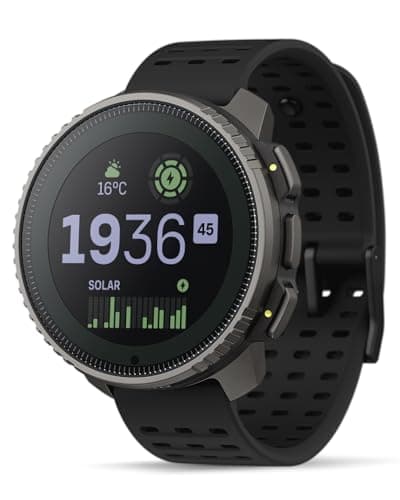 Suunto Vertical Titanium Solar Sapphire, Grade 5 titanium bezel, 74 g, and the only Suunto with a solar lens: up to 30 days of daily use, 60 with solar, and 90 multi-band GPS hours with solar. | Best Suunto overallSolar GPS | 8.1 /10 | $549.00Amazon |
| 2 | 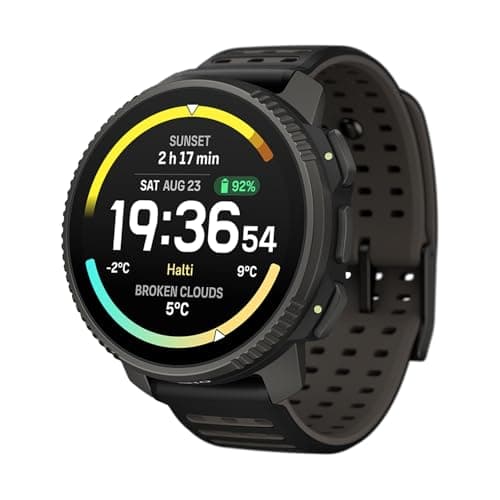 Suunto Vertical 2 Titanium A 1.5-inch LTPO AMOLED under sapphire with a titanium bezel, offline maps, a flashlight and 65 multi-band GPS hours. No solar on this generation. | Best Suunto for mapsRechargeable GPS | 7.6 /10 | $699.00Amazon |
| 3 | 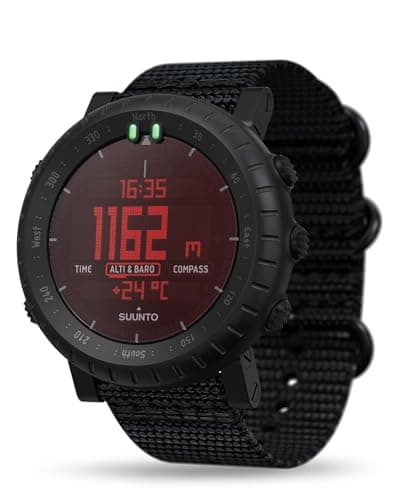 Suunto Core Alpha Altimeter, barometer and compass on a CR2032 Suunto rates at up to 12 months, with a night-vision-compatible red backlight. No GPS, no cable, 67 g. | Best Suunto with nothing to chargeReplaceable cell | 7.5 /10 | Check price · Amazon |
#ad · Prices come live from Amazon, last checked November 4, 2026. Scores are ours, built from the makers' manuals, battery tables and spec pages. Product photos come from Amazon; anything still on a stock frame is labelled on its card. Tap a row for the full write-up.
The whole Suunto line, in one table
Suunto is the easiest outdoor brand to shop, because the useful part of the catalogue is three watches with three different answers to the power question. That is also why this page ranks three rather than ten: we only rank watches we can cite a maker's spec page for, and padding a list with references nobody should buy is how affiliate pages lose their usefulness.
| Watch | Power | Display | Lens | Water | Weight |
|---|---|---|---|---|---|
| Vertical Titanium Solar | Rechargeable + solar lens | 1.4-inch MIP | Sapphire | 100 m | 74 g |
| Vertical 2 Titanium | Rechargeable, cable only | 1.5-inch LTPO AMOLED | Sapphire | 100 m | 87 g |
| Core Alpha | CR2032 coin cell | Monochrome LCD | Mineral | 30 m | 67 g |
Why anyone buys Suunto over Garmin
One reason, and it is a good one: materials for the money. Both Verticals are sapphire with a titanium bezel. The Garmin that competes with them on price, the Instinct 3 Solar, is a fibre-reinforced polymer case with a metal-reinforced bezel and a lens Garmin describes only as "scratch-resistant" without naming sapphire. We do not flag the Instinct as sapphire for exactly that reason, and the difference is explained in sapphire vs Gorilla Glass.
The second reason is weight. 74 g for a 100 m sapphire-and-titanium GPS watch with a solar lens is genuinely light for what it is, and Suunto publishes the number. The third is that Suunto states its battery figures in a single readable table instead of across four support pages.
The solar one is the decade buy
On this site the power system is scored first, because it is the part that ages fastest and the part that ends the watch. The Vertical Titanium Solar is the only Suunto that addresses it. Suunto's own figures: up to 30 days of daily use, up to 60 days with solar; standby up to 60 days, up to a year with solar; up to 65 hours of multi-band GPS, 90 with solar; up to 90 hours single-band, 140 with solar; and up to 500 hours in power-saving GNSS modes.
Read that again for what it means in ownership rather than in specification. A watch worn outside rarely reaches a charger, which means the lithium cell inside cycles a handful of times a year instead of a hundred, which is the single biggest factor in whether a GPS watch is still useful in 2036. The same logic is why the Garmin solar models win their categories, and it is laid out in best solar GPS watches.
It also uses a MIP display, which is the right call for this watch. MIP is reflective: the brighter the ambient light, the more readable it gets, and it costs almost nothing to leave on. That is why the solar Vertical can quote a 30-day figure and the AMOLED Vertical 2 quotes 20.
| Evidence | Suunto Vertical Titanium Solar | Suunto Vertical 2 Titanium | Suunto Core Alpha |
|---|---|---|---|
| Power | — | — | — |
| Battery (smartwatch) | Up to 30 days daily use (60 days with solar); standby up to 60 days (1 year with solar) | Up to 20 days daily use; up to 40 days standby | — |
| Battery (GPS) | Up to 65 h multi-band (90 h with solar); up to 90 h single-band (140 h with solar) | Up to 65 h all-systems + multi-band (60 h always-on); up to 75 h single-band | — |
| Glass | Sapphire crystal | Sapphire crystal | Mineral crystal |
| Bezel & case | Titanium Grade 5 bezel; glass fiber reinforced polyamide case | Titanium bezel; glass fiber reinforced polyamide case | Aluminum bezel; composite case; textile strap |
| Water rating | 100 m | 100 m | 30 m (suitable for shallow snorkeling to 10 m) |
| Weight | 74 g / 2.61 oz | 87 g / 3.07 oz | 67 g / 2.36 oz |
| Score | 8.1/10 | 7.6/10 | 7.5/10 |
The map one, and what AMOLED costs
The Vertical 2 Titanium is Suunto's flagship and the better watch if you navigate off a screen. A 1.5-inch, 466 by 466 LTPO AMOLED under sapphire, offline maps, a flashlight, five GNSS constellations, and a titanium bezel on a glass-fibre-reinforced polyamide case at 87 g.
What the colour screen costs, in Suunto's own numbers: 20 days of daily use instead of 30, 40 days of standby instead of 60, 65 multi-band GPS hours with no solar extension at all, and 13 extra grams. If you are buying a watch for the next decade and not for the next hike, that is a real price. If you are standing in fog trying to read a contour line, it is money well spent. The general version of this argument is in MIP vs AMOLED battery life.
The one with no battery to charge
The Core Alpha is a different product category wearing the same badge. No GPS, no charging, no app: an altimeter, a barometer and a compass with adjustable declination, on a CR2032 that Suunto rates at up to 12 months in time mode, in a 67 g composite case with an aluminium bezel.
Two things make it genuinely interesting rather than merely cheap. The first is the night-vision-goggle-compatible red backlight, which is why it turns up on light-discipline lists; it is the reason we rank it in best ABC watches. The second is that a coin cell is the most serviceable power source there is: any watchmaker, any decade, a few dollars.
Its limits are published and worth respecting. The lens is mineral, not sapphire. The rating is 30 m, which Suunto describes as suitable for shallow snorkelling to 10 m, so this is not a wading or diving watch. And a barometric altimeter drifts with the weather, which is a property of the technology rather than a fault, and is covered in ABC watch explained.
The honest case against Suunto
Three things, stated plainly, because a page that only praises a brand is not useful.
Only one model has solar. Suunto's newest flagship, the Vertical 2, dropped the solar lens in favour of the AMOLED. On a site that ranks power independence first, that is a step backwards, and it is the reason the older solar model is ranked above the newer flagship here.
The ecosystem is smaller. Fewer third-party apps, fewer watch faces, a smaller used market and fewer independent repairers than Garmin or Casio. For a buy-it-for-life purchase, serviceability in year eight matters, and Garmin's scale is a real advantage there.
No MIL-STD-810 claim. Suunto does not use the line on these watches, so we do not flag it. The Instinct 3 and the fenix 8 both do, in their makers' own words, and the standard is explained in MIL-STD-810 watches explained.
The decade pick
In detail
The picks, in full
Rank 1
Best Suunto overall
Suunto Vertical Titanium Solar
Sapphire, Grade 5 titanium bezel, 74 g, and the only Suunto with a solar lens: up to 30 days of daily use, 60 with solar, and 90 multi-band GPS hours with solar.
EvidenceResearched · every row sourced
| Power class | Solar GPS. A rechargeable cell topped up by a solar lens. Weeks between charges; the cell still ages like any lithium battery. |
|---|---|
| Battery (smartwatch) | Up to 30 days daily use (60 days with solar); standby up to 60 days (1 year with solar) |
| Battery (GPS) | Up to 65 h multi-band (90 h with solar); up to 90 h single-band (140 h with solar) |
| Battery (max GPS) | Up to 500 h in power-saving GNSS modes |
| Glass | Sapphire crystal |
| Bezel & case | Titanium Grade 5 bezel; glass fiber reinforced polyamide case |
| Water rating | 100 m |
| Display | 1.4-inch matrix (MIP) |
| Maps & GPS | Free offline outdoor maps, 32 GB map storage; dual-band GNSS, L1 + L5 |
| Weight | 74 g / 2.61 oz |
| Operating temp | -20°C to +55°C (-5°F to +130°F) |
How the 8.1 score breaks down
- Battery & power independence (25%)
- 9
- Durability of materials (25%)
- 9
- Serviceability & lifespan (20%)
- 6
- Field usability (15%)
- 8
- Value per decade (10%)
- 8
- Mission fit (5%)
- 7
What the spec sheet supports
- Solar, sapphire and titanium at 74 g, lighter than a fenix 8 51mm.
- 500 hours in power-saving GPS is the highest Suunto figure and beats the fenix 8 Solar 47mm's max-battery figure without solar.
Where it falls short
- Previous generation: no flashlight, dimmer MIP screen, older optical heart rate.
- 100 m water rating, no MIL-STD claim in Suunto's specs.
Skip this if…
…you want the brightest screen and a flashlight; that is the Vertical 2.
#ad · Price as of November 4, 2026 · Disclosure for the link to Suunto Vertical Titanium Solar
Rank 2
Best Suunto for maps
Suunto Vertical 2 Titanium
A 1.5-inch LTPO AMOLED under sapphire with a titanium bezel, offline maps, a flashlight and 65 multi-band GPS hours. No solar on this generation.
EvidenceResearched · every row sourced
| Power class | Rechargeable GPS. A rechargeable lithium cell charged from a cable. Days to a few weeks per charge; the cell ages with every cycle. |
|---|---|
| Battery (smartwatch) | Up to 20 days daily use; up to 40 days standby |
| Battery (GPS) | Up to 65 h all-systems + multi-band (60 h always-on); up to 75 h single-band |
| Battery (max GPS) | Up to 250 h in power-saving GNSS modes |
| Glass | Sapphire crystal |
| Bezel & case | Titanium bezel; glass fiber reinforced polyamide case |
| Water rating | 100 m |
| Display | 1.5-inch LTPO AMOLED, 466 × 466 |
| Maps & GPS | Offline maps; GPS, GLONASS, Galileo, QZSS, BeiDou |
| Flashlight | Integrated LED flashlight |
| Weight | 87 g / 3.07 oz |
| Operating temp | -20°C to +55°C (-5°F to +130°F) |
How the 7.6 score breaks down
- Battery & power independence (25%)
- 7
- Durability of materials (25%)
- 9
- Serviceability & lifespan (20%)
- 6
- Field usability (15%)
- 9
- Value per decade (10%)
- 7
- Mission fit (5%)
- 7
What the spec sheet supports
- Sapphire and titanium at the price of a polymer Garmin.
- Offline maps and a flashlight on a Suunto for the first time in the Vertical line.
Where it falls short
- The Vertical 2 dropped solar; the original Vertical Titanium Solar still has it.
- 100 m rating, no stated MIL-STD line, no dive rating.
Skip this if…
…you wanted a Suunto that never sees a charger; buy the first-gen Vertical Titanium Solar instead.
#ad · Price as of November 4, 2026 · Disclosure for the link to Suunto Vertical 2 Titanium
Rank 3
Best Suunto with nothing to charge
Suunto Core Alpha
Altimeter, barometer and compass on a CR2032 Suunto rates at up to 12 months, with a night-vision-compatible red backlight. No GPS, no cable, 67 g.
EvidenceResearched · every row sourced
| Power class | Replaceable cell. A replaceable coin cell measured in years. No charging, no electronics to update, and the cheapest thing on the watch to service. |
|---|---|
| Battery (cell) | CR2032; up to 12 months of battery life in time mode |
| Glass | Mineral crystal |
| Bezel & case | Aluminum bezel; composite case; textile strap |
| Water rating | 30 m (suitable for shallow snorkeling to 10 m) |
| Sensors | Altimeter, barometer, compass with adjustable declination; night-vision-goggle-compatible red backlight |
| Weight | 67 g / 2.36 oz |
| Operating temp | -20°C to +60°C (-5°F to +140°F) |
How the 7.5 score breaks down
- Battery & power independence (25%)
- 8
- Durability of materials (25%)
- 5
- Serviceability & lifespan (20%)
- 9
- Field usability (15%)
- 8
- Value per decade (10%)
- 8
- Mission fit (5%)
- 9
What the spec sheet supports
- Red backlight built for NVG use, on a watch with no radio to go silent.
- A user-replaceable CR2032 and no charger, ever.
Where it falls short
- 30 m is the lowest water rating on the site; a G-Shock Rangeman is 200 m.
- Mineral crystal and a composite case.
Skip this if…
…your watch goes in the water for anything more than rain; the Rangeman does the ABC job at 200 m.
#ad · Price as of November 4, 2026 · Disclosure for the link to Suunto Core Alpha
How to choose between the three
1. Answer the power question first. Solar lens or colour screen. You cannot have both in Suunto's current line, and the solar one is the better ten-year watch.
2. Decide if you actually navigate off a screen. If you follow a route on a map, buy the Vertical 2. If you follow a bearing and a breadcrumb, the MIP solar model is better in every other respect.
3. Check the water rating against your use. Both Verticals are 100 m. The Core Alpha is 30 m, which Suunto describes as shallow snorkelling to 10 m.
4. Weigh it, literally. 67 g, 74 g and 87 g are three noticeably different watches on a thin wrist. Suunto publishes all three figures.
5. Price the materials, not the badge. Sapphire and titanium at this money is the actual reason to choose Suunto. If you are being offered a Suunto without both, compare it against a Garmin again.
How we scored this
What we checked to build this ranking
Every pick here is researched against the documents that decide whether a watch lasts: the maker's own battery table read mode by mode, what the lens and case are actually made of, the water rating, whether a MIL-STD-810 line is on the record and in whose words, and how long the maker keeps updating the line. Each one is then scored on a public rubric weighted for a decade of ownership, and every figure links to where it came from.
That is why the order on this page is worth following: it is built from specs you can open yourself, and commissions never set a score or decide a pick. The rubric and its weights are published.
Questions
Frequently asked
What is the best Suunto watch?
The Suunto Vertical Titanium Solar. It is the only Suunto with a solar lens, and Suunto publishes up to 30 days of daily use (60 with solar) and up to 90 hours of multi-band GPS with solar, on a sapphire lens and a Grade 5 titanium bezel at 74 g. The Vertical 2 Titanium is the better pick only if you want a colour AMOLED map screen.
Is the Suunto Vertical 2 better than the Vertical Titanium Solar?
It is a better screen and a worse battery. The Vertical 2 gives a 1.5-inch AMOLED, offline maps and 20 days of daily use with no solar extension; the older Vertical Titanium Solar gives a MIP display, 30 days of daily use (60 with solar) and 90 multi-band GPS hours with solar. For a decade of ownership we rank the solar model higher.
Is Suunto better than Garmin?
On materials for the money, yes: both Verticals are sapphire with titanium bezels, where the comparably priced Garmin Instinct 3 Solar is polymer with a lens Garmin does not name as sapphire. On battery tables, mapping and long-term serviceability, Garmin is ahead. The full comparison is Suunto vs Garmin.
Does any Suunto have solar charging?
One: the Vertical Titanium Solar. Suunto's newer Vertical 2 flagship moved to an AMOLED display and no solar lens, which is why the older model still ranks first here.
Which Suunto has no battery to charge?
The Core Alpha. It runs on a CR2032 coin cell Suunto rates at up to 12 months in time mode, with an altimeter, barometer and compass and a night-vision-compatible red backlight. There is no GPS and no charging cable.
Keep reading
Related on Bezel & Bearing
Receipts
Sources
- Suunto — Vertical Titanium Solar Black product page and tech specs (checked 2026-09-20)
- Suunto — Vertical 2 Titanium Black product page and tech specs (checked 2026-09-20)
- Suunto — Core Alpha Stealth product page and tech specs (checked 2026-09-20)
- Garmin newsroom — Instinct 3 Series press release (checked 2026-09-20)
- Garmin — Instinct 3 Solar Series Owner's Manual, Battery Life Information (checked 2026-09-20)
Battery, glass, case and water figures come from the maker's own owner's manuals, spec pages and press releases, linked on every product so you can open the page they came from. Prices are set by Amazon and change often, so each buy button takes you to the current one. Read the full method.