GPS Watches / The rankings
The best hiking watch: seven picks for people who count nights, not steps
A hiking watch earns its place by lasting the trip, showing you where the trail went, and surviving the pack straps and granite. Ranked on the makers' own tables.
By Mike M.Updated Spec-sheet researched, not worn by us
#adReader-supported: we may earn a commission if you buy through our links, at no extra cost to you. It never decides a ranking. How we rate · Disclosure
Quick picks
The rankings at a glance
| # | Product | Best for | Score | Price |
|---|---|---|---|---|
| 1 |  Garmin Instinct 3 Solar (50mm) A week on the trail without thinking about the battery: 60 GPS hours, 260 with solar, 150 in max-battery mode. Breadcrumb navigation, 10 ATM, a flashlight for camp. | Best hiking watch overallSolar GPS | 8.7 /10 | Check price · Amazon |
| 2 | Garmin Enduro 3 320 GPS hours with solar in a 63 g package with maps. Built for weeks, not weekends. | Best for thru-hikesSolar GPS | 8.5 /10 | Check price · Amazon |
| 3 | Garmin fenix 8 Solar (47mm, Sapphire) Topo maps on a 47 mm wrist, sapphire and titanium, 92 GPS hours with solar. The watch for off-trail and route-finding days. | Best hiking watch with mapsSolar GPS | 8.4 /10 | Check price · Amazon |
| 4 | Suunto Vertical Titanium Solar 74 g, Grade 5 titanium, sapphire, offline maps and 90 multi-band GPS hours with solar. | Lightest solar mapping watchSolar GPS | 8.1 /10 | Check price · Amazon |
| 5 |  Casio Pro Trek PRW-61 Altimeter, barometer, compass, solar, radio time, 62 g, no charger ever. For hikers who navigate with a map and want the watch to just work. | Best no-GPS hiking watchSolar, no charger | 8.1 /10 | Check price · Amazon |
| 6 | COROS APEX 2 Pro 66 g, sapphire, titanium and 66 GPS hours; 5 ATM is the trade. | Best light sapphire watchRechargeable GPS | 7.3 /10 | Check price · Amazon |
| 7 | Garmin Instinct E (45mm) The Instinct case and 10 ATM with 24 GPS hours and no solar. Enough for weekends. | Best budget hiking watchRechargeable GPS | 6.7 /10 | Check price · Amazon |
#ad · Prices are set by Amazon and change often, so we don't print them. Scores are ours, built from the makers' manuals, battery tables and spec pages, not field tests. Photos are illustrative stock. Tap a row for the full write-up.
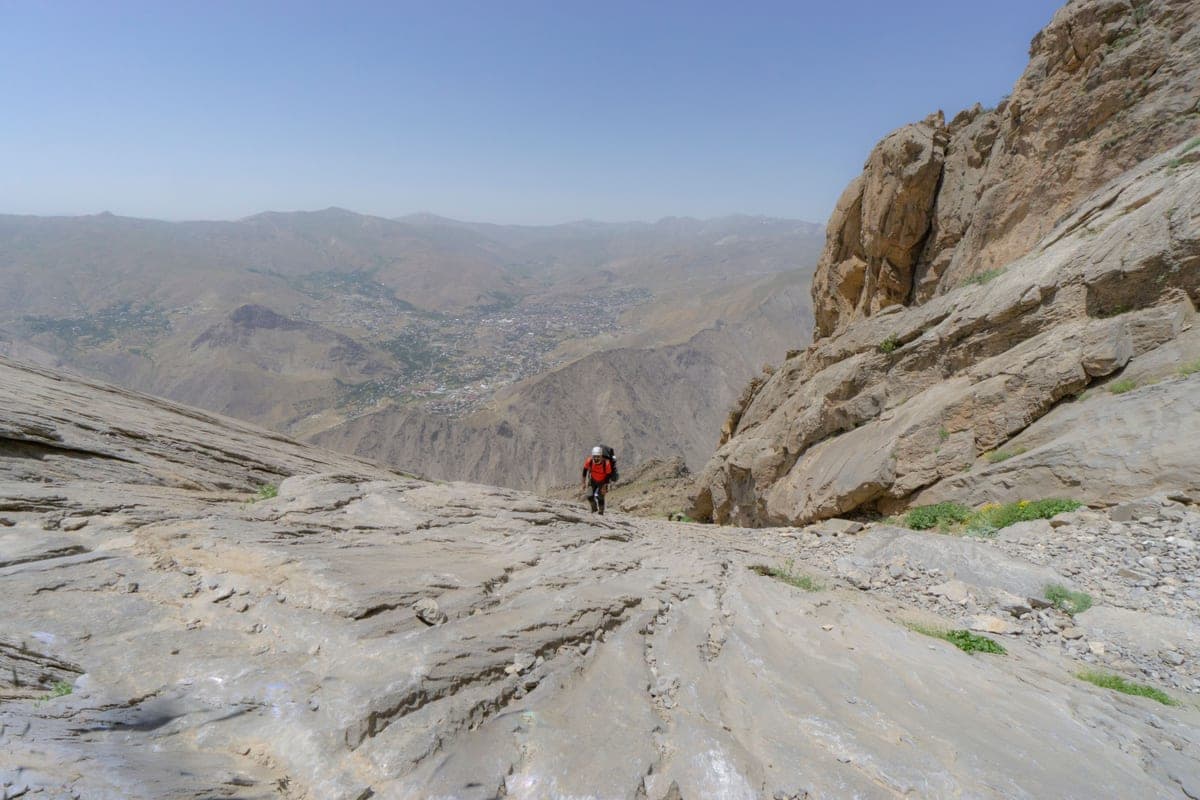
What matters on a hike
Three things: the battery has to outlast the trip with margin, the navigation has to match how you actually find your way, and the watch has to survive pack straps, granite and rain. We scored on the published rubric with those in mind, using each maker's own battery table and spec sheet. Heart-rate accuracy and training metrics did not move a score.
Battery per trip
Think in nights. A weekend is two nights and perhaps 14 hours of GPS tracking; a week is six nights and 40 to 50 hours; a thru-hike section is a charge cycle you cannot afford. The makers' GPS figures:
| Watch | GPS, standard mode | Longest GPS mode | Weight |
|---|---|---|---|
| Enduro 3 | 120 h multi-band | 320 h with solar | 63 g |
| Instinct 3 Solar 50mm | 60 h (260 h solar) | 150 h max-battery (unlimited solar) | Not in our sources |
| fenix 8 Solar 47mm | 67 h (92 h solar) | 132 h (283 h solar) | Not in our sources |
| Suunto Vertical Titanium Solar | 65 h multi-band (90 h solar) | 500 h power-saving | 74 g |
| COROS APEX 2 Pro | 66 h standard | 66 h | 66 g |
| Instinct E 45mm | 24 h | 50 h max-battery | Not in our sources |
| Pro Trek PRW-61 | No GPS | About 6 months from full solar charge (no light) | 62 g |
Every GPS watch here covers a week; only the Enduro 3, the Instinct 3 Solar in max-battery mode and the Suunto in power-saving mode cover a fortnight without a charger. A Pro Trek covers the year.
Maps, or a phone and a Pro Trek
On a marked trail, a map on the wrist is a luxury; the Instinct's breadcrumb trail and back-to-start do the safety job. Off trail, a map on the wrist changes the day, and the fenix 8, Enduro 3, Suunto Vertical and COROS APEX 2 Pro all carry one. The honest third option is a paper map plus an ABC watch like the Pro Trek PRW-61: altitude for locating yourself on contour lines, a barometer for weather, a compass for bearings, and no battery to plan around. Read which Garmin watches have topo maps before assuming.
Weight and the wrist
Fifteen grams is the difference between forgetting a watch and noticing it on a 20-mile day. The Enduro 3 (63 g), COROS APEX 2 Pro (66 g), Pro Trek (62 g) and Suunto Vertical Solar (74 g) publish their weights; Garmin does not put the Instinct or fenix weights in the documents we cite, so we do not print them. Nylon straps cut weight on any of them.
The mistake buyers make
Buying multi-band GPS for a trail hike and leaving it on. Every maker's table shows multi-band cutting GPS hours by a third or more. On an open trail, standard GPS is accurate enough and the extra hours are worth more. Our GPS accuracy guide covers the settings.
The decade pick
In detail
The picks, in full
Rank 1
Stock photoBest hiking watch overall
Garmin Instinct 3 Solar (50mm)
A week on the trail without thinking about the battery: 60 GPS hours, 260 with solar, 150 in max-battery mode. Breadcrumb navigation, 10 ATM, a flashlight for camp.
EvidenceResearched · not worn by us
How the 8.7 score breaks down
- Battery & power independence (25%)
- 10
- Durability of materials (25%)
- 8
- Serviceability & lifespan (20%)
- 7
- Field usability (15%)
- 9
- Value per decade (10%)
- 10
- Mission fit (5%)
- 8
What the spec sheet supports
- Garmin's own table shows the 50mm solar model doubling the 45mm in GPS-with-solar hours (260 vs 130).
- Physical buttons, a monochrome display readable in full sun, and a flashlight with a red mode.
- 10 ATM rating and a MIL-STD 810 claim on a watch that costs less than half a fenix.
Where it falls short
- No maps: it navigates breadcrumb trails and waypoints, not topo maps.
- The solar figures assume three hours a day at 50,000 lux, which is midday sun, not a sleeve.
- Garmin does not name the lens material; treat it as strengthened glass, not sapphire.
Skip this if…
…you need on-wrist topo maps, or you wear long sleeves and work indoors, where the solar math never happens.
#ad · Price set by Amazon · Disclosure for the link to Garmin Instinct 3 Solar (50mm)
Rank 2
Stock photoBest for thru-hikes
Garmin Enduro 3
320 GPS hours with solar in a 63 g package with maps. Built for weeks, not weekends.
EvidenceResearched · not worn by us
| Power class | Solar GPS. A rechargeable cell topped up by a solar lens. Weeks between charges; the cell still ages like any lithium battery. |
|---|---|
| Battery (smartwatch) | Up to 90 days in smartwatch mode |
| Battery (GPS) | Up to 320 hours in GPS mode with solar charging; up to 120 hours with multi-band SatIQ |
| Glass | Scratch-resistant sapphire lens |
| Bezel & case | 51mm titanium bezel; UltraFit nylon band |
| Maps & GPS | Preloaded TopoActive maps |
| Flashlight | Built-in LED flashlight with variable brightness, red light and strobe |
| Weight | 63 grams |
How the 8.5 score breaks down
- Battery & power independence (25%)
- 10
- Durability of materials (25%)
- 9
- Serviceability & lifespan (20%)
- 7
- Field usability (15%)
- 9
- Value per decade (10%)
- 6
- Mission fit (5%)
- 8
What the spec sheet supports
- 320 GPS hours with solar is the largest GPS figure Garmin publishes for any watch we list.
- Lighter than a 51mm fenix 8 thanks to the nylon strap and titanium bezel.
- Sapphire and preloaded maps.
Where it falls short
- Garmin's Enduro 3 release does not state a water rating or MIL-STD line, so we do not claim them here.
- The nylon strap is the point of the weight; a silicone strap adds it back.
Skip this if…
…you swim or dive with your watch and need a stated depth rating; the fenix 8 gives you one.
#ad · Price set by Amazon · Disclosure for the link to Garmin Enduro 3
Rank 3
Stock photoBest hiking watch with maps
Garmin fenix 8 Solar (47mm, Sapphire)
Topo maps on a 47 mm wrist, sapphire and titanium, 92 GPS hours with solar. The watch for off-trail and route-finding days.
EvidenceResearched · not worn by us
| Power class | Solar GPS. A rechargeable cell topped up by a solar lens. Weeks between charges; the cell still ages like any lithium battery. |
|---|---|
| Battery (smartwatch) | Up to 21 days typical use; up to 28 days with solar |
| Battery (GPS) | Up to 67 hours GPS-only; up to 92 hours with solar |
| Battery (max GPS) | Up to 132 hours max-battery GPS; up to 283 hours with solar |
| Glass | Scratch-resistant sapphire lens (sapphire versions) |
| Bezel & case | Titanium bezel (sapphire versions); leakproof metal buttons |
| Water rating | 40-meter dive-rated case |
| MIL-STD-810 | Tested to U.S. military standards for thermal, shock and water resistance |
| Maps & GPS | TopoActive maps preloaded on sapphire versions |
How the 8.4 score breaks down
- Battery & power independence (25%)
- 8
- Durability of materials (25%)
- 10
- Serviceability & lifespan (20%)
- 7
- Field usability (15%)
- 10
- Value per decade (10%)
- 6
- Mission fit (5%)
- 8
What the spec sheet supports
- Every fenix 8 durability feature in the size most people can actually wear.
- 92 GPS hours with solar covers a long weekend of tracking with margin.
Where it falls short
- Smartwatch battery drops below a month (28 days with solar) versus the 51mm's 48.
- Same MIP-display trade-off as the 51mm.
Skip this if…
…battery days are the reason you are here; the 51mm solar is the fenix for that.
#ad · Price set by Amazon · Disclosure for the link to Garmin fenix 8 Solar (47mm, Sapphire)
Rank 4
Stock photoLightest solar mapping watch
Suunto Vertical Titanium Solar
74 g, Grade 5 titanium, sapphire, offline maps and 90 multi-band GPS hours with solar.
EvidenceResearched · not worn by us
| Power class | Solar GPS. A rechargeable cell topped up by a solar lens. Weeks between charges; the cell still ages like any lithium battery. |
|---|---|
| Battery (smartwatch) | Up to 30 days daily use (60 days with solar); standby up to 60 days (1 year with solar) |
| Battery (GPS) | Up to 65 h multi-band (90 h with solar); up to 90 h single-band (140 h with solar) |
| Battery (max GPS) | Up to 500 h in power-saving GNSS modes |
| Glass | Sapphire crystal |
| Bezel & case | Titanium Grade 5 bezel; glass fiber reinforced polyamide case |
| Water rating | 100 m |
| Display | 1.4-inch matrix (MIP) |
| Weight | 74 g / 2.61 oz |
| Operating temp | -20°C to +55°C (-5°F to +130°F) |
How the 8.1 score breaks down
- Battery & power independence (25%)
- 9
- Durability of materials (25%)
- 9
- Serviceability & lifespan (20%)
- 6
- Field usability (15%)
- 8
- Value per decade (10%)
- 8
- Mission fit (5%)
- 7
What the spec sheet supports
- Solar, sapphire and titanium at 74 g, lighter than a fenix 8 51mm.
- 500 hours in power-saving GPS is the highest Suunto figure and beats the fenix 8 Solar 47mm's max-battery figure without solar.
Where it falls short
- Previous generation: no flashlight, dimmer MIP screen, older optical heart rate.
- 100 m water rating, no MIL-STD claim in Suunto's specs.
Skip this if…
…you want the brightest screen and a flashlight; that is the Vertical 2.
#ad · Price set by Amazon · Disclosure for the link to Suunto Vertical Titanium Solar
Rank 5
Stock photoBest no-GPS hiking watch
Casio Pro Trek PRW-61
Altimeter, barometer, compass, solar, radio time, 62 g, no charger ever. For hikers who navigate with a map and want the watch to just work.
EvidenceResearched · not worn by us
| Power class | Solar, no charger. A solar cell that recharges from any light and never meets a charger. The rechargeable cell is a watchmaker-replaceable part. |
|---|---|
| Battery (cell) | Approximately 6 months with no light (Casio's stated usage conditions) |
| Power | Solar panel and one rechargeable battery |
| Bezel & case | Biomass plastics case |
| Water rating | 100 m |
| Sensors | Direction, pressure/altitude and temperature sensors; radio time calibration (JJY, WWVB, MSF, DCF77, BPC); double LED light |
| Weight | 62 g |
| Size | 51.0 × 47.4 × 14.7 mm |
| Operating temp | Low-temperature resistance to -10°C (14°F) |
How the 8.1 score breaks down
- Battery & power independence (25%)
- 9
- Durability of materials (25%)
- 6
- Serviceability & lifespan (20%)
- 9
- Field usability (15%)
- 8
- Value per decade (10%)
- 9
- Mission fit (5%)
- 8
What the spec sheet supports
- Solar, atomic and triple sensor at 62 g and 14.7 mm.
- Cleaner dial and a proper altimeter graph for hikers.
Where it falls short
- 100 m and no mud-resistant buttons; it is a hiking watch, not a Mudman.
- Mineral glass.
Skip this if…
…your watch gets buried in mud or dunked regularly; the G-Shock Mudman is the sealed version of this idea.
#ad · Price set by Amazon · Disclosure for the link to Casio Pro Trek PRW-61
Rank 6
Stock photoBest light sapphire watch
COROS APEX 2 Pro
66 g, sapphire, titanium and 66 GPS hours; 5 ATM is the trade.
EvidenceResearched · not worn by us
| Power class | Rechargeable GPS. A rechargeable lithium cell charged from a cable. Days to a few weeks per charge; the cell ages with every cycle. |
|---|---|
| Battery (smartwatch) | 21 days daily use |
| Battery (GPS) | 66 hours standard full GPS; 41 hours all systems; 24 hours dual-frequency |
| Glass | Sapphire glass |
| Bezel & case | Grade 5 titanium alloy bezel with PVD; titanium alloy cover |
| Water rating | 5 ATM (surface water activities, not diving) |
| Weight | 66 g with silicone band; 53 g with nylon band |
| Size | 46.1 × 46.5 × 14 mm |
| Operating temp | -4°F to 122°F (-20°C to 50°C) |
How the 7.3 score breaks down
- Battery & power independence (25%)
- 7
- Durability of materials (25%)
- 8
- Serviceability & lifespan (20%)
- 6
- Field usability (15%)
- 8
- Value per decade (10%)
- 8
- Mission fit (5%)
- 6
What the spec sheet supports
- Sapphire and titanium under 70 grams.
- Offline maps included.
Where it falls short
- 5 ATM is half the rating of the VERTIX 2S and the Garmin Instinct.
- No solar, no flashlight.
Skip this if…
…you swim or fish with your watch on; 5 ATM is a shower-and-rain rating.
#ad · Price set by Amazon · Disclosure for the link to COROS APEX 2 Pro
Rank 7
Stock photoBest budget hiking watch
Garmin Instinct E (45mm)
The Instinct case and 10 ATM with 24 GPS hours and no solar. Enough for weekends.
EvidenceResearched · not worn by us
| Power class | Rechargeable GPS. A rechargeable lithium cell charged from a cable. Days to a few weeks per charge; the cell ages with every cycle. |
|---|---|
| Battery (smartwatch) | Up to 16 days |
| Battery (GPS) | Up to 24 hours GPS-only |
| Battery (max GPS) | Up to 50 hours max-battery GPS |
| Power | Rechargeable, built-in lithium-ion battery (no solar column in Garmin's battery table) |
| Water rating | 10 ATM |
| Flashlight | None: the owner's manual has no flashlight section |
| Operating temp | -20° to 60°C (-4° to 140°F) |
How the 6.7 score breaks down
- Battery & power independence (25%)
- 6
- Durability of materials (25%)
- 6
- Serviceability & lifespan (20%)
- 7
- Field usability (15%)
- 8
- Value per decade (10%)
- 8
- Mission fit (5%)
- 6
What the spec sheet supports
- 10 ATM water rating and the Instinct button layout at the lowest price in the line.
- Sixteen days of watch use is still weeks between charges.
Where it falls short
- No solar and no flashlight; Garmin's manual lists neither.
- 24 GPS hours is a weekend, not a week.
- Garmin does not make a MIL-STD 810 claim for the Instinct E in the material we could cite.
Skip this if…
…the reason you want an Instinct is to stop charging; this one charges like any other watch.
#ad · Price set by Amazon · Disclosure for the link to Garmin Instinct E (45mm)
How we scored this
Watches we claim to have worn or tested: 0
Plenty of sites say they took every watch up a mountain. We didn't, and we say so. What we do instead: read the maker's own battery table mode by mode, check what the lens and case are actually made of, note the water rating and whether a MIL-STD-810 claim exists, ask how long the maker keeps updating the line, and score every pick on a public rubric weighted for a decade of ownership. Every figure links to where it came from.
Scores are editorial judgments from that documented research, not test results. Commissions never set a score or decide a pick. The rubric and its weights are published.
Questions
Frequently asked
What is the best watch for hiking with GPS and maps?
The Garmin fenix 8 Solar for a 47 mm wrist, the Enduro 3 for the longest GPS hours with maps. Both carry preloaded TopoActive maps and a sapphire lens per Garmin.
Is a Garmin Instinct good for hiking?
Yes, if you can hike without a map on the wrist. Garmin rates the Instinct 3 Solar 50mm at 60 GPS hours and 260 with solar, with breadcrumb navigation and a 10 ATM case. See the Instinct 3 Solar review.
Do I need a GPS watch to hike?
No. An ABC watch like the Pro Trek PRW-61 or G-Shock Rangeman with a paper map is how most long trails were hiked before GPS watches existed. Our ABC watch rankings cover the options.
Keep reading
Related on Bezel & Bearing
Receipts
Sources
- Garmin — Instinct 3 Solar Series Owner's Manual, Battery Life Information (checked 2026-09-20)
- Garmin — fenix 8 Series Owner's Manual, Battery Information (checked 2026-09-20)
- Garmin newsroom — Enduro 3 press release (checked 2026-09-20)
- Garmin — Instinct E Owner's Manual, Battery Life Information (checked 2026-09-20)
- Suunto — Vertical Titanium Solar Black product page and tech specs (checked 2026-09-20)
- COROS — VERTIX 2S / APEX / NOMAD specification tables (checked 2026-09-20)
- Casio — Operation Guide, module 5673 (Pro Trek PRW-61), Specifications (checked 2026-09-20)
- New Atlas — Casio Pro Trek PRW-61 announcement (size, weight, water rating, battery) (checked 2026-09-20)
We don't own or wear-test these watches and we don't pretend to. Battery, glass, case and water figures come from the maker's own owner's manuals, spec pages and press releases (linked on every product), and where a figure isn't published we say so. Prices are set by Amazon and change often, so we don't print them. Read the full method.