GPS Watches / The rankings
The best GPS watch for trail running: ranked on the GPS hours the makers actually publish
A road watch is judged on pace accuracy. A trail watch is judged on whether it finishes the race with you, still holds a signal under tree cover, and shows you the way back. Here are the published numbers.
By Mike M.Updated Spec-sheet researched, not worn by us
#adReader-supported: we may earn a commission if you buy through our links, at no extra cost to you. It never decides a ranking. How we rate · Disclosure
Quick picks
The rankings at a glance
| # | Product | Best for | Score | Price |
|---|---|---|---|---|
| 1 |  Garmin Enduro 3 The longest solar GPS figures Garmin publishes, in a light nylon-strapped case with sapphire, maps and a flashlight. | Best trail running watch overallSolar GPS | 8.5 /10 | Check price · Amazon |
| 2 | COROS VERTIX 2S Sapphire, titanium, dual-frequency GNSS and the longest GPS endurance figures on the site. | Best for 100-milersRechargeable GPS | 8.1 /10 | Check price · Amazon |
| 3 | Garmin fenix 8 Solar (47mm, Sapphire) Sapphire, titanium bezel, full topo maps, a dive rating and weeks of solar battery. The one watch for trails and everything else. | Best all-roundSolar GPS | 8.4 /10 | Check price · Amazon |
| 4 | Suunto Vertical 2 Titanium Sapphire, titanium, free offline topo maps and an AMOLED, at well under fenix money. | Best value with mapsRechargeable GPS | 7.6 /10 | Check price · Amazon |
| 5 | Garmin Forerunner 970 (47mm) Sapphire, titanium bezel, maps, flashlight and 26 hours GPS-only. The running-first pick, and it charges from a cable. | Best if you race on road tooRechargeable GPS | 6.1 /10 | Check price · Amazon |
| 6 | COROS APEX 2 Pro Sapphire and titanium with offline maps at a low weight, from COROS's published spec table. | Best lightweightRechargeable GPS | 7.3 /10 | Check price · Amazon |
| 7 | Garmin Instinct 3 Solar (45mm) Unlimited smartwatch battery with solar, 10 ATM, MIL-STD-810 and a flashlight, in the smaller 45mm case. | Best without mapsSolar GPS | 8.3 /10 | Check price · Amazon |
#ad · Prices are set by Amazon and change often, so we don't print them. Scores are ours, built from the makers' manuals, battery tables and spec pages, not field tests. Photos are illustrative stock. Tap a row for the full write-up.
What actually matters on trail
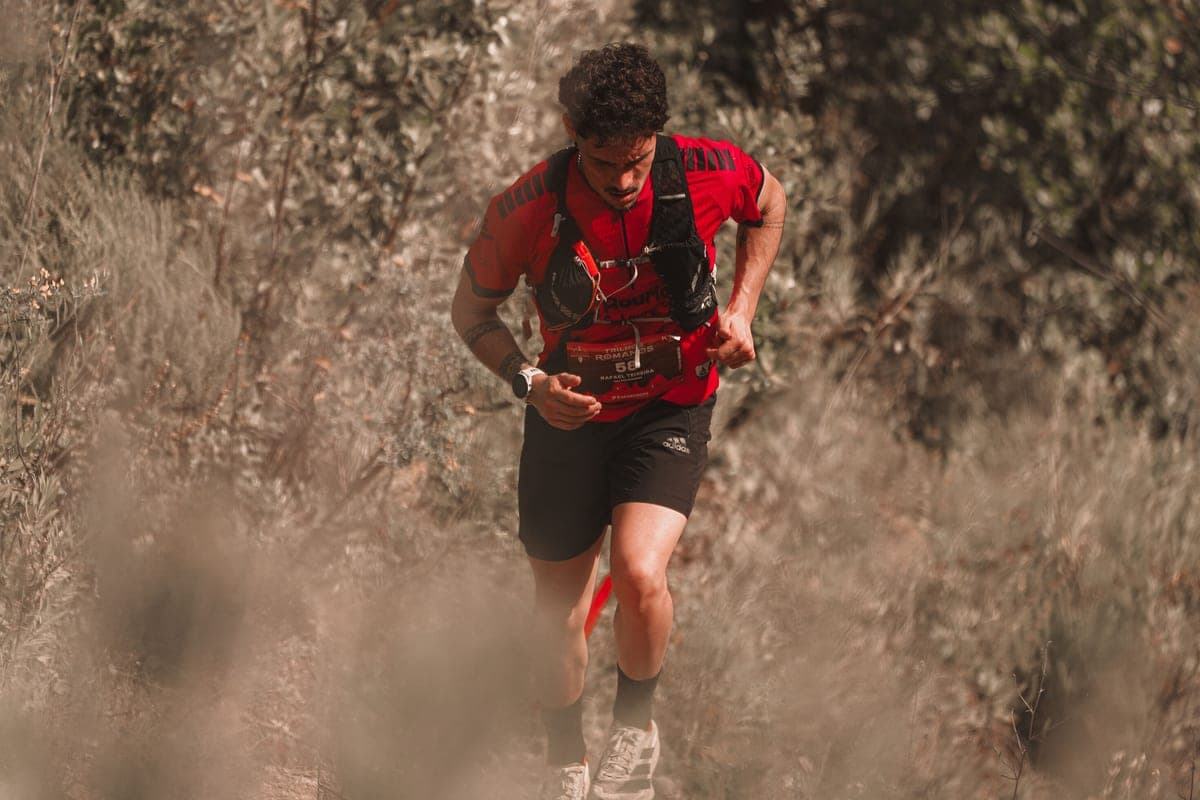
Four things, in this order. GPS hours, because a watch that dies at hour 19 of a 24-hour effort has failed at its only job. Signal quality under canopy and in valleys, which is a GNSS constellation and frequency question and not a marketing one. Maps or at least a route line, so that a missed junction at 2am is an inconvenience rather than an epic. And weight, because you are carrying it for hours and a heavy watch on a thin strap bounces.
Pace accuracy, running dynamics and training-load scores are real features and they are not what separates these watches. Every one of them does those well enough. The battery table is where they actually differ.
GPS hours: the only honest ranking
Every figure below is the maker's own, from its manual battery table or spec page, with the GNSS mode named — because the same watch can publish wildly different numbers depending on which satellites it is listening to. A single-band GPS-only figure and an all-systems multi-band figure are not comparable, which is exactly how these numbers get misquoted.
The Forerunner 970 is on this page for a specific reader — someone who races road and trail and wants one watch — and its published 26 hours GPS-only and 21 hours all-systems multi-band are honest ultra numbers. What it does not have is a solar lens, so it cycles a lithium cell every two weeks of normal use. Over five years that is a lot of cycles, and cycles are what eventually turn a good watch into one that needs charging at lunchtime.
Multi-band GNSS under tree cover
Trail running is the hardest case for a GPS receiver: switchbacks under dense canopy, steep-sided valleys, and a wrist that swings through a wide arc. Two things help. A multi-constellation receiver listens to GPS plus GLONASS, Galileo, BeiDou and QZSS, so there are more satellites above the ridge line. A dual-frequency (L1 + L5) receiver also rejects signals that bounced off a rock face before reaching you, which is the dominant error in a canyon.
Both cost battery, which is why every maker publishes a separate, shorter figure for the all-systems multi-band mode. Our GPS accuracy explained page covers what each mode does and does not fix; the short version for this page is that multi-band is worth switching on for a technical race and worth switching off for a long easy day.
Maps, and when you genuinely need them
There is a real difference between a route line and a map. Every watch here can follow a loaded course as a breadcrumb; the Enduro 3, fenix 8, Suunto Vertical 2, COROS models and Forerunner 970 also carry actual topo mapping, so you can see the trail you are not on. That matters when you miss a junction, when a course is rerouted, or when weather forces you off the plan.
The Instinct 3 Solar does not have maps, which is why it is last here and first on half the other pages of this site. It is the better watch for hiking, hunting and work and the worse watch for a technical race. The full maps-first ranking is best watch with offline maps.
Weight and the strap
Garmin built the Enduro line specifically around this: a light case and a nylon UltraFit strap rather than silicone, which is the single biggest comfort difference over a long day and the reason it wins this page ahead of heavier watches with similar numbers. Titanium bezels on the fenix 8, Suunto and COROS models do the same job from the other direction. If you have run in a heavy watch on a loose silicone strap and had it slide and bruise, that is the problem being solved.
Does solar help a trail runner?
The decade pick
In detail
The picks, in full
Rank 1
Stock photoBest trail running watch overall
Garmin Enduro 3
The longest solar GPS figures Garmin publishes, in a light nylon-strapped case with sapphire, maps and a flashlight.
EvidenceResearched · not worn by us
| Power class | Solar GPS. A rechargeable cell topped up by a solar lens. Weeks between charges; the cell still ages like any lithium battery. |
|---|---|
| Battery (smartwatch) | Up to 90 days in smartwatch mode |
| Battery (GPS) | Up to 320 hours in GPS mode with solar charging; up to 120 hours with multi-band SatIQ |
| Glass | Scratch-resistant sapphire lens |
| Bezel & case | 51mm titanium bezel; UltraFit nylon band |
| Maps & GPS | Preloaded TopoActive maps |
| Flashlight | Built-in LED flashlight with variable brightness, red light and strobe |
| Weight | 63 grams |
How the 8.5 score breaks down
- Battery & power independence (25%)
- 10
- Durability of materials (25%)
- 9
- Serviceability & lifespan (20%)
- 7
- Field usability (15%)
- 9
- Value per decade (10%)
- 6
- Mission fit (5%)
- 8
What the spec sheet supports
- 320 GPS hours with solar is the largest GPS figure Garmin publishes for any watch we list.
- Lighter than a 51mm fenix 8 thanks to the nylon strap and titanium bezel.
- Sapphire and preloaded maps.
Where it falls short
- Garmin's Enduro 3 release does not state a water rating or MIL-STD line, so we do not claim them here.
- The nylon strap is the point of the weight; a silicone strap adds it back.
Skip this if…
…you swim or dive with your watch and need a stated depth rating; the fenix 8 gives you one.
#ad · Price set by Amazon · Disclosure for the link to Garmin Enduro 3
Rank 2
Stock photoBest for 100-milers
COROS VERTIX 2S
Sapphire, titanium, dual-frequency GNSS and the longest GPS endurance figures on the site.
EvidenceResearched · not worn by us
| Power class | Rechargeable GPS. A rechargeable lithium cell charged from a cable. Days to a few weeks per charge; the cell ages with every cycle. |
|---|---|
| Battery (smartwatch) | 36 days daily use |
| Battery (GPS) | 118 hours standard full GPS; 73 hours all systems on; 43 hours dual-frequency |
| Glass | Sapphire glass |
| Bezel & case | Grade 5 titanium alloy bezel with PVD coating; titanium alloy cover |
| Water rating | 10 ATM (surface water activities, not diving) |
| Display | 1.4-inch touchscreen always-on memory LCD, 280 × 280 |
| Maps & GPS | Downloadable global landscape and topo maps; GPS, GLONASS, Galileo, BeiDou, QZSS dual-frequency |
| Weight | 87 g with silicone band; 70 g with nylon band |
| Size | 50.3 × 50.3 × 16 mm |
| Operating temp | -22°F to 122°F (-30°C to 50°C) working; charging under 2 hours |
How the 8.1 score breaks down
- Battery & power independence (25%)
- 9
- Durability of materials (25%)
- 9
- Serviceability & lifespan (20%)
- 6
- Field usability (15%)
- 8
- Value per decade (10%)
- 8
- Mission fit (5%)
- 7
What the spec sheet supports
- 118 standard-GPS hours without a solar lens beats every Garmin's non-solar figure here.
- Rated to work at -30°C, ten degrees colder than a Garmin's stated range.
- Sapphire, titanium, 10 ATM and free downloadable topo maps.
Where it falls short
- No solar, no flashlight.
- No MIL-STD claim in COROS's specs.
Skip this if…
…you want a watch that stops needing a cable altogether; that is the solar Garmin's job.
#ad · Price set by Amazon · Disclosure for the link to COROS VERTIX 2S
Rank 3
Stock photoBest all-round
Garmin fenix 8 Solar (47mm, Sapphire)
Sapphire, titanium bezel, full topo maps, a dive rating and weeks of solar battery. The one watch for trails and everything else.
EvidenceResearched · not worn by us
| Power class | Solar GPS. A rechargeable cell topped up by a solar lens. Weeks between charges; the cell still ages like any lithium battery. |
|---|---|
| Battery (smartwatch) | Up to 21 days typical use; up to 28 days with solar |
| Battery (GPS) | Up to 67 hours GPS-only; up to 92 hours with solar |
| Battery (max GPS) | Up to 132 hours max-battery GPS; up to 283 hours with solar |
| Glass | Scratch-resistant sapphire lens (sapphire versions) |
| Bezel & case | Titanium bezel (sapphire versions); leakproof metal buttons |
| Water rating | 40-meter dive-rated case |
| MIL-STD-810 | Tested to U.S. military standards for thermal, shock and water resistance |
| Maps & GPS | TopoActive maps preloaded on sapphire versions |
How the 8.4 score breaks down
- Battery & power independence (25%)
- 8
- Durability of materials (25%)
- 10
- Serviceability & lifespan (20%)
- 7
- Field usability (15%)
- 10
- Value per decade (10%)
- 6
- Mission fit (5%)
- 8
What the spec sheet supports
- Every fenix 8 durability feature in the size most people can actually wear.
- 92 GPS hours with solar covers a long weekend of tracking with margin.
Where it falls short
- Smartwatch battery drops below a month (28 days with solar) versus the 51mm's 48.
- Same MIP-display trade-off as the 51mm.
Skip this if…
…battery days are the reason you are here; the 51mm solar is the fenix for that.
#ad · Price set by Amazon · Disclosure for the link to Garmin fenix 8 Solar (47mm, Sapphire)
Rank 4
Stock photoBest value with maps
Suunto Vertical 2 Titanium
Sapphire, titanium, free offline topo maps and an AMOLED, at well under fenix money.
EvidenceResearched · not worn by us
| Power class | Rechargeable GPS. A rechargeable lithium cell charged from a cable. Days to a few weeks per charge; the cell ages with every cycle. |
|---|---|
| Battery (smartwatch) | Up to 20 days daily use; up to 40 days standby |
| Battery (GPS) | Up to 65 h all-systems + multi-band (60 h always-on); up to 75 h single-band |
| Battery (max GPS) | Up to 250 h in power-saving GNSS modes |
| Glass | Sapphire crystal |
| Bezel & case | Titanium bezel; glass fiber reinforced polyamide case |
| Water rating | 100 m |
| Display | 1.5-inch LTPO AMOLED, 466 × 466 |
| Maps & GPS | Offline maps; GPS, GLONASS, Galileo, QZSS, BeiDou |
| Flashlight | Integrated LED flashlight |
| Weight | 87 g / 3.07 oz |
| Operating temp | -20°C to +55°C (-5°F to +130°F) |
How the 7.6 score breaks down
- Battery & power independence (25%)
- 7
- Durability of materials (25%)
- 9
- Serviceability & lifespan (20%)
- 6
- Field usability (15%)
- 9
- Value per decade (10%)
- 7
- Mission fit (5%)
- 7
What the spec sheet supports
- Sapphire and titanium at the price of a polymer Garmin.
- Offline maps and a flashlight on a Suunto for the first time in the Vertical line.
Where it falls short
- The Vertical 2 dropped solar; the original Vertical Titanium Solar still has it.
- 100 m rating, no stated MIL-STD line, no dive rating.
Skip this if…
…you wanted a Suunto that never sees a charger; buy the first-gen Vertical Titanium Solar instead.
#ad · Price set by Amazon · Disclosure for the link to Suunto Vertical 2 Titanium
Rank 5
Stock photoBest if you race on road too
Garmin Forerunner 970 (47mm)
Sapphire, titanium bezel, maps, flashlight and 26 hours GPS-only. The running-first pick, and it charges from a cable.
EvidenceResearched · not worn by us
| Power class | Rechargeable GPS. A rechargeable lithium cell charged from a cable. Days to a few weeks per charge; the cell ages with every cycle. |
|---|---|
| Battery (smartwatch) | Up to 15 days in smartwatch mode with activity tracking, phone notifications and wrist heart rate |
| Battery (GPS) | Up to 26 hours in GPS Only GNSS mode |
| Battery (max GPS) | Up to 21 hours in All + Multi-Band GNSS mode; up to 12 hours with music playback |
| Power | Rechargeable, built-in lithium-ion battery (cable only, no solar lens) |
| Glass | Scratch-resistant sapphire lens |
| Bezel & case | Titanium bezel; 47 mm case |
| Water rating | Swim, 5 ATM |
| Display | Garmin's brightest AMOLED display, touchscreen, with built-in speaker and microphone |
| Maps & GPS | Full-color built-in mapping; multi-band GNSS |
| Flashlight | Built-in LED flashlight with brightness control from the display |
| Operating temp | From -20° to 60°C (from -4° to 140°F) |
How the 6.1 score breaks down
- Battery & power independence (25%)
- 5
- Durability of materials (25%)
- 7
- Serviceability & lifespan (20%)
- 5
- Field usability (15%)
- 9
- Value per decade (10%)
- 4
- Mission fit (5%)
- 7
What the spec sheet supports
- Sapphire and titanium on a running watch, which is the durability set the Instinct line does not get.
- Maps and a flashlight in a 47 mm case that weighs less than a fenix.
- 26 hours of GPS-only is enough for most 100 km races without a battery-saver mode.
Where it falls short
- No solar. It cycles a lithium cell every couple of weeks, which is the fastest-ageing power system on this site.
- An always-on AMOLED is the reason the smartwatch figure is 15 days rather than a month.
- 5 ATM, against 10 ATM on an Instinct 3.
Skip this if…
…you want to stop thinking about charging; a solar Instinct or fenix trades the AMOLED for weeks instead of days.
#ad · Price set by Amazon · Disclosure for the link to Garmin Forerunner 970 (47mm)
Rank 6
Stock photoBest lightweight
COROS APEX 2 Pro
Sapphire and titanium with offline maps at a low weight, from COROS's published spec table.
EvidenceResearched · not worn by us
| Power class | Rechargeable GPS. A rechargeable lithium cell charged from a cable. Days to a few weeks per charge; the cell ages with every cycle. |
|---|---|
| Battery (smartwatch) | 21 days daily use |
| Battery (GPS) | 66 hours standard full GPS; 41 hours all systems; 24 hours dual-frequency |
| Glass | Sapphire glass |
| Bezel & case | Grade 5 titanium alloy bezel with PVD; titanium alloy cover |
| Water rating | 5 ATM (surface water activities, not diving) |
| Weight | 66 g with silicone band; 53 g with nylon band |
| Size | 46.1 × 46.5 × 14 mm |
| Operating temp | -4°F to 122°F (-20°C to 50°C) |
How the 7.3 score breaks down
- Battery & power independence (25%)
- 7
- Durability of materials (25%)
- 8
- Serviceability & lifespan (20%)
- 6
- Field usability (15%)
- 8
- Value per decade (10%)
- 8
- Mission fit (5%)
- 6
What the spec sheet supports
- Sapphire and titanium under 70 grams.
- Offline maps included.
Where it falls short
- 5 ATM is half the rating of the VERTIX 2S and the Garmin Instinct.
- No solar, no flashlight.
Skip this if…
…you swim or fish with your watch on; 5 ATM is a shower-and-rain rating.
#ad · Price set by Amazon · Disclosure for the link to COROS APEX 2 Pro
Rank 7
Stock photoBest without maps
Garmin Instinct 3 Solar (45mm)
Unlimited smartwatch battery with solar, 10 ATM, MIL-STD-810 and a flashlight, in the smaller 45mm case.
EvidenceResearched · not worn by us
| Power class | Solar GPS. A rechargeable cell topped up by a solar lens. Weeks between charges; the cell still ages like any lithium battery. |
|---|---|
| Battery (smartwatch) | Up to 28 days typical use; unlimited with solar (3 hr/day at 50,000 lux) |
| Battery (GPS) | Up to 40 hours GPS-only; up to 130 hours with solar |
| Battery (max GPS) | Up to 100 hours max-battery GPS; unlimited with solar |
| Power | Rechargeable, built-in lithium-ion battery with solar charging display |
| Bezel & case | Metal-reinforced bezel; fiber-reinforced polymer case |
| Water rating | 10 ATM |
| MIL-STD-810 | Built to MIL-STD 810 for thermal and shock resistance |
| Flashlight | Built-in flashlight with variable intensities, a red light and strobe mode |
How the 8.3 score breaks down
- Battery & power independence (25%)
- 9
- Durability of materials (25%)
- 8
- Serviceability & lifespan (20%)
- 7
- Field usability (15%)
- 9
- Value per decade (10%)
- 9
- Mission fit (5%)
- 8
What the spec sheet supports
- Every durability claim of the 50mm (10 ATM, MIL-STD 810, metal-reinforced bezel) in a size that fits under a cuff.
- Still 'unlimited' in smartwatch mode under Garmin's solar assumption.
- Flashlight on every Instinct 3 size, which the Instinct 2 45mm never had.
Where it falls short
- Half the GPS-with-solar hours of the 50mm (130 vs 260) because the lens is smaller.
- No maps, same as the rest of the Instinct line.
Skip this if…
…you have the wrist for the 50mm; the bigger lens is where the solar numbers live.
#ad · Price set by Amazon · Disclosure for the link to Garmin Instinct 3 Solar (45mm)
Choosing by race, not by feature list
Under 6 hours. Any watch here finishes easily, including the Instinct 3 Solar. Buy for weight, comfort and whether you want maps.
6 to 24 hours. Check the all-systems multi-band figure specifically, not the GPS-only headline, because a technical course is where you want multi-band on. The Forerunner 970 at 21 hours and every watch above it clears this.
Over 24 hours. Now the battery table is the decision: the Enduro 3, the COROS VERTIX 2S and the fenix 8 Solar, with solar exposure genuinely counting in your favor on an exposed daylight course.
Then check the lens. Sapphire on the Enduro 3, the fenix 8 sapphire editions, the Suuntos, the COROS models and the Forerunner 970. Garmin does not name the Instinct's lens, so we do not either. On a watch that meets rock, that is not a cosmetic spec.
How we scored this
Watches we claim to have worn or tested: 0
Plenty of sites say they took every watch up a mountain. We didn't, and we say so. What we do instead: read the maker's own battery table mode by mode, check what the lens and case are actually made of, note the water rating and whether a MIL-STD-810 claim exists, ask how long the maker keeps updating the line, and score every pick on a public rubric weighted for a decade of ownership. Every figure links to where it came from.
Scores are editorial judgments from that documented research, not test results. Commissions never set a score or decide a pick. The rubric and its weights are published.
Questions
Frequently asked
What is the best GPS watch for trail running?
The Garmin Enduro 3. Garmin publishes the longest solar GPS battery figures of any watch it makes, and the watch pairs them with a sapphire lens, built-in maps, a flashlight and a light nylon strap. For races beyond 24 hours the COROS VERTIX 2S publishes the longest GPS endurance figures on this site.
Do I need maps on a trail running watch?
Not for a marked race you have recced, where a loaded route line is enough. You want real maps when a course is rerouted, when you explore new trails, or when weather pushes you off plan — the Enduro 3, fenix 8, Suunto Vertical 2, COROS models and Forerunner 970 all carry topo mapping; the Instinct 3 does not.
Is multi-band GPS worth it for trail running?
Yes on technical terrain. Dual-frequency L1 + L5 reception rejects signals that bounced off rock before reaching the watch, which is the main source of error in canyons and under canopy. It costs battery, which is why every maker publishes a shorter figure for that mode.
Is a Forerunner or a fenix better for trails?
A fenix 8 Solar, for this site's reader: it adds solar, a higher water rating and a rugged case for hiking and everyday wear. A Forerunner 970 is lighter and running-first with sapphire, a titanium bezel and maps, and it has no solar lens — so it cycles its battery far more often over the years.
How many GPS hours do I need for a 100-mile race?
Plan around your realistic finish time plus a margin, and read the figure for the GNSS mode you will actually run in rather than the GPS-only headline. Most 100-mile finishers need well over 24 hours of continuous recording, which is why the Enduro 3, COROS VERTIX 2S and fenix 8 Solar are the three picks at the top of this page.
Keep reading
Related on Bezel & Bearing
Receipts
Sources
- Garmin newsroom — Enduro 3 press release (checked 2026-09-20)
- Garmin newsroom — fenix 8 Series press release (checked 2026-09-20)
- Garmin — fenix 8 Series Owner's Manual, Battery Information (checked 2026-09-20)
- Garmin — Instinct 3 Solar Series Owner's Manual, Battery Life Information (checked 2026-09-20)
- Garmin newsroom — Forerunner 570 and Forerunner 970 press release (checked 2026-09-26)
- Garmin — Forerunner 970 Watch Owner's Manual, Battery Life Information (checked 2026-09-26)
- Garmin — Forerunner 970 Watch Owner's Manual, Specifications (checked 2026-09-26)
- COROS — VERTIX 2S / APEX / NOMAD specification tables (checked 2026-09-20)
- Suunto — Vertical 2 Titanium Black product page and tech specs (checked 2026-09-20)
We don't own or wear-test these watches and we don't pretend to. Battery, glass, case and water figures come from the maker's own owner's manuals, spec pages and press releases (linked on every product), and where a figure isn't published we say so. Prices are set by Amazon and change often, so we don't print them. Read the full method.