Garmin / Review
Garmin fenix 8 Pro review: the first fenix that can call for help on its own
Garmin put inReach satellite messaging and an LTE modem inside a fenix and still rated the 51mm AMOLED at 27 days. The hardware is the easy part of this review; the subscription, the missing solar lens and the much pricier MicroLED version are the parts worth arguing about.
By Mike M.Updated Researched from the maker's manuals and spec sheets
#adReader-supported: we may earn a commission if you buy through our links, at no extra cost to you. It never decides a ranking. How we rate · Disclosure
The verdict
The watch and its alternatives
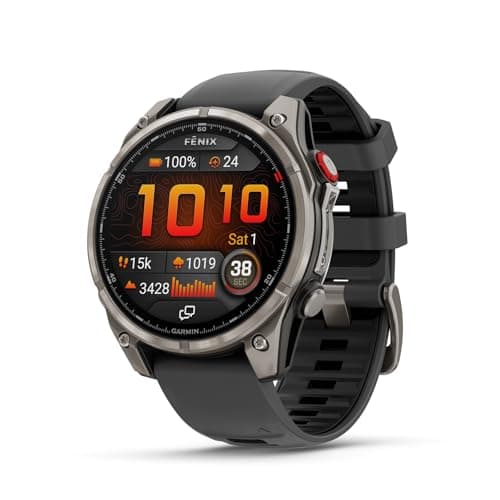
The watch under review
Garmin fenix 8 Pro – AMOLED (51mm)
Rechargeable GPS7.9 /1027 smartwatch days, 78 GPS-only hours, 123 max-battery hours, 24 expedition days, inReach satellite SOS and LTE. Subscription required. Score below.
$1,179.65Amazon#ad · Price as of November 4, 2026 · Disclosure for the link to Garmin fenix 8 Pro – AMOLED (51mm)
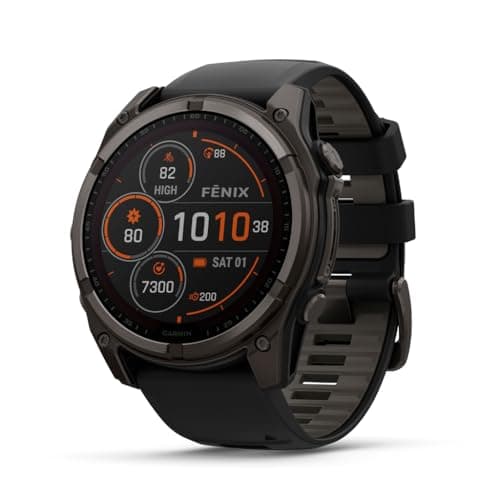
Alternative: the one with a solar lens
Garmin fenix 8 Solar (51mm, Sapphire)
Solar GPS8.7 /1048 days and 149 GPS hours with sun, a MIL-STD-810 line and a 40 m dive rating, for substantially less. No satellite messaging.
$1,092.78Amazon#ad · Price as of November 4, 2026 · Disclosure for the link to Garmin fenix 8 Solar (51mm, Sapphire)
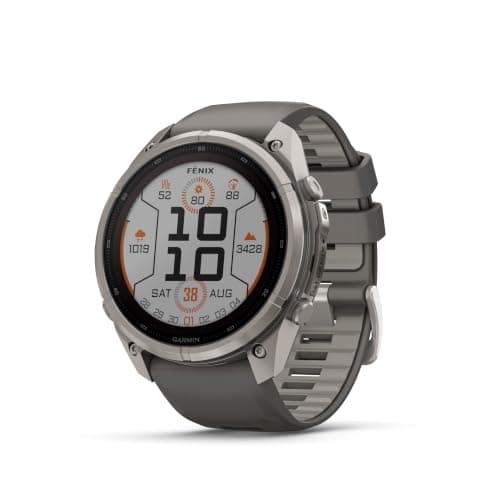
Alternative: the newer flagship
Garmin fenix 9 Pro (51mm)
Solar GPS8.4 /10Titanium case, solar on select models rated up to 57 days, 64 GB of maps and inReach on every Pro size. Announced August 2026.
$1,199.99Amazon#ad · Price as of November 4, 2026 · Disclosure for the link to Garmin fenix 9 Pro (51mm)
Verdict and score
What inReach on the wrist actually is
Garmin has sold inReach as a separate device for years: a small orange brick that talks to the Iridium satellite network, sends short text messages from anywhere with a view of the sky, and has an SOS button that reaches a 24/7 emergency coordination center. The fenix 8 Pro is the first watch with that radio inside it.
Garmin's press release describes two layers. Over satellite you get text messaging, location check-ins and SOS. Over LTE, where you have coverage, you get voice calls, voice messages, LiveTrack and weather forecasts. The specifications page lists the hardware behind both: LTE on bands 3, 8 and 20, and NTN — non-terrestrial network — on n255 and n256. Garmin states plainly that an active subscription is required and that LTE and satellite coverage are not available in every country.
The practical meaning for a buyer on this site: you can leave the phone in the truck, walk into a drainage with no signal, and still tell someone you are running late or that you need a helicopter. For solo hunters, solo ski tourers, backcountry anglers and anyone who works alone off the road network, that is the single most valuable thing a watch has learned to do in a decade. It is also the only reason to buy this watch over a cheaper fenix.
The subscription, honestly
That is not a reason to avoid it — a plan that costs a fraction of one helicopter deductible is a rational purchase for someone who genuinely goes out alone. It is a reason to be clear-eyed. On a site organized around watches that still work in ten years, a subscription dependency is a real mark against an otherwise outstanding piece of hardware, and it belongs in the verdict rather than in the small print.
The battery table, all three Pros
Garmin publishes a dedicated fenix 8 Pro column set in the fenix 8 Series battery table. Here it is in full, unrearranged. Where Garmin gives two figures, the first is gesture wake and the second is always-on display:
| Mode (Garmin's wording) | Pro AMOLED 47mm | Pro AMOLED 51mm | Pro MicroLED |
|---|---|---|---|
| Smartwatch mode | 15 days / 8 days | 27 days / 15 days | 10 days / 4 days |
| Battery saver watch mode | 19 days | 34 days | 14 days |
| GPS only | 44 h / 33 h | 78 h / 56 h | 44 h / 18 h |
| All satellite systems | 34 h / 26 h | 60 h / 47 h | 37 h / 16 h |
| All systems + multi-band | 30 h / 23 h | 53 h / 41 h | 34 h / 15 h |
| All systems + multi-band + LTE LiveTrack | 12 h / 11 h | 21 h / 19 h | 17 h / 10 h |
| All systems + multi-band + music | 13 h / 13 h | 23 h / 21 h | 19 h / 11 h |
| Max. battery GPS | 70 h | 123 h | 53 h |
| Expedition GPS | 14 days | 24 days | 8 days |
Three things in that table decide the purchase. First, the 51mm is not a slightly bigger 47mm — it is nearly double the watch on battery, 78 GPS hours against 44 and 123 max-battery hours against 70. If you are buying a Pro to spend days off the road, buy the 51mm and accept the size. Second, always-on display costs you roughly a third of every figure; leave it on gesture and the 51mm genuinely goes most of a month. Third, the LTE LiveTrack row is the sting: turning on live tracking over cellular drops the 51mm from 53 hours to 21. The radio is not free, and it is worth knowing before you promise someone at home a live track for a whole trip.
For context inside Garmin's own range, the fenix 8 Solar 51mm is rated at 30 days typical use and 48 with solar, 95 GPS-only hours and 149 with solar, and 186 max-battery hours rising to 653 with solar. The Pro does not get close, and the solar lens is the entire reason. Where every model lands is in longest-battery-life GPS watches, and the fenix-specific numbers are broken out in Garmin fenix 8 battery life.
MicroLED versus AMOLED
Garmin offers the Pro in two display technologies and the gap between them is the clearest buying advice on this page. The MicroLED is a genuinely remarkable screen: Garmin says over 400,000 individual LEDs and up to 4,500 nits, which it calls the brightest smartwatch display ever made. It is also only available in 51mm, it sits a full price class above the AMOLED on Garmin's own list prices, and it drops to 10 days of smartwatch mode, 44 GPS-only hours, 53 max-battery hours and 8 expedition days.
Put those numbers side by side: the MicroLED costs substantially more than the AMOLED 51mm and delivers roughly 37 percent of its smartwatch days, 56 percent of its GPS hours and 43 percent of its max-battery hours. On a site that treats battery as a durability spec, that is not a close call. Buy the AMOLED. The MicroLED is a showcase of what the technology can do, and it is the wrong watch for anyone who picked a fenix because they go a long way from a wall socket.
If you want the longer version of why display technology, not brand, is what sets a watch's battery ceiling, it is in MIP vs AMOLED battery life.
Materials, dive rating and temperature
Garmin's press release says every fenix 8 Pro is dive-rated with leakproof metal buttons, a metal sensor guard cover and a titanium bezel, plus an LED flashlight. The fenix 8 Series specifications page puts hard numbers on the sealing: 10 ATM water resistance with a 4 ATM Dive rating to EN 13319, a depth sensor accurate from 0 to 40 m, and the Bühlmann ZHL-16C decompression model on board. The sapphire configurations get a scratch-resistant sapphire lens.
That dive rating is a stricter claim than the 10 ATM or 100 m figure most outdoor watches carry, for the reason explained in water resistance explained: a dive rating is tested against a standard for repeated pressure cycling and gas exposure, not just for static immersion. It is the best sealing claim on any watch we rank.
The specification worth noting against the competition is temperature: Garmin gives the fenix 8 Series an operating and storage range of -20° to 45°C and a charging range of 0° to 45°C. The charging range is the one people get caught by — you cannot usefully top this watch up in a cold tent, which matters more on a Pro with no solar lens than it would on a solar model. The COROS VERTIX 2S is specified ten degrees colder for operation.
One absence to record: Garmin's fenix 8 Pro press release does not carry a MIL-STD-810 line, where the fenix 8 Solar release does. This site only sets that flag when the maker states it, so the Pro does not get one. The reasoning is in MIL-STD-810 watches explained, and the claim-by-claim ranking of every Garmin is in toughest Garmin watch.
The fenix 8 Pro has no solar lens
Garmin had a reason: a solar lens takes light through the display stack, and that is hard to reconcile with a bright AMOLED and a MicroLED. The fenix 9 Pro, announced in August 2026, says Garmin has now solved some of it — solar on select Pro models, rated up to 57 days. The 8 Pro does not have that option, and buyers who define a fenix by its solar lens should know that before they order one.
Against the fenix 8 Solar and the fenix 9 Pro
Against the fenix 8 Solar 51mm: the Solar wins on battery by a wide margin, has a 40 m dive rating and a MIL-STD-810 line, carries a solar lens, and costs meaningfully less. The Pro wins on exactly one thing — satellite messaging and SOS — and loses everything else. If you will not use the inReach features, the Solar is strictly the better watch and the better value. That is an unusual thing to say about a more expensive model in the same line, and it is the most important sentence in this review.
Against the Enduro 3, the Pro is heavier, shorter-lived and far more capable; the Enduro is the one to buy if the only thing you want is hours. Against the fenix 9 Pro, announced in August 2026 with a titanium case, sapphire, 64 GB of maps, inReach on every Pro size and solar on select models rated to 57 days, the fenix 8 Pro is now the previous generation. That is not automatically a reason to skip it — superseded flagships are often where the value is, and the 8 Pro's inReach hardware is the same idea — but anyone paying full list for an 8 Pro today should price the 9 Pro first.
If you are stepping up from an Instinct rather than across from another fenix, the size and feature jump is covered in Instinct 3 vs fenix 8 and Instinct vs fenix.
Who should buy it, and who should not
Buy it if you go out alone where there is no cell coverage and you do not already carry an inReach or a satellite-capable phone. Buy the AMOLED 51mm specifically: it is the only configuration with flagship battery, and the MicroLED is a worse watch at a higher price for this site's buyer. Buy the Sapphire configuration if you intend to keep it, for the lens.
Skip it if you already carry an inReach or a phone with satellite SOS, because you would be paying twice for the same rescue. Skip it if a subscription dependency on a four-figure watch is unacceptable to you. Skip it if what you wanted was a fenix that charges itself — that is the fenix 8 Solar or the fenix 9 Pro with the solar option. And skip the 47mm if your trips are measured in days; Garmin's own table says it is a different watch.
The broader map-watch rankings are in best watch with offline maps, and the value-for-money view across Garmin's whole range is in best Garmin watch for the money.
In detail
Spec sheet and score
The watch under review
Garmin fenix 8 Pro – AMOLED (51mm)
27 smartwatch days, 78 GPS-only hours, 123 max-battery hours, 24 expedition days, inReach satellite SOS and LTE. Subscription required. Score below.
EvidenceResearched · every row sourced
| Power class | Rechargeable GPS. A rechargeable lithium cell charged from a cable. Days to a few weeks per charge; the cell ages with every cycle. |
|---|---|
| Battery (smartwatch) | Up to 27 days with gesture (15 days always-on); up to 34 days in battery saver watch mode |
| Battery (GPS) | Up to 78 hours GPS-only (56 always-on); 60 hours all satellite systems; 53 hours all systems plus multi-band; 21 hours with LTE LiveTrack |
| Battery (max GPS) | Up to 123 hours max-battery GPS; up to 24 days expedition GPS |
| Glass | Sapphire lens and titanium bezel (fenix 8 sapphire construction) |
| Bezel & case | Titanium bezel; leakproof metal buttons; metal sensor guard cover |
| Water rating | 10 ATM; 4 ATM Dive (EN 13319) |
| Sensors | inReach satellite messaging, location check-ins and SOS; LTE voice and messages; active subscription required |
| Flashlight | Integrated LED flashlight |
| Operating temp | Operating and storage -20° to 45°C (-4° to 113°F); charging 0° to 45°C |
How the 7.9 score breaks down
- Battery & power independence (25%)
- 7
- Durability of materials (25%)
- 10
- Serviceability & lifespan (20%)
- 6
- Field usability (15%)
- 10
- Value per decade (10%)
- 5
- Mission fit (5%)
- 9
What the spec sheet supports
- Two-way satellite messaging and SOS without carrying a separate inReach.
- 27 days of smartwatch battery is unusual for a watch with a cellular modem.
Where it falls short
- The satellite and LTE features need an active subscription, and coverage is not global.
- The MicroLED version drops to 10 days; the AMOLED is the one to buy for battery.
Skip this if…
…you already carry an inReach or a phone with satellite SOS; you are paying twice for the same rescue.
#ad · Price as of November 4, 2026 · Disclosure for the link to Garmin fenix 8 Pro – AMOLED (51mm)
Alternative: the one with a solar lens
Garmin fenix 8 Solar (51mm, Sapphire)
48 days and 149 GPS hours with sun, a MIL-STD-810 line and a 40 m dive rating, for substantially less. No satellite messaging.
EvidenceResearched · every row sourced
| Power class | Solar GPS. A rechargeable cell topped up by a solar lens. Weeks between charges; the cell still ages like any lithium battery. |
|---|---|
| Battery (smartwatch) | Up to 30 days typical use; up to 48 days with solar |
| Battery (GPS) | Up to 95 hours GPS-only; up to 149 hours with solar |
| Battery (max GPS) | Up to 186 hours max-battery GPS; up to 653 hours with solar |
| Battery (solar) | Expedition GPS mode up to 50 days; up to 118 days with solar |
| Glass | Scratch-resistant sapphire lens (sapphire versions) |
| Bezel & case | Titanium bezel (sapphire versions); leakproof metal buttons; sensor guard |
| Water rating | 40-meter dive-rated case |
| MIL-STD-810 | Tested to U.S. military standards for thermal, shock and water resistance |
| Maps & GPS | TopoActive maps preloaded on sapphire versions |
| Flashlight | Built-in LED flashlight with variable intensities, red light and strobe |
How the 8.7 score breaks down
- Battery & power independence (25%)
- 9
- Durability of materials (25%)
- 10
- Serviceability & lifespan (20%)
- 7
- Field usability (15%)
- 10
- Value per decade (10%)
- 6
- Mission fit (5%)
- 8
What the spec sheet supports
- Sapphire, titanium and leakproof metal buttons on a case Garmin dive-rates to 40 m.
- 653 hours of max-battery GPS with solar is the longest figure in Garmin's fenix 8 table.
- Preloaded topo maps, a speaker and mic, and a flashlight.
Where it falls short
- A MIP display in a world of AMOLEDs; that is also why the battery lasts.
- The fenix 9 Pro (August 2026) now sits above it in the line, with a titanium case and solar on select models.
- Big: 51mm is a lot of watch under a sleeve.
Skip this if…
…you have never used the maps on a watch; the Instinct 3 Solar gives you the battery for half the money.
#ad · Price as of November 4, 2026 · Disclosure for the link to Garmin fenix 8 Solar (51mm, Sapphire)
Alternative: the newer flagship
Garmin fenix 9 Pro (51mm)
Titanium case, solar on select models rated up to 57 days, 64 GB of maps and inReach on every Pro size. Announced August 2026.
EvidenceResearched · every row sourced
| Power class | Solar GPS. A rechargeable cell topped up by a solar lens. Weeks between charges; the cell still ages like any lithium battery. |
|---|---|
| Battery (smartwatch) | Up to 31 days in smartwatch mode; solar models up to 57 days |
| Glass | Sapphire lens |
| Bezel & case | Titanium watch case (first fenix with a titanium case) |
| Water rating | Dive-rated up to 40 meters |
| Display | AMOLED up to 3,000 nits; 51mm has a 1.5-inch AMOLED |
| Maps & GPS | 64 GB memory; maps 30% faster to pan; perspective view mapping |
| Sensors | inReach connectivity on all Pro sizes; satellite weather; LiveTrack via LTE |
| Flashlight | Integrated LED flashlight with green light mode |
How the 8.4 score breaks down
- Battery & power independence (25%)
- 9
- Durability of materials (25%)
- 10
- Serviceability & lifespan (20%)
- 6
- Field usability (15%)
- 10
- Value per decade (10%)
- 5
- Mission fit (5%)
- 9
What the spec sheet supports
- A titanium case, not just a titanium bezel; sapphire on top.
- Solar on select Pro models pushes the AMOLED fenix past 50 days for the first time.
- Twice the map storage of the fenix 8, with inReach built in.
Where it falls short
- Weeks old at the time of writing; there is no long-term ownership record yet.
- The press release we cite does not spell out a MIL-STD-810 line, so we do not claim one.
- Subscription needed for the inReach and LTE features.
Skip this if…
…a fenix 8 Solar does everything you need for less, now that it has a successor.
#ad · Price as of November 4, 2026 · Disclosure for the link to Garmin fenix 9 Pro (51mm)
How we scored this
What we checked to build this ranking
Every pick here is researched against the documents that decide whether a watch lasts: the maker's own battery table read mode by mode, what the lens and case are actually made of, the water rating, whether a MIL-STD-810 line is on the record and in whose words, and how long the maker keeps updating the line. Each one is then scored on a public rubric weighted for a decade of ownership, and every figure links to where it came from.
That is why the order on this page is worth following: it is built from specs you can open yourself, and commissions never set a score or decide a pick. The rubric and its weights are published.
Questions
Frequently asked
How long does the Garmin fenix 8 Pro battery last?
Garmin's battery table gives the 51mm AMOLED up to 27 days in smartwatch mode with gesture wake (15 always-on), 34 days in battery saver, 78 hours GPS-only, 53 hours with all systems plus multi-band, 123 hours in max-battery GPS and 24 days in expedition GPS. The 47mm is rated at 15 days, 19 days, 44 hours, 30 hours, 70 hours and 14 days. The MicroLED is rated at 10 days, 14 days, 44 hours, 34 hours, 53 hours and 8 days.
Does the fenix 8 Pro need a subscription?
Yes, for the satellite and LTE features. Garmin states that an active subscription is required and that LTE network coverage and satellite connectivity are not available in all countries. The watch keeps working as a GPS watch without one; the inReach messaging, SOS and LTE features do not.
fenix 8 Pro MicroLED or AMOLED?
AMOLED, for almost everyone. Garmin lists the MicroLED a full price class above the AMOLED 51mm and rates it at 10 days of smartwatch mode against 27, 53 max-battery GPS hours against 123, and 8 expedition days against 24. The MicroLED is brighter — up to 4,500 nits — and that is the only row it wins.
Does the fenix 8 Pro have solar charging?
No. No fenix 8 Pro model has a solar lens. Solar in the fenix line means the fenix 8 Solar, and Garmin added a solar option to select fenix 9 Pro models announced in August 2026.
Is the fenix 8 Pro dive-rated?
Yes. Garmin's fenix 8 Series specifications page lists 10 ATM water resistance with a 4 ATM Dive rating to EN 13319, a depth sensor accurate from 0 to 40 m and the Bühlmann ZHL-16C decompression model.
Is the fenix 8 Pro tested to MIL-STD-810?
Garmin's fenix 8 Pro press release makes no MIL-STD-810 claim, so this site does not state one. Garmin does make that claim for the fenix 8 Solar release.
Keep reading
Related on Bezel & Bearing
Receipts
Sources
- Garmin newsroom — fenix 8 Pro press release (checked 2026-09-20)
- Garmin — fenix 8 Series Owner's Manual, Battery Information (checked 2026-09-20)
- Garmin — fenix 8 Series Owner's Manual, Specifications (checked 2026-09-20)
- Garmin newsroom — fenix 8 Series press release (checked 2026-09-20)
- Garmin newsroom — fenix 9 and fenix 9 Pro press release (checked 2026-09-20)
Battery, glass, case and water figures come from the maker's own owner's manuals, spec pages and press releases, linked on every product so you can open the page they came from. Prices are set by Amazon and change often, so each buy button takes you to the current one. Read the full method.