Garmin / The rankings
The best Garmin watch for the money: buy the solar one from last generation, not the new one without it
Value on this site means cost per decade, not features per dollar. By that measure the cheapest good Garmin is a previous-generation solar Instinct, because a watch that charges itself from daylight outlives one that cycles a lithium cell every two weeks.
By Mike M.Updated Researched from the maker's manuals and spec sheets
#adReader-supported: we may earn a commission if you buy through our links, at no extra cost to you. It never decides a ranking. How we rate · Disclosure
Quick picks
The rankings at a glance
| # | Product | Best for | Score | Price |
|---|---|---|---|---|
| 1 | 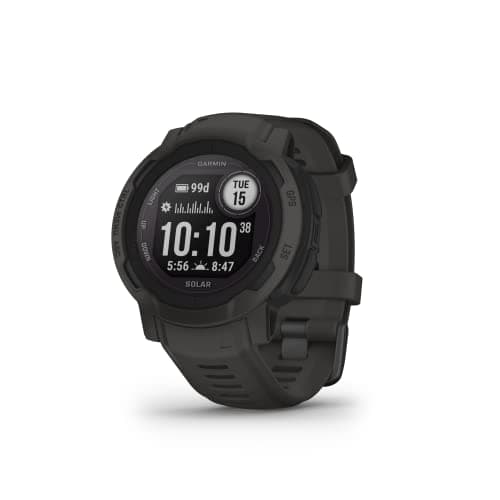 Garmin Instinct 2 Solar (45mm) Up to 28 days and unlimited with solar, 10 ATM and a MIL-STD-810 line, on the previous generation of the line Garmin still sells. The cheapest way to own a watch that charges itself. | Best Garmin for the moneySolar GPS | 7.7 /10 | $263.50Amazon |
| 2 | 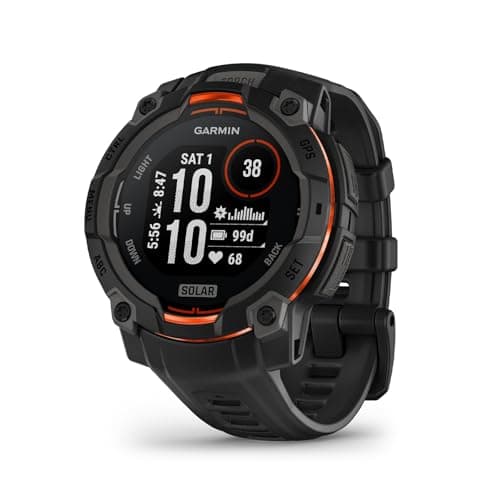 Garmin Instinct 3 Solar (45mm) 28 days, unlimited with solar, 40 GPS hours rising to 130 with solar, plus the flashlight the Instinct 2 does not have, in the smaller 45 mm case. | Best current-generation valueSolar GPS | 8.3 /10 | $339.99Amazon |
| 3 | 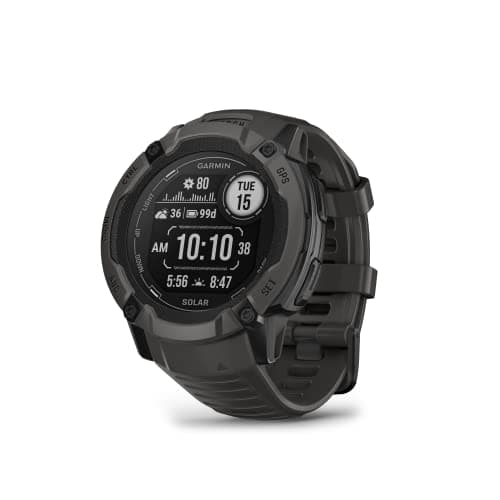 Garmin Instinct 2X Solar (50mm) 40 days, 145 GPS hours with solar, 150 in max-battery, a flashlight and a named Power Glass lens, at previous-generation money. | Most capability per dollarSolar GPS | 7.8 /10 | $334.90Amazon |
| 4 | 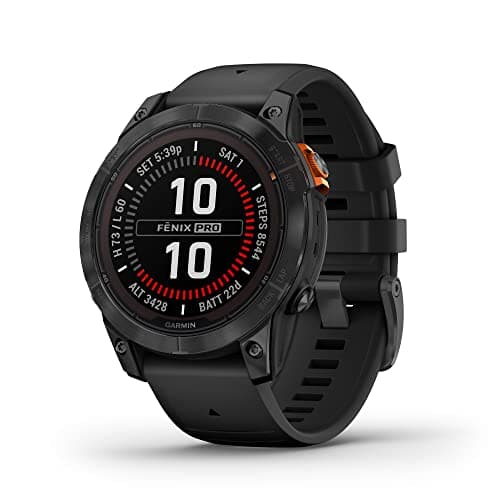 Garmin fenix 7 Pro Solar (47mm) 37 days of smartwatch battery and 139 days in expedition mode with preloaded TopoActive maps and a flashlight, for less than a current fenix. | Best value if you want mapsSolar GPS | 8.0 /10 | $679.99Amazon |
| 5 | 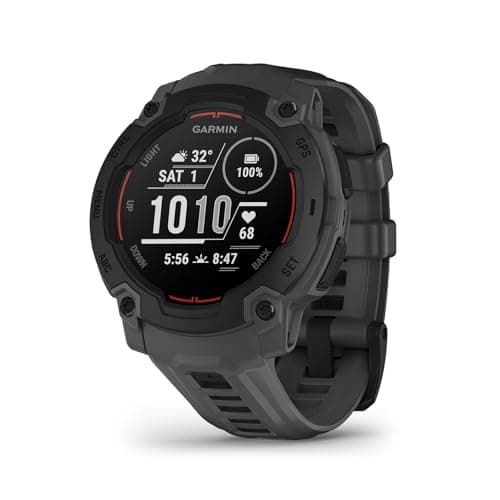 Garmin Instinct E (45mm) 16 days and 24 GPS hours with no solar column in Garmin's table, no flashlight and no MIL-STD-810 line. Buy it only if the budget is absolute. | Cheapest Garmin we would still buyRechargeable GPS | 6.7 /10 | $249.99Amazon |
#ad · Prices come live from Amazon, last checked November 4, 2026. Scores are ours, built from the makers' manuals, battery tables and spec pages. Product photos come from Amazon; anything still on a stock frame is labelled on its card. Tap a row for the full write-up.
What value means here
Most "best value" watch lists mean features per dollar on the day you buy. This site means something different and narrower: cost per decade. A watch you replace in four years because the battery will not hold a day is not good value, whatever it cost. A watch you still wear in 2036 is, even if it cost more than the one next to it.
That reframes the Garmin catalogue entirely. Garmin's newest watches are not its best-value ones, and several of its cheapest watches are bad value because of what they leave out. The whole of this page follows from one specification line, and it is not the price.
The one rule: solar beats new
Garmin publishes battery figures in two different forms, and the difference is the most important thing on this page. For non-solar watches you get a number of days. For solar watches you get a number of days and a condition: "unlimited with solar" at three hours a day of all-day wear at 50,000 lux.
Fifty thousand lux is a bright overcast day, not desert noon. For anyone who is outdoors regularly, the solar column is not a marketing asterisk; it is the real behaviour of the watch. And it matters for a reason that has nothing to do with convenience: lithium cells age by charge cycle. A solar Instinct cycles its cell a handful of times a year. A cable-charged watch cycles it dozens. Ten years out, that is the difference between a watch you still use and a watch with a dead afternoon.
Why these five, in this order
The Instinct 2 Solar is first because it is the cheapest watch Garmin sells that gets the solar column, the 10 ATM rating and the MIL-STD-810 line in Garmin's own wording. It is a previous-generation watch, which is exactly why it is good value: the generation that replaced it added a flashlight and a longer table, and it did not change what makes the watch last.
The Instinct 3 Solar (45mm) is second and the right answer for most people buying new. Same unlimited-with-solar claim, up to 28 days, 40 GPS hours rising to 130 with solar and 100 hours in max-battery mode, plus the flashlight with variable intensities, a red light and a strobe. The red mode alone is worth the step up for anyone who is awake before dawn. The 45 mm case is also the one to buy on a normal wrist, and the sizing argument is in what size GPS watch to buy.
The Instinct 2X Solar is the most specification per dollar on the page: up to 40 days, 60 GPS hours rising to 145 with solar, 150 hours in max-battery mode and unlimited with solar, an integrated LED flashlight, and the only Instinct whose lens Garmin actually names, a chemically strengthened Power Glass. It is 50 mm, which is the catch.
We do not print prices in prose on this site. What you actually pay moves weekly and differs by colourway, so the live number sits in the button on each card instead, dated and refreshed. What we can tell you is that the order above is the order of value per decade on Garmin's published figures, and that the gaps between these five are mostly about case size and the flashlight rather than about longevity.
Old generation or new?
Buy the older generation when the newer one did not change the power system. That is the case across the Instinct line: an Instinct 2 Solar and an Instinct 3 Solar make the same unlimited-with-solar claim, and the upgrade buys you a flashlight, a longer GPS table and a newer display rather than a longer life.
Buy the newer generation when the materials changed. That is the case at the top of the range: the fenix 8 introduced sapphire and a titanium bezel as standard on Solar editions plus a dive-rated case, which are decade-relevant upgrades, and the detail is in fenix 7 Pro vs fenix 8.
The generation-to-generation detail inside the Instinct line is in Instinct 2 vs Instinct 3.
What to stop paying for
Three upgrades that cost real money and do not improve how long the watch lasts.
- An AMOLED screen. It is brighter and prettier and it roughly halves the battery figure. On the Instinct 3 the AMOLED model drops from an unlimited-with-solar claim to 24 days by gesture or 9 days always-on. That is a weekly charge instead of never. The trade is in Instinct 3 solar vs AMOLED.
- Running features you will not use. A Forerunner 970 has sapphire and a titanium bezel and a 15-day table, because it is built to be charged. If your brief is a decade outdoors rather than race splits, the Instinct is the better buy at any price. See Instinct vs Forerunner.
- The biggest case. A 50 mm or 51 mm watch gets you a longer battery table and a watch you may stop wearing. The 45 mm Instinct 3 Solar still says unlimited with solar.
If you want maps on a budget
There is exactly one good answer and it is the fenix 7 Pro Solar. Garmin states up to 37 days in smartwatch mode and up to 139 days in expedition mode, with preloaded TopoActive maps, a flashlight with a red safety light and a strobe, a steel bezel and a MIL-STD-810 line, on a next-generation MIP display. The current fenix 8 Solar in 47 mm publishes 21 days, or 28 with solar. The older watch has the longer table and the lower price; what it gives up is sapphire on standard editions.
The cheaper mapping options outside the fenix line are compared in cheapest GPS watch with maps.
The decade pick
In detail
The picks, in full
Rank 1
Best Garmin for the money
Garmin Instinct 2 Solar (45mm)
Up to 28 days and unlimited with solar, 10 ATM and a MIL-STD-810 line, on the previous generation of the line Garmin still sells. The cheapest way to own a watch that charges itself.
EvidenceResearched · every row sourced
| Power class | Solar GPS. A rechargeable cell topped up by a solar lens. Weeks between charges; the cell still ages like any lithium battery. |
|---|---|
| Battery (smartwatch) | Up to 28 days; unlimited with solar (all-day wear, 3 hr/day at 50,000 lux) |
| Battery (GPS) | Up to 30 hours; 48 hours with solar |
| Battery (max GPS) | Up to 70 hours; 370 hours with solar |
| Battery (solar) | Expedition GPS mode up to 32 days; battery saver watch mode up to 65 days; both unlimited with solar |
| Water rating | Water-rated up to 10 ATM (Instinct 2 family, per the 2X Solar release) |
| MIL-STD-810 | Built to U.S. military standards (MIL-STD-810) for thermal shock, water resistance and shock (Instinct 2 family, per the 2X Solar release) |
How the 7.7 score breaks down
- Battery & power independence (25%)
- 9
- Durability of materials (25%)
- 7
- Serviceability & lifespan (20%)
- 6
- Field usability (15%)
- 8
- Value per decade (10%)
- 9
- Mission fit (5%)
- 7
What the spec sheet supports
- Garmin's table matches the current Instinct 3 Solar 45mm in smartwatch mode (28 days, unlimited with solar) and battery saver mode (65 days).
- Sold alongside the Instinct 3, so the price gap is real.
Where it falls short
- No flashlight on the 45mm Instinct 2; the Instinct 3 added one to every size.
- An older platform means an earlier end to firmware support.
Skip this if…
…you want the longest support runway; the Instinct 3 will be updated for years after this one stops.
#ad · Price as of November 4, 2026 · Disclosure for the link to Garmin Instinct 2 Solar (45mm)
Rank 2
Best current-generation value
Garmin Instinct 3 Solar (45mm)
28 days, unlimited with solar, 40 GPS hours rising to 130 with solar, plus the flashlight the Instinct 2 does not have, in the smaller 45 mm case.
EvidenceResearched · every row sourced
| Power class | Solar GPS. A rechargeable cell topped up by a solar lens. Weeks between charges; the cell still ages like any lithium battery. |
|---|---|
| Battery (smartwatch) | Up to 28 days typical use; unlimited with solar (3 hr/day at 50,000 lux) |
| Battery (GPS) | Up to 40 hours GPS-only; up to 130 hours with solar |
| Battery (max GPS) | Up to 100 hours max-battery GPS; unlimited with solar |
| Power | Rechargeable, built-in lithium-ion battery with solar charging display |
| Bezel & case | Metal-reinforced bezel; fiber-reinforced polymer case |
| Water rating | 10 ATM |
| MIL-STD-810 | Built to MIL-STD 810 for thermal and shock resistance |
| Flashlight | Built-in flashlight with variable intensities, a red light and strobe mode |
How the 8.3 score breaks down
- Battery & power independence (25%)
- 9
- Durability of materials (25%)
- 8
- Serviceability & lifespan (20%)
- 7
- Field usability (15%)
- 9
- Value per decade (10%)
- 9
- Mission fit (5%)
- 8
What the spec sheet supports
- Every durability claim of the 50mm (10 ATM, MIL-STD 810, metal-reinforced bezel) in a size that fits under a cuff.
- Still 'unlimited' in smartwatch mode under Garmin's solar assumption.
- Flashlight on every Instinct 3 size, which the Instinct 2 45mm never had.
Where it falls short
- Half the GPS-with-solar hours of the 50mm (130 vs 260) because the lens is smaller.
- No maps, same as the rest of the Instinct line.
Skip this if…
…you have the wrist for the 50mm; the bigger lens is where the solar numbers live.
#ad · Price as of November 4, 2026 · Disclosure for the link to Garmin Instinct 3 Solar (45mm)
Rank 3
Most capability per dollar
Garmin Instinct 2X Solar (50mm)
40 days, 145 GPS hours with solar, 150 in max-battery, a flashlight and a named Power Glass lens, at previous-generation money.
EvidenceResearched · every row sourced
| Power class | Solar GPS. A rechargeable cell topped up by a solar lens. Weeks between charges; the cell still ages like any lithium battery. |
|---|---|
| Battery (smartwatch) | Up to 40 days; unlimited with solar (all-day wear, 3 hr/day at 50,000 lux) |
| Battery (GPS) | Up to 60 hours GPS mode; up to 145 hours with solar |
| Battery (max GPS) | Up to 150 hours max-battery GPS; unlimited with solar |
| Battery (solar) | Expedition GPS mode up to 60 days; battery saver watch mode up to 100 days; both unlimited with solar |
| Glass | Chemically strengthened, scratch-resistant Power Glass lens |
| Bezel & case | 50mm fiber-reinforced polymer case |
| Water rating | Water-rated up to 10 ATM |
| MIL-STD-810 | Built to U.S. military standards (MIL-STD-810) for thermal shock, water resistance and shock |
| Flashlight | Integrated LED flashlight with variable intensities, white/red options and strobe |
| Operating temp | From -20º to 60ºC (from -4º to 140ºF); solar charging from 0º to 60ºC |
How the 7.8 score breaks down
- Battery & power independence (25%)
- 9
- Durability of materials (25%)
- 7
- Serviceability & lifespan (20%)
- 6
- Field usability (15%)
- 9
- Value per decade (10%)
- 8
- Mission fit (5%)
- 8
What the spec sheet supports
- The Power Glass lens produces 50% more energy than the Instinct 2 solar lens, per Garmin.
- Garmin's own table gives it the same 40 smartwatch days, 150 max-battery GPS hours and 60-day expedition mode as the current Instinct 3 Solar 50mm.
- Flashlight and a Tactical Edition variant with stealth mode and NVG compatibility.
Where it falls short
- 145 GPS hours with solar against the Instinct 3 Solar 50mm's 260: the newer lens harvests more.
- Garmin's Instinct 2 table publishes no all-systems (multi-band) GNSS battery row, so there is no figure to cite for that mode.
- A 2023 platform; the Instinct 3 is the one still getting new features.
Skip this if…
…you can find the Instinct 3 Solar 50mm for similar money; it is the newer version of this exact idea.
#ad · Price as of November 4, 2026 · Disclosure for the link to Garmin Instinct 2X Solar (50mm)
Rank 4
Best value if you want maps
Garmin fenix 7 Pro Solar (47mm)
37 days of smartwatch battery and 139 days in expedition mode with preloaded TopoActive maps and a flashlight, for less than a current fenix.
EvidenceResearched · every row sourced
| Power class | Solar GPS. A rechargeable cell topped up by a solar lens. Weeks between charges; the cell still ages like any lithium battery. |
|---|---|
| Battery (smartwatch) | Up to 37 days in smartwatch mode; up to 139 days in expedition mode |
| Bezel & case | Fiber-reinforced polymer case with a steel bezel and rear cover |
| MIL-STD-810 | Tested to U.S. military standards for thermal, shock and water resistance |
| Display | Next-generation MIP display |
| Maps & GPS | Preloaded TopoActive maps |
| Flashlight | Built-in LED flashlight with variable intensities, red safety light and strobe |
How the 8.0 score breaks down
- Battery & power independence (25%)
- 9
- Durability of materials (25%)
- 8
- Serviceability & lifespan (20%)
- 6
- Field usability (15%)
- 9
- Value per decade (10%)
- 8
- Mission fit (5%)
- 7
What the spec sheet supports
- Solar, flashlight and maps on every size, a generation before the fenix 8 made AMOLED the default.
- A steel bezel is heavier than titanium but takes a knock just as well.
Where it falls short
- Standard editions use a strengthened lens; only the Sapphire Edition gets sapphire, and Garmin's release does not name the standard lens.
- Two generations behind the current fenix 9 for firmware priority.
Skip this if…
…you want the longest firmware runway; buy the newest fenix you can afford instead.
#ad · Price as of November 4, 2026 · Disclosure for the link to Garmin fenix 7 Pro Solar (47mm)
Rank 5
Cheapest Garmin we would still buy
Garmin Instinct E (45mm)
16 days and 24 GPS hours with no solar column in Garmin's table, no flashlight and no MIL-STD-810 line. Buy it only if the budget is absolute.
EvidenceResearched · every row sourced
| Power class | Rechargeable GPS. A rechargeable lithium cell charged from a cable. Days to a few weeks per charge; the cell ages with every cycle. |
|---|---|
| Battery (smartwatch) | Up to 16 days |
| Battery (GPS) | Up to 24 hours GPS-only |
| Battery (max GPS) | Up to 50 hours max-battery GPS |
| Power | Rechargeable, built-in lithium-ion battery (no solar column in Garmin's battery table) |
| Water rating | 10 ATM |
| Flashlight | None: the owner's manual has no flashlight section |
| Operating temp | -20° to 60°C (-4° to 140°F) |
How the 6.7 score breaks down
- Battery & power independence (25%)
- 6
- Durability of materials (25%)
- 6
- Serviceability & lifespan (20%)
- 7
- Field usability (15%)
- 8
- Value per decade (10%)
- 8
- Mission fit (5%)
- 6
What the spec sheet supports
- 10 ATM water rating and the Instinct button layout at the lowest price in the line.
- Sixteen days of watch use is still weeks between charges.
Where it falls short
- No solar and no flashlight; Garmin's manual lists neither.
- 24 GPS hours is a weekend, not a week.
- Garmin does not make a MIL-STD 810 claim for the Instinct E in the material we could cite.
Skip this if…
…the reason you want an Instinct is to stop charging; this one charges like any other watch.
#ad · Price as of November 4, 2026 · Disclosure for the link to Garmin Instinct E (45mm)
How to get the most Garmin for your money
1. Make solar non-negotiable. It is the only feature on the list that changes how long the watch lasts rather than what it can do today.
2. Shop the previous generation of the same line. Within the Instinct family the power system did not change, so the older solar model is the value pick and the newer one is the convenience pick.
3. Read the battery table, not the headline. Garmin publishes smartwatch, GPS, max-battery and expedition figures separately, with and without solar. The one that matters is the mode you actually use.
4. Buy the smaller case unless you need the bigger table. 45 mm wears better and still carries the solar claim.
5. Skip AMOLED on a budget. It is the single most expensive way to shorten your battery figure.
6. Check the lens wording before you pay for durability. Garmin names sapphire on fenix, tactix and Enduro, and does not name it on the Instinct 3. We flag it only where the maker does, and the reasoning is in Garmin sapphire vs Gorilla Glass.
How we scored this
What we checked to build this ranking
Every pick here is researched against the documents that decide whether a watch lasts: the maker's own battery table read mode by mode, what the lens and case are actually made of, the water rating, whether a MIL-STD-810 line is on the record and in whose words, and how long the maker keeps updating the line. Each one is then scored on a public rubric weighted for a decade of ownership, and every figure links to where it came from.
That is why the order on this page is worth following: it is built from specs you can open yourself, and commissions never set a score or decide a pick. The rubric and its weights are published.
Questions
Frequently asked
What is the best Garmin watch for the money?
The Instinct 2 Solar. It is the cheapest Garmin that gets the solar column in Garmin's battery table, with up to 28 days of smartwatch use and an unlimited-with-solar claim at three hours a day at 50,000 lux, plus 10 ATM and a MIL-STD-810 line. Everything above it in the catalogue buys convenience rather than longevity.
Is an older Garmin still worth buying?
Within the Instinct line, yes. An Instinct 2 Solar and an Instinct 3 Solar make the same unlimited-with-solar claim, so the newer watch sells you a flashlight, a longer GPS table and a newer display rather than a longer life. At the top of the range the answer flips, because the fenix 8 added sapphire and titanium as standard on Solar editions.
Is the Garmin Instinct E good value?
Only if the budget is absolute. Garmin's table gives up to 16 days of smartwatch use and 24 GPS hours with no solar column, the owner's manual has no flashlight section, and the specification does not carry a MIL-STD-810 line. It is a cheaper watch that costs more per decade than an Instinct 2 Solar.
What is the cheapest Garmin with maps?
Among the watches we rank, the fenix 7 Pro Solar is the value route to preloaded TopoActive maps, and it also publishes the longest smartwatch figure of any fenix we list at up to 37 days. Cheaper mapping options outside the fenix line are compared in cheapest GPS watch with maps.
Should I buy a solar Garmin or a bigger AMOLED one?
Solar, if you are buying for a decade. On the Instinct 3 the AMOLED version drops from an unlimited-with-solar claim to 24 days by gesture or 9 days always-on, which means a weekly charge and dozens more cell cycles a year. AMOLED is the right buy only if you read the screen more than you wear the watch outdoors.
Keep reading
Related on Bezel & Bearing
Receipts
Sources
- Garmin — Instinct 2 Series Owner's Manual, Battery Life Information (checked 2026-09-20)
- Garmin — Instinct 2 Series Owner's Manual, Specifications (checked 2026-10-01)
- Garmin newsroom — Instinct 2X Solar press release (checked 2026-09-20)
- Garmin newsroom — Instinct 3 Series press release (checked 2026-09-20)
- Garmin — Instinct 3 Solar Series Owner's Manual, Battery Life Information (checked 2026-09-20)
- Garmin — Instinct 3 AMOLED Series Owner's Manual, Battery Life Information (checked 2026-09-20)
- Garmin — Instinct E Owner's Manual, Battery Life Information (checked 2026-09-20)
- Garmin — Instinct E Owner's Manual (contents: no flashlight or solar section) (checked 2026-09-20)
- Garmin newsroom — fenix 7 Pro Series press release (checked 2026-09-20)
- Garmin — fenix 8 Series Owner's Manual, Battery Information (checked 2026-09-20)
Battery, glass, case and water figures come from the maker's own owner's manuals, spec pages and press releases, linked on every product so you can open the page they came from. Prices are set by Amazon and change often, so each buy button takes you to the current one. Read the full method.