G-Shock & Pro Trek / Review
G-Shock Rangeman GPR-H1000 review: a real GPS watch in a real Rangeman case
Casio put five-constellation GNSS and a heart-rate sensor inside a 200-meter mud-resistant Rangeman, then asked you to charge it. This review is about whether the case is worth the compromise the electronics force on it.
By Mike M.Updated Researched from the maker's manuals and spec sheets
#adReader-supported: we may earn a commission if you buy through our links, at no extra cost to you. It never decides a ranking. How we rate · Disclosure
The verdict
The watch and its alternatives
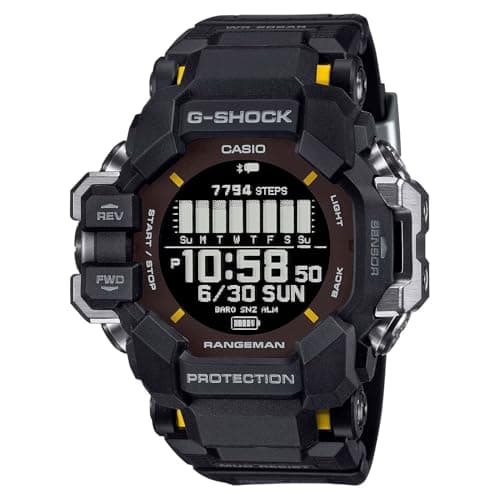
The watch under review
G-Shock Rangeman GPR-H1000
Rechargeable GPS6.9 /10Five-constellation L1/L5 GNSS, wrist heart rate, 14 to 19 GPS hours, about two months in watch mode with monitoring off, 200 m, mud resistant. Score below.
Check price · Amazon#ad · Price as of November 4, 2026 · Disclosure for the link to G-Shock Rangeman GPR-H1000
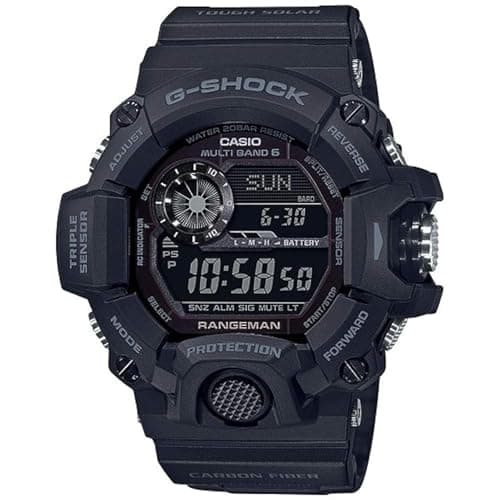
Alternative: the Rangeman that never charges
G-Shock Rangeman GW-9400
Solar, no charger8.7 /10No GPS and no heart rate, but Tough Solar, radio-set time and the full triple sensor in the same 200 m mud-resistant shape. In production since 2013.
$320.00Amazon#ad · Price as of November 4, 2026 · Disclosure for the link to G-Shock Rangeman GW-9400
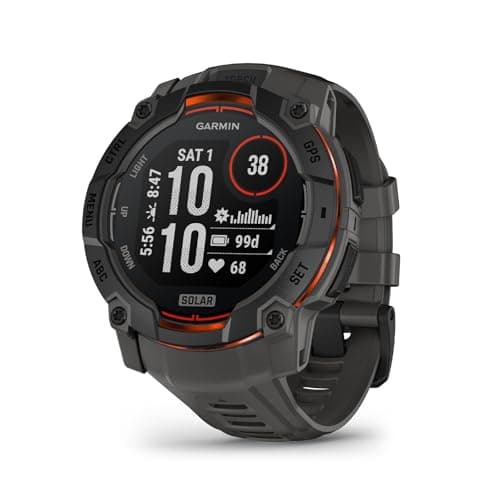
Alternative: the GPS watch that outlasts it
Garmin Instinct 3 Solar (50mm)
Solar GPS8.7 /10Garmin rates it unlimited in smartwatch mode with enough sun and far more GPS hours per charge, with a flashlight and breadcrumb navigation.
$399.99Amazon#ad · Price as of November 4, 2026 · Disclosure for the link to Garmin Instinct 3 Solar (50mm)
Verdict and score
What Casio actually built
The Rangeman has always been the Master of G model for people on foot: triple sensor, 200 meters, mud resistance, a bezel built to take the hit before the glass does. Every previous Rangeman measured the world — altitude, pressure, bearing, temperature — without ever knowing where it was. The GPR-H1000, released in 2024 on module 3554, is the first one that knows.
It is a wrist-recording device: start an activity and it logs a track with five-constellation GNSS and your heart rate, syncs to Casio's app over Bluetooth, and shows you distance, pace and zones on a MIP LCD. Alongside that it keeps every classic Rangeman function — compass, barometer, altimeter, thermometer, sunrise and sunset, moon data, tide graph — and adds vibration alerts. That combination does not exist anywhere else, which is the whole reason this watch has an audience.
What it is not, and what people keep hoping it is, is a navigation watch. There are no maps, no routes to follow and no breadcrumb-trail return. It records where you went; it will not lead you back. If that is the job, the honest answer is a Garmin, and the list of what the two brands actually do differently is in G-Shock vs Garmin Instinct.
The two battery stories
Casio's own operating-time table is the most important thing on this page, because the headline depends entirely on which row you read. Here it is unrearranged:
| Mode (Casio's wording) | GPR-H1000 |
|---|---|
| Watch mode, heart rate and sleep monitoring off | about 2 months |
| Watch mode, heart rate and sleep on, worn during sleep | about 14 days |
| Running / walking / trekking, HIGH GPS accuracy | about 14 hours |
| Running / walking / trekking, NORMAL | about 16 hours |
| Running / walking / trekking, LONG | about 19 hours |
Two months is excellent. Fourteen days with heart rate running day and night is respectable for any watch with an optical sensor. Fourteen to nineteen hours of recording is the number that decides what this watch can and cannot be asked to do.
Nineteen hours covers a marathon, a long day on the hill, a full shift, a drive and a hunt. It does not cover a two-day traverse, a multi-day hunt with the track left running, or a thru-hike section — and a watch that cannot record a two-day effort cannot be the one watch for someone who does them. For context, the Instinct 3 Solar is rated by Garmin at well over double that GPS-only, and the COROS VERTIX 2S reaches 118 hours. The full ranking is in longest-battery-life GPS watches.
The useful way to hold both facts at once: this is a two-month watch that you can spend a day of battery on when you want a track. Owners who think of it that way are satisfied. Owners who bought it as a GPS watch and leave recording on are the ones who end up disappointed.
GNSS and the sensors
The satellite spec is better than you would expect from Casio and better than most Garmins at the price. The module 3554 guide lists GPS, QZSS, Galileo, BeiDou and GLONASS on L1 and L5 — that is dual-frequency reception across five constellations, which is the hardware that fights canyon walls, dense canopy and city reflections. What dual-frequency buys and costs is explained in GPS watch accuracy explained.
The rest of the sensor set is pure Rangeman, and all of it reads straight off the wrist with no phone. Casio specifies the pressure sensor from 260 to 1,100 hPa with accuracy within ±3 hPa, the altimeter from -700 to 10,000 m within ±75 m, and the thermometer from -10.0 to 60.0 °C within ±2.0 °C. The heart-rate sensor covers 30 to 220 bpm with zone graphics and history. Timekeeping accuracy without a phone sync is ±15 seconds a month.
Read that altimeter accuracy figure carefully, because it is Casio being honest rather than Casio being bad: ±75 m is roughly what any barometric altimeter does between calibrations, and watches that quote tighter numbers are usually quoting resolution rather than accuracy. The same caveat applies to every ABC watch on this site.
The case, and what it costs you
G-Central's spec sheet gives 60.6 × 53.2 × 20.3 mm and 92 g, in resin and bio-based resin, with mineral glass, 200-meter water resistance, shock resistance and mud resistance. The mud rating is the part that earns its keep: it is achieved through the construction of the pushers and seals, and it is the reason a Rangeman survives work that quietly kills watches with ordinary buttons.
Twenty point three millimeters is the other cost. This watch is thicker than a Mudmaster and taller than most wrists want; it does not go under a cuff and it will catch on a pack strap. If 60.6 mm across sounds like a lot, it is, and the sizing guide is best G-Shock for small wrists — the GPR-H1000 is the opposite end of that list.
Solar assist is not Tough Solar
Casio describes the power system as a lithium-ion battery with wired USB charging and solar-assisted charging. That wording matters. On a Tough Solar G-Shock, the solar cell is the only charger the watch will ever have; there is no port, and a well-lit watch runs indefinitely. On the GPR-H1000, the panel slows the drain and extends the gap between charges. It does not remove the cable.
For a site organized around watches that outlast their owners' patience, that is the central mark against this model, and it is worth stating plainly rather than burying: the GPR-H1000 is the Rangeman with a charging habit. Whether that disqualifies it depends on how much you value the GPS, and our general position on the trade is in are solar watches worth it.
Against the GW-9400 and the Instinct
Against the Rangeman GW-9400, the trade is stark and clean. The GW-9400 has no GPS, no heart rate and no app, and it has been on sale since 2013 with Tough Solar, radio-set time and no charger in the box. It is cheaper by a wide margin and it is the better buy-it-for-life watch by every measure this site weights. The GPR-H1000's answer is that it does things the GW-9400 cannot do at all. Which Rangeman suits which job is laid out in Rangeman vs Mudmaster vs Mudman.
Against the Garmin Instinct 3 Solar, the GPR-H1000 loses on every number that matters to a GPS buyer: GPS hours, smartwatch days, navigation, flashlight, training software and weight. It wins on the case rating, on mud sealing, and on the fact that it is a Rangeman — which, for a certain buyer, is not a soft preference but the reason for the purchase. The full comparison of what each brand is actually good at is in G-Shock vs Garmin Instinct.
Inside Casio's own GPS lineup, the other option is the GBD-H2000, which has GPS and heart rate in a 63-gram case and is 29 g lighter for the same stated GPS hours, without the Rangeman's mud resistance or its tide and moon functions. That one is ranked in best G-Shock for running, and the whole GPS-in-a-G-Shock question is in G-Shocks with GPS.
Price and where to buy it
This is a flagship-priced Casio — G-Central lists it at the top of the G-Shock price ladder, in the same bracket as a sapphire-and-titanium GPS watch from Garmin or COROS, which is the uncomfortable fact behind the value score above. We print no number for it in prose; the buy button shows Amazon's live price when Amazon has stock and reads "check price" when it does not.
Worth knowing before you shop: Amazon stock on this model is intermittent, and at the time of writing there was no live Amazon offer for it, though Casio and its retailers continue to list it as a current model. That is normal for a low-volume Master of G release and not a sign the watch is discontinued — but it does mean the price you find will move more than it would on a mass-market G-Shock, and it is worth checking a dealer as well as Amazon.
Who should buy it, and who should not
Buy it if you want a Rangeman and you also want a heart rate and a track: that pairing exists in exactly one watch. Buy it if your work or your season involves mud, water and impact, and the recording is a bonus rather than the point. Buy it if you specifically want dual-frequency GNSS in a 200-meter resin case with sealed pushers.
Skip it if you need more than 19 hours of recording in one go; skip it if you want maps or turn-back navigation, which it does not have in any form; skip it if what you liked about Rangemans was never meeting a charger — buy the GW-9400 and keep the difference. And skip it if 20.3 mm on a 60.6 mm case is more watch than your wrist will tolerate.
If toughness is the thing you came for, the cross-brand ranking is toughest G-Shock, and the hunting-specific picks are in best G-Shock for hunting.
In detail
Spec sheet and score
The watch under review
G-Shock Rangeman GPR-H1000
Five-constellation L1/L5 GNSS, wrist heart rate, 14 to 19 GPS hours, about two months in watch mode with monitoring off, 200 m, mud resistant. Score below.
EvidenceResearched · every row sourced
| Power class | Rechargeable GPS. A rechargeable lithium cell charged from a cable. Days to a few weeks per charge; the cell ages with every cycle. |
|---|---|
| Battery (smartwatch) | About 14 days with heart rate and sleep monitoring worn during sleep; about 2 months with heart rate monitoring off |
| Battery (GPS) | Running/walking/trekking: about 14 hours (HIGH GPS), 16 hours (NORMAL), 19 hours (LONG) |
| Power | Lithium-ion battery; wired USB charging with solar-assisted charging |
| Glass | Mineral |
| Water rating | 200 meters; shock resistant; mud resistant |
| Display | MIP LCD |
| Maps & GPS | GPS, QZSS, Galileo, BeiDou, GLONASS on L1/L5 |
| Sensors | Heart rate (30-220 bpm), accelerometer, barometric pressure, temperature |
| Weight | 92 g |
| Size | 60.6 × 53.2 × 20.3 mm |
How the 6.9 score breaks down
- Battery & power independence (25%)
- 6
- Durability of materials (25%)
- 7
- Serviceability & lifespan (20%)
- 7
- Field usability (15%)
- 8
- Value per decade (10%)
- 6
- Mission fit (5%)
- 8
What the spec sheet supports
- Dual-frequency GNSS in a G-Shock case with 200 m and mud resistance.
- Two months of watch-mode battery with heart rate off, per Casio's manual.
Where it falls short
- 14 to 19 GPS hours is a third of a Garmin Instinct 3 Solar's GPS-only figure.
- 20.3 mm thick and 92 g.
- Solar 'assist' tops up; it does not replace the USB cable the way Tough Solar does.
Skip this if…
…you want GPS tracking for more than a day out; the Instinct 3 Solar triples the hours.
#ad · Price as of November 4, 2026 · Disclosure for the link to G-Shock Rangeman GPR-H1000
Alternative: the Rangeman that never charges
G-Shock Rangeman GW-9400
No GPS and no heart rate, but Tough Solar, radio-set time and the full triple sensor in the same 200 m mud-resistant shape. In production since 2013.
EvidenceResearched · every row sourced
| Power class | Solar, no charger. A solar cell that recharges from any light and never meets a charger. The rechargeable cell is a watchmaker-replaceable part. |
|---|---|
| Battery (cell) | Approximately 8 months from full charge to Level 4 with no light (Casio's stated usage conditions) |
| Power | Solar panel and one rechargeable battery (Tough Solar) |
| Glass | Mineral crystal |
| Water rating | 200 meters |
| Sensors | Digital compass, barometer, altimeter, thermometer; sunrise/sunset; Multi-Band 6 time calibration (WWVB, DCF77, MSF, JJY, BPC) |
| Weight | 93 g |
| Size | 55.2 × 53.5 × 18.2 mm |
| Operating temp | Low-temperature resistance -10°C (14°F) |
How the 8.7 score breaks down
- Battery & power independence (25%)
- 10
- Durability of materials (25%)
- 7
- Serviceability & lifespan (20%)
- 10
- Field usability (15%)
- 7
- Value per decade (10%)
- 10
- Mission fit (5%)
- 8
What the spec sheet supports
- Solar and atomic: it sets itself from a radio signal and never sees a cable.
- A module that has been in production for over a decade; parts, straps and bezels are everywhere.
- Sunrise/sunset on the watch, the one hunting feature the Garmin Instinct does without a phone.
Where it falls short
- Mineral crystal, not sapphire; the Rangeman lives behind a raised bezel for a reason.
- No GPS, no maps, no heart rate. It tells you where north is, not where you are.
- Big and thick at 18.2 mm.
Skip this if…
…you want a track of where you walked; an ABC watch measures the world, it does not map it.
#ad · Price as of November 4, 2026 · Disclosure for the link to G-Shock Rangeman GW-9400
Alternative: the GPS watch that outlasts it
Garmin Instinct 3 Solar (50mm)
Garmin rates it unlimited in smartwatch mode with enough sun and far more GPS hours per charge, with a flashlight and breadcrumb navigation.
EvidenceResearched · every row sourced
How the 8.7 score breaks down
- Battery & power independence (25%)
- 10
- Durability of materials (25%)
- 8
- Serviceability & lifespan (20%)
- 7
- Field usability (15%)
- 9
- Value per decade (10%)
- 10
- Mission fit (5%)
- 8
What the spec sheet supports
- Garmin's own table shows the 50mm solar model doubling the 45mm in GPS-with-solar hours (260 vs 130).
- Physical buttons, a monochrome display readable in full sun, and a flashlight with a red mode.
- 10 ATM rating and a MIL-STD 810 claim on a watch that costs less than half a fenix.
Where it falls short
- No maps: it navigates breadcrumb trails and waypoints, not topo maps.
- The solar figures assume three hours a day at 50,000 lux, which is midday sun, not a sleeve.
- Garmin does not name the lens material; treat it as strengthened glass, not sapphire.
Skip this if…
…you need on-wrist topo maps, or you wear long sleeves and work indoors, where the solar math never happens.
#ad · Price as of November 4, 2026 · Disclosure for the link to Garmin Instinct 3 Solar (50mm)
How we scored this
What we checked to build this ranking
Every pick here is researched against the documents that decide whether a watch lasts: the maker's own battery table read mode by mode, what the lens and case are actually made of, the water rating, whether a MIL-STD-810 line is on the record and in whose words, and how long the maker keeps updating the line. Each one is then scored on a public rubric weighted for a decade of ownership, and every figure links to where it came from.
That is why the order on this page is worth following: it is built from specs you can open yourself, and commissions never set a score or decide a pick. The rubric and its weights are published.
Questions
Frequently asked
How long does the G-Shock GPR-H1000 battery last?
Casio's module 3554 guide states about two months in watch mode with heart rate and sleep monitoring disabled, about 14 days with both enabled and worn during sleep, and 14 hours of GPS recording at high accuracy, 16 hours at normal and 19 hours in long-battery mode.
Is the GPR-H1000 Tough Solar?
No. Casio describes it as a lithium-ion battery with wired USB charging and solar-assisted charging. The panel extends the time between charges; it does not replace the cable the way Tough Solar does on a GW-9400.
Does the G-Shock GPR-H1000 have maps?
No. It records a GPS track and shows distance, pace and heart-rate zones, but it has no map, no route following and no breadcrumb return. For navigation on the wrist you need a Garmin, Suunto or COROS.
How accurate is the GPR-H1000 altimeter?
Casio specifies the altimeter from -700 to 10,000 m with accuracy within ±75 m, and the barometer from 260 to 1,100 hPa within ±3 hPa. That is typical for a barometric altimeter between calibrations.
Is the GPR-H1000 waterproof and mud resistant?
Casio rates it to 200 meters with shock resistance and mud resistance. It is not a dive watch, but 200 m covers swimming, wading and surface water work comfortably.
GPR-H1000 or Rangeman GW-9400?
The GW-9400 if you want a watch that never sees a charger and you can live without GPS and heart rate; the GPR-H1000 if the track and the heart rate are worth a rechargeable cell and a much higher price. The GW-9400 is the better decade watch; the GPR-H1000 does more on the day.
Keep reading
Related on Bezel & Bearing
Receipts
Sources
- Casio — Operation Guide, module 3554 (GPR-H1000 Rangeman), Specifications (checked 2026-09-20)
- G-Central — G-Shock GPR-H1000 Rangeman spec sheet (checked 2026-09-20)
- Casio — Operation Guide, module 3410 (GW-9400 Rangeman), Specifications (checked 2026-09-20)
- Garmin — Instinct 3 Solar Series Owner's Manual, Battery Life Information (checked 2026-09-20)
Battery, glass, case and water figures come from the maker's own owner's manuals, spec pages and press releases, linked on every product so you can open the page they came from. Prices are set by Amazon and change often, so each buy button takes you to the current one. Read the full method.