G-Shock & Pro Trek / The rankings
The best G-Shock for running: what Casio actually publishes, and where a Garmin still wins
Casio does make real running watches, with GPS, heart rate and a solar panel. It does not make one that beats a Garmin on GPS hours. Here is the honest split, from Casio's module specifications.
By Mike M.Updated Spec-sheet researched, not worn by us
#adReader-supported: we may earn a commission if you buy through our links, at no extra cost to you. It never decides a ranking. How we rate · Disclosure
Quick picks
The rankings at a glance
| # | Product | Best for | Score | Price |
|---|---|---|---|---|
| 1 |  G-Shock GBD-H2000 GPS, wrist heart rate and the full triple sensor at 63 g, solar-assisted. Casio states 14 hours of high-accuracy GPS and two months in watch mode. | Best G-Shock for runningSolar GPS | 6.8 /10 | Check price · Amazon |
| 2 |  G-Shock GBD-200 Step counter, accelerometer pace and distance, vibration alerts and a MIP display on a CR2032 rated at about two years. | Best without a chargerReplaceable cell | 7.5 /10 | Check price · Amazon |
| 3 |  G-Shock Rangeman GPR-H1000 Solar-assisted GPS in a Master of G case with mud resistance, 200 m and the ABC sensors a road watch leaves out. | Best for long days off-roadRechargeable GPS | 6.9 /10 | Check price · Amazon |
| 4 | G-Shock DW-5600E $99.95 list, 52 g, a 1/100-second stopwatch, full-dial EL backlight and a five-year cell. No data, no app, no charging. | Best minimalistReplaceable cell | 7.7 /10 | Check price · Amazon |
| 5 | G-Shock GMA-S2100 41 g and 11.2 mm, 200 m, three-year cells. A stopwatch on the smallest G-Shock case Casio makes. | LightestReplaceable cell | 7.8 /10 | Check price · Amazon |
#ad · Prices are set by Amazon and change often, so we don't print them. Scores are ours, built from the makers' manuals, battery tables and spec pages, not field tests. Photos are illustrative stock. Tap a row for the full write-up.
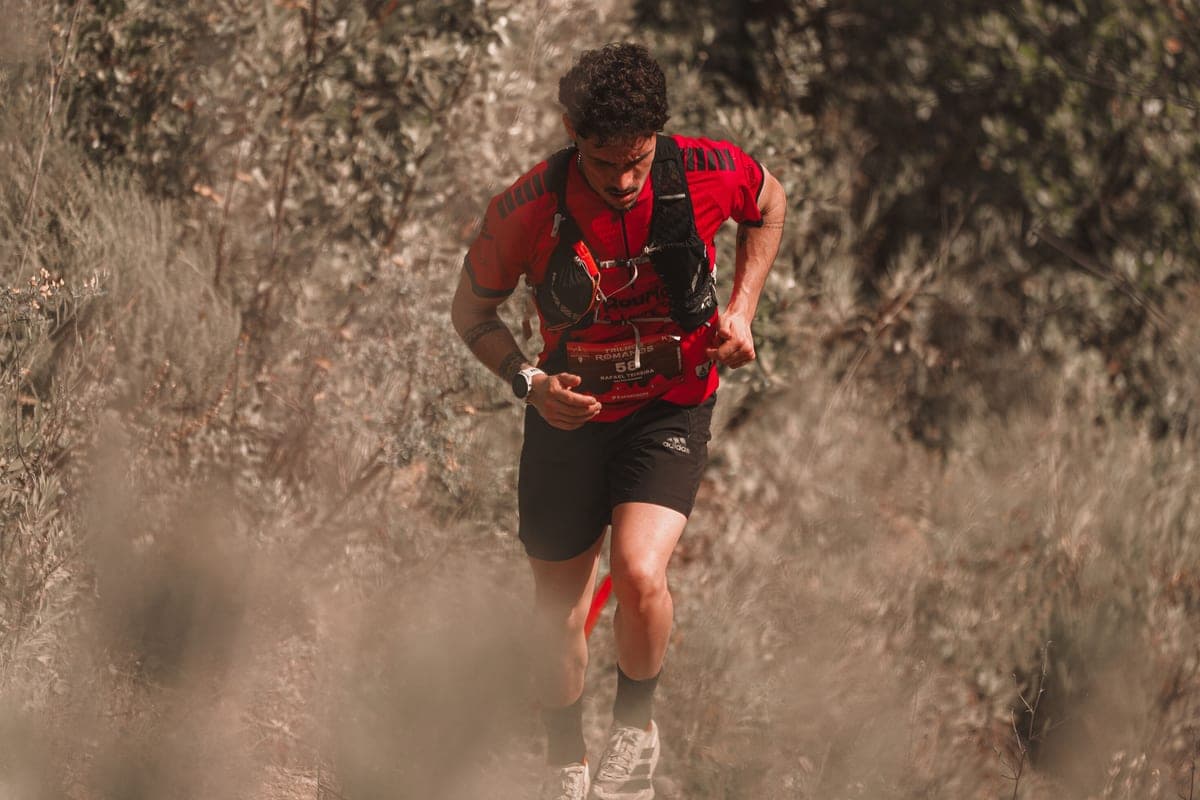
The honest answer first
If running is the main reason you are buying a watch, a Garmin is the better buy and we are not going to pretend otherwise. A Forerunner 970 publishes 26 hours of GPS-only recording against the GBD-H2000's 14 at high accuracy, and it adds maps and Garmin's running-science metrics. The comparison is best GPS watch for trail running.
What a G-Shock gives you instead is everything else: 200 meters of water resistance on every model here, a case built to be dropped, and — on the two best picks — a battery you measure in months rather than days. If you want one watch for running and for work, mud, water and a decade of ordinary abuse, this page is the right page.
GPS, or an accelerometer
This is the first fork and it decides most of the page. Two G-Shocks here have real GPS: the GBD-H2000 and the Rangeman GPR-H1000. Their distance and pace come from satellites, which means they are accurate out of the box and they cost battery while recording.
The GBD-200 has no GPS. Its pace and distance come from the accelerometer — it counts your steps and multiplies by a stride length, which needs calibration and drifts on hills, on trails and when your form changes with fatigue. For a treadmill or a known loop it is fine. For an accurate race split it is not, and you should not buy it expecting one.
The two squares have neither. A DW-5600E has a 1/100-second stopwatch and that is the whole feature set, which for a large number of runners is genuinely all they use.
Battery: where Casio actually wins
Every figure here is Casio's own, from the module specifications. This is the column where a G-Shock beats a running watch outright:
| Watch | Power | Watch mode | GPS recording | Charger? |
|---|---|---|---|---|
| GBD-H2000 | Solar-assisted rechargeable | 2 months with monitoring off; 14 days with heart rate and sleep on, worn overnight | 14 hours high accuracy; up to 19 hours in long-battery mode | USB, as backup |
| GBD-200 | CR2032 coin cell | Approx. 2 years | None (accelerometer) | Never |
| Rangeman GPR-H1000 | Solar-assisted GPS | See Casio's module table | See Casio's module table | Charging unit |
| DW-5600E | CR2016 coin cell | Approx. 5 years | None | Never |
| GMA-S2100 | Two coin cells | Approx. 3 years | None | Never |
Two months of watch-mode running on the GBD-H2000 is a figure no AMOLED running watch comes close to, and the solar panel means most weeks need no cable at all. The GBD-200 goes further in a different direction: about two years on a coin cell, with step counting and vibration alerts, and no charging ever. If your objection to running watches is the charging, that watch is the answer to it.
Weight and bulk on a run
Casio publishes these and they matter more running than anywhere else, because a heavy watch on a loose strap bounces. The GBD-H2000 is 63 g — genuinely light for what is inside it — but it is 59.6 mm tall and 19.4 mm thick, which is the largest case we rank and will catch a sleeve. The GBD-200 is 58 g and 15 mm. The GMA-S2100 is 41 g and 11.2 mm, the smallest and lightest option here by a distance.
If the bulk is the problem rather than the features, the small squares are the answer, and every published measurement is side by side in best G-Shock for small wrists.
What you get and what you do not
The GBD-H2000 covers the real running feature set: wrist heart rate (Casio states 30 to 220 bpm), GPS with position and time correction, a digital compass, an altimeter and barometer accurate to ±3 hPa, a thermometer to ±2.0 °C, sunrise, sunset and moon data, vibration alerts and Bluetooth to Casio's app. The GBD-200 adds auto pause, interval timers with settings, target alerts and a MIP display — the same display technology that makes a Garmin Instinct readable in direct sun.
What no G-Shock here has: maps, a music player, structured-workout following from a coach platform, or running-form metrics. And the training data on both GBD models depends on Casio's phone app, which is a software-support question the DW-5600E simply does not have.
Against a real running watch
So the split is clean: a Garmin for race-day GPS endurance and maps, a G-Shock for everything around the running. The full Garmin comparison is Instinct vs Forerunner, and the broader Casio-against-Garmin argument is G-Shock vs Garmin Instinct.
The decade pick
In detail
The picks, in full
Rank 1
Stock photoBest G-Shock for running
G-Shock GBD-H2000
GPS, wrist heart rate and the full triple sensor at 63 g, solar-assisted. Casio states 14 hours of high-accuracy GPS and two months in watch mode.
EvidenceResearched · not worn by us
How the 6.8 score breaks down
- Battery & power independence (25%)
- 7
- Durability of materials (25%)
- 7
- Serviceability & lifespan (20%)
- 5
- Field usability (15%)
- 8
- Value per decade (10%)
- 6
- Mission fit (5%)
- 9
What the spec sheet supports
- Two months of stated watch-mode running is far beyond any AMOLED running watch, and the solar panel means most weeks need no cable at all.
- GPS, heart rate and the full triple sensor in a 63-gram case with 200 m water resistance.
- Sunrise, sunset and moon data on the watch, which running watches usually leave to a phone.
Where it falls short
- 19.4 mm thick and 59.6 mm tall. This is a large watch by any measure and the largest Casio we rank.
- Mineral glass on a watch that costs $399, and no maps.
- A sealed rechargeable cell and a firmware dependency: this is the one G-Shock with the ageing profile of a smartwatch.
Skip this if…
…you want maps or the longest GPS hours; 14 hours at high accuracy is short next to a Garmin Enduro 3 or a COROS VERTIX 2S.
#ad · Price set by Amazon · Disclosure for the link to G-Shock GBD-H2000
Rank 2
Stock photoBest without a charger
G-Shock GBD-200
Step counter, accelerometer pace and distance, vibration alerts and a MIP display on a CR2032 rated at about two years.
EvidenceResearched · not worn by us
| Power class | Replaceable cell. A replaceable coin cell measured in years. No charging, no electronics to update, and the cheapest thing on the watch to service. |
|---|---|
| Battery (cell) | CR2032, approx. 2 years, with power saving |
| Glass | Mineral |
| Bezel & case | Resin case, bezel and band |
| Water rating | 200-meter water resistance, shock resistant |
| Display | MIP LCD, higher contrast than a standard LCD |
| Sensors | Step counter, accelerometer-based pace and distance, vibration alerts, auto pause, target alerts, interval timer; Bluetooth Mobile Link to the Casio Watches and G-Shock Move apps; module 3506 |
| Weight | 58 g |
| Size | 48.4 × 45.9 × 15 mm |
How the 7.5 score breaks down
- Battery & power independence (25%)
- 7
- Durability of materials (25%)
- 7
- Serviceability & lifespan (20%)
- 8
- Field usability (15%)
- 8
- Value per decade (10%)
- 8
- Mission fit (5%)
- 8
What the spec sheet supports
- Training data, vibration alerts and an interval timer without ever plugging the watch in.
- A MIP display, which is the technology that makes a Garmin Instinct readable in sun.
- 58 grams and 200 m: you can swim in it and forget it.
Where it falls short
- No GPS. Distance and pace come from the accelerometer, so they need calibration and they drift.
- Mineral glass, no solar, no sensors beyond the accelerometer.
- The training features depend on Casio's phone app, which is a software support question the DW-5600E does not have.
Skip this if…
…you want accurate distance without calibrating anything; that needs GPS, which means the GBD-H2000 or a Garmin.
#ad · Price set by Amazon · Disclosure for the link to G-Shock GBD-200
Rank 3
Stock photoBest for long days off-road
G-Shock Rangeman GPR-H1000
Solar-assisted GPS in a Master of G case with mud resistance, 200 m and the ABC sensors a road watch leaves out.
EvidenceResearched · not worn by us
| Power class | Rechargeable GPS. A rechargeable lithium cell charged from a cable. Days to a few weeks per charge; the cell ages with every cycle. |
|---|---|
| Battery (smartwatch) | About 14 days with heart rate and sleep monitoring worn during sleep; about 2 months with heart rate monitoring off |
| Battery (GPS) | Running/walking/trekking: about 14 hours (HIGH GPS), 16 hours (NORMAL), 19 hours (LONG) |
| Power | Lithium-ion battery; wired USB charging with solar-assisted charging |
| Glass | Mineral |
| Water rating | 200 meters; shock resistant; mud resistant |
| Display | MIP LCD |
| Maps & GPS | GPS, QZSS, Galileo, BeiDou, GLONASS on L1/L5 |
| Sensors | Heart rate (30-220 bpm), accelerometer, barometric pressure, temperature |
| Weight | 92 g |
| Size | 60.6 × 53.2 × 20.3 mm |
How the 6.9 score breaks down
- Battery & power independence (25%)
- 6
- Durability of materials (25%)
- 7
- Serviceability & lifespan (20%)
- 7
- Field usability (15%)
- 8
- Value per decade (10%)
- 6
- Mission fit (5%)
- 8
What the spec sheet supports
- Dual-frequency GNSS in a G-Shock case with 200 m and mud resistance.
- Two months of watch-mode battery with heart rate off, per Casio's manual.
Where it falls short
- 14 to 19 GPS hours is a third of a Garmin Instinct 3 Solar's GPS-only figure.
- 20.3 mm thick and 92 g.
- Solar 'assist' tops up; it does not replace the USB cable the way Tough Solar does.
Skip this if…
…you want GPS tracking for more than a day out; the Instinct 3 Solar triples the hours.
#ad · Price set by Amazon · Disclosure for the link to G-Shock Rangeman GPR-H1000
Rank 4
Stock photoBest minimalist
G-Shock DW-5600E
$99.95 list, 52 g, a 1/100-second stopwatch, full-dial EL backlight and a five-year cell. No data, no app, no charging.
EvidenceResearched · not worn by us
| Power class | Replaceable cell. A replaceable coin cell measured in years. No charging, no electronics to update, and the cheapest thing on the watch to service. |
|---|---|
| Battery (cell) | CR2016, approx. 5 years |
| Glass | Mineral |
| Bezel & case | Resin case and band |
| Water rating | 200 meters; shock resistant |
| Weight | 52 g |
| Size | 48.9 × 42.8 × 13.4 mm |
How the 7.7 score breaks down
- Battery & power independence (25%)
- 8
- Durability of materials (25%)
- 6
- Serviceability & lifespan (20%)
- 10
- Field usability (15%)
- 6
- Value per decade (10%)
- 10
- Mission fit (5%)
- 6
What the spec sheet supports
- In production since 1987 with a module refresh in 2023; parts and straps will exist for the rest of your life.
- A five-year coin cell is the longest-stated battery on the site.
- Small enough for any wrist and any cuff.
Where it falls short
- Mineral crystal on a flat face with a low bezel; it scratches.
- No sensors, no solar, no radio time.
Skip this if…
…you want it to set itself; the GW-M5610U is the same square with solar and radio time.
#ad · Price set by Amazon · Disclosure for the link to G-Shock DW-5600E
Rank 5
Stock photoLightest
G-Shock GMA-S2100
41 g and 11.2 mm, 200 m, three-year cells. A stopwatch on the smallest G-Shock case Casio makes.
EvidenceResearched · not worn by us
| Power class | Replaceable cell. A replaceable coin cell measured in years. No charging, no electronics to update, and the cheapest thing on the watch to service. |
|---|---|
| Battery (cell) | SR726W × 2, approx. 3 years |
| Glass | Mineral |
| Bezel & case | Carbon Core Guard construction: carbon and resin case, resin band; Casio's small case size |
| Water rating | 200-meter water resistance |
| Sensors | None. World time, 1/100-second stopwatch, timer, 5 alarms, Double LED light; module 5611 |
| Weight | 41 g |
| Size | 46.2 × 42.9 × 11.2 mm |
How the 7.8 score breaks down
- Battery & power independence (25%)
- 7
- Durability of materials (25%)
- 7
- Serviceability & lifespan (20%)
- 9
- Field usability (15%)
- 8
- Value per decade (10%)
- 10
- Mission fit (5%)
- 6
What the spec sheet supports
- 41 grams and 42.9 mm across: the only G-Shock here that disappears on a six-inch wrist.
- It gives up nothing structural to the full-size GA-2100 — same carbon case, same 200 m, same module.
- A three-year cell and a case shops open every day.
Where it falls short
- Casio sells it as the small size, so the strap and bezel catalog is thinner than the DW-5600 family's.
- Same analog-over-digital legibility problem as the GA-2100, on a smaller dial.
- Mineral crystal, no solar, no sensors.
Skip this if…
…you want sensors or solar on a small case; the square GW-M5610U is 42.8 mm with Tough Solar and radio time.
#ad · Price set by Amazon · Disclosure for the link to G-Shock GMA-S2100
Three questions before you buy
1. Do you need accurate distance? That means GPS, which means the GBD-H2000 or the GPR-H1000. An accelerometer watch like the GBD-200 needs calibrating and drifts on hills.
2. How long is your longest run? Fourteen hours of high-accuracy GPS covers a marathon several times over and does not cover a mountain hundred. If your target race is longer than a day, buy a Garmin or a COROS and accept the 5 ATM.
3. Do you want to stop charging things? This is the reason to buy a G-Shock for running at all. The GBD-200 never charges; the GBD-H2000 mostly does not. Nothing in a Garmin catalog matches either on that one measure.
One practical note: on any of these, wear the strap one hole tighter than feels natural for the wrist heart rate and the accelerometer to read properly. A loose watch gives bad data on every brand.
How we scored this
Watches we claim to have worn or tested: 0
Plenty of sites say they took every watch up a mountain. We didn't, and we say so. What we do instead: read the maker's own battery table mode by mode, check what the lens and case are actually made of, note the water rating and whether a MIL-STD-810 claim exists, ask how long the maker keeps updating the line, and score every pick on a public rubric weighted for a decade of ownership. Every figure links to where it came from.
Scores are editorial judgments from that documented research, not test results. Commissions never set a score or decide a pick. The rubric and its weights are published.
Questions
Frequently asked
What is the best G-Shock for running?
The GBD-H2000. It has GPS, wrist heart rate, a compass, altimeter, barometer and thermometer in a 63-gram 200 m case with solar-assisted charging, and Casio states 14 hours of high-accuracy GPS recording (up to 19 in long-battery mode) plus two months in watch mode with monitoring disabled.
Does any G-Shock have GPS?
Yes — the GBD-H2000 and the Rangeman GPR-H1000. Both use solar-assisted charging. Every other G-Shock we rank has no GPS at all; the GBD-200 measures pace and distance from its accelerometer instead, which needs calibration. More detail in G-Shock with GPS.
Is a G-Shock good for running?
For most running, yes, with one caveat. You get 200 m of water resistance, a case built to be dropped and a battery measured in months rather than days. What you do not get is a Garmin's GPS endurance, maps or running-form metrics — so a G-Shock is the better everyday watch and a Garmin is the better race watch.
Does the G-Shock GBD-200 track distance without GPS?
It estimates it. The GBD-200 counts steps with an accelerometer and converts them to pace and distance, so the figures depend on a calibrated stride length and drift on hills, on trails and as your form changes. It is fine for a treadmill or a familiar loop and not a substitute for GPS.
Can you swim with a G-Shock running watch?
Yes. Every G-Shock on this page is rated to 200 meters, and Casio states approximately 50 hours of pool swimming recording on the GBD-H2000. That is a meaningful advantage over most dedicated running watches, which are rated at 5 ATM.
Keep reading
Related on Bezel & Bearing
Receipts
Sources
- Casio — Specifications, module 3515 (GBD-H2000), battery operating times and sensor accuracy (checked 2026-09-28)
- G-Central — G-Shock GBD-H2000 spec sheet and list price (checked 2026-09-28)
- G-Central — G-Shock GBD-200 spec sheet and list price (checked 2026-09-28)
- Casio — Operation Guide, module 3554 (GPR-H1000 Rangeman), Specifications (checked 2026-09-20)
- G-Central — G-Shock GPR-H1000 Rangeman spec sheet (checked 2026-09-20)
- G-Central — G-Shock DW-5600 spec sheet (checked 2026-09-20)
- G-Central — G-Shock GMA-S2100 spec sheet (checked 2026-09-26)
We don't own or wear-test these watches and we don't pretend to. Battery, glass, case and water figures come from the maker's own owner's manuals, spec pages and press releases (linked on every product), and where a figure isn't published we say so. Prices are set by Amazon and change often, so we don't print them. Read the full method.