G-Shock & Pro Trek / Guide
Can you swim with a G-Shock? Yes, and 200 metres is far more than swimming needs
Nearly every G-Shock Casio sells is rated to 200 metres, which is a long way past a pool, a lake or the surf. The rules that matter are about buttons, chlorine and salt, not about depth.
By Mike M.Updated Researched from the maker's manuals and spec sheets
#adReader-supported: we may earn a commission if you buy through our links, at no extra cost to you. It never decides a ranking. How we rate · Disclosure
The short answer
This question gets asked because watch water ratings are genuinely confusing, and because most watches rated "30 m" or "50 m" should not be swum in at all. G-Shocks are the opposite case: they are over specified for swimming by a factor nobody will ever test.
Every G-Shock we rank on this site carries a published 200-metre rating. The DW-5600E, the DW-9052, the DW-6900, the GA-2100, the GMA-S2100, the GM-5600, the GMW-B5000, the GBD-200, the GBD-H2000, the Rangeman GW-9400, the Mudman GW-9500 and both Mudmasters are all 200 metres, shock resistant, and in the case of the Mud series mud resistant on top. The Pro Trek models step down to 100 metres, which is still comfortably past swimming.
What 200 metres actually means
It does not mean you can take the watch to 200 metres of depth, and it does not mean you cannot. It means the case passed a static pressure test equivalent to that depth, in a lab, on a new watch with fresh gaskets.
Two things that test does not model:
- Dynamic pressure. Moving through water, a dive off a board, or water hitting a watch at speed creates momentary pressure well above the static depth. A 200-metre margin swallows that easily. A 30-metre rating does not, which is why 30 m watches should not be swum in.
- Age. Gaskets harden and compress over years. A ten-year-old watch with original seals is not holding its original rating, which is why Casio service centres replace gaskets whenever a case back comes off for a cell.
The practical translation for swimming is that a 200-metre G-Shock is fine in a pool, a lake, the ocean, the surf and a shower, indefinitely. The whole rating system, including why 3 ATM watches are rain-only, is in watch water resistance explained.
The one rule: never press a button underwater
If a G-Shock floods, this is almost always why.
A pusher is the weakest seal on the watch: a shaft through the case wall with a gasket around it. Pressing it moves that shaft against the gasket, and under water pressure that is the moment water can get past. Casio says so in its own operation guides, and so does every other watch maker.
So the rule is simple and absolute on any watch that is not specifically rated for it: get the watch out of the water before you touch a button. On a swim stroke that is half a second. The same rule applies to the crown on an analog watch, and to the light button, which people forget because it feels harmless.
The exception is a watch whose maker explicitly rates the buttons for submerged use, which some dive watches and a few GPS watches do; Garmin, for instance, specifies leakproof metal buttons on the fenix 8 and dive-rates that case. Casio makes no such claim on the models here, so treat the rule as absolute.
Is a G-Shock a dive watch?
No — and this is the one place to be precise, because "200 metres" and "dive watch" are not the same claim.
A diver's watch in the regulated sense meets ISO 6425, which adds requirements beyond a depth test: a unidirectional elapsed-time bezel or equivalent, legibility of the elapsed-time indication in darkness at 25 cm, resistance to a specified thermal shock, magnetic and shock resistance, and testing of the individual watch rather than a sample. A watch meeting it is marked "DIVER'S" with its depth.
The G-Shocks on this page are 200 metres water resistant and we do not claim ISO 6425 for any of them, because the sources we read do not state it. Casio does build a dedicated dive line, and the one model from it we now cover in full is the analog Frogman: Casio rates it as an ISO diver's 200 m watch, which is a different and stricter claim than the figure on the back of the watches here. The detail is in our Frogman GWF-A1000 review.
Practically, the distinction matters for scuba and not for anything else. For swimming, snorkelling, surfing, kayaking and jumping off things, a 200-metre G-Shock is more watch than the activity needs. If you want a watch with an actual certified dive rating, the site's picks are in most durable watches, and the dive-rated GPS options are in best watch for kayaking.
Chlorine, salt and the resin band
Neither chlorine nor salt will get through a 200-metre case. Both will work on the parts outside it.
Chlorine is hard on resin over time. A pool watch's band will stiffen and then crack sooner than a dry-land watch's will, and chlorine residue left in the gaps around the pushers is mildly corrosive to the steel case back and spring bars. None of that is a failure; it is a band every few years, which is a cheap part.
Salt is worse, and for a different reason: when sea water dries it leaves crystals in the pusher gaps, around the spring bars and in the case back groove. Those are abrasive and they hold moisture against metal. A metal G-Shock such as the stainless GMW-B5000 is the one most worth rinsing for this reason; a resin case genuinely does not care about the salt itself.
Sunscreen and sand are the sleeper problems. Sunscreen degrades resin and sand grinds into buttons, which is a different failure from water and is why Casio rates the Mud series separately for mud resistance. The material trade-offs are in resin vs steel cases.
The picks
Our picks for this
Four G-Shocks that live in the water
The cheap square, the one that counts pool laps, the solar square, and the 200-metre ABC watch, each with Casio's published rating.
Best cheap buy-it-for-life watch
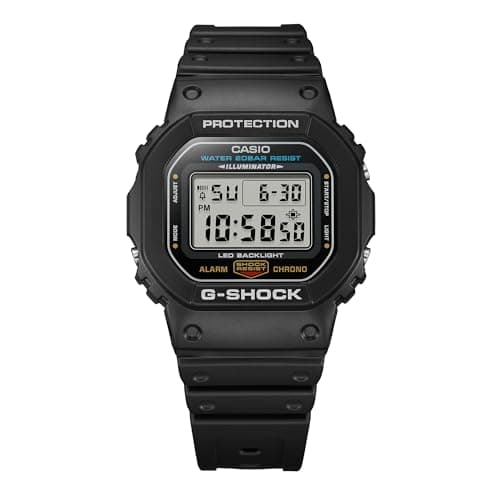
G-Shock DW-5600E
Replaceable cell7.7/10200 m, shock resistant, resin case and band, 52 g. The classic answer: cheap enough to swim in daily and never think about.
$83.99Amazon#ad · Price as of November 4, 2026 · Disclosure for the link to G-Shock DW-5600E
Best G-Shock for running
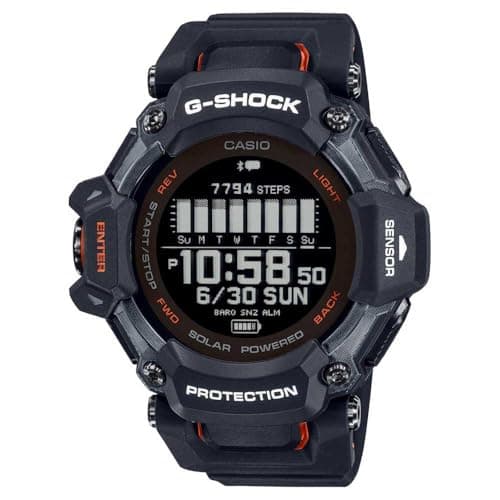
G-Shock GBD-H2000
Solar GPS6.8/10200 m and shock resistant, with Casio stating approximately 50 hours of battery for pool swimming. The one that actually logs the session.
$450.00Amazon#ad · Price as of November 4, 2026 · Disclosure for the link to G-Shock GBD-H2000
Best solar square G-Shock
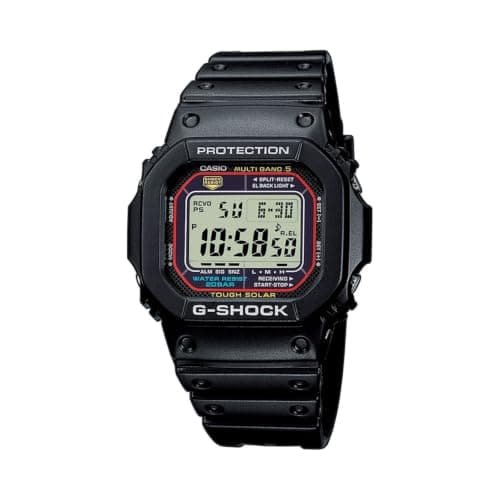
G-Shock GW-M5610U
Solar, no charger8.2/10The solar square: 200 m, shock resistant, and a Tough Solar cell so a pool watch never needs a case back opened for a battery.
$155.63Amazon#ad · Price as of November 4, 2026 · Disclosure for the link to G-Shock GW-M5610U
Best for a decade without a charger
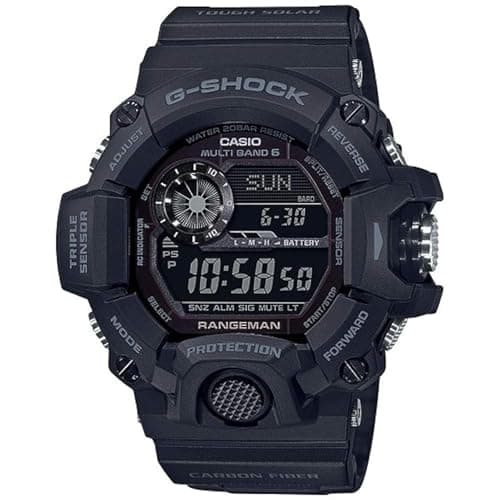
G-Shock Rangeman GW-9400
Solar, no charger8.7/10200 m with a barometer, altimeter, thermometer and sunrise and sunset times, on Tough Solar with about eight months of reserve in the dark.
$320.00Amazon#ad · Price as of November 4, 2026 · Disclosure for the link to G-Shock Rangeman GW-9400
If you want it to count laps
Water resistance and swim tracking are different questions, and most G-Shocks do the first and not the second.
The exception on this site is the GBD-H2000, which Casio specifies with GPS, wrist heart rate, compass, altimeter, barometer and thermometer, and which publishes a battery figure for pool swimming of approximately 50 hours alongside 14 hours of high-accuracy GPS and about 79 hours of gym workouts. It is a large watch at 59.6 by 52.6 by 19.4 mm, it is 63 grams, and it has solar-assisted charging with USB as a backup.
If lap counting and distance in open water are the point of the purchase rather than a bonus, a GPS watch is the better instrument, and the options are in best rugged GPS watches. If you simply want a watch to be on your wrist in the water and to still be running in ten years, the DW-5600E does that for very little money.
The care routine
1. Keep buttons dry when you press them. The whole rule, in one line.
2. Rinse in fresh water after chlorine or salt. Thirty seconds under a tap, working the buttons while the water runs over them, then dry face up.
3. Get the gaskets replaced with the battery. Any time a case back comes off, the seals should be replaced and the case pressure-tested. This is the single reason a solar G-Shock is the better pool watch: with Tough Solar the case may never need opening at all, as covered in G-Shock solar battery replacement.
4. Replace the band before it cracks. Chlorine shortens resin life. A spare band costs very little while the model is current.
5. Do not take a 200-metre watch scuba diving and call it a dive watch. For everything short of that, it is the most over-engineered thing on your wrist.
How we scored this
What we checked to build this ranking
Every pick here is researched against the documents that decide whether a watch lasts: the maker's own battery table read mode by mode, what the lens and case are actually made of, the water rating, whether a MIL-STD-810 line is on the record and in whose words, and how long the maker keeps updating the line. Each one is then scored on a public rubric weighted for a decade of ownership, and every figure links to where it came from.
That is why the order on this page is worth following: it is built from specs you can open yourself, and commissions never set a score or decide a pick. The rubric and its weights are published.
Questions
Frequently asked
Can you swim with a G-Shock?
Yes. Almost every G-Shock is rated to 200 metres of water resistance, which is far beyond what swimming, snorkelling or surf requires. The rules that matter are not to press any button while the watch is submerged, and to rinse chlorine or salt off in fresh water afterwards.
Can you dive with a G-Shock?
A 200-metre rating is not the same as a certified diver's watch. ISO 6425 adds requirements beyond depth, including an elapsed-time indication readable in darkness at 25 cm, thermal-shock and magnetic resistance, and testing of every individual watch. We do not claim ISO 6425 for any model on this page because the sources we read do not state it. For snorkelling and surface water, 200 metres is ample.
Can I shower with a G-Shock?
Yes, a 200-metre case handles it easily. The thing to avoid is soap and shampoo residue building up around the pushers, so rinse it in clean water now and then rather than letting it dry in the gaps.
Will chlorine damage a G-Shock?
Not the case. It does shorten the life of the resin band and leaves a mildly corrosive residue around the pushers and the steel case back, so rinse after swimming. Expect to replace a pool watch's band more often than a dry-land watch's; it is a cheap part.
Why did my G-Shock get water inside it?
Almost always one of two causes: a button was pressed while the watch was underwater, or the case back was opened for a battery without the gasket being replaced and the case pressure-tested. Both are avoidable, and both are why a solar G-Shock is the better choice for a watch that lives in water.
Keep reading
Related on Bezel & Bearing
Receipts
Sources
- G-Central — G-Shock DW-5600 spec sheet (checked 2026-09-20)
- G-Central — G-Shock GW-M5610 spec sheet and list price (checked 2026-09-28)
- Casio — Operation Guide, module 3495 (GW-M5610U), Specifications (checked 2026-09-20)
- G-Central — G-Shock GBD-H2000 spec sheet and list price (checked 2026-09-28)
- Casio — Specifications, module 3515 (GBD-H2000), battery operating times and sensor accuracy (checked 2026-09-28)
- Casio — Operation Guide, module 3410 (GW-9400 Rangeman), Specifications (checked 2026-09-20)
- G-Central — G-Shock GMW-B5000 spec sheet and list price (checked 2026-09-28)
- Casio — Operation Guide, module 5678 (GWG-2000 Mudmaster), Specifications (checked 2026-09-20)
Battery, glass, case and water figures come from the maker's own owner's manuals, spec pages and press releases, linked on every product so you can open the page they came from. Prices are set by Amazon and change often, so each buy button takes you to the current one. Read the full method.