Tactical / The rankings
The best watch for rucking: pace under load, and a battery that lasts the event
Rucking is the one discipline where the watch is doing something genuinely hard: holding pace at three and a half miles an hour, for hours, under a load, often in the dark, strapped to a wrist that is swelling. Here is what survives it.
By Mike M.Updated Researched from the maker's manuals and spec sheets
#adReader-supported: we may earn a commission if you buy through our links, at no extra cost to you. It never decides a ranking. How we rate · Disclosure
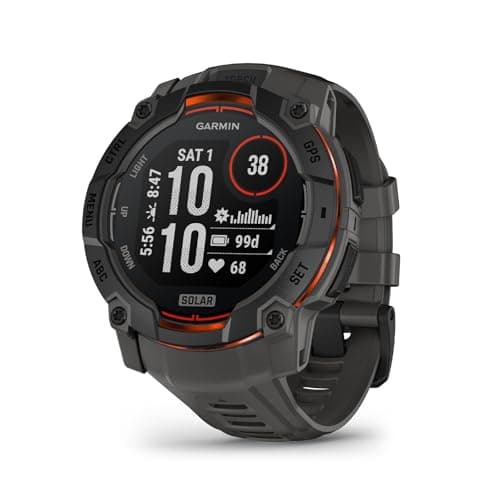
Our top pick
Garmin Instinct 3 Solar (50mm)
Five physical buttons that work in gloves, a monochrome screen readable in full sun, a flashlight with a red mode, and a solar lens Garmin rates as unlimited in smartwatch mode. 10 ATM and MIL-STD-810.
#ad · Price as of November 12, 2026 · Disclosure for the link to Garmin Instinct 3 Solar (50mm)
Quick picks
The rankings at a glance
| # | Product | Best for | Score | Price |
|---|---|---|---|---|
| 1 | Garmin Instinct 3 Solar (50mm) Five physical buttons that work in gloves, a monochrome screen readable in full sun, a flashlight with a red mode, and a solar lens Garmin rates as unlimited in smartwatch mode. 10 ATM and MIL-STD-810. | Best watch for ruckingSolar GPS | 9.8 /10 | |
| 2 | 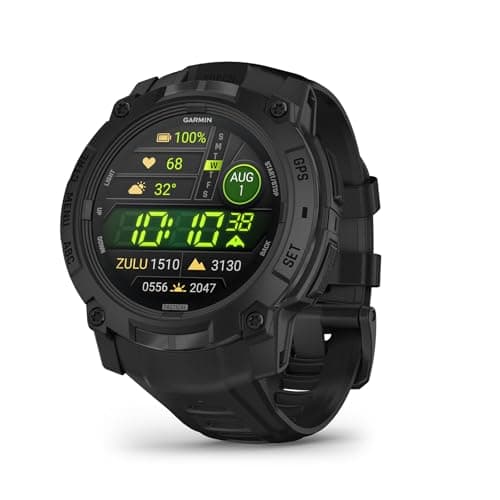 Garmin Instinct 3 Solar – Tactical Edition (50mm) The same solar Instinct with stealth mode, a kill switch, NVG mode, jumpmaster and a green flashlight instead of red. Buy it only if you will use those. | Best for a unit ruck or selectionSolar GPS | 9.8 /10 | |
| 3 | 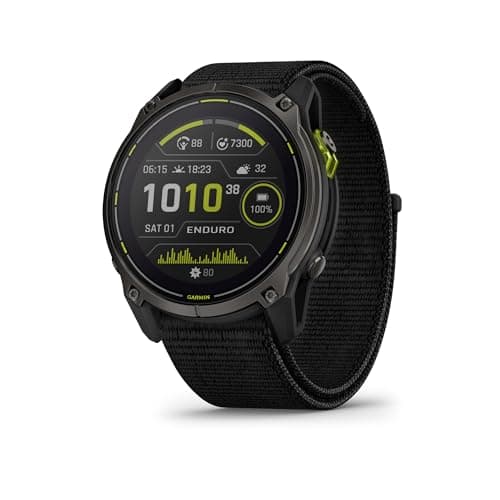 Garmin Enduro 3 63 grams on a nylon UltraFit band, sapphire lens, titanium bezel, preloaded TopoActive maps and 320 GPS hours with solar. The lightest and longest-running watch here. | Best for long events and heavy loadsSolar GPS | 9.7 /10 | |
| 4 | 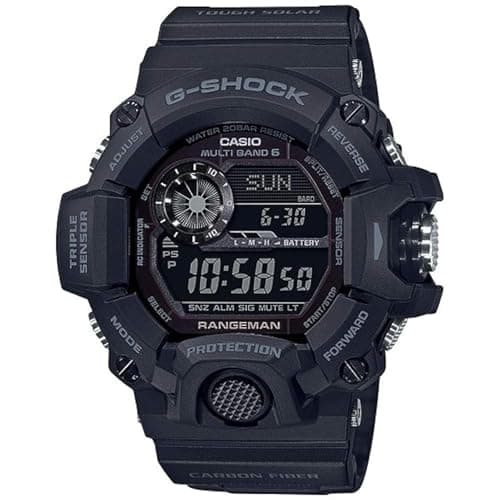 G-Shock Rangeman GW-9400 Tough Solar rated about eight months with no light, radio-set time, compass, barometer, altimeter and thermometer in a 200 m mud-resistant case. No GPS, so no distance. | Best with no charger at allSolar, no charger | 9.8 /10 | |
| 5 | 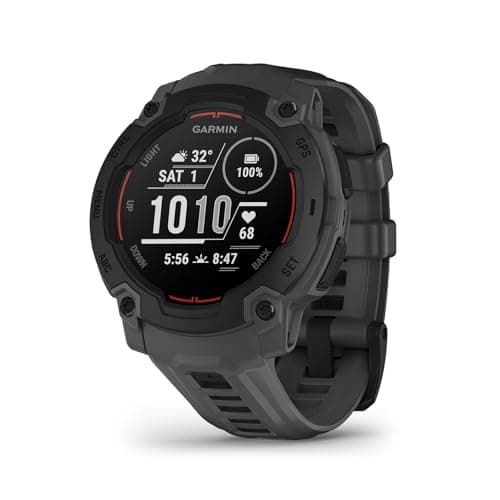 Garmin Instinct E (45mm) The cheapest Instinct: same 10 ATM case and button layout, 16 days of watch use and 24 GPS hours, with no solar lens and no flashlight. | Best budget pickRechargeable GPS | 9.0 /10 |
#ad · Prices come live from Amazon, last checked November 12, 2026. Scores are ours, built from the makers' manuals, battery tables and spec pages. Product photos come from Amazon; anything still on a stock frame is labelled on its card. Tap a row for the full write-up.
What rucking actually asks of a watch
A ruck is not a run and it is not a hike, and the watch requirements are different from both. You are moving at a deliberate pace for a long time under a load, and the single number you care about most is the one almost nobody optimizes for: current pace, readable at a glance, mid-stride, without stopping. A ruck standard is a pace standard. Twelve miles in three hours is a pace. Fifteen-minute miles under 35 pounds is a pace. If the watch cannot tell you whether you are ahead or behind right now, it is not helping.
The second thing a ruck does is put the watch in an unusually hostile position. A pack's sternum and shoulder straps sit over the wrists on every arm swing, so a tall watch gets knocked repeatedly for hours. Your wrist swells under load and in heat, so the strap you set at the trailhead is tighter at mile eight. Sweat runs down the forearm into the case and the strap keepers, all day, and salt is harder on a band than mud is. Nothing about that is extreme, which is exactly why it gets ignored — a watch does not fail a ruck dramatically, it just becomes annoying enough that you stop wearing it.
And the third thing is timing. Rucks start early. A 0400 step-off is in darkness, often without permission to use a white light, which makes an on-watch flashlight a genuinely useful tool rather than a gimmick — the models with one are listed in Garmin watches with a flashlight.
The five things we ranked on
1. Buttons, not a touchscreen. You will be checking pace with a gloved or sweating hand while both arms are loaded. Every pick on this page is driven by physical buttons. A wet touchscreen under a pack strap registers inputs you did not make, which is why no touch-first watch leads this list.
2. Battery measured in events, not hours. A single ruck is rarely the problem; a training block is. A watch rated in weeks means the one you own is charged when a 0400 start is called with no notice. A solar lens is the cleanest route to that, and the honest caveat is that Garmin's solar figures assume three hours a day outdoors at 50,000 lux — an assumption that rucking, unusually, actually meets.
3. A display you can read in full sun and full dark. A monochrome memory-in-pixel screen is at its best in direct sunlight and costs almost nothing to leave on permanently, which is the right property for a watch you glance at two hundred times in an afternoon. A bright AMOLED is easier at night and far more expensive in power; the full trade is in MIP vs AMOLED battery life.
4. Weight and height on the wrist. See the section below — this is the criterion most lists skip and the one you notice by mile ten.
5. A light, and ideally a colored one. Red preserves your night vision and does not broadcast. Green is the version Garmin puts on its Tactical Edition watches for night-vision-device compatibility. White is a last resort on a dark trail with other people on it.
Why these five, in this order
1. Garmin Instinct 3 Solar (50mm) — the one to buy. It wins because it does every ruck job well and never needs a cable. Garmin rates it as unlimited in smartwatch mode with solar at its standard three-hours-at-50,000-lux assumption, 40 days without solar, 60 GPS hours rising to 260 with solar, and 150 max-battery GPS hours going unlimited with sun. The case is 10 ATM, Garmin describes it as built to MIL-STD 810 for thermal and shock resistance, and the bezel is metal-reinforced — which matters on the watch most likely to get clipped by a shoulder strap. The flashlight has variable intensities, a red mode and a strobe. Honest cons: no maps, so you navigate by waypoint and breadcrumb rather than a drawn route; Garmin does not name the lens material, so treat it as strengthened glass rather than sapphire; and 50mm is a lot of watch for a small wrist, where the 45mm version is the answer at half the solar GPS hours.
2. Garmin Instinct 3 Solar – Tactical Edition (50mm) — if the ruck is in uniform.Identical hardware and the same solar battery table, plus the software a unit environment asks for: stealth mode, which Garmin says stops wireless and location recording; a kill switch that wipes user memory; a night-vision goggle display mode; jumpmaster; dual-position format; and a green flashlight rather than red. For a selection course or a unit ruck with light and emissions discipline, those are the difference between a watch you can wear and one you cannot. Honest cons: everything durable about it is already in the standard Instinct 3 Solar, so you are paying for software, and the Applied Ballistics solver needs a paid unlock. If you will never open stealth mode or jumpmaster, buy pick one instead — and we say that again in the Instinct 3 Tactical review.
3. Garmin Enduro 3 — for long events, and the lightest thing here. This is the pick for a 50K ruck, a 24-hour event or a selection week, and it earns the spot on two published numbers: 63 grams and 320 GPS hours in GPS mode with solar. The weight comes from a titanium bezel and a nylon UltraFit band, and nylon is also the right strap material for a day of salt sweat — it does not seal moisture against the skin the way a silicone strap does. It adds a sapphire lens, preloaded TopoActive maps and a flashlight with red and strobe modes. Honest cons: Garmin's Enduro 3 release states no water rating and no MIL-STD line, so we claim neither; it is the most expensive watch on this page by a wide margin; and the moment you fit a silicone strap you give the weight advantage straight back.
4. G-Shock Rangeman GW-9400 — the no-charger answer, with one real limitation. If your rucking is training rather than a timed standard, this is a legitimate and much cheaper choice. Casio rates the Tough Solar cell at approximately eight months from a full charge with no light at all, it sets itself from a radio time signal, and it carries a digital compass, barometer, altimeter and thermometer plus sunrise and sunset in a 200 m, mud-resistant case with a low-temperature rating to -10°C. There is no cable in the box and there never will be. The limitation, stated plainly: no GPS, which means no distance and no pace. You get elapsed time, a stopwatch and a bearing. If pace against a standard is the reason you want a watch, this is the wrong tool and pick one is the right one; the two philosophies are compared in GPS vs ABC watch. Also honest: mineral crystal rather than sapphire, and 18.2 mm thick, which is the tallest watch on this page under a pack strap.
5. Garmin Instinct E (45mm) — the budget pick. The cheapest route to a buttoned, 10 ATM Instinct with GPS pace and distance. Garmin rates it at 16 days of watch use, 24 GPS hours and 50 max-battery GPS hours, with an operating range of -20° to 60°C. Honest cons, and there are three: there is no solar column in Garmin's battery table for it, the owner's manual has no flashlight section at all — which costs you the pre-dawn tool this page cares about — and Garmin makes no MIL-STD-810 claim for the Instinct E in any document we can cite, so neither do we. Twenty-four GPS hours still covers a long event; it just does not cover a week of them without a cable. If this is the budget you are shopping in, the whole sub-$300 shelf is ranked in best GPS watch under $300.
Weight matters more here than anywhere else
On a run, a watch is on a swinging arm for an hour. On a ruck it is under a loaded shoulder strap for five, and the two measurements that decide whether you notice it are mass and height. The published spread on this page is large: the Enduro 3 is 63 grams on its nylon band, and the Rangeman is 93 grams and 18.2 mm tall in a case measuring 55.2 × 53.5 mm. That is a genuinely different object on the wrist, and the taller one is the one that catches a strap.
Two practical notes that cost nothing. First, set the strap one hole looser than feels right at the start; your wrist will meet it by the third hour. Second, a nylon or fabric strap beats silicone for an all-day sweat event because it dries and breathes, and most watches here take standard straps, which is the cheapest upgrade available to any of them. Sizing across the whole category is in what size GPS watch should I buy.
What we will not claim
We have not carried any of these watches under a ruck and we are not going to pretend otherwise. Every figure above is read from the maker's own owner's manual, specification page or press release and linked in the sources below. In particular: we make no GPS distance-accuracy claim for any watch here, because no maker publishes an accuracy figure for walking pace under load; we claim MIL-STD-810 only for the two Instinct 3 models and the Instinct 2 family, where Garmin states it; and we claim no water rating or military standard for the Enduro 3, because Garmin's release for it states neither.
We also make no claim about what any unit, course or cadre permits on the wrist. That is set by policy, not by a spec sheet, and the published rules we could find are collected in what watches are allowed in the military.
In detail
The picks, in full
Rank 1
Best watch for rucking
Garmin Instinct 3 Solar (50mm)
Five physical buttons that work in gloves, a monochrome screen readable in full sun, a flashlight with a red mode, and a solar lens Garmin rates as unlimited in smartwatch mode. 10 ATM and MIL-STD-810.
EvidenceResearched · every row sourced
What the 9.8 score weighs
- Battery & power independence (25% of the score)
- Durability of materials (25% of the score)
- Serviceability & lifespan (20% of the score)
- Field usability (15% of the score)
- Value per decade (10% of the score)
- Mission fit (5% of the score)
What the spec sheet supports
- Garmin's own table shows the 50mm solar model doubling the 45mm in GPS-with-solar hours (260 vs 130).
- Physical buttons, a monochrome display readable in full sun, and a flashlight with a red mode.
- 10 ATM rating and a MIL-STD 810 claim on a watch that costs less than half a fenix.
Good to know
No maps: it navigates breadcrumb trails and waypoints, not topo maps.
#ad · Price as of November 12, 2026 · Disclosure for the link to Garmin Instinct 3 Solar (50mm)
Rank 2
Best for a unit ruck or selection
Garmin Instinct 3 Solar – Tactical Edition (50mm)
The same solar Instinct with stealth mode, a kill switch, NVG mode, jumpmaster and a green flashlight instead of red. Buy it only if you will use those.
EvidenceResearched · every row sourced
| Power class | Solar GPS. A rechargeable cell topped up by a solar lens. Weeks between charges; the cell still ages like any lithium battery. |
|---|---|
| Battery (smartwatch) | Solar models: unlimited battery life (all-day wear, 3 hr/day at 50,000 lux) |
| Battery (GPS) | Up to 60 hours GPS-only; up to 260 hours with solar (50mm Instinct 3 Solar table) |
| Bezel & case | Bolted construction with a metal-reinforced bezel; fiber-reinforced polymer case |
| Water rating | Water-rated up to 100 meters |
| MIL-STD-810 | Built to MIL-STD 810 for thermal and shock resistance |
| Sensors | Stealth Mode, Kill Switch, Night Vision Goggle mode, Jumpmaster, dual-position format, multi-band GPS with SatIQ |
| Flashlight | Built-in LED flashlight with variable intensities, a green light and strobe mode |
What the 9.8 score weighs
- Battery & power independence (25% of the score)
- Durability of materials (25% of the score)
- Serviceability & lifespan (20% of the score)
- Field usability (15% of the score)
- Value per decade (10% of the score)
- Mission fit (5% of the score)
What the spec sheet supports
- Stealth mode stops wireless and location recording; the kill switch wipes user memory, per Garmin.
- NVG mode and a green (not red) flashlight are the light-discipline features a standard Instinct lacks.
- Same solar battery table as the Instinct 3 Solar 50mm.
Good to know
Applied Ballistics needs a paid unlock.
#ad · Price as of November 12, 2026 · Disclosure for the link to Garmin Instinct 3 Solar – Tactical Edition (50mm)
Rank 3
Best for long events and heavy loads
Garmin Enduro 3
63 grams on a nylon UltraFit band, sapphire lens, titanium bezel, preloaded TopoActive maps and 320 GPS hours with solar. The lightest and longest-running watch here.
EvidenceResearched · every row sourced
| Power class | Solar GPS. A rechargeable cell topped up by a solar lens. Weeks between charges; the cell still ages like any lithium battery. |
|---|---|
| Battery (smartwatch) | Up to 90 days in smartwatch mode |
| Battery (GPS) | Up to 320 hours in GPS mode with solar charging; up to 120 hours with multi-band SatIQ |
| Glass | Scratch-resistant sapphire lens |
| Bezel & case | 51mm titanium bezel; UltraFit nylon band |
| Maps & GPS | Preloaded TopoActive maps |
| Flashlight | Built-in LED flashlight with variable brightness, red light and strobe |
| Weight | 63 grams |
What the 9.7 score weighs
- Battery & power independence (25% of the score)
- Durability of materials (25% of the score)
- Serviceability & lifespan (20% of the score)
- Field usability (15% of the score)
- Value per decade (10% of the score)
- Mission fit (5% of the score)
What the spec sheet supports
- 320 GPS hours with solar is the largest GPS figure Garmin publishes for any watch we list.
- Lighter than a 51mm fenix 8 thanks to the nylon strap and titanium bezel.
- Sapphire and preloaded maps.
Good to know
Garmin's Enduro 3 release does not state a water rating or MIL-STD line, so we do not claim them here.
#ad · Price as of November 12, 2026 · Disclosure for the link to Garmin Enduro 3
Rank 4
Best with no charger at all
G-Shock Rangeman GW-9400
Tough Solar rated about eight months with no light, radio-set time, compass, barometer, altimeter and thermometer in a 200 m mud-resistant case. No GPS, so no distance.
EvidenceResearched · every row sourced
| Power class | Solar, no charger. A solar cell that recharges from any light and never meets a charger. The rechargeable cell is a watchmaker-replaceable part. |
|---|---|
| Battery (cell) | Approximately 8 months from full charge to Level 4 with no light (Casio's stated usage conditions) |
| Power | Solar panel and one rechargeable battery (Tough Solar) |
| Glass | Mineral crystal |
| Water rating | 200 meters |
| Sensors | Digital compass, barometer, altimeter, thermometer; sunrise/sunset; Multi-Band 6 time calibration (WWVB, DCF77, MSF, JJY, BPC) |
| Weight | 93 g |
| Size | 55.2 × 53.5 × 18.2 mm |
| Operating temp | Low-temperature resistance -10°C (14°F) |
What the 9.8 score weighs
- Battery & power independence (25% of the score)
- Durability of materials (25% of the score)
- Serviceability & lifespan (20% of the score)
- Field usability (15% of the score)
- Value per decade (10% of the score)
- Mission fit (5% of the score)
What the spec sheet supports
- Solar and atomic: it sets itself from a radio signal and never sees a cable.
- A module that has been in production for over a decade; parts, straps and bezels are everywhere.
- Sunrise/sunset on the watch, the one hunting feature the Garmin Instinct does without a phone.
Good to know
Mineral crystal, not sapphire; the Rangeman lives behind a raised bezel for a reason.
#ad · Price as of November 12, 2026 · Disclosure for the link to G-Shock Rangeman GW-9400
Rank 5
Best budget pick
Garmin Instinct E (45mm)
The cheapest Instinct: same 10 ATM case and button layout, 16 days of watch use and 24 GPS hours, with no solar lens and no flashlight.
EvidenceResearched · every row sourced
| Power class | Rechargeable GPS. A rechargeable lithium cell charged from a cable. Days to a few weeks per charge; the cell ages with every cycle. |
|---|---|
| Battery (smartwatch) | Up to 16 days |
| Battery (GPS) | Up to 24 hours GPS-only |
| Battery (max GPS) | Up to 50 hours max-battery GPS |
| Power | Rechargeable, built-in lithium-ion battery (no solar column in Garmin's battery table) |
| Water rating | 10 ATM |
| Flashlight | None: the owner's manual has no flashlight section |
| Operating temp | -20° to 60°C (-4° to 140°F) |
What the 9.0 score weighs
- Battery & power independence (25% of the score)
- Durability of materials (25% of the score)
- Serviceability & lifespan (20% of the score)
- Field usability (15% of the score)
- Value per decade (10% of the score)
- Mission fit (5% of the score)
What the spec sheet supports
- 10 ATM water rating and the Instinct button layout at the lowest price in the line.
- Sixteen days of watch use is still weeks between charges.
Good to know
No solar and no flashlight; Garmin's manual lists neither.
#ad · Price as of November 12, 2026 · Disclosure for the link to Garmin Instinct E (45mm)
The one question that decides it
Are you rucking against a standard, or just rucking? If there is a time and a distance you have to hit, you need GPS pace and the answer is an Instinct 3 Solar, or an Enduro 3 if the events are long and you want maps and the lowest weight. If you are carrying a pack because it is good for you, a Tough Solar Casio gives you elapsed time, a bearing and eight months of independence for a fraction of the money, and you will never think about charging it.
Set the watch up once, before the first event
Most ruck complaints are setup complaints. Put current pace on the first data screen, not average pace — average pace is a report card and current pace is a steering wheel. Add elapsed time and distance to the same screen so one glance answers everything. Turn on a per-mile or per-kilometer autolap so the watch confirms your split without you pressing anything, and set a pace alert if there is a standard to hit. If the watch has a backlight gesture, switch it off before a night event: a wrist-raise backlight firing every twenty seconds is both a battery drain and a light-discipline problem.
Three mistakes ruckers make buying a watch
Buying for heart rate. Optical wrist HR is at its least reliable with a static grip, cold hands and a strap over a swelling wrist — which is a ruck exactly. If you train by heart rate, buy a chest strap and let the watch be a watch.
Buying an AMOLED for a daylight sport. A color screen is lovely in a tent and costs you the battery you came for. Garmin's own table puts the Instinct 3 AMOLED at nine days with the display always on against "unlimited" for the solar model. In sunlight, the cheaper monochrome screen is also the easier one to read.
Ignoring the strap. The band is the part that fails first on a sweat-heavy discipline, and it is the cheapest part to replace. Budget for a nylon strap at the same time as the watch rather than two years later.
If your requirement is narrower than this
For a uniformed context with no pace requirement, start at best tactical watches or, with a budget, best tactical watches under $500. If this is for a course rather than training, best watch for army basic training and best watch for deployment are written for exactly those two situations. If the load comes off and the miles stay, best watch for thru-hiking ranks the same watches on resupply intervals instead, and best GPS watch for trail running covers the unloaded version.
The bottom line
Our recommendation
Buy this one
Garmin Instinct 3 Solar (50mm)
Five physical buttons that work in gloves, a monochrome screen readable in full sun, a flashlight with a red mode, and a solar lens Garmin rates as unlimited in smartwatch mode. 10 ATM and MIL-STD-810.
#ad · Price as of November 12, 2026 · Disclosure for the link to Garmin Instinct 3 Solar (50mm)
The runner-up
Garmin Instinct 3 Solar – Tactical Edition (50mm)
The same solar Instinct with stealth mode, a kill switch, NVG mode, jumpmaster and a green flashlight instead of red. Buy it only if you will use those.
#ad · Price as of November 12, 2026 · Disclosure for the link to Garmin Instinct 3 Solar – Tactical Edition (50mm)
How we scored this
What we checked to build this ranking
Every pick here is researched against the documents that decide whether a watch lasts: the maker's own battery table read mode by mode, what the lens and case are actually made of, the water rating, whether a MIL-STD-810 line is on the record and in whose words, and how long the maker keeps updating the line. Each one is then scored on a public rubric weighted for a decade of ownership, and every figure links to where it came from.
That is why the order on this page is worth following: it is built from specs you can open yourself, and commissions never set a score or decide a pick. The rubric and its weights are published.
Corrections & updates
- First published. Every battery, weight, water and flashlight figure read from the Garmin owner's manuals and newsroom releases and the Casio GW-9400 operation guide cited below. No water rating or MIL-STD-810 line is claimed for the Enduro 3 or the Instinct E, because neither maker document states one, and no GPS accuracy claim is made for any pick.
Questions
Frequently asked
What is the best watch for rucking?
The Garmin Instinct 3 Solar (50mm). It gives you GPS pace and distance on a buttoned, glove-friendly watch with a sun-readable monochrome screen, a flashlight with a red mode for pre-dawn starts, a 10 ATM case Garmin describes as built to MIL-STD 810, and a solar lens rated as unlimited in smartwatch mode and 260 GPS hours with sun. For a unit ruck with light discipline, the Tactical Edition adds stealth mode, NVG mode and a green light on the same hardware.
Do you need GPS for rucking?
Only if you are rucking against a time and a distance. Pace is the number that matters in a ruck standard and pace needs GPS. If you walk a known route or ruck for fitness rather than a standard, a Tough Solar G-Shock like the Rangeman GW-9400 gives you elapsed time, a stopwatch, a compass and a barometer and runs about eight months with no light at all, by Casio's figure — with no cable in existence.
How much battery do you need for a 12-mile ruck?
Far less than the battery you need for a training block, which is the real question. A 12-mile ruck at a standard pace is roughly three hours of GPS, and every GPS watch on this page covers that many times over: the Instinct E is rated at 24 GPS hours, the Instinct 3 Solar 50mm at 60 rising to 260 with solar, and the Enduro 3 at 320 GPS hours with solar. The watch worth buying is the one still charged when an unannounced 0400 start is called, which is why the solar models rank above the cheaper one.
Is a G-Shock good for rucking?
Yes, with one caveat. A Rangeman GW-9400 is 200 m rated, mud-resistant, cold-rated to -10°C, sets itself from a radio signal and never meets a charger, which makes it close to unkillable on a training ruck. It has no GPS, so there is no distance and no pace. It is also the tallest watch here at 18.2 mm, which is the dimension that catches a pack strap. Our Casio-specific ranking for hard use is best G-Shock for work.
Does the watch need a rucking activity profile?
No. A hiking or walking profile with current pace, elapsed time and distance on the first data screen does the same job on every watch on this page. A named rucking profile mostly changes a label and a calorie estimate, and no maker publishes an accuracy figure for either under load, so there is nothing to rank there.
What strap holds up best for rucking?
A fabric or nylon strap, for the same reason the Enduro 3 ships on one: it breathes and dries, where silicone traps sweat against the skin for hours. It is also why the Enduro 3 is the lightest watch here at 63 grams on Garmin's figure. Most of these watches take standard straps, so it is a cheap change on any of them. We do not rank or recommend specific bands, because a strap carries none of the sourced specs this site judges a watch on.
Keep reading
Related on Bezel & Bearing
- Best tactical watchesThe whole field, no pace requirement.
- Best watch for basic trainingWritten for a course, not a training block.
- Best watch for thru-hikingThe same watches, ranked on resupply.
- Garmin watches with a flashlightWhich models have red and green light.
- GPS vs ABC watchWhy the Rangeman has no distance.
- What size GPS watch to buyHeight and mass under a pack strap.
Receipts
Sources
- Garmin newsroom — Instinct 3 Series press release (checked 2026-09-20)
- Garmin — Instinct 3 Solar Series Owner's Manual, Battery Life Information (checked 2026-09-20)
- Garmin — Instinct 3 Solar Series Owner's Manual, Specifications (checked 2026-09-20)
- Garmin — Instinct 3 AMOLED Series Owner's Manual, Battery Life Information (checked 2026-09-20)
- Garmin newsroom — Instinct 3 Tactical Edition press release (checked 2026-09-20)
- Garmin newsroom — Enduro 3 press release (checked 2026-09-20)
- Garmin — Instinct E Owner's Manual, Battery Life Information (checked 2026-09-20)
- Garmin — Instinct E Owner's Manual, Specifications (checked 2026-09-20)
- Garmin — Instinct E Owner's Manual (contents: no flashlight or solar section) (checked 2026-09-20)
- Casio — Operation Guide, module 3410 (GW-9400 Rangeman), Specifications (checked 2026-09-20)
- Pilot Mall — Casio G-Shock Rangeman GW9400-1 listing (case size, weight, water rating) (checked 2026-09-20)
Battery, glass, case and water figures come from the maker's own owner's manuals, spec pages and press releases, linked on every product so you can open the page they came from. Prices are set by Amazon and change often, so each buy button takes you to the current one. Read the full method.