GPS Watches / Guide
The Suunto lineup explained: which line is which, and who each one is actually for
Suunto sells five current families and the names tell you almost nothing. Here is what separates them, using the battery tables and materials Suunto publishes, so you can work out which one you are shopping for before you look at a price.
By Mike M.Updated Researched from the maker's manuals and spec sheets
#adReader-supported: we may earn a commission if you buy through our links, at no extra cost to you. It never decides a ranking. How we rate · Disclosure
Our top pick
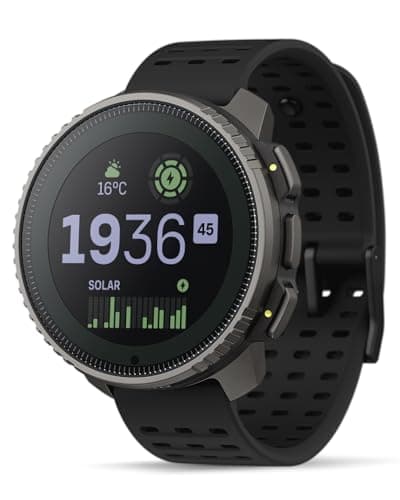
Suunto Vertical Titanium Solar
The solar Suunto: Grade 5 titanium bezel, sapphire, 74 grams, and battery promises of 60 days smartwatch and 90 multi-band GPS hours with solar. Still sold beside the Vertical 2.
#ad · Suunto list price as of November 6, 2026 · Disclosure for the link to Suunto Vertical Titanium Solar
Quick picks
Compared at a glance
| # | Product | Best for | Score | Price |
|---|---|---|---|---|
| 1 | Suunto Vertical Titanium Solar The solar Suunto: Grade 5 titanium bezel, sapphire, 74 grams, and battery promises of 60 days smartwatch and 90 multi-band GPS hours with solar. Still sold beside the Vertical 2. | Best solar GPS watch that isn't a GarminSolar GPS | 9.6 /10 | |
| 2 |  Suunto Race (steel) The cheapest way into sapphire and free offline maps: a 1.43-inch AMOLED Suunto with 50 multi-band GPS hours, 200 in power saving, and a digital crown instead of a touchscreen-only interface. | Best value sapphire GPS watch with mapsRechargeable GPS | 9.1 /10 | |
| 3 | Suunto 9 Peak Pro Sapphire, a steel bezel and 21 days of smartwatch battery in a 10.8 mm case at Suunto's lowest list price. No maps and a 240 x 240 screen are what it trades away. | Best cheap sapphire GPS watchRechargeable GPS | 9.2 /10 | |
| 4 | Suunto Ocean A real dive computer wearing a sports watch: 60 m to EN 13319, up to five gases on the Suunto Bühlmann 16 GF algorithm, 40 to 60 hours of dive battery, and the Race's 32 GB of offline maps for the walk back to the car. | Best dive computer you can wear every dayRechargeable GPS | 9.3 /10 |
#ad · Prices come live from Amazon, last checked November 12, 2026. Scores are ours, built from the makers' manuals, battery tables and spec pages. Product photos come from Amazon; anything still on a stock frame is labelled on its card. Tap a row for the full write-up.
The five families, in one table
Suunto's naming is the opposite of Garmin's. There is no number that tells you where a watch sits, no "Pro" that reliably means more, and the same family name covers a steel version and a titanium one with different glass. So the only sane way to read the range is by what each line is built to do, and the figures below are Suunto's own.
| Line | The one thing it does | Maps | Solar | Suunto's GPS figure |
|---|---|---|---|---|
| Vertical | Altitude and days between charges | Yes, 32 GB | Titanium Solar only | 65 h multi-band (90 h with solar) |
| Race | Screen and navigation | Yes | No | 50 h multi-band, 200 h power saving |
| Race S | The same, on a small wrist | Yes, 32 GB | No | 30 h multi-band, 120 h power saving |
| 9 Peak Pro | Battery and thinness per dollar | No | No | 40 h single-band, 300 h power saving |
| Ocean | Diving, properly | Yes, 32 GB | No | 50 h multi-band; 40–60 h dive |
| Core | Altimeter and compass, no GPS | No | No (coin cell) | No GPS at all |
Two things fall out of that table immediately. Only one current Suunto has a solar lens, and it is the first-generation Vertical rather than anything newer. And the longest GPS figure in the range belongs to the cheapest watch in it, because the 9 Peak Pro drives a 240 x 240 memory-in-pixel screen instead of an AMOLED.
Vertical: the solar one
The Vertical is the line to look at if the point of the watch is to stop charging it. The Vertical Titanium Solar states up to 30 days of daily use, 60 with solar, and 65 multi-band GPS hours rising to 90 with solar, under sapphire on a Grade 5 titanium bezel at 74 g. It is the only Suunto that converts light into runtime, which is the whole argument of this site — the full read is in Vertical Solar vs Garmin Instinct 3 Solar.
The Vertical 2 is the newer watch and, for this site's purposes, a step sideways: Suunto swapped the solar MIP screen for a 1.5-inch AMOLED and dropped the solar lens, taking daily use from 30 days to 20. It gains a flashlight, which the first generation does not have. If you want the brightest Suunto screen and a light, that is the one; if you want the longest interval between charges, the older model is still the answer and Suunto still sells both.
Race and Race S: the screen and the maps
The Race line is Suunto's answer to a mapping sports watch. The Race pairs a 1.43-inch AMOLED at 466 x 466 with free offline maps, a digital crown and a sapphire touchscreen on a stainless bezel, at 83 g. Suunto states up to 16 days of smartwatch use, 50 multi-band GPS hours and 200 hours in the power-saving GNSS modes. For the money it is the cheapest route into sapphire plus maps that Suunto sells.
The Race S is the small-wrist version and the trade is steeper than the name suggests. It is 45 mm and 60 g against the Race's 49 mm and 83 g, keeps the 32 GB of offline maps and the dual-band L1+L5 positioning — and then halves the battery table: 9 days of smartwatch use and 30 multi-band GPS hours. Its water rating is 50 m rather than 100 m, and Suunto does not name a sapphire lens for it anywhere in the specification table, so we do not claim one.
The Race 2 Titanium sits above both: the same screen and maps with a Grade 5 titanium bezel at 65 g, 18 days of smartwatch use and 55 multi-band hours. Our longer read is the Race 2 review, and the Race-versus-Vertical decision has its own page at Suunto Race vs Suunto Vertical.
9 Peak Pro: battery per dollar
The 9 Peak Pro is the most interesting watch in the range for the reader this site is written for, and it is the cheapest. Suunto states up to 21 days in smartwatch mode and up to 300 hours in the power-saving GNSS modes — the longest GPS figure of any Suunto here — behind a sapphire touchscreen on a stainless bezel, in a 10.8 mm case at 64 g.
What pays for that is the screen and the positioning. The display is a 1.2-inch, 240 x 240 memory-in-pixel panel rather than an AMOLED, and the GNSS is single-band L1 rather than the dual-band L1+L5 on the Race line. Suunto lists no offline map storage for it at all: it navigates a route, not a map. Whether that is a compromise or the correct set of priorities is the argument in MIP vs AMOLED battery life.
Ocean: the one that is a dive computer
The Ocean is not a sports watch with a depth gauge. Suunto states a maximum operating depth of 60 m to EN 13319, up to five gases with oxygen from 21 to 100%, the Suunto Bühlmann 16 GF decompression algorithm, a wireless tank pressure display and 40 to 60 hours of battery in dive mode. Above the surface it is a Race: the same 1.43-inch AMOLED, the same 32 GB of offline maps, the same dual-band GNSS.
It is also the heaviest Suunto on this site at 99 g and by some way the most expensive. The dive-mode operating range is 0°C to +40°C, much narrower than the watch's own -20°C to +55°C, which is worth knowing before a cold-water trip. What separates a dive computer from a dive-rated watch is set out in best dive computer watches.
Core: the one with nothing to charge
The Core line predates all of this and is still sold. The Core Alpha has no GPS at all: an altimeter, barometer and compass on a replaceable CR2032 that Suunto rates at up to 12 months, with a night-vision-compatible red backlight. It is the Suunto for someone who wants a bearing and a pressure trend rather than a track log, and it is the only one in the range that never meets a charger. The 30 m water rating is the catch; the full read is in our Core Alpha review.
One pick per line
Four watches, four different reasons. Prices on the Suunto buttons are Suunto's own list prices with the date we read them.
Our picks for this
The pick of each Suunto line
The solar one, the maps-and-screen one, the battery-per-dollar one and the dive computer.
Best solar GPS watch that isn't a Garmin
Suunto Vertical Titanium Solar
Solar GPS9.6/10The only Suunto that runs on light: 60 days with solar, sapphire, Grade 5 titanium, 74 g.
Check price at SuuntoAlso on Amazon — $549.00#ad · Suunto list price as of November 6, 2026 · Disclosure for the link to Suunto Vertical Titanium Solar
- Stock photo
Best value sapphire GPS watch with maps
Suunto Race (steel)
Rechargeable GPS9.1/10Sapphire and free offline maps for Suunto's lowest price in the Race line; 200 h power saving.
Check price at SuuntoAlso on Amazon — check price#ad · Suunto list price as of November 6, 2026 · Disclosure for the link to Suunto Race (steel)
- Stock photo
Best cheap sapphire GPS watch
Suunto 9 Peak Pro
Rechargeable GPS9.2/1021 days, 300 h power-saving GPS and sapphire in a 10.8 mm case. No maps.
Check price at SuuntoAlso on Amazon — check price#ad · Suunto list price as of November 6, 2026 · Disclosure for the link to Suunto 9 Peak Pro
- Stock photo
Best dive computer you can wear every day
Suunto Ocean
Rechargeable GPS9.3/10A real dive computer: 60 m to EN 13319, five gases, 40-60 h of dive battery.
Check price at SuuntoAlso on Amazon — check price#ad · Suunto list price as of November 6, 2026 · Disclosure for the link to Suunto Ocean
What we will not claim
No Suunto on this page has been on our wrist. Every figure above is Suunto's own, read from the specification tables linked at the bottom of this page on the date recorded there.
Specifically: Suunto names a sapphire lens on the Race, the 9 Peak Pro and the Ocean, and does not name one on the Race S, so the Race S does not carry the flag here. Suunto makes no MIL-STD-810 claim for any watch in the range, so this site states none. Only the Ocean carries a dive certification, quoted in Suunto's words as EN 13319 — a 100 m water rating on the others is a pressure test, not a dive rating, and the difference is explained in watch water resistance explained. Prices move: the numbers on the buttons are Suunto's list prices on the date stamped beside them, not a discount and not a promise.
The bottom line
Our recommendation
Buy this one
Suunto Vertical Titanium Solar
The solar Suunto: Grade 5 titanium bezel, sapphire, 74 grams, and battery promises of 60 days smartwatch and 90 multi-band GPS hours with solar. Still sold beside the Vertical 2.
#ad · Suunto list price as of November 6, 2026 · Disclosure for the link to Suunto Vertical Titanium Solar
How we scored this
What we checked to build this ranking
Every pick here is researched against the documents that decide whether a watch lasts: the maker's own battery table read mode by mode, what the lens and case are actually made of, the water rating, whether a MIL-STD-810 line is on the record and in whose words, and how long the maker keeps updating the line. Each one is then scored on a public rubric weighted for a decade of ownership, and every figure links to where it came from.
That is why the order on this page is worth following: it is built from specs you can open yourself, and commissions never set a score or decide a pick. The rubric and its weights are published.
Questions
Frequently asked
Which Suunto has solar charging?
Only the first-generation Vertical Titanium Solar. Suunto states up to 30 days of daily use rising to 60 with solar, and 65 multi-band GPS hours rising to 90. The newer Vertical 2 dropped the solar lens for an AMOLED screen, and no watch in the Race, 9 Peak or Ocean lines has one.
What is the difference between the Suunto Race and the Race S?
Size and battery. The Race is 49 mm and 83 g with 16 days of smartwatch use and 50 multi-band GPS hours; the Race S is 45 mm and 60 g with 9 days and 30 hours. Both carry free offline maps and dual-band L1+L5. The Race S is also rated to 50 m rather than 100 m, and Suunto does not name a sapphire lens for it.
Which Suunto has the longest battery life?
It depends on the mode. For GPS, the 9 Peak Pro: Suunto states up to 300 hours in its power-saving GNSS modes, the longest figure in the range. For everyday wear, the Vertical Titanium Solar: up to 30 days of daily use and 60 days with solar. The 9 Peak Pro manages 21 days of smartwatch use without any solar lens at all.
Does the Suunto 9 Peak Pro have maps?
No. Suunto lists no offline map storage for the 9 Peak Pro; it navigates routes and waypoints rather than showing a map. The Race, Race S, Vertical and Ocean all carry free offline maps, with 32 GB of storage on most versions and 16 GB on the steel Race.
Is the Suunto Ocean a real dive computer?
Yes, by Suunto's own specification: a maximum operating depth of 60 m to EN 13319, up to five gases with oxygen from 21 to 100%, the Suunto Bühlmann 16 GF algorithm, a wireless tank pressure display and 40 to 60 hours of dive-mode battery. It is the only watch on this site that runs a decompression algorithm.
Keep reading
Related on Bezel & Bearing
- Best Suunto watchThe same range, ranked rather than explained.
- Suunto Race vs VerticalThe decision most Suunto buyers actually face.
- Suunto vs GarminHow the range reads against the market leader.
- Best dive computer watchesWhere the Ocean sits against the dive-rated field.
- Best watch with offline mapsEvery mapping watch we cover.
Receipts
Sources
- Suunto — Vertical Titanium Solar Black product page and tech specs (checked 2026-09-20)
- Suunto — Vertical 2 Titanium Black product page and tech specs (checked 2026-09-20)
- Suunto — Core Alpha Stealth product page and tech specs (checked 2026-09-20)
- Suunto — Race 2 Titanium Black product page and tech specs (checked 2026-10-28)
- Suunto — Race All Black product page and specification table (checked 2026-11-06)
- Suunto — Race S All Black product page and specification table (checked 2026-11-06)
- Suunto — 9 Peak Pro All Black product page and specification table (checked 2026-11-06)
- Suunto — Ocean All Black product page and specification table (checked 2026-11-06)
Battery, glass, case and water figures come from the maker's own owner's manuals, spec pages and press releases, linked on every product so you can open the page they came from. Prices are set by Amazon and change often, so each buy button takes you to the current one. Read the full method.