GPS Watches / Head to head
Suunto Race vs Suunto Vertical: the screen, or the days between charges
These two sit at a similar price and do genuinely different jobs. The Race is the screen and the navigation; the Vertical is the one that can stop meeting a charger. Suunto publishes enough to settle it without anyone guessing.
By Mike M.Updated Researched from the maker's manuals and spec sheets
#adReader-supported: we may earn a commission if you buy through our links, at no extra cost to you. It never decides a ranking. How we rate · Disclosure
Our top pick
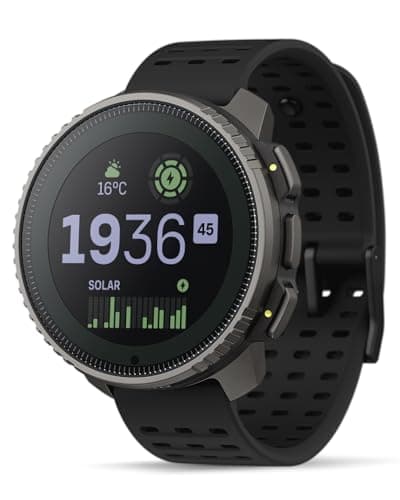
Suunto Vertical Titanium Solar
30 days of daily use and 60 with solar, 65 multi-band GPS hours rising to 90, sapphire on a Grade 5 titanium bezel at 74 g. The only Suunto that runs on light.
#ad · Suunto list price as of November 6, 2026 · Disclosure for the link to Suunto Vertical Titanium Solar
The contenders
Side by side
Buy this to stop charging
Suunto Vertical Titanium Solar
Solar GPS9.6 /1030 days of daily use and 60 with solar, 65 multi-band GPS hours rising to 90, sapphire on a Grade 5 titanium bezel at 74 g. The only Suunto that runs on light.
Check price at SuuntoAlso on Amazon — $549.00#ad · Suunto list price as of November 6, 2026 · Disclosure for the link to Suunto Vertical Titanium Solar
 Stock photo
Buy this for the screen and the price
Suunto Race (steel)
Rechargeable GPS9.1 /10A 1.43-inch AMOLED under sapphire with free offline maps and a digital crown, 50 multi-band GPS hours and 200 in power saving, for Suunto's lowest price in the Race line.
Check price at SuuntoAlso on Amazon — check price#ad · Suunto list price as of November 6, 2026 · Disclosure for the link to Suunto Race (steel)
The newer Vertical, for completeness
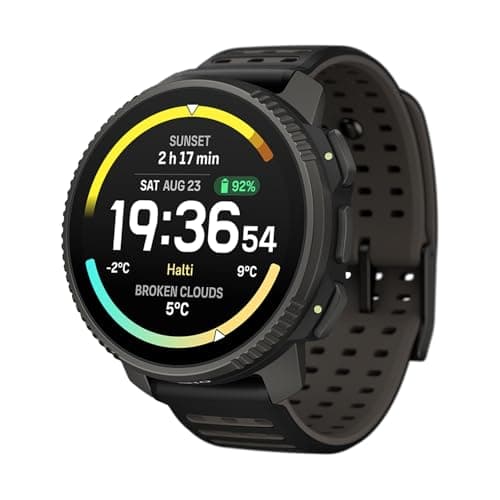
Suunto Vertical 2 Titanium
Rechargeable GPS9.3 /10The same sapphire and titanium with an AMOLED and a flashlight, but Suunto dropped the solar lens: 20 days of daily use instead of 30, and no solar column at all.
Check price at SuuntoAlso on Amazon — $699.00#ad · Suunto list price as of November 6, 2026 · Disclosure for the link to Suunto Vertical 2 Titanium
The short version
This is not a good-better-best pair. The Race is the newer idea — a bright AMOLED, a digital crown, free offline maps — and the Vertical Titanium Solar is the older one that does the single thing this site cares most about: it converts daylight into runtime.
Row by row
Every figure there is Suunto's own, read from its specification tables on the dates recorded at the bottom of this page. Where a row is blank for one of them, Suunto does not publish it.
Battery: the row that decides it
Everyday wear. Suunto states up to 30 days of daily use for the Vertical Titanium Solar, rising to 60 days with solar, and standby of 60 days rising to a year. The Race states up to 16 days of smartwatch use and 26 days of standby, with no solar column because there is no solar lens. That is roughly double, before the sun does anything at all.
Full-accuracy GPS. The Vertical states 65 hours all-systems multi-band, rising to 90 with solar; the Race states 50 hours multi-band and 65 single-band. Again the Vertical leads before solar and leads further after it.
The long-trip mode. Here the Race closes up: 200 hours in power-saving GNSS against the Vertical's 500. Both are multi-day figures and both degrade the fix rate to get there, so for most people the difference never gets tested.
Materials and weight
The Vertical Titanium Solar states a sapphire crystal and a Grade 5 titanium bezel on a glass fiber reinforced polyamide case, at 74 g. The Race states a sapphire touchscreen on a stainless steel bezel and the same polyamide case, at 83 g. Both are 100 m rated and neither carries a MIL-STD-810 claim from Suunto.
So the lens is a draw — both sapphire, which is the row that decides whether a watch still reads clearly in year ten — and the Vertical takes the bezel and the weight. Nine grams is not much, but titanium also conducts heat away from the wrist more slowly than steel, which is a real comfort difference in cold weather and is covered in titanium vs stainless steel.
One row the Race wins outright on paper is map storage, and it is version-dependent: Suunto states 32 GB on the titanium Race and 16 GB on the steel one. Check which version a listing is before buying on price.
Screen and navigation
The Race drives a 1.43-inch AMOLED at 466 x 466. The Vertical Titanium Solar uses a 1.4-inch memory-in-pixel matrix — dimmer, far more readable in direct sun, and the reason its battery table is what it is. If you have used a monochrome transflective watch and found it drab, you will prefer the Race every day of the week; if you have used an AMOLED and resented charging it, the opposite. The trade is the whole subject of MIP vs AMOLED battery life.
Both carry free offline maps and dual-band L1+L5 GNSS on four satellite systems at once, so navigation capability is genuinely equivalent. The Race adds a digital crown, which means the watch is fully drivable without touching the screen — worth more than it sounds in rain or with gloves on.
The Vertical generation trap
This catches people out, so it is worth stating plainly: the newer Vertical has no solar lens. Suunto replaced the first generation's solar MIP screen with an AMOLED on the Vertical 2 and dropped solar entirely, taking daily use from 30 days to 20. The Vertical 2 gains a flashlight, which the first generation does not have, and keeps the sapphire and titanium.
So "Vertical" on its own does not mean solar. If solar is why you are shopping, the words Titanium Solar have to be in the model name. Both generations are still sold. The Vertical 2 on its own terms is in our Vertical 2 review.
Which one to buy
Buy the Vertical Titanium Solar if the watch has a job to do away from a charger: multi-day hikes, hunting trips, deployments, or simply a dislike of charging things. Thirty days before the sun helps, sixty after it, 65 multi-band GPS hours, titanium, sapphire, 74 g. You give up the bright screen and the flashlight, and you are buying a previous-generation platform.
Buy the Race if the watch is mostly worn in ordinary life and charged at home: it is the better object to look at and use, with the same sapphire and the same maps, for less money. You give up roughly half the battery table and the titanium bezel.
Buy neither if what you actually want is the longest GPS figure Suunto publishes, because that belongs to the cheapest watch in the range — the 9 Peak Pro, at up to 300 hours in power saving with no maps. The whole range is laid out in the Suunto lineup explained.
In detail
The contenders, in full
Buy this to stop charging
Suunto Vertical Titanium Solar
30 days of daily use and 60 with solar, 65 multi-band GPS hours rising to 90, sapphire on a Grade 5 titanium bezel at 74 g. The only Suunto that runs on light.
EvidenceResearched · every row sourced
| Power class | Solar GPS. A rechargeable cell topped up by a solar lens. Weeks between charges; the cell still ages like any lithium battery. |
|---|---|
| Battery (smartwatch) | Up to 30 days daily use (60 days with solar); standby up to 60 days (1 year with solar) |
| Battery (GPS) | Up to 65 h multi-band (90 h with solar); up to 90 h single-band (140 h with solar) |
| Battery (max GPS) | Up to 500 h in power-saving GNSS modes |
| Glass | Sapphire crystal |
| Bezel & case | Titanium Grade 5 bezel; glass fiber reinforced polyamide case |
| Water rating | 100 m |
| Display | 1.4-inch matrix (MIP) |
| Maps & GPS | Free offline outdoor maps, 32 GB map storage; dual-band GNSS, L1 + L5 |
| Weight | 74 g / 2.61 oz |
| Operating temp | -20°C to +55°C (-5°F to +130°F) |
What the 9.6 score weighs
- Battery & power independence (25% of the score)
- Durability of materials (25% of the score)
- Serviceability & lifespan (20% of the score)
- Field usability (15% of the score)
- Value per decade (10% of the score)
- Mission fit (5% of the score)
What the spec sheet supports
- Solar, sapphire and titanium at 74 g, lighter than a fenix 8 51mm.
- 500 hours in power-saving GPS is the highest Suunto figure and beats the fenix 8 Solar 47mm's max-battery figure without solar.
Good to know
Previous generation: no flashlight, dimmer MIP screen, older optical heart rate.
#ad · Suunto list price as of November 6, 2026 · Disclosure for the link to Suunto Vertical Titanium Solar
Stock photoBuy this for the screen and the price
Suunto Race (steel)
A 1.43-inch AMOLED under sapphire with free offline maps and a digital crown, 50 multi-band GPS hours and 200 in power saving, for Suunto's lowest price in the Race line.
EvidenceResearched · every row sourced
| Power class | Rechargeable GPS. A rechargeable lithium cell charged from a cable. Days to a few weeks per charge; the cell ages with every cycle. |
|---|---|
| Battery (smartwatch) | Up to 16 days in smartwatch mode; up to 26 days standby only |
| Battery (GPS) | Up to 50 h all-systems GNSS + multi-band; up to 65 h single-band |
| Battery (max GPS) | Up to 200 h in power-saving GNSS modes; Suunto states 50 h / 65 h / 90 h / 200 h across its four modes |
| Glass | Sapphire crystal touchscreen |
| Bezel & case | Stainless steel bezel; glass fiber reinforced polyamide case |
| Water rating | 100 m |
| Display | 1.43-inch AMOLED matrix, 466 x 466 |
| Maps & GPS | Free offline maps, 32 GB storage on titanium / 16 GB on steel; GPS, GLONASS, Galileo, QZSS, BeiDou; dual band L1+L5, four systems at once |
| Sensors | Barometric altimeter, digital compass (5° accuracy), wrist heart rate; >95 sport modes; 10 m freedive depth meter |
| Weight | 83 g / 2.93 oz |
| Size | 49 mm diameter; 22 mm strap; fits 125-175 mm wrists |
| Operating temp | -20°C to +55°C (-5°F to +130°F); charging 0°C to +35°C |
What the 9.1 score weighs
- Battery & power independence (25% of the score)
- Durability of materials (25% of the score)
- Serviceability & lifespan (20% of the score)
- Field usability (15% of the score)
- Value per decade (10% of the score)
- Mission fit (5% of the score)
What the spec sheet supports
- Sapphire and free offline maps for Suunto's lowest list price in the Race line.
- 200 hours in power-saving GNSS is a multi-day figure, and 50 h at full multi-band accuracy covers a long race.
- A digital crown, so the watch is fully drivable without the touchscreen in rain or gloves.
Good to know
Steel bezel and 83 g: heavier than the titanium Race 2 at 65 g.
#ad · Suunto list price as of November 6, 2026 · Disclosure for the link to Suunto Race (steel)
The newer Vertical, for completeness
Suunto Vertical 2 Titanium
The same sapphire and titanium with an AMOLED and a flashlight, but Suunto dropped the solar lens: 20 days of daily use instead of 30, and no solar column at all.
EvidenceResearched · every row sourced
| Power class | Rechargeable GPS. A rechargeable lithium cell charged from a cable. Days to a few weeks per charge; the cell ages with every cycle. |
|---|---|
| Battery (smartwatch) | Up to 20 days daily use; up to 40 days standby |
| Battery (GPS) | Up to 65 h all-systems + multi-band (60 h always-on); up to 75 h single-band |
| Battery (max GPS) | Up to 250 h in power-saving GNSS modes |
| Glass | Sapphire crystal |
| Bezel & case | Titanium bezel; glass fiber reinforced polyamide case |
| Water rating | 100 m |
| Display | 1.5-inch LTPO AMOLED, 466 × 466 |
| Maps & GPS | Offline maps; GPS, GLONASS, Galileo, QZSS, BeiDou |
| Flashlight | Integrated LED flashlight |
| Weight | 87 g / 3.07 oz |
| Operating temp | -20°C to +55°C (-5°F to +130°F) |
What the 9.3 score weighs
- Battery & power independence (25% of the score)
- Durability of materials (25% of the score)
- Serviceability & lifespan (20% of the score)
- Field usability (15% of the score)
- Value per decade (10% of the score)
- Mission fit (5% of the score)
What the spec sheet supports
- Sapphire and titanium at the price of a polymer Garmin.
- Offline maps and a flashlight on a Suunto for the first time in the Vertical line.
Good to know
The Vertical 2 dropped solar; the original Vertical Titanium Solar still has it.
#ad · Suunto list price as of November 6, 2026 · Disclosure for the link to Suunto Vertical 2 Titanium
The bottom line
Our recommendation
Buy this one
Suunto Vertical Titanium Solar
30 days of daily use and 60 with solar, 65 multi-band GPS hours rising to 90, sapphire on a Grade 5 titanium bezel at 74 g. The only Suunto that runs on light.
#ad · Suunto list price as of November 6, 2026 · Disclosure for the link to Suunto Vertical Titanium Solar
How we scored this
What we checked to build this ranking
Every pick here is researched against the documents that decide whether a watch lasts: the maker's own battery table read mode by mode, what the lens and case are actually made of, the water rating, whether a MIL-STD-810 line is on the record and in whose words, and how long the maker keeps updating the line. Each one is then scored on a public rubric weighted for a decade of ownership, and every figure links to where it came from.
That is why the order on this page is worth following: it is built from specs you can open yourself, and commissions never set a score or decide a pick. The rubric and its weights are published.
Questions
Frequently asked
Is the Suunto Race better than the Suunto Vertical?
For screen and price, yes; for battery and materials, no. The Race has a brighter 1.43-inch AMOLED, a digital crown and a lower list price. The Vertical Titanium Solar states roughly double the battery (30 days against 16, 60 with solar), 65 multi-band GPS hours against 50, and a Grade 5 titanium bezel against steel. Both have sapphire and both have free offline maps.
Does the Suunto Race have solar charging?
No. No watch in the Race line has a solar lens. The only current Suunto with solar is the first-generation Vertical Titanium Solar — and note that the newer Vertical 2 dropped solar as well.
Do both have offline maps?
Yes, and both are free. Suunto states 32 GB of offline map storage on the Vertical Titanium Solar and on the titanium Race, and 16 GB on the steel Race. Both use dual-band L1+L5 GNSS across GPS, GLONASS, Galileo, QZSS and BeiDou, four systems at once.
Which is lighter?
The Vertical Titanium Solar, at 74 g against the Race's 83 g, because its bezel is Grade 5 titanium rather than stainless steel. Both use the same glass fiber reinforced polyamide case and both are rated to 100 m.
Keep reading
Related on Bezel & Bearing
Receipts
Sources
- Suunto — Vertical Titanium Solar Black product page and tech specs (checked 2026-09-20)
- Suunto — Vertical 2 Titanium Black product page and tech specs (checked 2026-09-20)
- Suunto — Race All Black product page and specification table (checked 2026-11-06)
Battery, glass, case and water figures come from the maker's own owner's manuals, spec pages and press releases, linked on every product so you can open the page they came from. Prices are set by Amazon and change often, so each buy button takes you to the current one. Read the full method.