GPS Watches / Head to head
Garmin vs COROS: the solar lens against the biggest battery without one
COROS puts sapphire and Grade 5 titanium on watches that cost less than a fenix, and quotes GPS hours nobody else matches. Garmin answers with a solar lens, a deeper case rating and a decade of support. Only one of those survives year eight.
By Mike M.Updated Researched from the maker's manuals and spec sheets
#adReader-supported: we may earn a commission if you buy through our links, at no extra cost to you. It never decides a ranking. How we rate · Disclosure
The contenders
Side by side
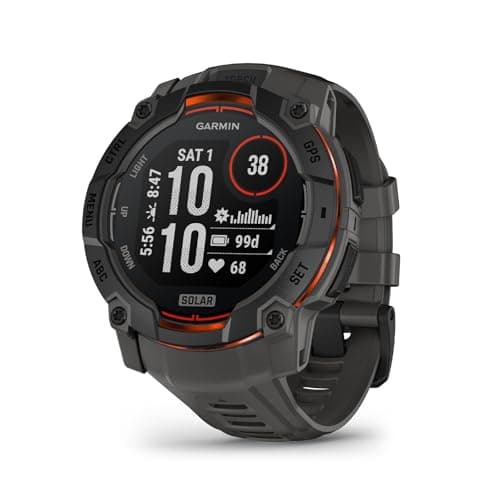
Garmin's decade watch
Garmin Instinct 3 Solar (50mm)
Solar GPS8.7 /10Unlimited smartwatch battery with sun, 10 ATM, built to MIL-STD-810, a flashlight. No sapphire, no maps.
$399.99Amazon#ad · Price as of November 4, 2026 · Disclosure for the link to Garmin Instinct 3 Solar (50mm)
 Stock photo
COROS's battery flagship
COROS VERTIX 2S
Rechargeable GPS8.1 /1036 days of daily use and 118 hours of standard full GPS, with sapphire and a Grade 5 titanium bezel. No solar, and no Amazon listing.
Check price · Amazon#ad · Price as of November 4, 2026 · Disclosure for the link to COROS VERTIX 2S
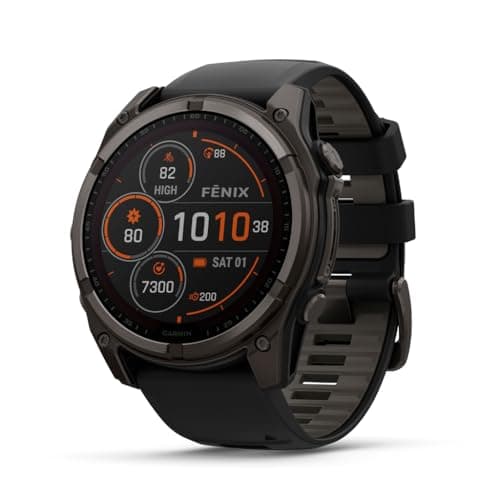
Garmin's complete watch
Garmin fenix 8 Solar (51mm, Sapphire)
Solar GPS8.7 /10Sapphire, titanium bezel, 40 m dive rating, preloaded maps, and 48 days of smartwatch battery with solar.
$1,092.78Amazon#ad · Price as of November 4, 2026 · Disclosure for the link to Garmin fenix 8 Solar (51mm, Sapphire)
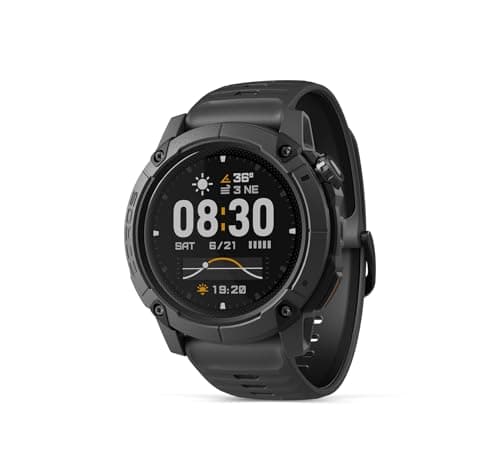
COROS for the price
COROS NOMAD
Rechargeable GPS6.9 /1022 days of daily use with topo maps at 61 g, on mineral glass and a 5 ATM rating. The light, cheap option.
$349.00Amazon#ad · Price as of November 4, 2026 · Disclosure for the link to COROS NOMAD
The verdict
These two brands have genuinely different theories of what a long-lasting watch is, and both are defensible.
COROS makes the battery enormous. The VERTIX 2S is quoted at 36 days of daily use, 118 hours of standard full GPS, 73 hours with all systems on and 43 hours dual-frequency, in a sapphire-and-titanium case at 10 ATM. Nothing from Garmin matches that GPS figure without the sun helping.
Garmin removes the charging problem instead. The Instinct 3 Solar is rated up to 40 days of typical use and unlimited smartwatch battery with three hours a day at 50,000 lux, plus up to 260 GPS hours with solar. The fenix 8 Solar 51 mm does 30 days, 48 with solar, 95 GPS hours and 149 with solar.
On this site the second approach wins, for a reason that has nothing to do with the headline numbers: a rechargeable lithium cell ages by charge cycle, so the watch that cycles six times a year is the watch still worth wearing in 2036. A 36-day watch charges about ten times a year. A solar Instinct worn outdoors may never charge at all. That is the argument, and it is laid out at length in buy-it-for-life watches.
Battery, in both makers' tables
No estimates here: these are the figures each maker publishes, which is also why the modes are named differently. COROS quotes standard full GPS, all systems and dual-frequency; Garmin quotes GPS-only, max-battery GPS and expedition mode, each with and without solar.
| Evidence | Garmin Instinct 3 Solar (50mm) | COROS VERTIX 2S | Garmin fenix 8 Solar (51mm, Sapphire) | COROS NOMAD |
|---|---|---|---|---|
| Power | Rechargeable, built-in lithium-ion battery with solar charging display | — | — | — |
| Battery (smartwatch) | Up to 40 days typical use; unlimited with solar (3 hr/day at 50,000 lux) | 36 days daily use | Up to 30 days typical use; up to 48 days with solar | 22 days daily use |
| Battery (GPS) | Up to 60 hours GPS-only; up to 260 hours with solar (50,000 lux) | 118 hours standard full GPS; 73 hours all systems on; 43 hours dual-frequency | Up to 95 hours GPS-only; up to 149 hours with solar | 50 hours all systems on; 56 hours endurance mode; 34 hours dual-frequency |
| Score | 8.7/10 | 8.1/10 | 8.7/10 | 6.9/10 |
Read it in two columns rather than as a race. In pure numbers with no sun, COROS wins the GPS row outright: 118 hours of standard full GPS on the VERTIX 2S against 60 GPS-only hours on the Instinct 3 Solar and 95 on the 51 mm fenix 8 Solar. Add sunlight and Garmin's numbers go to 260 and 149 hours respectively, and its smartwatch row stops having a number at all.
Which column is the real one depends entirely on whether your watch sees daylight. For a hunter, a rancher, a thru-hiker or anyone working outside, the solar column is the honest one. For someone who trains outdoors and works indoors, COROS's raw figures are closer to what you will see.
The solar question, which is the whole argument
COROS does not sell a solar watch. That is not a criticism of the engineering; it is a product-line fact with a consequence.
A solar lens does two things. The obvious one is extending runtime, and that is what the marketing talks about. The one that matters over ten years is that it keeps a lithium cell near the top of its charge without plugging in, which reduces the number of full cycles the cell sees. Cycle count, not calendar age, is the dominant factor in how much capacity a lithium cell has left. A watch with half its original capacity in year eight is a watch you replace.
So the comparison is not 118 hours against 60. It is 118 hours against a watch that may still be at most of its original capacity when the COROS has been through 80 or 100 full cycles. The mechanism is explained in Garmin solar explained and the practical routine in how to charge a solar watch.
Materials and water rating
COROS is unusually generous here and Garmin is unusually careful, so read both makers' words exactly.
The VERTIX 2S specifies sapphire glass with a Grade 5 titanium alloy bezel and a titanium alloy cover, at 10 ATM, which COROS qualifies as surface water activities and not diving. The NOMAD drops to hardened mineral glass, a fibre-reinforced polymer case with an aluminium alloy bezel and 5 ATM.
The Instinct 3 Solar is a metal-reinforced bezel on a fibre-reinforced polymer case, 10 ATM, and Garmin describes the display only as scratch-resistant, which is why we do not flag it as sapphire. The fenix 8 Solar is the one that beats everything here: a sapphire lens, a titanium bezel, leakproof metal buttons, a metal sensor guard and a case Garmin dive-rates to 40 metres rather than simply water-rating.
Two things fall out of that. If you want sapphire cheaply, COROS is the answer and Garmin is not. If you want a case rated for actual diving, Garmin is the answer and COROS explicitly is not. The ranking of lens materials across the whole site is in most scratch-resistant smartwatch.
One more Garmin-only line worth weighing: both Garmins here are built to MIL-STD-810 for thermal and shock resistance, in Garmin's own words. COROS makes no MIL-STD claim on these models, so we do not flag one. What the standard does and does not promise is in MIL-STD-810 watches explained.
Weight and size
COROS publishes its weights twice, once on silicone and once on nylon, which is a genuinely useful habit. The VERTIX 2S is 87 grams on silicone and 70 on nylon, at 50.3 by 50.3 by 16 mm. The NOMAD is 61 grams on silicone and 49 on nylon, at 47.8 by 47.8 by 14.8 mm, which makes it one of the lightest mapping watches anyone sells.
If weight is your deciding factor, the NOMAD is a strong answer and the strap swap is worth knowing about on any watch; it is the cheapest comfort upgrade there is, as covered in resin vs steel cases.
Where you can actually buy them
This is the practical difference nobody writes about, and it matters for a watch you intend to own for a decade.
The VERTIX 2S has no Amazon listing at all. We checked the catalogue directly and the model is not sold there; the buy link on this site is an honest tagged search rather than a product page we invented. COROS sells it directly, and the NOMAD is on Amazon normally. Garmin's entire line is on Amazon, at every retailer, with a used market, third-party straps and independent repairers.
For a buy-it-for-life purchase, distribution is part of serviceability. The brand whose bands, bezels and batteries will still be obtainable in year eight is the brand with the bigger installed base, and that is Garmin by a wide margin.
Who should buy neither
If what you want is a watch with nothing to charge ever, both of these are the wrong category. A Casio Tough Solar ABC watch runs for months in the dark on its reserve, costs a fraction as much, and has no software to go unsupported; the options are in best ABC watches and best Casio Pro Trek.
In detail
The contenders, in full
Garmin's decade watch
Garmin Instinct 3 Solar (50mm)
Unlimited smartwatch battery with sun, 10 ATM, built to MIL-STD-810, a flashlight. No sapphire, no maps.
EvidenceResearched · every row sourced
How the 8.7 score breaks down
- Battery & power independence (25%)
- 10
- Durability of materials (25%)
- 8
- Serviceability & lifespan (20%)
- 7
- Field usability (15%)
- 9
- Value per decade (10%)
- 10
- Mission fit (5%)
- 8
What the spec sheet supports
- Garmin's own table shows the 50mm solar model doubling the 45mm in GPS-with-solar hours (260 vs 130).
- Physical buttons, a monochrome display readable in full sun, and a flashlight with a red mode.
- 10 ATM rating and a MIL-STD 810 claim on a watch that costs less than half a fenix.
Where it falls short
- No maps: it navigates breadcrumb trails and waypoints, not topo maps.
- The solar figures assume three hours a day at 50,000 lux, which is midday sun, not a sleeve.
- Garmin does not name the lens material; treat it as strengthened glass, not sapphire.
Skip this if…
…you need on-wrist topo maps, or you wear long sleeves and work indoors, where the solar math never happens.
#ad · Price as of November 4, 2026 · Disclosure for the link to Garmin Instinct 3 Solar (50mm)
Stock photoCOROS's battery flagship
COROS VERTIX 2S
36 days of daily use and 118 hours of standard full GPS, with sapphire and a Grade 5 titanium bezel. No solar, and no Amazon listing.
EvidenceResearched · every row sourced
| Power class | Rechargeable GPS. A rechargeable lithium cell charged from a cable. Days to a few weeks per charge; the cell ages with every cycle. |
|---|---|
| Battery (smartwatch) | 36 days daily use |
| Battery (GPS) | 118 hours standard full GPS; 73 hours all systems on; 43 hours dual-frequency |
| Glass | Sapphire glass |
| Bezel & case | Grade 5 titanium alloy bezel with PVD coating; titanium alloy cover |
| Water rating | 10 ATM (surface water activities, not diving) |
| Display | 1.4-inch touchscreen always-on memory LCD, 280 × 280 |
| Maps & GPS | Downloadable global landscape and topo maps; GPS, GLONASS, Galileo, BeiDou, QZSS dual-frequency |
| Weight | 87 g with silicone band; 70 g with nylon band |
| Size | 50.3 × 50.3 × 16 mm |
| Operating temp | -22°F to 122°F (-30°C to 50°C) working; charging under 2 hours |
How the 8.1 score breaks down
- Battery & power independence (25%)
- 9
- Durability of materials (25%)
- 9
- Serviceability & lifespan (20%)
- 6
- Field usability (15%)
- 8
- Value per decade (10%)
- 8
- Mission fit (5%)
- 7
What the spec sheet supports
- 118 standard-GPS hours without a solar lens beats every Garmin's non-solar figure here.
- Rated to work at -30°C, ten degrees colder than a Garmin's stated range.
- Sapphire, titanium, 10 ATM and free downloadable topo maps.
Where it falls short
- No solar, no flashlight.
- No MIL-STD claim in COROS's specs.
Skip this if…
…you want a watch that stops needing a cable altogether; that is the solar Garmin's job.
#ad · Price as of November 4, 2026 · Disclosure for the link to COROS VERTIX 2S
Garmin's complete watch
Garmin fenix 8 Solar (51mm, Sapphire)
Sapphire, titanium bezel, 40 m dive rating, preloaded maps, and 48 days of smartwatch battery with solar.
EvidenceResearched · every row sourced
| Power class | Solar GPS. A rechargeable cell topped up by a solar lens. Weeks between charges; the cell still ages like any lithium battery. |
|---|---|
| Battery (smartwatch) | Up to 30 days typical use; up to 48 days with solar |
| Battery (GPS) | Up to 95 hours GPS-only; up to 149 hours with solar |
| Battery (max GPS) | Up to 186 hours max-battery GPS; up to 653 hours with solar |
| Battery (solar) | Expedition GPS mode up to 50 days; up to 118 days with solar |
| Glass | Scratch-resistant sapphire lens (sapphire versions) |
| Bezel & case | Titanium bezel (sapphire versions); leakproof metal buttons; sensor guard |
| Water rating | 40-meter dive-rated case |
| MIL-STD-810 | Tested to U.S. military standards for thermal, shock and water resistance |
| Maps & GPS | TopoActive maps preloaded on sapphire versions |
| Flashlight | Built-in LED flashlight with variable intensities, red light and strobe |
How the 8.7 score breaks down
- Battery & power independence (25%)
- 9
- Durability of materials (25%)
- 10
- Serviceability & lifespan (20%)
- 7
- Field usability (15%)
- 10
- Value per decade (10%)
- 6
- Mission fit (5%)
- 8
What the spec sheet supports
- Sapphire, titanium and leakproof metal buttons on a case Garmin dive-rates to 40 m.
- 653 hours of max-battery GPS with solar is the longest figure in Garmin's fenix 8 table.
- Preloaded topo maps, a speaker and mic, and a flashlight.
Where it falls short
- A MIP display in a world of AMOLEDs; that is also why the battery lasts.
- The fenix 9 Pro (August 2026) now sits above it in the line, with a titanium case and solar on select models.
- Big: 51mm is a lot of watch under a sleeve.
Skip this if…
…you have never used the maps on a watch; the Instinct 3 Solar gives you the battery for half the money.
#ad · Price as of November 4, 2026 · Disclosure for the link to Garmin fenix 8 Solar (51mm, Sapphire)
COROS for the price
COROS NOMAD
22 days of daily use with topo maps at 61 g, on mineral glass and a 5 ATM rating. The light, cheap option.
EvidenceResearched · every row sourced
| Power class | Rechargeable GPS. A rechargeable lithium cell charged from a cable. Days to a few weeks per charge; the cell ages with every cycle. |
|---|---|
| Battery (smartwatch) | 22 days daily use |
| Battery (GPS) | 50 hours all systems on; 56 hours endurance mode; 34 hours dual-frequency |
| Glass | Hardened mineral glass |
| Bezel & case | Fiber reinforced polymer with aluminum alloy bezel |
| Water rating | 5 ATM (surface water activities, not diving) |
| Maps & GPS | Landscape maps with trail and street names, topo maps; dual-frequency GNSS |
| Weight | 61 g with silicone band; 49 g with nylon band |
| Size | 47.8 × 47.8 × 14.8 mm |
How the 6.9 score breaks down
- Battery & power independence (25%)
- 7
- Durability of materials (25%)
- 6
- Serviceability & lifespan (20%)
- 6
- Field usability (15%)
- 8
- Value per decade (10%)
- 8
- Mission fit (5%)
- 8
What the spec sheet supports
- Trail and street names on the map layer, which a Garmin Instinct cannot show at all.
- Lightest mapping watch on the site.
Where it falls short
- Mineral glass and 5 ATM.
- No solar, no flashlight.
Skip this if…
…your season involves wading; 5 ATM and mineral glass are the wrong pair for a river.
#ad · Price as of November 4, 2026 · Disclosure for the link to COROS NOMAD
How we scored this
What we checked to build this ranking
Every pick here is researched against the documents that decide whether a watch lasts: the maker's own battery table read mode by mode, what the lens and case are actually made of, the water rating, whether a MIL-STD-810 line is on the record and in whose words, and how long the maker keeps updating the line. Each one is then scored on a public rubric weighted for a decade of ownership, and every figure links to where it came from.
That is why the order on this page is worth following: it is built from specs you can open yourself, and commissions never set a score or decide a pick. The rubric and its weights are published.
Questions
Frequently asked
Is Garmin or COROS better?
COROS publishes longer GPS runtime without solar, and gives you sapphire and Grade 5 titanium for less: the VERTIX 2S states 36 days of daily use and 118 hours of standard full GPS. Garmin wins on solar charging, dive ratings, MIL-STD-810 build claims, and the retail and repair network, which is what decides a ten-year purchase.
Does COROS make a solar watch?
No. COROS reaches its long runtimes with a large cell and efficient hardware instead. That is a real engineering achievement and it still means the watch charges from a cable, where a solar Garmin worn outdoors may not charge at all.
Does the COROS VERTIX 2S have a better battery than a Garmin fenix 8?
Without sunlight, yes on the GPS row: 118 hours of standard full GPS against up to 95 GPS-only hours on the 51 mm fenix 8 Solar. With solar the fenix goes to 149 GPS hours and 48 days of smartwatch use, and the Instinct 3 Solar reaches 260 GPS hours and unlimited smartwatch battery.
Is a COROS watch sapphire?
The VERTIX 2S and APEX 2 Pro specify sapphire glass with a Grade 5 titanium alloy bezel. The NOMAD does not: it uses hardened mineral glass with an aluminium alloy bezel and a 5 ATM rating.
Can you buy a COROS VERTIX 2S on Amazon?
Not at the time of writing. We checked the Amazon catalogue directly and the model is not listed there, so the link on this site is a tagged search rather than a product page. The COROS NOMAD is listed normally, and every Garmin on this page is.
Keep reading
Related on Bezel & Bearing
Receipts
Sources
- COROS — VERTIX 2S / APEX / NOMAD specification tables (checked 2026-09-20)
- Garmin newsroom — Instinct 3 Series press release (checked 2026-09-20)
- Garmin — Instinct 3 Solar Series Owner's Manual, Battery Life Information (checked 2026-09-20)
- Garmin newsroom — fenix 8 Series press release (checked 2026-09-20)
- Garmin — fenix 8 Series Owner's Manual, Battery Information (checked 2026-09-20)
- Garmin — fenix 8 Series Owner's Manual, Specifications (checked 2026-09-20)
Battery, glass, case and water figures come from the maker's own owner's manuals, spec pages and press releases, linked on every product so you can open the page they came from. Prices are set by Amazon and change often, so each buy button takes you to the current one. Read the full method.