Garmin / Review
Garmin Instinct E review: the Instinct that charges like every other watch
Garmin's entry Instinct keeps the case shape, the five buttons and the 10 ATM rating, then removes the solar lens, the flashlight and the military-standard claim. The manual says exactly what is left, and for one specific buyer it is enough.
By Mike M.Updated Researched from the maker's manuals and spec sheets
#adReader-supported: we may earn a commission if you buy through our links, at no extra cost to you. It never decides a ranking. How we rate · Disclosure
The verdict
The watch and its alternatives
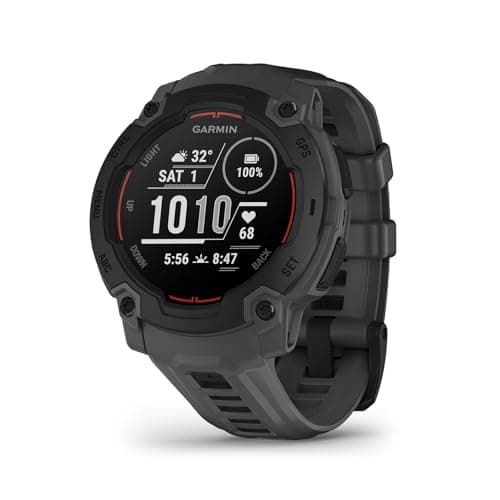
The watch under review
Garmin Instinct E (45mm)
Rechargeable GPS6.7 /1016 smartwatch days, 24 GPS hours, 50 max-battery hours, 20 expedition days, 10 ATM. No solar column in Garmin's table and no flashlight section in the manual.
$249.99Amazon#ad · Price as of November 4, 2026 · Disclosure for the link to Garmin Instinct E (45mm)
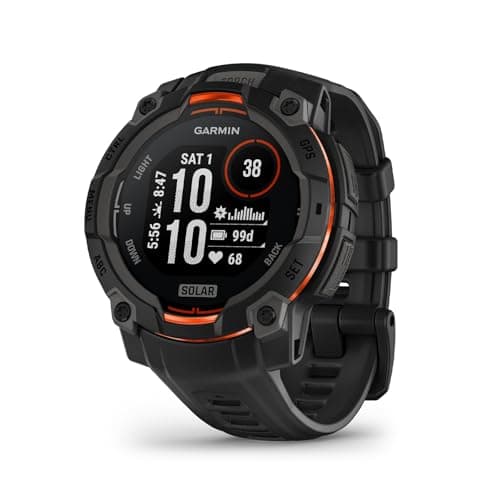
Alternative: the same size with solar
Garmin Instinct 3 Solar (45mm)
Solar GPS8.3 /1028 days (unlimited with sun), 40 GPS hours, a flashlight, a metal-reinforced bezel and a MIL-STD-810 line. The upgrade that answers every complaint below.
$339.99Amazon#ad · Price as of November 4, 2026 · Disclosure for the link to Garmin Instinct 3 Solar (45mm)
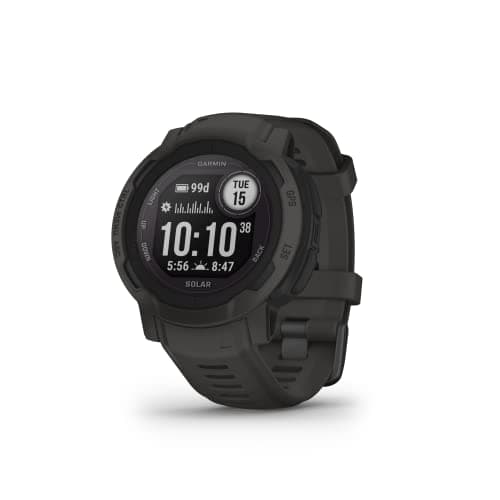
Alternative: last generation, with solar
Garmin Instinct 2 Solar (45mm)
Solar GPS7.7 /1028 days and 30 GPS hours with a solar lens, and a MIL-STD-810 claim, at previous-generation pricing. No flashlight on the 45mm.
$263.50Amazon#ad · Price as of November 4, 2026 · Disclosure for the link to Garmin Instinct 2 Solar (45mm)
Verdict and score
What the Instinct E actually is
Garmin sells four current Instincts: the Instinct 3 Solar, the Instinct 3 AMOLED, the Instinct 3 Tactical and the Instinct E. The E is the floor of the line, and the honest way to describe it is by subtraction. Take an Instinct 3 Solar, remove the solar lens, remove the flashlight, remove the metal-reinforced bezel and remove the military-standard line from the spec sheet. What remains is the case shape, the five-button layout, the monochrome memory-in-pixel display, the altimeter-barometer-compass sensor set, the 10 ATM water rating and a plain rechargeable battery.
That is a smaller subtraction than it sounds for one kind of buyer and a fatal one for another, which is why this review spends most of its length on the removals rather than the features. The features are the Instinct features and they are well understood: buttons that work in gloves and in rain, a screen with no touch layer to misfire, a sensor set that gives you altitude and a bearing without a phone, and a shape that has been in Garmin's catalog since 2018 and has outlasted several generations of round AMOLED fashion.
One thing the Instinct E is not is a map watch. No Instinct is. It navigates by breadcrumb trail, saved waypoints and TracBack, which is the same navigation the Instinct 3 does; if you want contour lines on the wrist the list is which Garmin watches have topo maps, and the Instinct E is not on it. That is a line-wide limitation, not a criticism of the cheap model.
The battery table, both sizes
Garmin publishes the Instinct E battery table in two columns, 40mm and 45mm, and the difference between them is real enough to matter to the buying decision. Here it is in full, unrearranged:
| Mode | Instinct E 40mm | Instinct E 45mm |
|---|---|---|
| Smartwatch mode | Up to 14 days | Up to 16 days |
| Battery saver watch mode | Up to 35 days | Up to 40 days |
| GPS only mode | Up to 21 hours | Up to 24 hours |
| All satellite systems mode | Up to 14 hours | Up to 16 hours |
| Max. battery GPS mode | Up to 43 hours | Up to 50 hours |
| Expedition GPS activity mode | Up to 17 days | Up to 20 days |
Two rows deserve comment. The first is all satellite systems mode: 16 hours on the 45mm. That is the multi-band accuracy mode, the one you want in a canyon or under canopy, and on this watch it costs you a third of your GPS endurance. A full day of recording in that mode does not fit. The second is expedition mode: 20 days. Expedition drops the sampling rate to one fix every few minutes, which is useless for pace and perfectly good for a track log, and it is the mode that turns this into a watch you can take on a long trip with one battery pack and no anxiety.
Garmin's own caveat on the table is worth quoting because it applies to every figure above: "The actual battery life depends on the features enabled on your watch, such as activity tracking, wrist-based heart rate, phone notifications, GPS, internal sensors, and connected sensors." Sixteen days is not sixteen days with notifications streaming and pulse-ox running overnight. It is the number you approach by turning things off, which is the same arithmetic on every watch in this category.
The three things Garmin removed
The solar lens. This is the big one, and for this site it is close to disqualifying on its own. The entire argument of the Instinct line, the reason it outsells watches with better screens, is that a solar lens plus a low-draw monochrome display equals a GPS watch you stop thinking about. Remove the lens and you have a watch you charge every other week instead of a watch you charge when you remember it exists. Sixteen days is still good. It is not the thing people buy an Instinct for, and the ranking in longest-battery-life GPS watches is where you can see how far back that puts it.
The flashlight. Garmin's Instinct E owner's manual has no flashlight section. The Instinct 3 line has one on every size, and the Instinct 2X Solar introduced it in 2023. A wrist flashlight sounds like a novelty until the first time you need both hands in the dark with no headlamp, and every owner we have read on the feature says the same thing. If you want it, the list of models that have it is which Garmin watches have a flashlight.
The MIL-STD-810 line. Garmin states a military-standard build for the Instinct 3 line and for the Instinct 2 family. We could not find that claim for the Instinct E in Garmin's own material, so this site does not print it, and the Instinct E card below carries no military-standard badge. Be careful how you read that: the absence of a claim is not evidence of a weak watch, and MIL-STD-810 is a test methodology rather than a grade in the first place — what it means and does not mean is laid out in MIL-STD-810 explained. But a buy-it-for-life decision should be made on claims a maker will put in writing, and on this model Garmin has not.
Durability, and what the manual does not claim
Here is everything Garmin's Instinct E specifications page gives us, verbatim in substance: a "rechargeable, built-in lithium-ion battery," a water rating of "10 ATM," an operating and storage temperature range of "from -20º to 60ºC (from -4º to 140ºF)," and a USB charging temperature range of "from 0º to 45ºC (from 32º to 113ºF)."
That last row is the one nobody reads and the one that matters in a cold climate. The watch operates down to -20ºC, but it will not accept a charge below freezing. If you are hunting a late season out of a truck or a tent, the charge has to happen somewhere warm — inside a jacket, in the cab with the heater on, in a sleeping bag. That is not a defect, it is lithium chemistry, and it is true of every rechargeable watch on this site. It is simply more consequential on a watch that has to be charged every two weeks than on one Garmin rates at 40 days.
What the page does not give us is a lens material, a bezel material, a case material or a weight. Garmin names a "chemically strengthened, scratch-resistant Power Glass lens" on the Instinct 2X and a metal-reinforced bezel on the Instinct 3, and names neither here. So we print neither. Assume a polymer case and a mineral lens because that is the class of watch this is, and understand that assuming is what we are doing. No Instinct in any generation is offered with sapphire — that starts at the fenix line, and the difference is argued in Garmin sapphire vs Gorilla Glass.
40mm or 45mm
The Instinct E is the only current Instinct offered in 40mm, and that is a genuine reason to look at it rather than a consolation. Garmin's smaller cases in this family usually stop at 45mm, so if you have a wrist that a 45mm watch overhangs, the E is the only door into the Instinct shape at all.
The cost is in the table above and it is consistent: the 40mm gives up roughly 12 to 15 percent across every row — 14 days instead of 16, 21 GPS hours instead of 24, 43 max-battery hours instead of 50, 17 expedition days instead of 20. That is a smaller penalty than the 45mm-to-50mm step costs elsewhere in the Instinct line, where the solar lens area changes the numbers much more dramatically. Pick the size that fits; the battery difference is not worth wearing a watch you dislike.
Against the Instinct 3 Solar
This is the only comparison that decides anything, because the Instinct 3 Solar 45mm is the same size, the same shape and the same button layout, from the same maker, in the same catalog, one price step up.
The Instinct 3 Solar 45mm is rated at 28 days in smartwatch mode against 16, 40 GPS hours against 24, 100 max-battery GPS hours against 50, and "unlimited" in smartwatch mode under Garmin's solar assumption. It adds the flashlight, the metal-reinforced bezel and the MIL-STD-810 line. In other words it is better on every row this site weights most heavily, for a price step that is a fraction of either watch's total cost.
We will not print either price, because the live Amazon number is the only one worth acting on and it moves every week — the buy buttons on this page carry it. What we will say is that the gap between the two sits in the low hundreds, the Instinct E lands in the entry bracket for a rugged GPS watch and the Instinct 3 Solar in the mid bracket, and that in our judgment the step is worth taking for almost everyone. Over ten years, the per-year difference is small enough to disappear, which is the whole premise of buying a watch for life. The full generational picture is in Instinct 2 vs Instinct 3, and the previous-generation Instinct 2 Solar is a third option worth pricing: it has the solar lens and the MIL-STD line that the E does not, often at a similar price.
Who should buy it, and who should not
Buy the Instinct E if you want a tough button watch with real ABC sensors and a screen you can read in sun, you have a hard ceiling on what you will spend, and charging it every week or two is genuinely not a problem — you are home most nights, near a cable, in a climate with power. Buy it if you need a 40mm case, where it is the only Instinct available. Buy it as a first GPS watch for someone who has never owned one and might discover they want maps, because this is the cheapest way to find out.
Do not buy it if the appeal of an Instinct was never having to think about a charger; the solar models are a different category of object and the Instinct 3 Solar is the one to buy. Do not buy it if you record all-day activities, where 24 GPS hours and 16 multi-band hours run out mid-trip. Do not buy it if a written military-standard or lens specification is part of how you decide, because Garmin has not published one here. And do not buy it expecting a flashlight, because the manual does not have the section.
Our standing recommendation for a decade of GPS without a charger is still the top of the rugged GPS rankings, and the Instinct E is not near it. But it is an honest entry watch that does not pretend to be more, and in a line where the cheap model is usually the one to avoid, the 40mm case gives it a real reason to exist.
Before you buy on price alone, compare what the solar models give you for a little more in best Garmin watch for the money.
In detail
Spec sheet and score
The watch under review
Garmin Instinct E (45mm)
16 smartwatch days, 24 GPS hours, 50 max-battery hours, 20 expedition days, 10 ATM. No solar column in Garmin's table and no flashlight section in the manual.
EvidenceResearched · every row sourced
| Power class | Rechargeable GPS. A rechargeable lithium cell charged from a cable. Days to a few weeks per charge; the cell ages with every cycle. |
|---|---|
| Battery (smartwatch) | Up to 16 days |
| Battery (GPS) | Up to 24 hours GPS-only |
| Battery (max GPS) | Up to 50 hours max-battery GPS |
| Power | Rechargeable, built-in lithium-ion battery (no solar column in Garmin's battery table) |
| Water rating | 10 ATM |
| Flashlight | None: the owner's manual has no flashlight section |
| Operating temp | -20° to 60°C (-4° to 140°F) |
How the 6.7 score breaks down
- Battery & power independence (25%)
- 6
- Durability of materials (25%)
- 6
- Serviceability & lifespan (20%)
- 7
- Field usability (15%)
- 8
- Value per decade (10%)
- 8
- Mission fit (5%)
- 6
What the spec sheet supports
- 10 ATM water rating and the Instinct button layout at the lowest price in the line.
- Sixteen days of watch use is still weeks between charges.
Where it falls short
- No solar and no flashlight; Garmin's manual lists neither.
- 24 GPS hours is a weekend, not a week.
- Garmin does not make a MIL-STD 810 claim for the Instinct E in the material we could cite.
Skip this if…
…the reason you want an Instinct is to stop charging; this one charges like any other watch.
#ad · Price as of November 4, 2026 · Disclosure for the link to Garmin Instinct E (45mm)
Alternative: the same size with solar
Garmin Instinct 3 Solar (45mm)
28 days (unlimited with sun), 40 GPS hours, a flashlight, a metal-reinforced bezel and a MIL-STD-810 line. The upgrade that answers every complaint below.
EvidenceResearched · every row sourced
| Power class | Solar GPS. A rechargeable cell topped up by a solar lens. Weeks between charges; the cell still ages like any lithium battery. |
|---|---|
| Battery (smartwatch) | Up to 28 days typical use; unlimited with solar (3 hr/day at 50,000 lux) |
| Battery (GPS) | Up to 40 hours GPS-only; up to 130 hours with solar |
| Battery (max GPS) | Up to 100 hours max-battery GPS; unlimited with solar |
| Power | Rechargeable, built-in lithium-ion battery with solar charging display |
| Bezel & case | Metal-reinforced bezel; fiber-reinforced polymer case |
| Water rating | 10 ATM |
| MIL-STD-810 | Built to MIL-STD 810 for thermal and shock resistance |
| Flashlight | Built-in flashlight with variable intensities, a red light and strobe mode |
How the 8.3 score breaks down
- Battery & power independence (25%)
- 9
- Durability of materials (25%)
- 8
- Serviceability & lifespan (20%)
- 7
- Field usability (15%)
- 9
- Value per decade (10%)
- 9
- Mission fit (5%)
- 8
What the spec sheet supports
- Every durability claim of the 50mm (10 ATM, MIL-STD 810, metal-reinforced bezel) in a size that fits under a cuff.
- Still 'unlimited' in smartwatch mode under Garmin's solar assumption.
- Flashlight on every Instinct 3 size, which the Instinct 2 45mm never had.
Where it falls short
- Half the GPS-with-solar hours of the 50mm (130 vs 260) because the lens is smaller.
- No maps, same as the rest of the Instinct line.
Skip this if…
…you have the wrist for the 50mm; the bigger lens is where the solar numbers live.
#ad · Price as of November 4, 2026 · Disclosure for the link to Garmin Instinct 3 Solar (45mm)
Alternative: last generation, with solar
Garmin Instinct 2 Solar (45mm)
28 days and 30 GPS hours with a solar lens, and a MIL-STD-810 claim, at previous-generation pricing. No flashlight on the 45mm.
EvidenceResearched · every row sourced
| Power class | Solar GPS. A rechargeable cell topped up by a solar lens. Weeks between charges; the cell still ages like any lithium battery. |
|---|---|
| Battery (smartwatch) | Up to 28 days; unlimited with solar (all-day wear, 3 hr/day at 50,000 lux) |
| Battery (GPS) | Up to 30 hours; 48 hours with solar |
| Battery (max GPS) | Up to 70 hours; 370 hours with solar |
| Battery (solar) | Expedition GPS mode up to 32 days; battery saver watch mode up to 65 days; both unlimited with solar |
| Water rating | Water-rated up to 10 ATM (Instinct 2 family, per the 2X Solar release) |
| MIL-STD-810 | Built to U.S. military standards (MIL-STD-810) for thermal shock, water resistance and shock (Instinct 2 family, per the 2X Solar release) |
How the 7.7 score breaks down
- Battery & power independence (25%)
- 9
- Durability of materials (25%)
- 7
- Serviceability & lifespan (20%)
- 6
- Field usability (15%)
- 8
- Value per decade (10%)
- 9
- Mission fit (5%)
- 7
What the spec sheet supports
- Garmin's table matches the current Instinct 3 Solar 45mm in smartwatch mode (28 days, unlimited with solar) and battery saver mode (65 days).
- Sold alongside the Instinct 3, so the price gap is real.
Where it falls short
- No flashlight on the 45mm Instinct 2; the Instinct 3 added one to every size.
- An older platform means an earlier end to firmware support.
Skip this if…
…you want the longest support runway; the Instinct 3 will be updated for years after this one stops.
#ad · Price as of November 4, 2026 · Disclosure for the link to Garmin Instinct 2 Solar (45mm)
How we scored this
What we checked to build this ranking
Every pick here is researched against the documents that decide whether a watch lasts: the maker's own battery table read mode by mode, what the lens and case are actually made of, the water rating, whether a MIL-STD-810 line is on the record and in whose words, and how long the maker keeps updating the line. Each one is then scored on a public rubric weighted for a decade of ownership, and every figure links to where it came from.
That is why the order on this page is worth following: it is built from specs you can open yourself, and commissions never set a score or decide a pick. The rubric and its weights are published.
Questions
Frequently asked
How long does the Garmin Instinct E battery last?
Garmin's Instinct E battery table gives the 45mm up to 16 days in smartwatch mode, up to 40 days in battery saver watch mode, up to 24 hours in GPS only mode, up to 16 hours in all satellite systems mode, up to 50 hours in max-battery GPS mode and up to 20 days in expedition GPS activity mode. The 40mm is rated at 14 days, 35 days, 21 hours, 14 hours, 43 hours and 17 days respectively.
Does the Garmin Instinct E have solar charging?
No. Garmin's Instinct E battery table has no solar column and the specifications page lists a plain "rechargeable, built-in lithium-ion battery." Solar starts with the Instinct 3 Solar and the Instinct 2 Solar models.
Does the Instinct E have a flashlight?
No. The Instinct E owner's manual has no flashlight section. Among Instincts, the flashlight arrived on the Instinct 2X Solar and is on every Instinct 3 size.
Is the Garmin Instinct E waterproof?
Garmin's specifications page rates it to 10 ATM, the same water rating as the Instinct 3 Solar. That covers swimming and surface water work. Garmin does not dive-rate it.
Is the Instinct E built to MIL-STD-810?
We could not find a MIL-STD-810 claim for the Instinct E in Garmin's own material, so this site does not state one. Garmin does make that claim for the Instinct 3 line and the Instinct 2 family.
Does the Garmin Instinct E have maps?
No. Like every Instinct, it navigates by breadcrumb trail, saved waypoints and TracBack rather than a topographic base map. Maps start at the fenix, Enduro and tactix lines.
Keep reading
Related on Bezel & Bearing
Receipts
Sources
- Garmin — Instinct E Owner's Manual, Battery Life Information (checked 2026-09-20)
- Garmin — Instinct E Owner's Manual, Specifications (checked 2026-09-20)
- Garmin — Instinct E Owner's Manual (contents: no flashlight or solar section) (checked 2026-09-20)
- Garmin — Instinct 3 Solar Series Owner's Manual, Battery Life Information (checked 2026-09-20)
- Garmin newsroom — Instinct 3 Series press release (checked 2026-09-20)
- Garmin newsroom — Instinct 2X Solar press release (checked 2026-09-20)
Battery, glass, case and water figures come from the maker's own owner's manuals, spec pages and press releases, linked on every product so you can open the page they came from. Prices are set by Amazon and change often, so each buy button takes you to the current one. Read the full method.