Garmin / Review
Garmin Instinct Crossover Solar review: what real hands cost you, in hours
The Crossover puts two motor-driven luminescent hands over a digital Instinct. Garmin's own numbers say that trade costs you more than half the GPS runtime of an Instinct 3 Solar. Here is when it is worth paying, and when it is not.
By Mike M.Updated Researched from the maker's manuals and spec sheets
#adReader-supported: we may earn a commission if you buy through our links, at no extra cost to you. It never decides a ranking. How we rate · Disclosure
The verdict
The watch and its alternatives
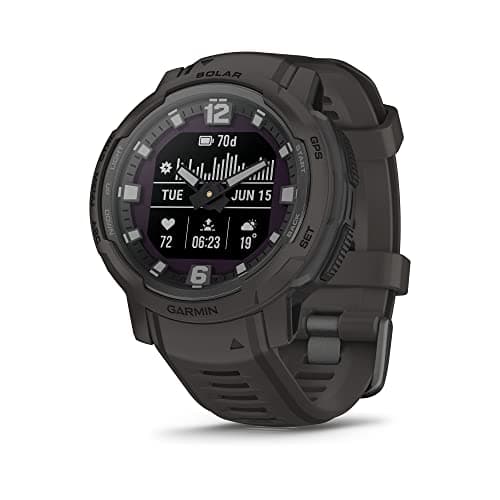
The watch under review
Garmin Instinct Crossover Solar
Solar GPS7.2 /10RevoDrive luminescent hands over a monochrome digital Instinct. 10 ATM, built to MIL-STD-810, 70 smartwatch days and 553 max-battery GPS hours with solar. Score below.
$259.95Amazon#ad · Price as of November 4, 2026 · Disclosure for the link to Garmin Instinct Crossover Solar
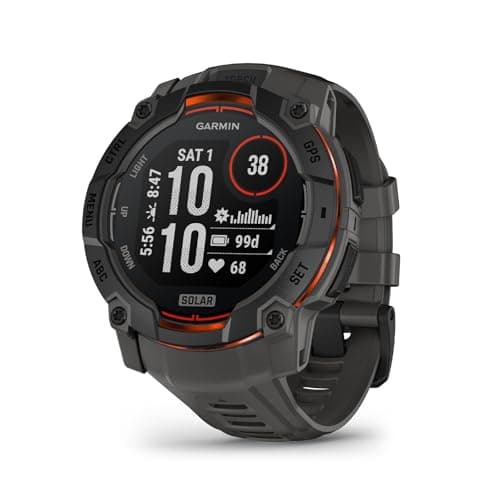
Alternative: the one with the hours
Garmin Instinct 3 Solar (50mm)
Solar GPS8.7 /10No hands, but 60 GPS hours rising to 260 with solar, a flashlight with a red mode and a current-generation platform.
$399.99Amazon#ad · Price as of November 4, 2026 · Disclosure for the link to Garmin Instinct 3 Solar (50mm)
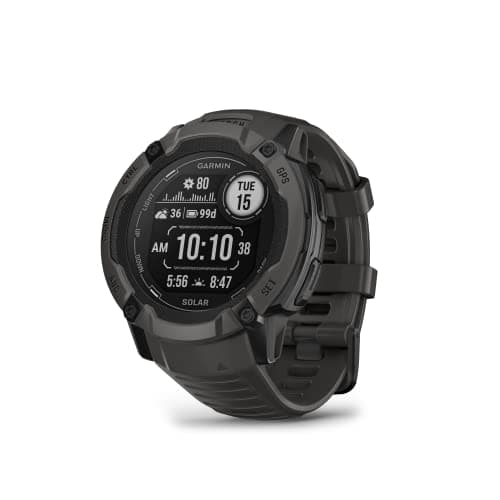
Alternative: the big-case predecessor
Garmin Instinct 2X Solar (50mm)
Solar GPS7.8 /10The 50mm Instinct 2X Solar, which is where Garmin's flashlight first appeared on this line. No hands, no maps.
$334.90Amazon#ad · Price as of November 4, 2026 · Disclosure for the link to Garmin Instinct 2X Solar (50mm)
Verdict and score
The Instinct Crossover is the strangest watch Garmin sells and the only one that answers a question nobody else in the lineup answers: what do you wear when you want a GPS watch but you also want to glance at a wrist in a dark truck cab and read the time off two glowing hands without pressing anything? Every other Instinct answers that with a backlight. This one answers it with hands.
It earns its place on this site because of the second half of its spec sheet rather than the first. Garmin's own battery table gives the Solar edition 28 days in smartwatch mode, 70 days with solar, and 553 hours of max-battery GPS with solar. Those are month-and-year figures on a 10 ATM case that Garmin says is built to MIL-STD-810. That is a buy-it-for-life power profile with a mechanical-looking face bolted to the front of it.
What it is not is the Instinct with the most runtime, the newest platform or the most features. It launched in November 2022 at a suggested retail price beginning at $499.99 and the line has since been joined by an AMOLED version that is a materially different watch. If you buy it, buy it for the hands.
What RevoDrive actually is
Garmin calls the mechanism RevoDrive, and describes it as "RevoDrive analog hand technology" that is "prepared to deliver accurate timekeeping even in the harshest activities and environments." In practice it is a pair of motor-driven, luminescent hands mounted above the Instinct's monochrome display. They are driven by the same clock the digital face uses, so they do not drift against it, and they can step out of the way of the screen's center when the watch needs the space.
Two things follow from that, and they are the whole experience of wearing this watch. The first is good: the hands are lume, not pixels. They are legible at 3 a.m. with a dead screen, in a way no Instinct backlight and no AMOLED wake-gesture matches, and they do not consume a milliamp while they sit still. The second is the compromise: they sit over the display permanently. Garmin can move them, but it cannot remove them, so on any screen with a dense data layout there are two opaque lines across it. A map would be unreadable, which is part of why the Crossover has none.
The hours the hands cost
The interesting number on this watch is not any single figure in Garmin's table. It is the gap between this table and the Instinct 3 Solar's. Both are solar MIP Instincts. One has motors.
Read the GPS row twice. Garmin gives the Crossover Solar 25 hours of GPS, rising to 31 with solar. It gives the Instinct 3 Solar 50mm 60 hours, rising to 260 with solar. That is not a rounding difference; the Crossover delivers roughly 40 percent of the GPS runtime, and barely a tenth of the solar-assisted figure. Two stepper motors and the power budget of a 2022 platform are what you are paying.
The smartwatch row behaves very differently, and this is the part most reviews skip. In smartwatch mode the Crossover gives 28 days, 70 with solar, against the Instinct 3 Solar's 40 days and "unlimited" with solar. Still a loss, but a much smaller one, because hands at rest cost almost nothing. The hands are expensive only while the GPS is running — which is to say, the Crossover is a great watch and a mediocre tracker.
Battery, mode by mode
Garmin publishes five modes for this series, and every solar figure in the table carries the same footnote: the smartwatch, expedition and battery-saver figures assume "all-day wear with 3 hr./day outside in 50,000 lux conditions", and the two GPS figures assume "with use in 50,000 lux conditions". 50,000 lux is open midday sun. A sleeve, a cab or a northern December is not that, which is why we treat the non-solar column as the number you should plan around and the solar column as the upside.
- Smartwatch mode with activity tracking and 24/7 wrist heart rate: up to 28 days, 70 days with solar.
- GPS mode: up to 25 hours, 31 hours with solar.
- Max. battery GPS mode: up to 111 hours, 553 hours with solar.
- Expedition GPS mode: up to 40 days, 327 days with solar.
- Battery saver watch mode: up to 71 days, unlimited with solar.
The expedition row is the one worth planning a trip around. Forty days of periodic GPS fixes without sun, 327 with it, is a season of elk scouting or a thru-hike on one charge, and the hands tell you the time the whole way. The same argument against solar marketing applies here as everywhere on this site, and the arithmetic is in Garmin solar explained.
Case, water rating and MIL-STD-810
Garmin's specification page for the series states a 10 ATM water rating — "the device withstands pressure equivalent to a depth of 100 m" — a rechargeable built-in lithium-ion battery, an operating and storage range of -20 to 60°C (-4 to 140°F) and a USB charging range of 0 to 45°C (32 to 113°F). The launch release adds that the watch is "thermal and shock resistant, built to MIL-STD-810".
Three practical readings of that. First, 10 ATM is the Instinct line's normal rating and it is a static pressure rating, not a dive certification; what that does and does not mean is in watch water resistance explained. Second, the MIL-STD-810 line is a build claim, not a certification you can look up, and we treat every maker's version of it the same way — see MIL-STD-810 watches explained. Third, the charging range is the figure people get caught by: a watch rated to -20°C will not accept a charge below freezing, so winter charging happens indoors. That applies to every Garmin with a cable and it is covered in best watch for cold weather.
What Garmin does not claim for it
This site states absences rather than filling them, and the Crossover has four worth naming. Garmin does not name the lens material for this line in its series manual or its launch release, so we do not call it sapphire — assume strengthened glass and read sapphire vs Gorilla Glass if the lens is your deciding factor. Garmin does not name the bezel or case material in those documents either. There is no flashlight in the launch release; the flashlight arrived on this line with the Instinct 2X Solar and is on every Instinct 3, and the full list is in Garmin watches with a flashlight. And there are no maps, which is a design consequence of the hands rather than a cost saving.
The AMOLED Crossover, and why it is a different watch
Garmin now publishes a separate owner's manual for an Instinct Crossover AMOLED series, and its battery table makes clear it is not a variant but a different proposition. The AMOLED Crossover is rated at up to 14 days in smartwatch mode with wrist gesture, 5 days with the display always on, 18 days in battery saver, 29 hours of GPS-only with wrist gesture, 15 hours with all satellite systems plus multi-band, and 53 hours in max-battery GPS.
Set that against the Solar's 28 days, 70 with solar, and 553 max-battery hours with solar. The AMOLED version gives you a bright color screen under the hands and gives up the entire reason this watch is on a battery-life-and-durability site. If you want the Crossover concept, buy the Solar. The general version of this argument is in MIP vs AMOLED battery life.
The Tactical Edition
Garmin's launch release says the Instinct Crossover – Tactical Edition "builds on these features and provides dedicated tactical-oriented features like night vision compatibility, stealth mode, dual-format GPS, a kill switch and more." That is the same feature set the rest of Garmin's tactical line carries and it is the version to buy if light discipline is part of your job, because lume hands and a night-vision mode are a genuinely good pairing: nothing has to light up for you to read the time.
We do not list the Tactical Edition as a separate product because its battery table is the series table above and Garmin publishes no separate specification page for it. If you are shopping that end of the line, the current-generation comparison is the Instinct 3 Tactical review, and the broader ranking is in best tactical smartwatch.
The decade question
This site asks one question of every watch: will you still be wearing it in ten years, or will you buy another one? The Crossover's honest answer is split. The power system is excellent — a solar lens over a MIP display is the longest-lived rechargeable arrangement anyone sells, and the expedition and battery-saver rows say so. The materials are mid-table, because Garmin names neither lens nor bezel material. The moving hands are a question mark nobody has data on. And the platform is four years old, which matters less than it sounds on a watch with no maps and no app ecosystem to fall behind on, but it does mean feature updates have moved on to the Instinct 3 line.
Our score reflects that split: strong on power, strong on mission fit for the one reader who wants hands, middling on materials and value per decade. The full method is at how we rate.
Who should skip it
Skip it if you record long activities. Twenty-five GPS hours is a weekend, not a week, and the watch that costs about the same gives you sixty. Skip it if you navigate from a screen, because there are no maps and two hands across the display. Skip it if you want the current platform, a flashlight or a named sapphire lens. And skip it if the hands are a styling preference rather than a functional one — a styling preference is not worth 35 GPS hours.
Buy it if a glanceable, powerless, luminescent readout is worth real money to you: night shifts, aviation, stand hunting, uniformed work where a lit screen is a liability. That reader is small, and for that reader nothing else Garmin sells does the job.
In detail
Spec sheet and score
The watch under review
Garmin Instinct Crossover Solar
RevoDrive luminescent hands over a monochrome digital Instinct. 10 ATM, built to MIL-STD-810, 70 smartwatch days and 553 max-battery GPS hours with solar. Score below.
EvidenceResearched · every row sourced
| Power class | Solar GPS. A rechargeable cell topped up by a solar lens. Weeks between charges; the cell still ages like any lithium battery. |
|---|---|
| Battery (smartwatch) | Up to 28 days; 70 days with solar (all-day wear with 3 hr/day outside at 50,000 lux) |
| Battery (GPS) | Up to 25 hours; 31 hours with solar (at 50,000 lux) |
| Battery (max GPS) | Up to 111 hours max-battery GPS; 553 hours with solar (at 50,000 lux) |
| Battery (solar) | Expedition GPS mode up to 40 days; 327 days with solar. Battery saver watch mode up to 71 days; unlimited with solar |
| Power | Rechargeable, built-in lithium-ion battery (solar lens on the Solar and Tactical editions) |
| Water rating | 10 ATM (withstands pressure equivalent to a depth of 100 m) |
| MIL-STD-810 | Thermal and shock resistant, built to MIL-STD-810 |
| Display | Monochrome digital display beneath RevoDrive luminescent analog hands |
| Operating temp | From -20° to 60°C (from -4° to 140°F); USB charging from 0° to 45°C (32° to 113°F) |
How the 7.2 score breaks down
- Battery & power independence (25%)
- 9
- Durability of materials (25%)
- 7
- Serviceability & lifespan (20%)
- 6
- Field usability (15%)
- 7
- Value per decade (10%)
- 6
- Mission fit (5%)
- 7
What the spec sheet supports
- The only Garmin where the time is told by real hands you can read with the screen asleep or dead.
- Garmin's own table gives it 70 smartwatch days and 553 max-battery GPS hours with solar — the solar MIP platform at its best.
- 10 ATM and a MIL-STD-810 claim, and the Tactical Edition adds night vision compatibility, stealth mode, dual-format GPS and a kill switch.
Where it falls short
- Two stepper motors and two hands eat power: 25 GPS hours against 60 on an Instinct 3 Solar 50mm.
- The hands sit over the display permanently. There is no moving them off a data field.
- A 2022 platform: no flashlight in Garmin's release, and no maps.
Skip this if…
…you want the longest GPS session for the money — the hands are a 35-hour tax the Instinct 3 Solar does not charge.
#ad · Price as of November 4, 2026 · Disclosure for the link to Garmin Instinct Crossover Solar
Alternative: the one with the hours
Garmin Instinct 3 Solar (50mm)
No hands, but 60 GPS hours rising to 260 with solar, a flashlight with a red mode and a current-generation platform.
EvidenceResearched · every row sourced
How the 8.7 score breaks down
- Battery & power independence (25%)
- 10
- Durability of materials (25%)
- 8
- Serviceability & lifespan (20%)
- 7
- Field usability (15%)
- 9
- Value per decade (10%)
- 10
- Mission fit (5%)
- 8
What the spec sheet supports
- Garmin's own table shows the 50mm solar model doubling the 45mm in GPS-with-solar hours (260 vs 130).
- Physical buttons, a monochrome display readable in full sun, and a flashlight with a red mode.
- 10 ATM rating and a MIL-STD 810 claim on a watch that costs less than half a fenix.
Where it falls short
- No maps: it navigates breadcrumb trails and waypoints, not topo maps.
- The solar figures assume three hours a day at 50,000 lux, which is midday sun, not a sleeve.
- Garmin does not name the lens material; treat it as strengthened glass, not sapphire.
Skip this if…
…you need on-wrist topo maps, or you wear long sleeves and work indoors, where the solar math never happens.
#ad · Price as of November 4, 2026 · Disclosure for the link to Garmin Instinct 3 Solar (50mm)
Alternative: the big-case predecessor
Garmin Instinct 2X Solar (50mm)
The 50mm Instinct 2X Solar, which is where Garmin's flashlight first appeared on this line. No hands, no maps.
EvidenceResearched · every row sourced
| Power class | Solar GPS. A rechargeable cell topped up by a solar lens. Weeks between charges; the cell still ages like any lithium battery. |
|---|---|
| Battery (smartwatch) | Up to 40 days; unlimited with solar (all-day wear, 3 hr/day at 50,000 lux) |
| Battery (GPS) | Up to 60 hours GPS mode; up to 145 hours with solar |
| Battery (max GPS) | Up to 150 hours max-battery GPS; unlimited with solar |
| Battery (solar) | Expedition GPS mode up to 60 days; battery saver watch mode up to 100 days; both unlimited with solar |
| Glass | Chemically strengthened, scratch-resistant Power Glass lens |
| Bezel & case | 50mm fiber-reinforced polymer case |
| Water rating | Water-rated up to 10 ATM |
| MIL-STD-810 | Built to U.S. military standards (MIL-STD-810) for thermal shock, water resistance and shock |
| Flashlight | Integrated LED flashlight with variable intensities, white/red options and strobe |
| Operating temp | From -20º to 60ºC (from -4º to 140ºF); solar charging from 0º to 60ºC |
How the 7.8 score breaks down
- Battery & power independence (25%)
- 9
- Durability of materials (25%)
- 7
- Serviceability & lifespan (20%)
- 6
- Field usability (15%)
- 9
- Value per decade (10%)
- 8
- Mission fit (5%)
- 8
What the spec sheet supports
- The Power Glass lens produces 50% more energy than the Instinct 2 solar lens, per Garmin.
- Garmin's own table gives it the same 40 smartwatch days, 150 max-battery GPS hours and 60-day expedition mode as the current Instinct 3 Solar 50mm.
- Flashlight and a Tactical Edition variant with stealth mode and NVG compatibility.
Where it falls short
- 145 GPS hours with solar against the Instinct 3 Solar 50mm's 260: the newer lens harvests more.
- Garmin's Instinct 2 table publishes no all-systems (multi-band) GNSS battery row, so there is no figure to cite for that mode.
- A 2023 platform; the Instinct 3 is the one still getting new features.
Skip this if…
…you can find the Instinct 3 Solar 50mm for similar money; it is the newer version of this exact idea.
#ad · Price as of November 4, 2026 · Disclosure for the link to Garmin Instinct 2X Solar (50mm)
How we scored this
What we checked to build this ranking
Every pick here is researched against the documents that decide whether a watch lasts: the maker's own battery table read mode by mode, what the lens and case are actually made of, the water rating, whether a MIL-STD-810 line is on the record and in whose words, and how long the maker keeps updating the line. Each one is then scored on a public rubric weighted for a decade of ownership, and every figure links to where it came from.
That is why the order on this page is worth following: it is built from specs you can open yourself, and commissions never set a score or decide a pick. The rubric and its weights are published.
Questions
Frequently asked
Is the Garmin Instinct Crossover still worth buying?
Yes, for one specific reason: it is the only Garmin with real luminescent hands, and Garmin still rates the Solar edition at 28 smartwatch days (70 with solar) on a 10 ATM, MIL-STD-810 case. It is not worth buying for runtime or features — the Instinct 3 Solar 50mm gives 60 GPS hours against the Crossover's 25, plus a flashlight and a current platform.
What is the battery life of the Instinct Crossover Solar?
Garmin publishes up to 28 days in smartwatch mode and 70 days with solar; 25 hours of GPS and 31 with solar; 111 hours of max-battery GPS and 553 with solar; 40 days of expedition GPS and 327 with solar; and 71 days in battery saver watch mode, unlimited with solar. Every solar figure assumes 3 hours a day outside at 50,000 lux, which is open midday sun.
Does the Instinct Crossover have a flashlight?
No. Garmin's Crossover launch release names no flashlight. The flashlight appeared on this line with the Instinct 2X Solar and is on every Instinct 3; the complete list of Garmin models that have one is in Garmin watches with a flashlight. The Crossover does have luminescent hands, which cover part of the same need without any power draw at all.
Does the Instinct Crossover have maps?
No. It navigates waypoints, routes and a breadcrumb trail like the rest of the Instinct line, but there is no topo map, and two physical hands across the display is part of why. If you want a map on the wrist, the current options are ranked in best watch with offline maps.
Instinct Crossover Solar or Instinct Crossover AMOLED?
Solar, if you came to this watch for the reasons this site exists. Garmin rates the AMOLED Crossover at 14 days in smartwatch mode with wrist gesture (5 with the display always on) and 53 hours in max-battery GPS, against the Solar's 70 days with solar and 553 max-battery hours with solar. The AMOLED is a nicer screen and a much shorter-lived watch.
Is the Instinct Crossover waterproof?
Garmin rates it 10 ATM, which its specification page defines as withstanding pressure equivalent to a depth of 100 m. That covers swimming, rain and submersion; it is not a dive certification. The distinction is explained in watch water resistance explained.
Keep reading
Related on Bezel & Bearing
- Instinct Crossover vs Instinct 3The head-to-head, row by row.
- Garmin Instinct 3 Solar reviewThe watch with more than double the GPS hours.
- Toughest Garmin watchRanked on the four claims Garmin publishes.
- MIP vs AMOLED battery lifeWhy the AMOLED Crossover is a different watch.
- Garmin solar explainedWhat 50,000 lux means on your wrist.
Receipts
Sources
- Garmin — Instinct Crossover Series Owner's Manual, Battery Life Information (checked 2026-10-28)
- Garmin — Instinct Crossover Series Owner's Manual, Specifications (checked 2026-10-28)
- Garmin newsroom — Instinct Crossover launch release (RevoDrive hands, MIL-STD-810, 10 ATM, editions and starting price) (checked 2026-10-28)
- Garmin — Instinct Crossover AMOLED Series Owner's Manual, Battery Life Information (checked 2026-10-28)
- Garmin — Instinct 3 Solar Series Owner's Manual, Battery Life Information (checked 2026-09-20)
- Garmin newsroom — Instinct 3 Series press release (checked 2026-09-20)
- Garmin newsroom — Instinct 2X Solar press release (checked 2026-09-20)
Battery, glass, case and water figures come from the maker's own owner's manuals, spec pages and press releases, linked on every product so you can open the page they came from. Prices are set by Amazon and change often, so each buy button takes you to the current one. Read the full method.