Built to Last / The rankings
The best watches for farm and ranch work: mud-proof, solar, and nothing to charge
A ranch watch gets washed down, crushed against a gate, caked in mud and never taken to a charger. That rules out most of the market and points hard at two kinds of watch.
By Mike M.Updated Researched from the maker's manuals and spec sheets
#adReader-supported: we may earn a commission if you buy through our links, at no extra cost to you. It never decides a ranking. How we rate · Disclosure
Quick picks
The rankings at a glance
| # | Product | Best for | Score | Price |
|---|---|---|---|---|
| 1 | 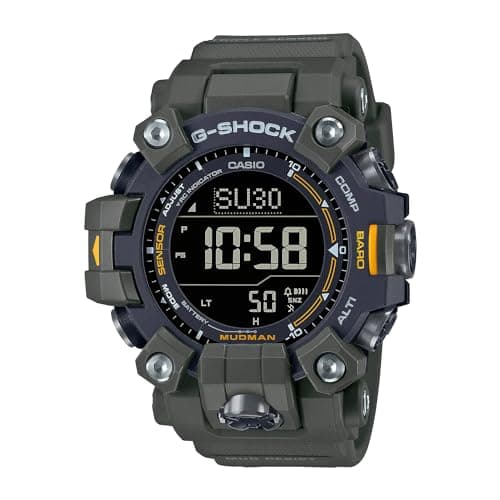 G-Shock Mudman GW-9500 Mud resistant as well as 200 m water resistant, Tough Solar with about six months of reserve in the dark, 81 g, carbon and bio-resin case. | Best for farm work overallSolar, no charger | 8.2 /10 | $347.00Amazon |
| 2 | 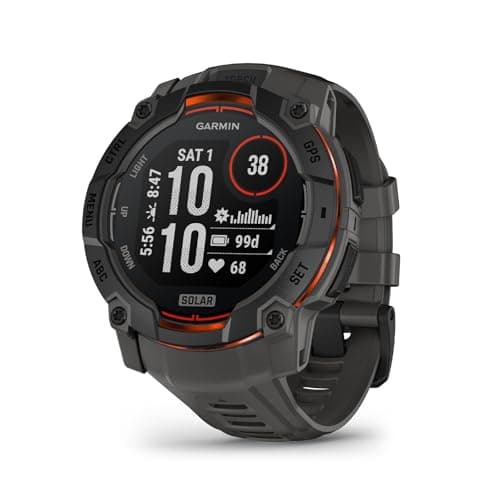 Garmin Instinct 3 Solar (50mm) Unlimited battery with solar, 10 ATM, built to MIL-STD-810, a flashlight, and GPS for marking gates, pumps and fence breaks. | Best if you need to find thingsSolar GPS | 8.7 /10 | $399.99Amazon |
| 3 | 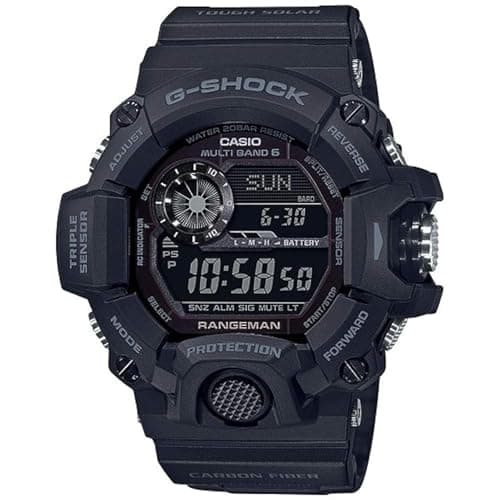 G-Shock Rangeman GW-9400 Barometer, altimeter, thermometer, sunrise and sunset, Multi-Band 6 radio time, and about eight months of solar reserve with no light. | Best for weather and sunsetSolar, no charger | 8.7 /10 | $320.00Amazon |
| 4 | 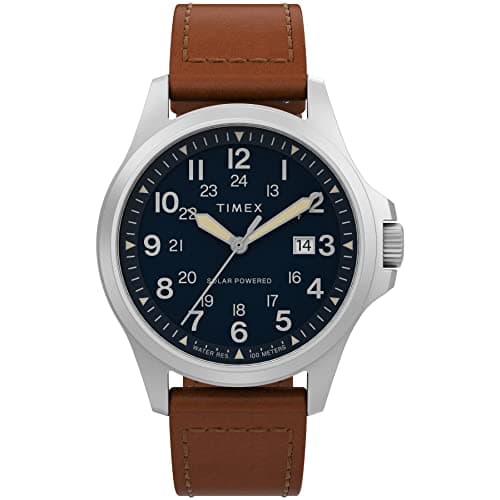 Timex Expedition North Field Post Solar (41mm) Sapphire on a 41 mm steel case with a screw-down crown and case back, 100 m, solar, and legible at a glance. | Best analog for a ranchSolar, no charger | 7.8 /10 | $151.90Amazon |
| 5 | 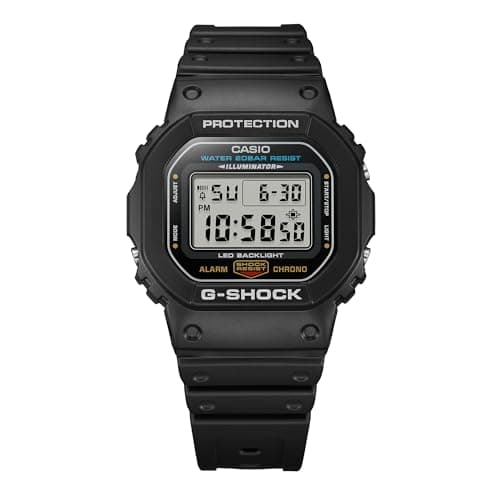 G-Shock DW-5600E 52 g, 200 m, shock resistant, and inexpensive enough that a crushed one is an inconvenience rather than a loss. | Best watch to not care aboutReplaceable cell | 7.7 /10 | $83.99Amazon |
#ad · Prices come live from Amazon, last checked November 4, 2026. Scores are ours, built from the makers' manuals, battery tables and spec pages. Product photos come from Amazon; anything still on a stock frame is labelled on its card. Tap a row for the full write-up.
The direct answer
Farm and ranch work is one of the few jobs that stresses a watch in every direction at once. There is grit, which kills buttons. There is water, because everything gets washed down. There is mechanical crushing, against gates, chutes, panels and tailgates. There are long days a long way from an outlet. And there are gloves on, which means you will be reading the watch from an arm's length with a thumb that cannot press a small button.
Two kinds of watch survive that: a mud-rated solar Casio, or a solar GPS watch with sealed construction. Everything else is a compromise you will discover in month four.
Mud resistance is a separate rating
This is the part that matters most and the part almost no roundup mentions. Water resistance does not imply dust or mud resistance. A 200-metre watch keeps water out of the case; it says nothing about grit working into the gap around a pusher until the button grinds and then sticks.
Casio treats it as its own claim and states it separately on three watches on this site: the Mudman GW-9500, the Mudmaster GWG-2000 and the Mudmaster GG-B100 are each specified as 200 metres water resistant, shock resistant and mud resistant. On those models the buttons are built with extra sealing specifically to keep particulates out of the mechanism. The Rangeman GW-9400 and the standard squares are 200 m and shock resistant without the mud claim.
If your day involves a hoof-deep corral, a feedlot or a wet silage pit, that single word on the spec sheet is the most valuable thing you can buy, and it is why the Mudman leads this page rather than a watch with a better feature list. The broader version of the rating question is in watch water resistance explained.
Why a charger is the wrong plan
Farm work is not an environment where charging happens on schedule. A watch that needs a cable every five days gets forgotten in a shop, left on a workbench, and eventually replaced by a phone in a pocket.
The solar picks here remove the problem entirely. Casio rates the Rangeman GW-9400 at roughly eight months from full charge with no light at all, and the Mudman GW-9500 at about six, under Casio's own stated usage conditions. In practice an outdoor job gives these watches more light than they will ever need, and they go their whole service life without meeting a charger.
The Instinct 3 Solar is the GPS exception that works for the same reason: Garmin states up to 40 days of typical use and unlimited smartwatch battery with three hours a day at 50,000 lux, which is a figure a person working outdoors actually hits. If charging routine is the thing you are worried about, the full argument is in are solar watches worth it and how to charge a solar watch.
The picks, side by side
| Evidence | G-Shock Mudman GW-9500 | Garmin Instinct 3 Solar (50mm) | G-Shock Rangeman GW-9400 | Timex Expedition North Field Post Solar (41mm) |
|---|---|---|---|---|
| Power | Solar panel and one rechargeable battery | Rechargeable, built-in lithium-ion battery with solar charging display | Solar panel and one rechargeable battery (Tough Solar) | Quartz analog movement, solar battery |
| Water rating | 200 meters; shock resistant; mud resistant | 10 ATM | 200 meters | Water resistant to 100 meters |
| Bezel & case | Carbon, resin and bio-based resin | Metal-reinforced bezel; fiber-reinforced polymer case | — | Stainless steel, brushed / beadblast finish; screw-down case back and crown |
| Weight | 81 g | — | 93 g | 80.09 g |
| Score | 8.2/10 | 8.7/10 | 8.7/10 | 7.8/10 |
The Mudman is the specialist: 56.7 by 52.7 by 14.8 mm, 81 grams, a carbon and bio-based resin case, mud resistance on top of 200 m, and the compass, altimeter, barometer and thermometer set with sunrise and sunset times. For livestock and machinery work there is nothing on the market that fits the job better.
The Rangeman GW-9400 is the pick if weather matters more than mud. The barometer and the trend graph are genuinely useful for haying and spraying decisions, and Multi-Band 6 radio calibration means the time is right without a phone. It is the bigger watch at 93 grams and 18.2 mm thick, and it does not carry the mud claim.
The Timex Expedition North Field Post Solar is here for anyone who wants an analog watch at work: sapphire, which is the hard lens explained in most scratch-resistant smartwatch, a 41 mm brushed steel case with a screw-down crown and case back, 100 m, and solar. It is the one pick here that looks right off the ranch as well as on it.
The DW-5600E is the rational floor: 52 grams, 200 m, shock resistant, and cheap enough that you will genuinely stop protecting it. That is worth more than it sounds, because a watch you are careful with is a watch you take off.
Gloves, legibility and buttons
Three practical details decide whether a watch is usable with work gloves on, and only one of them shows up in a spec table.
- Physical buttons, not a touchscreen. Every watch on this page has them. A touchscreen is useless in a wet leather glove, which is most of why the AMOLED outdoor watches are not here.
- A light you can trigger one-handed. Casio's EL backlight lights the whole dial; the Instinct 3 has a real LED flashlight with variable intensities and a red mode, which turns out to be the most used feature on the watch for anyone doing chores before dawn.
- Size that clears a cuff. The Mudman at 14.8 mm thick slides under a work glove and a jacket cuff. The Rangeman at 18.2 mm does not, quite, and you will notice it on a gate latch.
When GPS earns its place on a ranch
Most of the time it does not, and a page that pretended otherwise would be selling you something. For checking the time, timing a treatment and knowing when the light goes, a solar Casio is the better instrument and costs a fraction as much.
GPS earns its place when you have ground to keep track of. Marking a waypoint at a broken fence line, a dead ewe, a pump, a gate you left open or a stock tank that needs filling, and then navigating back to it in the dark, is a genuinely different capability. The Instinct 3 Solar does that at 10 ATM, built to MIL-STD-810, with a flashlight and a battery that does not run out, which is why it is ranked second rather than fifth.
The same watch covers the hunting season, which for a lot of ranch owners is the other half of the use case; the detail is in best GPS watch for hunting.
The decade pick
In detail
The picks, in full
Rank 1
Best for farm work overall
G-Shock Mudman GW-9500
Mud resistant as well as 200 m water resistant, Tough Solar with about six months of reserve in the dark, 81 g, carbon and bio-resin case.
EvidenceResearched · every row sourced
| Power class | Solar, no charger. A solar cell that recharges from any light and never meets a charger. The rechargeable cell is a watchmaker-replaceable part. |
|---|---|
| Battery (cell) | Approximately 6 months with no light (Casio's stated usage conditions) |
| Power | Solar panel and one rechargeable battery |
| Glass | Mineral |
| Bezel & case | Carbon, resin and bio-based resin |
| Water rating | 200 meters; shock resistant; mud resistant |
| Sensors | Digital compass, altimeter, barometer, thermometer; sunrise/sunset times |
| Weight | 81 g |
| Size | 56.7 × 52.7 × 14.8 mm |
How the 8.2 score breaks down
- Battery & power independence (25%)
- 9
- Durability of materials (25%)
- 7
- Serviceability & lifespan (20%)
- 9
- Field usability (15%)
- 7
- Value per decade (10%)
- 9
- Mission fit (5%)
- 9
What the spec sheet supports
- 3.4 mm thinner and 12 g lighter than the Rangeman GW-9400 by the published figures.
- Mud-resistant buttons and a carbon-reinforced case.
- Sunrise/sunset and a barometer graph for reading weather in a stand.
Where it falls short
- Six months of stated dark-running versus the Rangeman's eight.
- Mineral crystal.
Skip this if…
…you want the longest-proven G-Shock module; the Rangeman has a decade more history behind it.
#ad · Price as of November 4, 2026 · Disclosure for the link to G-Shock Mudman GW-9500
Rank 2
Best if you need to find things
Garmin Instinct 3 Solar (50mm)
Unlimited battery with solar, 10 ATM, built to MIL-STD-810, a flashlight, and GPS for marking gates, pumps and fence breaks.
EvidenceResearched · every row sourced
How the 8.7 score breaks down
- Battery & power independence (25%)
- 10
- Durability of materials (25%)
- 8
- Serviceability & lifespan (20%)
- 7
- Field usability (15%)
- 9
- Value per decade (10%)
- 10
- Mission fit (5%)
- 8
What the spec sheet supports
- Garmin's own table shows the 50mm solar model doubling the 45mm in GPS-with-solar hours (260 vs 130).
- Physical buttons, a monochrome display readable in full sun, and a flashlight with a red mode.
- 10 ATM rating and a MIL-STD 810 claim on a watch that costs less than half a fenix.
Where it falls short
- No maps: it navigates breadcrumb trails and waypoints, not topo maps.
- The solar figures assume three hours a day at 50,000 lux, which is midday sun, not a sleeve.
- Garmin does not name the lens material; treat it as strengthened glass, not sapphire.
Skip this if…
…you need on-wrist topo maps, or you wear long sleeves and work indoors, where the solar math never happens.
#ad · Price as of November 4, 2026 · Disclosure for the link to Garmin Instinct 3 Solar (50mm)
Rank 3
Best for weather and sunset
G-Shock Rangeman GW-9400
Barometer, altimeter, thermometer, sunrise and sunset, Multi-Band 6 radio time, and about eight months of solar reserve with no light.
EvidenceResearched · every row sourced
| Power class | Solar, no charger. A solar cell that recharges from any light and never meets a charger. The rechargeable cell is a watchmaker-replaceable part. |
|---|---|
| Battery (cell) | Approximately 8 months from full charge to Level 4 with no light (Casio's stated usage conditions) |
| Power | Solar panel and one rechargeable battery (Tough Solar) |
| Glass | Mineral crystal |
| Water rating | 200 meters |
| Sensors | Digital compass, barometer, altimeter, thermometer; sunrise/sunset; Multi-Band 6 time calibration (WWVB, DCF77, MSF, JJY, BPC) |
| Weight | 93 g |
| Size | 55.2 × 53.5 × 18.2 mm |
| Operating temp | Low-temperature resistance -10°C (14°F) |
How the 8.7 score breaks down
- Battery & power independence (25%)
- 10
- Durability of materials (25%)
- 7
- Serviceability & lifespan (20%)
- 10
- Field usability (15%)
- 7
- Value per decade (10%)
- 10
- Mission fit (5%)
- 8
What the spec sheet supports
- Solar and atomic: it sets itself from a radio signal and never sees a cable.
- A module that has been in production for over a decade; parts, straps and bezels are everywhere.
- Sunrise/sunset on the watch, the one hunting feature the Garmin Instinct does without a phone.
Where it falls short
- Mineral crystal, not sapphire; the Rangeman lives behind a raised bezel for a reason.
- No GPS, no maps, no heart rate. It tells you where north is, not where you are.
- Big and thick at 18.2 mm.
Skip this if…
…you want a track of where you walked; an ABC watch measures the world, it does not map it.
#ad · Price as of November 4, 2026 · Disclosure for the link to G-Shock Rangeman GW-9400
Rank 4
Best analog for a ranch
Timex Expedition North Field Post Solar (41mm)
Sapphire on a 41 mm steel case with a screw-down crown and case back, 100 m, solar, and legible at a glance.
EvidenceResearched · every row sourced
| Power class | Solar, no charger. A solar cell that recharges from any light and never meets a charger. The rechargeable cell is a watchmaker-replaceable part. |
|---|---|
| Battery (solar) | Lasts up to 4 months from a full charge |
| Power | Quartz analog movement, solar battery |
| Glass | Sapphire crystal |
| Bezel & case | Stainless steel, brushed / beadblast finish; screw-down case back and crown |
| Water rating | Water resistant to 100 meters |
| Weight | 80.09 g |
| Size | 41 mm diameter, 12 mm case height, 20 mm band |
| Warranty | One-year limited manufacturer's warranty |
How the 7.8 score breaks down
- Battery & power independence (25%)
- 9
- Durability of materials (25%)
- 8
- Serviceability & lifespan (20%)
- 6
- Field usability (15%)
- 7
- Value per decade (10%)
- 9
- Mission fit (5%)
- 7
What the spec sheet supports
- Sapphire on a watch at this price is rare, and it is the spec that decides how the watch looks in year eight.
- Solar with a four-month reserve: no charger, no battery appointment.
- 100 m and a screw-down crown, which the Marathon GPQ does not have.
Where it falls short
- A one-year warranty against Hamilton's two and Bertucci's three.
- Timex does not publish a service path for the solar cell the way Casio and Citizen do.
- No lume-heavy dial or tritium; it is painted luminous, so it fades over a night.
Skip this if…
…you want a movement any watchmaker can open and service for decades; a Hamilton H-10 or a Seiko 4R36 is the serviceable choice.
#ad · Price as of November 4, 2026 · Disclosure for the link to Timex Expedition North Field Post Solar (41mm)
Rank 5
Best watch to not care about
G-Shock DW-5600E
52 g, 200 m, shock resistant, and inexpensive enough that a crushed one is an inconvenience rather than a loss.
EvidenceResearched · every row sourced
| Power class | Replaceable cell. A replaceable coin cell measured in years. No charging, no electronics to update, and the cheapest thing on the watch to service. |
|---|---|
| Battery (cell) | CR2016, approx. 5 years |
| Glass | Mineral |
| Bezel & case | Resin case and band |
| Water rating | 200 meters; shock resistant |
| Weight | 52 g |
| Size | 48.9 × 42.8 × 13.4 mm |
How the 7.7 score breaks down
- Battery & power independence (25%)
- 8
- Durability of materials (25%)
- 6
- Serviceability & lifespan (20%)
- 10
- Field usability (15%)
- 6
- Value per decade (10%)
- 10
- Mission fit (5%)
- 6
What the spec sheet supports
- In production since 1987 with a module refresh in 2023; parts and straps will exist for the rest of your life.
- A five-year coin cell is the longest-stated battery on the site.
- Small enough for any wrist and any cuff.
Where it falls short
- Mineral crystal on a flat face with a low bezel; it scratches.
- No sensors, no solar, no radio time.
Skip this if…
…you want it to set itself; the GW-M5610U is the same square with solar and radio time.
#ad · Price as of November 4, 2026 · Disclosure for the link to G-Shock DW-5600E
How to choose a watch for farm work
1. Look for mud resistance stated separately. Not just water resistance. On this site that is the Mudman GW-9500 and the two Mudmasters, and it is the single most relevant claim for livestock and machinery work.
2. Rule out anything with a charging cable, unless it has a solar lens. A charging routine does not survive a harvest.
3. Insist on physical buttons. Gloves, water and grit make touchscreens useless.
4. Keep it under about 15 mm thick. Thickness, not diameter, is what catches on gloves, gates and cuffs.
5. Buy resin or a washable strap. And buy the spare band at the same time, while the model is current.
6. Decide honestly whether you need GPS. If you are marking and returning to places on a large property, it is worth the money. If not, the solar Casio is the better instrument.
How we scored this
What we checked to build this ranking
Every pick here is researched against the documents that decide whether a watch lasts: the maker's own battery table read mode by mode, what the lens and case are actually made of, the water rating, whether a MIL-STD-810 line is on the record and in whose words, and how long the maker keeps updating the line. Each one is then scored on a public rubric weighted for a decade of ownership, and every figure links to where it came from.
That is why the order on this page is worth following: it is built from specs you can open yourself, and commissions never set a score or decide a pick. The rubric and its weights are published.
Questions
Frequently asked
What is the best watch for farm work?
The G-Shock Mudman GW-9500. Casio rates it mud resistant as well as 200 m water resistant and shock resistant, it runs on Tough Solar with roughly six months of reserve in the dark, and at 81 grams and 14.8 mm thick it clears a work glove. The Garmin Instinct 3 Solar is the pick if you also want GPS.
Is a G-Shock good for ranch work?
It is the standard answer for good reasons: 200-metre water resistance, shock resistance, resin that absorbs impact rather than denting, physical buttons that work in gloves, and solar models that never need a charger. Choose a Mud-series model if your work involves deep mud or manure, because that adds sealed buttons.
Do I need a mud-resistant watch?
If grit regularly packs around the buttons, yes. Water resistance seals the case but does not stop particulates working into a pusher until it sticks. Casio states mud resistance separately on the Mudman GW-9500, Mudmaster GWG-2000 and Mudmaster GG-B100.
Is a GPS watch worth it on a farm?
Only if you need to mark and find locations on the ground, such as fence breaks, pumps, tanks or gates. For telling the time, timing treatments and tracking sunset, a solar Casio does the job better and for a fraction of the price. The Instinct 3 Solar is the GPS watch that works here because it does not need charging.
Can you wash down a watch while wearing it?
Every pick on this page is rated to at least 100 metres, and the Casios are 200 metres, so a hose or a pressure wash from a sensible distance is within spec. Rinse grit off the buttons with fresh water afterwards rather than leaving it to dry in the gaps, and never press buttons while the watch is submerged.
Keep reading
Related on Bezel & Bearing
Receipts
Sources
- Casio — Operation Guide, module 3553 (GW-9500 Mudman), Specifications (checked 2026-09-20)
- G-Central — G-Shock GW-9500 Mudman spec sheet (checked 2026-09-20)
- Casio — Operation Guide, module 3410 (GW-9400 Rangeman), Specifications (checked 2026-09-20)
- G-Central — G-Shock GWG-2000 Mudmaster spec sheet (checked 2026-09-20)
- G-Central — G-Shock DW-5600 spec sheet (checked 2026-09-20)
- Garmin newsroom — Instinct 3 Series press release (checked 2026-09-20)
- Garmin — Instinct 3 Solar Series Owner's Manual, Battery Life Information (checked 2026-09-20)
- Timex — Expedition Field Post Solar 41mm, specifications (checked 2026-09-26)
Battery, glass, case and water figures come from the maker's own owner's manuals, spec pages and press releases, linked on every product so you can open the page they came from. Prices are set by Amazon and change often, so each buy button takes you to the current one. Read the full method.