Tactical / The rankings
The best watches for firefighters: what survives the shift, and the one thing none of them survives
Nothing on this page is rated for the inside of a structure fire, and no maker claims it is. What you can buy is a watch that takes the other ninety-nine percent of the job, the hose, the grit, the cold, the 48-hour tour, and still reads at 3 a.m. ten years from now.
By Mike M.Updated Researched from the maker's manuals and spec sheets
#adReader-supported: we may earn a commission if you buy through our links, at no extra cost to you. It never decides a ranking. How we rate · Disclosure
Quick picks
The rankings at a glance
| # | Product | Best for | Score | Price |
|---|---|---|---|---|
| 1 | 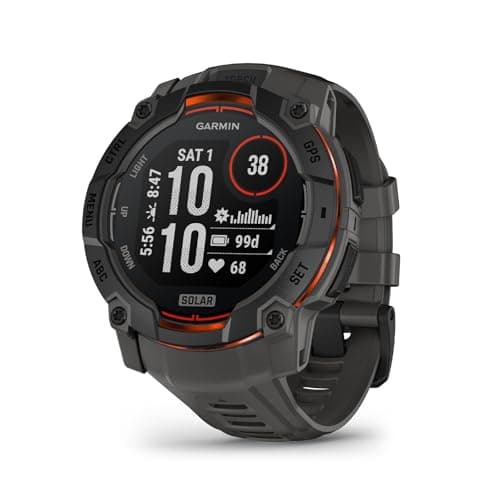 Garmin Instinct 3 Solar (50mm) Built to MIL-STD-810, 10 ATM, a flashlight with a red mode for a dark apparatus bay, and a solar lens that means the watch is never dead at shift change. | Best overall for a firefighterSolar GPS | 8.7 /10 | $399.99Amazon |
| 2 | 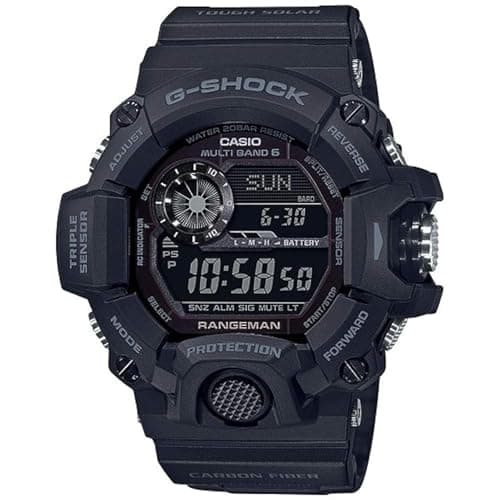 G-Shock Rangeman GW-9400 Tough Solar, Multi-Band 6, 200 m, a thermometer and an altimeter, and about eight months of running in the dark. Nothing to plug in across a whole career. | Best with no charger, everSolar, no charger | 8.7 /10 | $320.00Amazon |
| 3 | 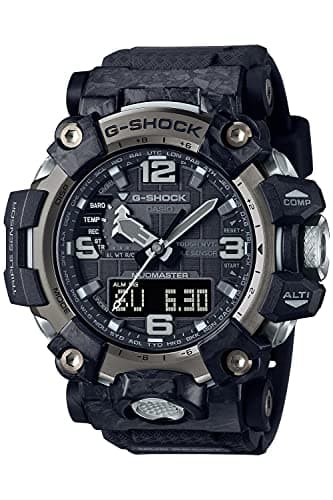 G-Shock Mudmaster GWG-2000 The only sapphire G-Shock, with mud-sealed buttons and a forged carbon bezel: the one to buy if your watch meets grit and gets struck. | Toughest build on the pageSolar, no charger | 8.7 /10 | $699.00Amazon |
| 4 |  Amazfit T-Rex 3 A published low-temperature mode down to -30 C and up to 180 hours of GNSS, which is a fire-line battery figure rather than a city-shift one. | Best for a cold wildland seasonRechargeable GPS | 7.0 /10 | Check price · Amazon |
| 5 | 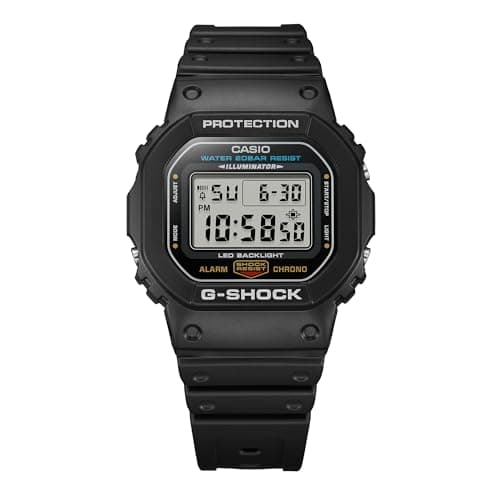 G-Shock DW-5600E 52 g, 200 m, a five-year cell and a price that makes a destroyed watch an annoyance instead of a loss. | Best station beaterReplaceable cell | 7.7 /10 | $83.99Amazon |
#ad · Prices come live from Amazon, last checked November 4, 2026. Scores are ours, built from the makers' manuals, battery tables and spec pages. Product photos come from Amazon; anything still on a stock frame is labelled on its card. Tap a row for the full write-up.
What the job does to a watch
Firefighting is not one environment, it is four, and they break watches in different ways. The fireground is heat, impact and water under pressure. Overhaul is grit and solvents. EMS is hand sanitizer, pathogen wipes and twelve hours of hand washing. The station is 48 hours of sleep interrupted by an alarm you need to read instantly in the dark. A watch that handles three of those and fails the fourth is a watch you replace.
Which is why this page ranks the way the rest of the site does: on the power system first, because a dead watch is a useless watch and a charging cable is one more thing to forget; then on materials, because the strap and the lens are what actually fail; then on whether you can read and operate it with a structural glove on. Nothing here is scored on step counts.
The heat problem nobody publishes
Here is the honest part. No maker on this page publishes a survival temperature for the inside of a working structure fire, because no consumer watch is built for one. What they publish is an operating range, and those ranges tell you plenty:
- Garmin Instinct 3 Solar: -20 to 60 C (-4 to 140 F), with the MIL-STD-810 line covering thermal and shock resistance.
- Casio Rangeman GW-9400: low-temperature resistance to -10 C (14 F). Casio publishes the cold number, not a hot one.
- Amazfit T-Rex 3: a low-temperature mode rated to -30 C, with its own stated GNSS figures.
Sixty degrees Celsius is 140 F. That is a truck cab in August, a hot attic, a parking lot in Phoenix, not a flashover. Under turnout gear your watch lives in a comparatively protected pocket of air, which is the real reason resin G-Shocks have survived on firefighters' wrists for forty years. Treat any watch worn into a structure as a consumable, keep the expensive one for the other 95% of the job, and do not buy a story about a watch that handles fire. Nobody prints that spec because nobody will stand behind it.
Why these five, in this order
The Instinct 3 Solar wins because it removes the most decisions. Garmin's battery table gives up to 40 days of typical use and calls it unlimited with three hours a day at 50,000 lux, which in plain terms means a watch worn outdoors on even some of your shifts does not need charging on any schedule you have to remember. Add the built-in flashlight with a red mode, genuinely useful in a dark bay or a patient compartment where you do not want to wreck your night vision, plus the metal-reinforced bezel, 10 ATM and the MIL-STD-810 line, and it is the most job-shaped watch Garmin makes at this price. The full read is the Instinct 3 Solar review.
The Rangeman GW-9400 is second only because it has no GPS, and first if you do not want any. It is Tough Solar, so Casio states roughly eight months of running from a full charge with no light at all; it sets itself from a radio time signal on Multi-Band 6, which matters when your report times have to be right; it is 200 m water resistant; and it carries a thermometer, barometer, altimeter and compass in a 93 g case. Across ten years you will replace a strap and nothing else. Our full write-up is the Rangeman GW-9400 review.
The Mudmaster GWG-2000 is the build upgrade: sapphire with an anti-glare coating, a forged carbon and stainless bezel on a Carbon Core Guard case, mud resistance, 200 m and the same six-month-in-the-dark Tough Solar module. It is 106 g and 61.2 mm across, which is a lot of watch under a cuff. That is the trade.
Wildland is a different watch
A wildland assignment inverts the priorities. Heat stops being a two-minute spike and becomes an ambient, all-day condition; you are off-grid for days; and nobody is handing you an outlet. That makes battery endurance and cold tolerance the whole specification, because fire season in the mountains means 90 F afternoons and freezing mornings in the same 24 hours.
The T-Rex 3 is the value answer: Amazfit publishes up to 27 days of typical use, up to 180 hours of GNSS in its maximum battery-life mode, 10 ATM tested to ISO 22810 by SGS, and a low-temperature mode rated to -30 C with its own stated battery figures. The Instinct 3 Solar is the better answer if you will keep it a decade, because the days you spend outside are the days it charges. Either way, read longest battery life GPS watches before you spend more.
EMS and paramedic shifts
If most of your calls are medical, the fireground specification is overkill and the thing that kills watches is chemistry: alcohol gel, quaternary wipes, and twenty hand washes a shift. Resin and polymer shrug that off; leather and most plated finishes do not. A second, quieter consideration is the one every medic raises: a 50 mm case with a raised bezel snags on a sleeve while you are taking a pulse.
That is where the DW-5600E earns its slot. It is 42.8 mm wide, 13.4 mm thick and 52 g, 200 m water resistant, with a CR2016 Casio rates at about five years, and it is cheap enough that a destroyed watch is a shrug. If you want the same case with solar and radio time, the GW-M5610U is the step up, and the tiers are laid out in best G-Shock under $200.
Gloves, cuffs and reading it at 3 a.m.
Three practical things decide whether a watch survives on a firefighter rather than in a drawer. First, button size: every Casio here can be operated with a structural glove on, because the pushers are large and proud of the case. Second, display technology: the Instinct's MIP display and every Casio LCD stay readable in direct sun and cost almost nothing to keep lit, which is why the AMOLED T-Rex 3 ranks below both for shift work. Third, case height: a 19 mm-thick watch catches on a turnout sleeve every time you reach, and the 11.8 mm GA-2100 is the thin alternative if that is the problem you are solving. See best G-Shock for work.
The decade pick
In detail
The picks, in full
Rank 1
Best overall for a firefighter
Garmin Instinct 3 Solar (50mm)
Built to MIL-STD-810, 10 ATM, a flashlight with a red mode for a dark apparatus bay, and a solar lens that means the watch is never dead at shift change.
EvidenceResearched · every row sourced
How the 8.7 score breaks down
- Battery & power independence (25%)
- 10
- Durability of materials (25%)
- 8
- Serviceability & lifespan (20%)
- 7
- Field usability (15%)
- 9
- Value per decade (10%)
- 10
- Mission fit (5%)
- 8
What the spec sheet supports
- Garmin's own table shows the 50mm solar model doubling the 45mm in GPS-with-solar hours (260 vs 130).
- Physical buttons, a monochrome display readable in full sun, and a flashlight with a red mode.
- 10 ATM rating and a MIL-STD 810 claim on a watch that costs less than half a fenix.
Where it falls short
- No maps: it navigates breadcrumb trails and waypoints, not topo maps.
- The solar figures assume three hours a day at 50,000 lux, which is midday sun, not a sleeve.
- Garmin does not name the lens material; treat it as strengthened glass, not sapphire.
Skip this if…
…you need on-wrist topo maps, or you wear long sleeves and work indoors, where the solar math never happens.
#ad · Price as of November 4, 2026 · Disclosure for the link to Garmin Instinct 3 Solar (50mm)
Rank 2
Best with no charger, ever
G-Shock Rangeman GW-9400
Tough Solar, Multi-Band 6, 200 m, a thermometer and an altimeter, and about eight months of running in the dark. Nothing to plug in across a whole career.
EvidenceResearched · every row sourced
| Power class | Solar, no charger. A solar cell that recharges from any light and never meets a charger. The rechargeable cell is a watchmaker-replaceable part. |
|---|---|
| Battery (cell) | Approximately 8 months from full charge to Level 4 with no light (Casio's stated usage conditions) |
| Power | Solar panel and one rechargeable battery (Tough Solar) |
| Glass | Mineral crystal |
| Water rating | 200 meters |
| Sensors | Digital compass, barometer, altimeter, thermometer; sunrise/sunset; Multi-Band 6 time calibration (WWVB, DCF77, MSF, JJY, BPC) |
| Weight | 93 g |
| Size | 55.2 × 53.5 × 18.2 mm |
| Operating temp | Low-temperature resistance -10°C (14°F) |
How the 8.7 score breaks down
- Battery & power independence (25%)
- 10
- Durability of materials (25%)
- 7
- Serviceability & lifespan (20%)
- 10
- Field usability (15%)
- 7
- Value per decade (10%)
- 10
- Mission fit (5%)
- 8
What the spec sheet supports
- Solar and atomic: it sets itself from a radio signal and never sees a cable.
- A module that has been in production for over a decade; parts, straps and bezels are everywhere.
- Sunrise/sunset on the watch, the one hunting feature the Garmin Instinct does without a phone.
Where it falls short
- Mineral crystal, not sapphire; the Rangeman lives behind a raised bezel for a reason.
- No GPS, no maps, no heart rate. It tells you where north is, not where you are.
- Big and thick at 18.2 mm.
Skip this if…
…you want a track of where you walked; an ABC watch measures the world, it does not map it.
#ad · Price as of November 4, 2026 · Disclosure for the link to G-Shock Rangeman GW-9400
Rank 3
Toughest build on the page
G-Shock Mudmaster GWG-2000
The only sapphire G-Shock, with mud-sealed buttons and a forged carbon bezel: the one to buy if your watch meets grit and gets struck.
EvidenceResearched · every row sourced
| Power class | Solar, no charger. A solar cell that recharges from any light and never meets a charger. The rechargeable cell is a watchmaker-replaceable part. |
|---|---|
| Battery (cell) | Approximately 6 months with no light (Casio's stated usage conditions) |
| Power | Solar panel and one rechargeable battery |
| Glass | Sapphire with anti-glare coating |
| Bezel & case | Carbon Core Guard case; forged carbon, resin and stainless steel bezel |
| Water rating | 200 meters; shock resistant; mud resistant |
| Sensors | Digital compass, altimeter, barometer, thermometer; radio time calibration (JJY, WWVB, MSF, DCF77, BPC) |
| Weight | 106 g |
| Size | 61.2 × 54.4 × 16.1 mm |
How the 8.7 score breaks down
- Battery & power independence (25%)
- 9
- Durability of materials (25%)
- 10
- Serviceability & lifespan (20%)
- 9
- Field usability (15%)
- 7
- Value per decade (10%)
- 7
- Mission fit (5%)
- 8
What the spec sheet supports
- Sapphire on a G-Shock: the glass that stops the usual first failure.
- Forged carbon bezel and a carbon monocoque case.
- Solar and atomic like the Rangeman.
Where it falls short
- At 106 g and 61 mm wide it is the heaviest watch on this site.
- Analog-digital display: harder to read at a glance than a pure digital.
Skip this if…
…you have a small wrist or wear a cuff over your watch.
#ad · Price as of November 4, 2026 · Disclosure for the link to G-Shock Mudmaster GWG-2000
Rank 4
Stock photoBest for a cold wildland season
Amazfit T-Rex 3
A published low-temperature mode down to -30 C and up to 180 hours of GNSS, which is a fire-line battery figure rather than a city-shift one.
EvidenceResearched · every row sourced
| Power class | Rechargeable GPS. A rechargeable lithium cell charged from a cable. Days to a few weeks per charge; the cell ages with every cycle. |
|---|---|
| Battery (smartwatch) | Up to 27 days typical use; 13 days heavy use; 40 days battery saver; 81 days clock mode |
| Battery (GPS) | Up to 42 hours accurate GNSS; 72 hours power-saving GNSS; 114 hours long battery life mode |
| Battery (max GPS) | Up to 180 hours GNSS max battery life |
| Glass | Gorilla Glass touchscreen |
| Bezel & case | Stainless steel bezel; polymer middle frame |
| Water rating | 10 ATM (ISO 22810, third-party tested by SGS); freediving certification to 45 m (EN13319, ISO 6425) |
| Display | 1.5-inch AMOLED, 480 × 480 |
| Maps & GPS | Free offline maps with topographic contours; dual-band GPS, six satellite systems |
| Weight | 68.3 g without strap |
| Size | 48.5 × 48.5 × 13.75 mm |
| Operating temp | Low temperature mode to -30°C (GNSS on: up to 28 hours; GNSS off: up to 32 days) |
How the 7.0 score breaks down
- Battery & power independence (25%)
- 7
- Durability of materials (25%)
- 7
- Serviceability & lifespan (20%)
- 5
- Field usability (15%)
- 8
- Value per decade (10%)
- 9
- Mission fit (5%)
- 7
What the spec sheet supports
- Amazfit publishes its water-resistance test report number, which few makers do.
- 180 GPS hours in max-battery mode and a stated -30°C low-temperature mode.
- Free offline topo maps at a price where Garmin gives you breadcrumbs.
Where it falls short
- Amazfit says 'military-grade' but does not cite MIL-STD-810 on the page we read, so we do not credit it.
- Gorilla Glass, not sapphire, and a shorter firmware history than Garmin or COROS.
- Offline maps need a route file for navigation; you cannot tap a point on the map.
Skip this if…
…you plan to own it for a decade; Amazfit's update record is too short to promise that yet.
#ad · Price as of November 4, 2026 · Disclosure for the link to Amazfit T-Rex 3
Rank 5
Best station beater
G-Shock DW-5600E
52 g, 200 m, a five-year cell and a price that makes a destroyed watch an annoyance instead of a loss.
EvidenceResearched · every row sourced
| Power class | Replaceable cell. A replaceable coin cell measured in years. No charging, no electronics to update, and the cheapest thing on the watch to service. |
|---|---|
| Battery (cell) | CR2016, approx. 5 years |
| Glass | Mineral |
| Bezel & case | Resin case and band |
| Water rating | 200 meters; shock resistant |
| Weight | 52 g |
| Size | 48.9 × 42.8 × 13.4 mm |
How the 7.7 score breaks down
- Battery & power independence (25%)
- 8
- Durability of materials (25%)
- 6
- Serviceability & lifespan (20%)
- 10
- Field usability (15%)
- 6
- Value per decade (10%)
- 10
- Mission fit (5%)
- 6
What the spec sheet supports
- In production since 1987 with a module refresh in 2023; parts and straps will exist for the rest of your life.
- A five-year coin cell is the longest-stated battery on the site.
- Small enough for any wrist and any cuff.
Where it falls short
- Mineral crystal on a flat face with a low bezel; it scratches.
- No sensors, no solar, no radio time.
Skip this if…
…you want it to set itself; the GW-M5610U is the same square with solar and radio time.
#ad · Price as of November 4, 2026 · Disclosure for the link to G-Shock DW-5600E
How to buy a watch for the fire service
1. Rank the power system first. Solar or Tough Solar means the watch is never dead when the tones drop, and it is the only feature on this page that pays off every single shift for ten years.
2. Treat anything worn inside as consumable. No maker publishes a structure-fire rating. Buy the cheap watch for that and keep the good one for everything else.
3. Buy 200 m or 10 ATM, not "water resistant". A hose line is pressurized water, and pressure is exactly what a low rating does not cover. The ratings are explained in watch water resistance explained.
4. Check case height against your cuff. 11 to 14 mm disappears under a sleeve; 19 to 20 mm catches. Casio and Garmin both publish the number.
5. Budget a spare strap on day one. On every watch here the strap fails first, and it is the cheapest part of the watch.
6. Mud-sealed buttons are worth real money if your watch meets grit. That is the Master of G feature, on the Rangeman, Mudman and Mudmaster, and it is why those three dominate trade lists.
The closest sibling list. Search and rescue shares the light discipline and glove requirements but adds satellite messaging and multi-day battery, which changes the ranking: best watch for search and rescue.
How we scored this
What we checked to build this ranking
Every pick here is researched against the documents that decide whether a watch lasts: the maker's own battery table read mode by mode, what the lens and case are actually made of, the water rating, whether a MIL-STD-810 line is on the record and in whose words, and how long the maker keeps updating the line. Each one is then scored on a public rubric weighted for a decade of ownership, and every figure links to where it came from.
That is why the order on this page is worth following: it is built from specs you can open yourself, and commissions never set a score or decide a pick. The rubric and its weights are published.
Questions
Frequently asked
What is the best watch for a firefighter?
The Garmin Instinct 3 Solar (50mm) for most people: Garmin states it is built to MIL-STD-810 for thermal and shock resistance, rates it to 10 ATM and an operating range of -20 to 60 C, and gives up to 40 days of smartwatch battery, unlimited with three hours a day of sun. If you never want to own a charging cable, buy the G-Shock Rangeman GW-9400 instead.
Can you wear a watch into a structure fire?
No watch on this page is rated for it, and no maker claims it is. The published operating ranges top out around 60 C (140 F), which is a hot attic rather than a fire room. Under turnout gear a watch is partly shielded, which is why resin G-Shocks have lasted on firefighters for decades, but treat any watch worn inside as a consumable and keep the expensive one for the rest of the job.
Is a G-Shock or a Garmin better for firefighting?
A G-Shock if you want one watch for a career with no charger and no screen to break: the Rangeman GW-9400 is Tough Solar, 200 m, radio-set and carries a thermometer. A Garmin if you want navigation, a flashlight with a red mode, and a solar lens that still means weeks between charges. The direct comparison is G-Shock vs Garmin Instinct.
What watch is best for wildland firefighters?
Battery endurance and cold tolerance decide it. The Amazfit T-Rex 3 publishes up to 180 hours of GNSS in its maximum battery-life mode and a low-temperature mode to -30 C, which is the cheapest way to get fire-line endurance. The Garmin Instinct 3 Solar is the better ten-year buy because the days you spend outside are the days it charges.
Do firefighters need a watch with a compass and altimeter?
Not for structural work. They matter on wildland assignments and in search operations, and both the Rangeman GW-9400 and the Mudmaster GWG-2000 carry a compass, barometer, altimeter and thermometer with no GPS and no charging. What an ABC watch does and does not do is in ABC watch explained.
Keep reading
Related on Bezel & Bearing
Receipts
Sources
- Garmin newsroom — Instinct 3 Series press release (checked 2026-09-20)
- Garmin — Instinct 3 Solar Series Owner's Manual, Battery Life Information (checked 2026-09-20)
- Garmin — Instinct 3 Solar Series Owner's Manual, Specifications (checked 2026-09-20)
- Casio — Operation Guide, module 3410 (GW-9400 Rangeman), Specifications (checked 2026-09-20)
- Pilot Mall — Casio G-Shock Rangeman GW9400-1 listing (case size, weight, water rating) (checked 2026-09-20)
- Casio — Operation Guide, module 5678 (GWG-2000 Mudmaster), Specifications (checked 2026-09-20)
- G-Central — G-Shock GWG-2000 Mudmaster spec sheet (checked 2026-09-20)
- G-Central — G-Shock DW-5600 spec sheet (checked 2026-09-20)
- Amazfit — T-Rex 3 product page, Technical Specifications (checked 2026-09-20)
Battery, glass, case and water figures come from the maker's own owner's manuals, spec pages and press releases, linked on every product so you can open the page they came from. Prices are set by Amazon and change often, so each buy button takes you to the current one. Read the full method.