Built to Last / The rankings
The most durable fitness tracker is not a fitness tracker: it is a rugged watch that happens to count
Every wristband sold as a fitness tracker shares two problems: a glued-in cell measured in days and a case nobody rates. Swap categories and you can have heart rate, steps and training data inside a 200 m case that runs for weeks.
By Mike M.Updated Researched from the maker's manuals and spec sheets
#adReader-supported: we may earn a commission if you buy through our links, at no extra cost to you. It never decides a ranking. How we rate · Disclosure
Quick picks
The rankings at a glance
| # | Product | Best for | Score | Price |
|---|---|---|---|---|
| 1 | 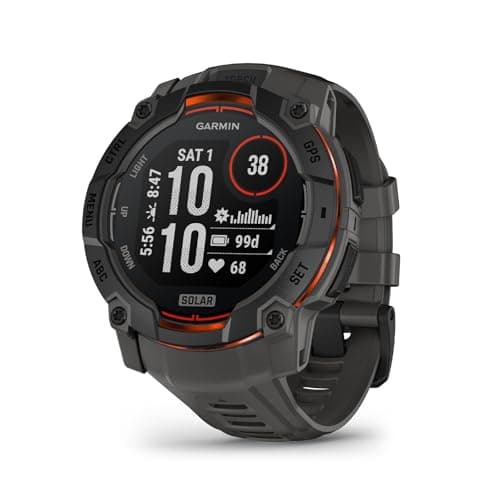 Garmin Instinct 3 Solar (50mm) Wrist heart rate and full training data inside a 10 ATM case built to MIL-STD-810, with up to 40 days of battery and an unlimited-with-solar claim. | Most durable tracker overallSolar GPS | 8.7 /10 | $399.99Amazon |
| 2 | 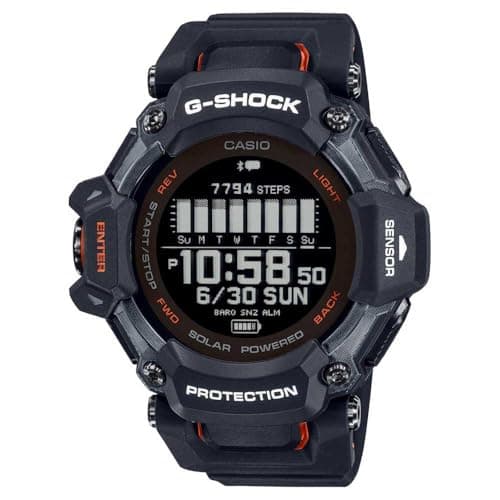 G-Shock GBD-H2000 200 m and shock resistant with GPS, wrist heart rate, compass, altimeter, barometer and thermometer, on solar-assisted charging rather than a nightly cable. | Toughest case with heart rateSolar GPS | 6.8 /10 | $450.00Amazon |
| 3 |  Amazfit T-Rex 3 10 ATM tested to ISO 22810 by SGS plus freediving certification to 45 m, a 1.5-inch AMOLED and up to 27 days of typical use. | Best tracker valueRechargeable GPS | 7.0 /10 | Check price · Amazon |
| 4 | 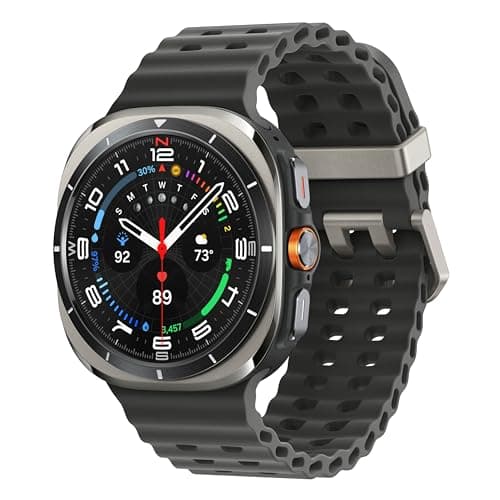 Samsung Galaxy Watch Ultra (2025, 47mm) Grade 4 titanium, sapphire, 10 ATM, IP68 and MIL-STD-810H, with up to 60 hours of normal use and dual-frequency GPS. | Most durable Wear OS trackerRechargeable GPS | 5.7 /10 | $489.99Amazon |
| 5 | 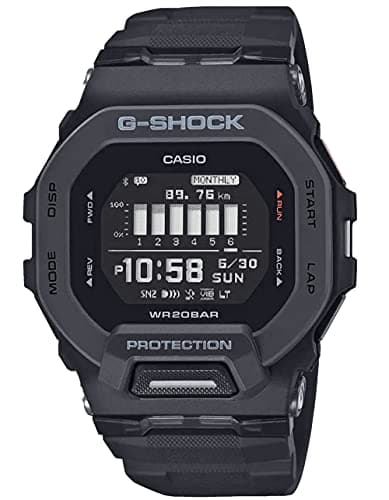 G-Shock GBD-200 Steps, pace, distance, intervals and vibration alerts on a CR2032 Casio rates at about two years, inside a 200 m shock-resistant 58 g case. | Cheapest durable trackerReplaceable cell | 7.5 /10 | $129.90Amazon |
#ad · Prices come live from Amazon, last checked November 4, 2026. Scores are ours, built from the makers' manuals, battery tables and spec pages. Product photos come from Amazon; anything still on a stock frame is labelled on its card. Tap a row for the full write-up.
Why bands do not survive
A fitness band is a sealed plastic shell around a small lithium cell and a screen. Three things follow from that, and all three are the reason this page recommends watches instead.
The cell is the clock. A band charges every three to seven days, which is a hundred or more charge cycles a year. Lithium cells age by cycle, and in a band the cell is glued in, so when it stops holding a day the product is finished. Nothing else about it has failed.
Nobody publishes a rating. The honest test of a durability claim is whether a maker will put a number against it: a pressure rating, a standard, a lens material. Most bands offer "water resistant" and a swim icon. Every watch on this page publishes at least 10 ATM, and three of them publish a military test standard in the maker's own words.
The screen is the whole front. A band is a display with a strap. A rugged watch puts a smaller lens behind a raised bezel, which is the oldest and best trick in watch durability and is why mineral-crystal G-Shocks survive decades. We cover the mechanism in sapphire vs Gorilla Glass.
The bar a durable tracker has to clear
To appear on this page a watch has to do the tracking and publish the durability. Specifically:
- Real fitness data from the wrist: heart rate, or at minimum step, pace and distance tracking with training structure like intervals and auto pause.
- A published water rating of at least 10 ATM or 200 m. Sweat and showers are trivial; the rating is a proxy for how seriously the case is sealed.
- A power system measured in weeks, not days, or a named standard that justifies the compromise.
- A lens and bezel the maker will describe. If a maker will not name the materials, we do not credit them.
Why these five, in this order
The Instinct 3 Solar wins because it is the only watch here that is both fully instrumented and genuinely free of a charging schedule. Garmin's table gives up to 40 days of typical use and calls it unlimited with three hours a day at 50,000 lux, so the cell inside cycles a handful of times a year rather than a hundred. Add 10 ATM, the MIL-STD-810 line, an altimeter, barometer and compass, the sunrise and sunset glance, and a flashlight with a red mode, and the tracking is almost a side effect of a very good outdoor watch.
The GBD-H2000 is second and first on case toughness. It is a real G-Shock: 200 m water resistance, shock resistance, a resin and bio-based resin case, and a high-contrast MIP LCD. Inside it there is GPS, wrist heart rate from 30 to 220 bpm, a digital compass, a pressure sensor for altimeter and barometer, a thermometer, an accelerometer and a gyroscope. Casio states two months in watch mode with monitoring disabled, 14 days with heart rate and sleep tracking worn overnight, and solar-assisted charging alongside the USB cable, which is the closest thing to a no-cable tracker on the market. GPS running time is 14 hours at high accuracy, up to 19 in its long-battery mode, so this is a training watch rather than an ultra watch.
The T-Rex 3 is third on value. It publishes the best-documented water resistance here, a bright 1.5-inch AMOLED, free offline maps with topographic contours and up to 27 days of typical use. The reasons it is not higher are stated on its own card: Gorilla Glass rather than sapphire, no MIL-STD-810 citation on the page we read, and a shorter firmware history than Garmin or Casio. The head-to-head is Amazfit T-Rex 3 vs Garmin.
The Samsung Galaxy Watch Ultra is the most durable thing in the Wear OS world, and Samsung publishes all of it: Grade 4 titanium, a sapphire crystal, 10 ATM and IP68, MIL-STD-810H, an operating range of -20 to 55 C and a 9,000 m altitude rating, with dual-frequency L1 and L5 GPS. It is fifth on this page for the obvious reason: up to 60 hours of normal use with the display always on, or 100 in power saving. That is a watch you charge every second or third day, which is the pattern this site exists to argue against. It is ranked for Android users in best rugged smartwatch for Android.
The no-charger options
If the real complaint behind "most durable fitness tracker" is that you are tired of charging a band, there is a category almost nobody suggests: a tracker on a coin cell.
The GBD-200 does step counting, accelerometer-based pace and distance, auto pause, interval timers, target alerts and vibration alerts, syncing by Bluetooth to Casio's app, on a CR2032 that Casio rates at about two years. The case is 200 m water resistant and shock resistant and weighs 58 g. There is no heart rate and the distance comes from your steps rather than satellites, so it needs calibration and drifts on hills. For a lot of people that is the honest trade: no charging at all, for two years at a time, in a case that outlives three bands.
If you want the data but not the screen management, the GBD-H2000 with solar assistance is the middle ground, and the whole Casio training line is compared in best G-Shock for running.
What we will not claim about accuracy
This page ranks durability, not measurement quality. We have not tested a single heart-rate sensor against a chest strap, and we are not going to tell you which optical sensor is most accurate, because we have no evidence to offer and nobody should take that claim from a web page without data behind it.
What we can say from published specifications: Casio states a heart-rate range of 30 to 220 bpm on the GBD-H2000; Samsung and Amazfit state dual-frequency GNSS, which materially helps position accuracy under tree cover and between buildings; and Garmin's multi-band GPS with SatIQ does the same thing with a battery-management layer on top. Why that matters for distance is explained in GPS watch accuracy explained, and our evidence rules are on how we rate.
The decade pick
In detail
The picks, in full
Rank 1
Most durable tracker overall
Garmin Instinct 3 Solar (50mm)
Wrist heart rate and full training data inside a 10 ATM case built to MIL-STD-810, with up to 40 days of battery and an unlimited-with-solar claim.
EvidenceResearched · every row sourced
How the 8.7 score breaks down
- Battery & power independence (25%)
- 10
- Durability of materials (25%)
- 8
- Serviceability & lifespan (20%)
- 7
- Field usability (15%)
- 9
- Value per decade (10%)
- 10
- Mission fit (5%)
- 8
What the spec sheet supports
- Garmin's own table shows the 50mm solar model doubling the 45mm in GPS-with-solar hours (260 vs 130).
- Physical buttons, a monochrome display readable in full sun, and a flashlight with a red mode.
- 10 ATM rating and a MIL-STD 810 claim on a watch that costs less than half a fenix.
Where it falls short
- No maps: it navigates breadcrumb trails and waypoints, not topo maps.
- The solar figures assume three hours a day at 50,000 lux, which is midday sun, not a sleeve.
- Garmin does not name the lens material; treat it as strengthened glass, not sapphire.
Skip this if…
…you need on-wrist topo maps, or you wear long sleeves and work indoors, where the solar math never happens.
#ad · Price as of November 4, 2026 · Disclosure for the link to Garmin Instinct 3 Solar (50mm)
Rank 2
Toughest case with heart rate
G-Shock GBD-H2000
200 m and shock resistant with GPS, wrist heart rate, compass, altimeter, barometer and thermometer, on solar-assisted charging rather than a nightly cable.
EvidenceResearched · every row sourced
How the 6.8 score breaks down
- Battery & power independence (25%)
- 7
- Durability of materials (25%)
- 7
- Serviceability & lifespan (20%)
- 5
- Field usability (15%)
- 8
- Value per decade (10%)
- 6
- Mission fit (5%)
- 9
What the spec sheet supports
- Two months of stated watch-mode running is far beyond any AMOLED running watch, and the solar panel means most weeks need no cable at all.
- GPS, heart rate and the full triple sensor in a 63-gram case with 200 m water resistance.
- Sunrise, sunset and moon data on the watch, which running watches usually leave to a phone.
Where it falls short
- 19.4 mm thick and 59.6 mm tall. This is a large watch by any measure and the largest Casio we rank.
- Mineral glass on a watch that costs $399, and no maps.
- A sealed rechargeable cell and a firmware dependency: this is the one G-Shock with the ageing profile of a smartwatch.
Skip this if…
…you want maps or the longest GPS hours; 14 hours at high accuracy is short next to a Garmin Enduro 3 or a COROS VERTIX 2S.
#ad · Price as of November 4, 2026 · Disclosure for the link to G-Shock GBD-H2000
Rank 3
Stock photoBest tracker value
Amazfit T-Rex 3
10 ATM tested to ISO 22810 by SGS plus freediving certification to 45 m, a 1.5-inch AMOLED and up to 27 days of typical use.
EvidenceResearched · every row sourced
| Power class | Rechargeable GPS. A rechargeable lithium cell charged from a cable. Days to a few weeks per charge; the cell ages with every cycle. |
|---|---|
| Battery (smartwatch) | Up to 27 days typical use; 13 days heavy use; 40 days battery saver; 81 days clock mode |
| Battery (GPS) | Up to 42 hours accurate GNSS; 72 hours power-saving GNSS; 114 hours long battery life mode |
| Battery (max GPS) | Up to 180 hours GNSS max battery life |
| Glass | Gorilla Glass touchscreen |
| Bezel & case | Stainless steel bezel; polymer middle frame |
| Water rating | 10 ATM (ISO 22810, third-party tested by SGS); freediving certification to 45 m (EN13319, ISO 6425) |
| Display | 1.5-inch AMOLED, 480 × 480 |
| Maps & GPS | Free offline maps with topographic contours; dual-band GPS, six satellite systems |
| Weight | 68.3 g without strap |
| Size | 48.5 × 48.5 × 13.75 mm |
| Operating temp | Low temperature mode to -30°C (GNSS on: up to 28 hours; GNSS off: up to 32 days) |
How the 7.0 score breaks down
- Battery & power independence (25%)
- 7
- Durability of materials (25%)
- 7
- Serviceability & lifespan (20%)
- 5
- Field usability (15%)
- 8
- Value per decade (10%)
- 9
- Mission fit (5%)
- 7
What the spec sheet supports
- Amazfit publishes its water-resistance test report number, which few makers do.
- 180 GPS hours in max-battery mode and a stated -30°C low-temperature mode.
- Free offline topo maps at a price where Garmin gives you breadcrumbs.
Where it falls short
- Amazfit says 'military-grade' but does not cite MIL-STD-810 on the page we read, so we do not credit it.
- Gorilla Glass, not sapphire, and a shorter firmware history than Garmin or COROS.
- Offline maps need a route file for navigation; you cannot tap a point on the map.
Skip this if…
…you plan to own it for a decade; Amazfit's update record is too short to promise that yet.
#ad · Price as of November 4, 2026 · Disclosure for the link to Amazfit T-Rex 3
Rank 4
Most durable Wear OS tracker
Samsung Galaxy Watch Ultra (2025, 47mm)
Grade 4 titanium, sapphire, 10 ATM, IP68 and MIL-STD-810H, with up to 60 hours of normal use and dual-frequency GPS.
EvidenceResearched · every row sourced
| Power class | Rechargeable GPS. A rechargeable lithium cell charged from a cable. Days to a few weeks per charge; the cell ages with every cycle. |
|---|---|
| Battery (smartwatch) | Up to 60 hours normal use with always-on display; up to 100 hours in Power Saving Mode |
| Battery (GPS) | Up to 48 hours in Exercise Power Saving Mode |
| Power | 590 mAh rechargeable lithium battery (cable/wireless charging, no solar) |
| Glass | Sapphire crystal |
| Bezel & case | Grade 4 titanium, 47 mm |
| Water rating | 10 ATM / IP68 |
| MIL-STD-810 | MIL-STD-810H |
| Maps & GPS | L1 + L5 dual-frequency GPS |
| Operating temp | -20°C to 55°C; rated to 9,000 m altitude |
How the 5.7 score breaks down
- Battery & power independence (25%)
- 3
- Durability of materials (25%)
- 9
- Serviceability & lifespan (20%)
- 4
- Field usability (15%)
- 8
- Value per decade (10%)
- 3
- Mission fit (5%)
- 7
What the spec sheet supports
- Grade 4 titanium, sapphire and 10 ATM: on materials this outspecs every Garmin Instinct.
- A named MIL-STD-810H claim with the test list published, which Garmin does not do.
- Dual-band GPS and full Wear OS apps, notifications and replies on an Android phone.
Where it falls short
- Sixty hours with the screen on. Nothing else on this site charges that often.
- Wear OS watches are supported for a stated number of years, not the indefinite life of a Casio module.
- It is a phone accessory first: pair it with an iPhone and most of it stops working.
Skip this if…
…you measure a watch in weeks rather than days; the materials are excellent and the power system is the opposite of this site's thesis.
#ad · Price as of November 4, 2026 · Disclosure for the link to Samsung Galaxy Watch Ultra (2025, 47mm)
Rank 5
Cheapest durable tracker
G-Shock GBD-200
Steps, pace, distance, intervals and vibration alerts on a CR2032 Casio rates at about two years, inside a 200 m shock-resistant 58 g case.
EvidenceResearched · every row sourced
| Power class | Replaceable cell. A replaceable coin cell measured in years. No charging, no electronics to update, and the cheapest thing on the watch to service. |
|---|---|
| Battery (cell) | CR2032, approx. 2 years, with power saving |
| Glass | Mineral |
| Bezel & case | Resin case, bezel and band |
| Water rating | 200-meter water resistance, shock resistant |
| Display | MIP LCD, higher contrast than a standard LCD |
| Sensors | Step counter, accelerometer-based pace and distance, vibration alerts, auto pause, target alerts, interval timer; Bluetooth Mobile Link to the Casio Watches and G-Shock Move apps; module 3506 |
| Weight | 58 g |
| Size | 48.4 × 45.9 × 15 mm |
How the 7.5 score breaks down
- Battery & power independence (25%)
- 7
- Durability of materials (25%)
- 7
- Serviceability & lifespan (20%)
- 8
- Field usability (15%)
- 8
- Value per decade (10%)
- 8
- Mission fit (5%)
- 8
What the spec sheet supports
- Training data, vibration alerts and an interval timer without ever plugging the watch in.
- A MIP display, which is the technology that makes a Garmin Instinct readable in sun.
- 58 grams and 200 m: you can swim in it and forget it.
Where it falls short
- No GPS. Distance and pace come from the accelerometer, so they need calibration and they drift.
- Mineral glass, no solar, no sensors beyond the accelerometer.
- The training features depend on Casio's phone app, which is a software support question the DW-5600E does not have.
Skip this if…
…you want accurate distance without calibrating anything; that needs GPS, which means the GBD-H2000 or a Garmin.
#ad · Price as of November 4, 2026 · Disclosure for the link to G-Shock GBD-200
How to buy a tracker that lasts
1. Count charge cycles, not days. A seven-day band is a hundred cycles a year. A solar watch is a handful. That is the whole difference in how long either lasts.
2. Demand a published water rating. 10 ATM or 200 m. "Water resistant" with a swim icon is not a specification.
3. Check whether the maker names the lens and bezel. If it will not, assume the cheapest option. We only flag sapphire where a maker names it.
4. Decide if you need heart rate at all. If steps, pace and intervals are enough, a coin-cell G-Shock gives you two years per battery and a 200 m case.
5. Prefer a sunlight-readable display for outdoor training. MIP and plain LCD stay legible in direct sun and cost almost nothing to leave on.
6. Do not pay for accuracy claims nobody has published. Dual-frequency GNSS is a real, documented advantage. "Medical grade" heart rate on a wrist is not.
How we scored this
What we checked to build this ranking
Every pick here is researched against the documents that decide whether a watch lasts: the maker's own battery table read mode by mode, what the lens and case are actually made of, the water rating, whether a MIL-STD-810 line is on the record and in whose words, and how long the maker keeps updating the line. Each one is then scored on a public rubric weighted for a decade of ownership, and every figure links to where it came from.
That is why the order on this page is worth following: it is built from specs you can open yourself, and commissions never set a score or decide a pick. The rubric and its weights are published.
Questions
Frequently asked
What is the most durable fitness tracker?
The Garmin Instinct 3 Solar (50mm), if you count the power system as part of durability, which you should. Garmin states 10 ATM, a build to MIL-STD-810 for thermal and shock resistance, and up to 40 days of smartwatch battery that becomes unlimited with three hours a day at 50,000 lux. For the toughest case, the G-Shock GBD-H2000 is 200 m and shock resistant with GPS and wrist heart rate.
Why do fitness bands stop working after a couple of years?
Because the cell is the clock. A band charged every three to seven days takes a hundred or more charge cycles a year, lithium cells age by cycle, and the cell is glued in. When it stops holding a day the product is finished even though nothing else has failed.
Is there a fitness tracker that does not need charging?
Close to it. The G-Shock GBD-200 counts steps and tracks pace, distance, intervals and targets on a CR2032 Casio rates at about two years, in a 200 m shock-resistant case. The GBD-H2000 adds GPS and heart rate with solar-assisted charging, and Casio states two months in watch mode with monitoring off.
Is a G-Shock a good fitness tracker?
The GBD line is. The GBD-H2000 carries GPS, wrist heart rate, a compass, a pressure sensor and a thermometer in a 200 m shock-resistant case, and the GBD-200 does step-based tracking on a two-year coin cell. Neither matches a Garmin for training analysis, and both beat any band on case rating.
What is the most durable fitness tracker for Android?
The Samsung Galaxy Watch Ultra on materials: Grade 4 titanium, sapphire crystal, 10 ATM, IP68 and MIL-STD-810H. The catch is battery, at up to 60 hours of normal use with the display always on. The Garmin Instinct 3 Solar works fully with Android too and runs for weeks, which is why it ranks above it here.
Keep reading
Related on Bezel & Bearing
Receipts
Sources
- Garmin newsroom — Instinct 3 Series press release (checked 2026-09-20)
- Garmin — Instinct 3 Solar Series Owner's Manual, Battery Life Information (checked 2026-09-20)
- Garmin — Instinct 3 Solar Series Owner's Manual, Specifications (checked 2026-09-20)
- Casio — Specifications, module 3515 (GBD-H2000), battery operating times and sensor accuracy (checked 2026-09-28)
- G-Central — G-Shock GBD-H2000 spec sheet and list price (checked 2026-09-28)
- G-Central — G-Shock GBD-200 spec sheet and list price (checked 2026-09-28)
- Amazfit — T-Rex 3 product page, Technical Specifications (checked 2026-09-20)
- Samsung — Galaxy Watch Ultra (2025) 47mm specifications page (checked 2026-09-26)
Battery, glass, case and water figures come from the maker's own owner's manuals, spec pages and press releases, linked on every product so you can open the page they came from. Prices are set by Amazon and change often, so each buy button takes you to the current one. Read the full method.