Built to Last / Guide
Tritium vs lume: one glows on its own and fades, the other is brighter and needs light first
Tritium tubes make their own light and Luminox rates the glow in decades. Photoluminescent lume is far brighter for the first few minutes and needs charging from a light source. For a watch you check at 3 a.m. with no light nearby, that difference decides everything.
By Mike M.Updated Researched from the maker's manuals and spec sheets
#adReader-supported: we may earn a commission if you buy through our links, at no extra cost to you. It never decides a ranking. How we rate · Disclosure
The short version
These two things solve the same problem in opposite directions, and almost every argument about them comes from comparing them at the wrong moment.
Hold a freshly charged lume dial and a tritium dial side by side and the lume wins easily; it is dramatically brighter. Come back six hours later, in a tent, and the lume dial is a faint smudge while the tritium dial is exactly as bright as it was. Neither material changed. The test did.
So the honest question is not which glows brighter. It is when do you need to read the watch.
How tritium tubes work
A tritium marker is a tiny sealed borosilicate glass tube with a phosphor coating inside and tritium gas sealed in. The tritium decays, the emitted electrons excite the phosphor, and the phosphor glows. There is no light input, no switch and nothing to charge. The light is a product of the decay itself, which is why it never goes out while the gas lasts.
That also sets the lifespan. The glow gets dimmer year on year as the gas decays, steadily rather than suddenly, and the makers quote it in decades. Luminox publishes a constant glow for up to 25 years on the 3001, explicitly with no charging and no button pushing. Marathon uses tritium gas tubes on the hands and hour markers of its General Purpose Quartz and on the 41 mm diver, and specifies a dial that pairs tubes with luminescent paint.
The practical consequences of a tube-based system, as opposed to paint:
- Nothing is ever fully dark. Night shift, submarine, cave, inside a sleeping bag: the dial reads the same.
- It is dimmer than fresh lume. Tritium brightness is roughly constant and modest. It is readable, not dazzling.
- It has an expiry you cannot service cheaply. Replacing tubes means replacing the dial and hands, which is a factory or specialist job.
- It costs more. Sealed gas tubes are a manufacturing step, not a coating, which is why tritium watches cluster at the mid and upper end.
How photoluminescent lume works
Modern lume, Seiko's LumiBrite, Super-LumiNova and Marathon's MaraGlo, is a strontium aluminate phosphor in a binder, painted onto hands, indexes or the dial. Expose it to light and it stores energy; in the dark it releases that energy as visible light, decaying quickly at first and then slowly over hours.
Three things follow, and they are the mirror image of tritium:
- It is far brighter at first. A well-lumed dial after a minute under a lamp is bright enough to read across a room.
- It needs a light source. A watch kept under a sleeve all day, or in a dark cab, charges poorly and will be faint by midnight.
- It lasts forever. There is no decay clock. Strontium aluminate lume on a thirty-year-old watch still charges and glows, which is exactly what tritium cannot do.
Seiko states LumiBrite on the hands and indexes of the 5 Sports SRPD51, and Marathon pairs MaraGlo with its tritium tubes, which is a sensible belt-and-braces approach: the tubes give you the always-on baseline, the paint gives you the burst of brightness after exposure.
The comparison that matters
| Tritium tubes | Photoluminescent lume | |
|---|---|---|
| Needs light first? | No | Yes |
| Brightness, first 10 minutes | Modest, constant | Much brighter |
| Brightness, hour 8 | Unchanged | Faint to invisible |
| Lifespan | Decays with the gas; Luminox states up to 25 years of constant glow | Indefinite; recharges every time it sees light |
| Serviceable? | New dial and hands; a factory or specialist job | Nothing to service |
| Cost | Higher; sealed tubes are a manufacturing step | Lower; it is paint |
| Best for | Night work, long darkness, unpredictable wake-ups | Evening and early-night use, diving after a lit descent |
When a backlight beats both
There is a third answer, and on this site it usually wins: an electrically lit display.
Every Casio on this site has either an EL backlight that lights the whole dial, as on the DW-6900 and DW-9052, or an LED. Garmin goes further and puts a real flashlight on the Instinct, fenix, tactix and Enduro lines, with variable intensities, a red mode and a strobe. A red mode is the detail that matters for anyone whose night vision is working, and the tactical Garmins use a green light for the same reason.
So the full hierarchy for reading a watch in the dark is: a backlight or flashlight beats everything when you can press a button; tritium beats lume when you cannot; and lume beats tritium in the first few minutes after exposure to light. If you want the light-discipline version of this argument rather than the brightness one, the watches built for it are in best tactical smartwatch, and the night-vision-compatible red backlight on the Suunto Core Alpha is covered in best ABC watches.
The picks
Our picks for this
Three tritium watches and one on pure lume
The watch tritium is famous for, the military-issue diver, the smallest mil-spec field watch, and a well-lumed automatic for comparison.
 Stock photo
Best analog military watch
Luminox Original Navy SEAL 3001
Replaceable cell7.7/10Luminox states constant glow for up to 25 years with no charging and no button, in a 43 mm CARBONOX case rated to 200 m, at 50 g.
Check price · Amazon#ad · Price as of November 4, 2026 · Disclosure for the link to Luminox Original Navy SEAL 3001
- Stock photo
Best military-issue analog
Marathon 41mm Large Diver's Quartz (TSAR)
Replaceable cell8.2/10Tritium gas tubes plus MaraGlo paint, in 316L stainless at 30 ATM with a sapphire lens and a screw-down crown.
Check price · Amazon#ad · Price as of November 4, 2026 · Disclosure for the link to Marathon 41mm Large Diver's Quartz (TSAR)
Best mil-spec field watch
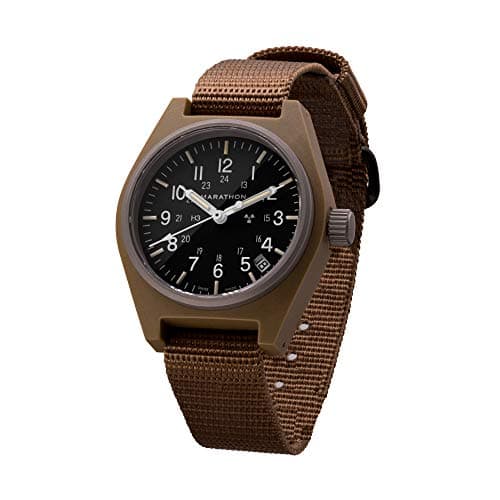
Marathon General Purpose Quartz with Date (34mm)
Replaceable cell7.8/10Tritium tubes on the hands and hour markers of a 34 mm composite case made to MIL-PRF-46374G, Type II, Class 1.
$450.00Amazon#ad · Price as of November 4, 2026 · Disclosure for the link to Marathon General Purpose Quartz with Date (34mm)
Best cheap automatic
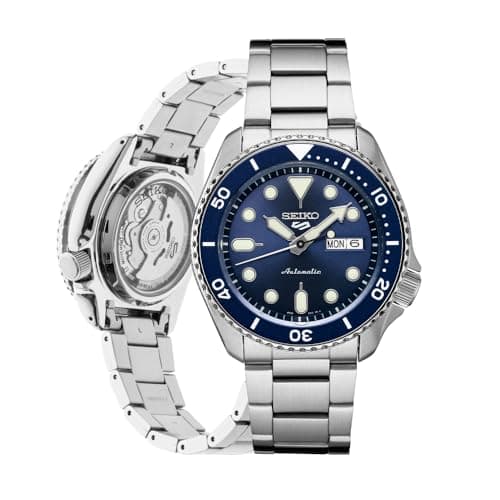
Seiko 5 Sports SRPD51
No battery7.0/10No tritium: LumiBrite on the hands and indexes of a 4R36 automatic, which is the brighter-for-minutes side of this comparison.
$280.00Amazon#ad · Price as of November 4, 2026 · Disclosure for the link to Seiko 5 Sports SRPD51
How to choose
Buy tritium if you are woken in the dark, work nights, sleep in a vehicle or a tent, or want to read the time without pressing anything and without having charged the dial first. The trade is a dimmer dial than fresh lume and a glow clock measured in decades. The watches that do this best are in best military watches.
Buy lume if your watch sees daylight before dark, if you want maximum brightness for the first part of the night, or if you want a dial that will still light up in forty years. It is also the cheaper technology by a long way, which matters if you are spending the difference on a better case or a better power system.
Buy a backlight if you are honest about how you actually check a watch in the dark, which for most people is: press the button. Every Casio here has one and every Garmin outdoor watch has a flashlight, and neither has a decay clock.
How we scored this
What we checked to build this ranking
Every pick here is researched against the documents that decide whether a watch lasts: the maker's own battery table read mode by mode, what the lens and case are actually made of, the water rating, whether a MIL-STD-810 line is on the record and in whose words, and how long the maker keeps updating the line. Each one is then scored on a public rubric weighted for a decade of ownership, and every figure links to where it came from.
That is why the order on this page is worth following: it is built from specs you can open yourself, and commissions never set a score or decide a pick. The rubric and its weights are published.
Questions
Frequently asked
What is the difference between tritium and lume?
Tritium tubes make their own light continuously with no charging; Luminox states up to 25 years of constant glow on the 3001. Photoluminescent lume, such as Seiko LumiBrite, Super-LumiNova or Marathon MaraGlo, has to be charged by light, is far brighter for the first minutes and fades over hours, and lasts indefinitely.
Is tritium brighter than Super-LumiNova?
No, not at first. A freshly charged lume dial is considerably brighter than tritium. Several hours into darkness the comparison reverses, because the lume has faded and the tritium has not. Tritium wins on duration; lume wins on peak brightness.
How long does tritium last in a watch?
The makers quote it in decades and the glow dims gradually rather than stopping. Luminox publishes a constant glow for up to 25 years on the Original Navy SEAL 3001. Replacing the tubes means a new dial and hands, which is a factory or specialist job rather than a routine service.
Is a tritium watch safe to wear?
Tritium is a low-energy beta emitter sealed inside glass tubes, which is why tritium watches are sold openly and widely worn. We do not publish radiological dose figures because we cannot source them, and the practical consequence of the decay for a buyer is a dial that dims over decades.
Do I need tritium or is a backlight enough?
For most people a backlight is enough and better: every Casio on this site has an EL or LED light, and Garmin puts a real flashlight with a red mode on the Instinct, fenix, tactix and Enduro. Tritium earns its place when you cannot or will not press a button, or when the dial must be readable instantly after hours of darkness.
Keep reading
Related on Bezel & Bearing
Receipts
Sources
- Luminox — Original Navy SEAL 3001 product page (checked 2026-09-20)
- Marathon Watch — 41mm Large Diver's Quartz (TSAR) product page (checked 2026-09-20)
- Marathon Watch — 34mm Black General Purpose Quartz (GPQ), specifications (checked 2026-09-26)
- Marathon Watch — 34mm Desert Tan General Purpose Quartz with Date (GPQ-D), specifications (checked 2026-10-03)
- Seiko Watch Corporation — 5 Sports SRPD51, specifications (checked 2026-09-26)
- Suunto — Core Alpha Stealth product page and tech specs (checked 2026-09-20)
- G-Central — G-Shock DW-6900 spec sheet (checked 2026-09-26)
- G-Central — G-Shock DW-9052 spec sheet (checked 2026-09-26)
- Garmin newsroom — Instinct 3 Series press release (checked 2026-09-20)
- Garmin newsroom — tactix 8 press release (checked 2026-09-20)
Battery, glass, case and water figures come from the maker's own owner's manuals, spec pages and press releases, linked on every product so you can open the page they came from. Prices are set by Amazon and change often, so each buy button takes you to the current one. Read the full method.